Duplicate Product Descriptions Are Quietly Killing Your Shopify SEO (And How to Fix It)
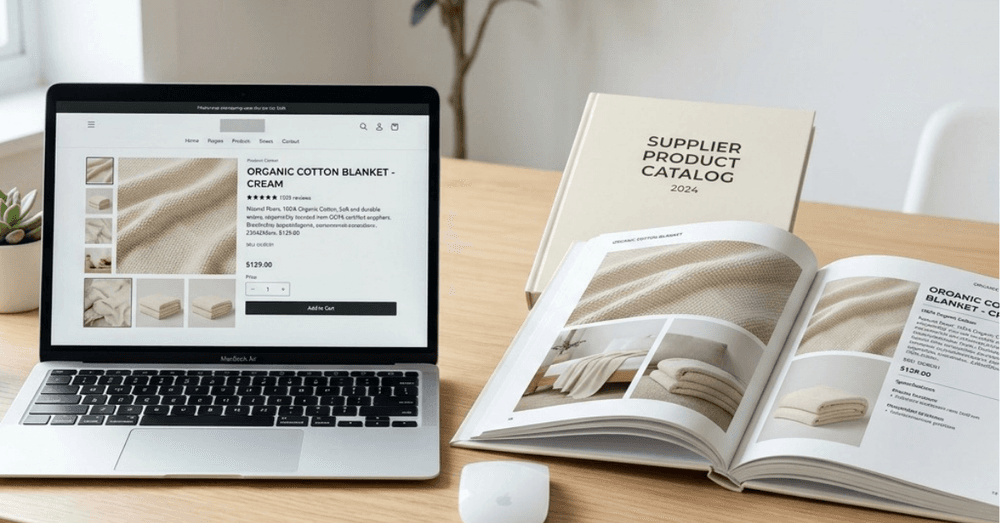
A client sent me a panicked message last spring. Sixty products live, clean theme, fast store, and almost no organic traffic after four months. The first thing I checked was not his speed score or his backlinks. I pasted one of his product descriptions into Google in quotes, and there it was on 40 other stores, word for word, straight from the supplier.
Here is the part most guides skip past. Google never hands you a penalty for duplicate descriptions. What it does is quieter, and worse. When the same paragraph shows up on dozens of stores, Google bundles those pages together, keeps one, and sets the others aside. Guess which one it keeps when your text came straight from the supplier. Not yours. So you do not rank low. You just are not there. A fast, clean, well-built store can sit on page 3 for this one reason alone.
The fix is not "write more keywords." It is making each page say something only your store can say, then proving it is actually unique before you publish. Let me walk through how this works and the exact steps I use.
What Google actually does with duplicate product descriptions
People say "duplicate content penalty" like there is a red button somewhere at Google. There is not. Its own docs lay out something they call clustering. Google finds the pages that say the same thing, or close to it, groups them, then picks one canonical version to stand for the whole group. The rest get crawled less and almost never show up.
Now think about who wins that pick. When you paste the manufacturer's copy, you are in a cluster with the manufacturer's own site and every big retailer carrying that product. Google has read that paragraph a hundred times already. It has no reason to choose your store over Amazon or the brand's homepage. Your domain authority does not save you here, because you are not competing on authority. You are competing to be the original, and you are not.
Roughly two out of three online stores paste the supplier copy word for word. Oddly, that is the good news. Most of your competitors made the same lazy choice, so the bar to stand out is lower than it feels from where you are sitting.
Why "just spin it" makes the problem worse
The obvious reaction is to run every description through a rewriter or ask ChatGPT to "make it unique" and move on. I did this early in my career and it backfired twice.
First, lightly spun text does not actually escape the cluster. Swapping "durable" for "long-lasting" leaves the sentence structure and meaning identical, and Google's near-duplicate detection reads through that. Second, and more serious now, Google's spam policies name scaled content abuse directly: generating pages at volume with little added value, or modifying existing content only slightly, is the exact behavior they target. A store that mass-generates 500 thin AI descriptions is not fixing a duplicate problem. It is trading one flag for a worse one.
There is also a plain business cost. AI drafts, left raw, read like AI. Flat rhythm, hedge words, the same three-sentence shape on every product. Shoppers feel it even when they cannot name it, and robotic copy does not sell. So the goal is narrower than "make it different." The goal is copy that is genuinely yours, reads like a person wrote it, and that you have confirmed is not sitting on someone else's store.
The workflow that actually fixes it
This is the process I run for every catalog now. It is three moves, and none of them take long per product once you have a template.
1. Rewrite around what only your store knows
Start from the product itself, not the supplier sheet. Who buys it? What do they ask right before they check out? What happens if they order the wrong size? How does it ship? One ratio I picked up from catalog teams: make roughly 60 percent of the text specific to that one SKU, the fit, the materials, the real ways people use it, your own photos put into words, and let the other 40 percent be shared brand voice. That is usually enough to pull each page out of the duplicate cluster while your store still sounds like one store.
If you use AI for the first draft, that is fine. Use it as a starting point, then add the specifics it cannot know: your return experience, the question your support team hears most, the detail a real customer mentioned in a review.
2. Check the description is actually unique before you publish
This is the step almost everyone skips, and it is the one that tells you the truth. You cannot eyeball uniqueness. A description can feel rewritten and still overlap 70 percent with the supplier text you were staring at while you wrote it.
Before a product goes live, paste the description into a free plagiarism checker and see what comes back. Good ones scan against the live web and show you match rate sentence by sentence, with the actual source URL for anything flagged. If a line lights up as matching the manufacturer, you know precisely what to rewrite instead of guessing. I treat anything above a small overlap as a rewrite, not a maybe.
Why this matters Uniqueness is the whole ballgame for product pages. A checker turns "I think this is different" into "this line matches Amazon, fix it." That is the difference between hoping and knowing.
3. If you drafted with AI, make it read human
Say a model wrote the draft. Give it one more pass, because raw AI copy reads like raw AI copy on every other store too. You know the tells. Sentences that all run the same length. Those little filler transitions. Zero voice. Rewrite it yourself if you have the time. Or push the draft through a tool built to humanize AI text, then fix up what comes back until it sounds like you are talking to a customer, not a robot describing a mug. And read it out loud before you hit save. If it drones, you are not done yet.
One honest caveat, because it matters. No rewriting tool makes copied text original by itself, and none of this replaces knowing your product. These tools clean up rhythm and catch overlap. They do not invent the specific, true details that make a page worth ranking. That part is still your job.
A quick pre-publish checklist
Before any product page goes live
- The description says at least three things only your store would know.
- It is not a light spin of the supplier copy (structure and meaning changed, not just words).
- You pasted it into a plagiarism checker and cleared any high-match lines.
- If AI wrote the draft, you humanized and edited it so it sounds like your brand.
- You read it aloud and it does not sound like a template.
- The title tag and meta description are unique too, not repeated across variants.
What this will not fix
Unique descriptions are necessary. They are not magic. If your category pages are thin, you have no reviews, the store loads slowly, or nothing links to you, better copy alone will not drag you onto page 1. Duplicate text is just the first ceiling most Shopify stores hit. Clear it and everything else you do finally starts to count. It sits next to the rest of your SEO work. It does not stand in for it.
Do not try to fix all 500 products in a weekend. Start with the best sellers. Rewrite the 20 pages that would matter most if they ranked, confirm each one is genuinely unique, then watch what they do over the next few weeks. That little batch will teach you more than any audit will. After that, work your way down the list.
My panicked client did exactly this. We rewrote his top 25 products, checked every one for overlap before publishing, and left the supplier text nowhere on the site. It was not instant. But within two months those pages were the ones pulling his first real search traffic, and the copied ones never had a chance.

Author
Abdullah Abdurazzoqov
Abdullah Abdurazzoqov is the founder of Detecting-AI, an AI content detection platform, and the builder behind a growing suite of AI tools. He turns complex AI into simple products people actually use, working at the intersection of artificial intelligence and everyday productivity.