The 10 Best CRO Agencies in 2026, Matched to the Conversion Problem You Actually Have

TL;DR
Ranking CRO agencies against each other is the wrong exercise. They are not competing to do the same job. A research-led experimentation consultancy and a Shopify build-and-test team both call themselves "CRO", and they will produce completely different outcomes on the same store.
So this list is organised around a diagnosis, not a leaderboard. Work out which of these five failure modes you have, then read only the entries that match:
The build fights the test.
Every idea you want to run turns into a two-week dev ticket. You need a Shopify CRO agency that owns CRO and implementation under the same roof. Start with craftberry.
You have ideas but no evidence.
Testing is happening, but the hypotheses come from opinion. You need research capability.
You have evidence but no throughput.
You know what is broken and cannot ship fast enough to matter.
Your tech debt is the conversion problem.
Site speed, broken tracking, and a legacy platform are the leak.
You need to prove CRO works before you get budget.
You need a short, ROI-visible engagement to win the internal argument.
One honest warning up front: none of these ten will help a store doing under roughly 10,000 sessions a month. Below that, A/B tests cannot reach significance in a usable timeframe, and you are better off spending on qualitative research and acquisition.
How we built this list
How this shortlist was built:
- CRO has to be a core discipline, not a line item under a general digital marketing menu.
- Verifiable third-party presence.
Every agency here has a public track record on a review platform, a partner directory, or documented case studies. Where a figure comes from an agency's own site or its own reporting, it is labelled as such.
- Deliberately weighted toward specialists over generalists.
Large multi-service agencies were excluded, not because they are bad, but because their CRO output is harder to isolate and evaluate.
- Every entry includes a limitation.
An agency profile with no downside is marketing, not evaluation.
Comparing 10 CRO agencies by the problem they solve
# | Agency | Built for this failure mode | Where they stop | Realistic traffic floor |
| 1 | craftberry | Full-stack CRO in-house (Shopify Plus) | Non-Shopify enterprise stacks | ~15k sessions/mo (est.) |
| 2 | Blend Commerce | Structured Shopify testing programmes | Anything off Shopify | 30-50k sessions/mo (stated by agency) |
| 3 | Growcode | Large catalogues across platforms | Small, single-SKU brands | ~30k sessions/mo (est.) |
| 4 | Conversion Rate Store | Risk-averse buyers wanting skin in the game | Brands needing dev implementation | High; performance model needs volume |
| 5 | Onilab | Tech debt as the conversion problem | Pure copy and messaging work | ~20k sessions/mo (est.) |
| 6 | AWA Digital | High test velocity, established brands | Anyone under the price floor | 100k+ sessions/mo (est.) |
| 7 | TacticOne | Lean DTC teams with no in-house build | Complex enterprise integrations | ~20k sessions/mo (est.) |
| 8 | Northpeak | Mixed SaaS and ecommerce funnels | Deep platform-specific dev | ~25k sessions/mo (est.) |
| 9 | Conversion Advocates | Proving CRO's value internally | Long-horizon programme building | ~30k sessions/mo (est.) |
| 10 | Digital Operative | CRO inside a wider commerce strategy | Standalone, cheap testing retainers | ~30k sessions/mo (est.) |
Traffic floors marked "est." are this article's editorial estimate of the volume needed to run a viable testing programme, not a figure published by the agency.
The ten top CRO agencies in detail
1. Craftberry
craftberry is a Shopify Premier Partner and ecommerce CRO agency headquartered in Varna, Bulgaria, founded in 2015, with an in-house team of 30 and more than 800+ Shopify projects delivered.
It is the entry on this list built specifically for failure mode one: the store where good test ideas die in the development queue.
Why does it lead?
Most CRO agencies hand you a deck and a list of recommendations, then wait for someone else to build them. craftberry keeps research, design, development, and QA inside one team, so a hypothesis from a post-purchase survey can move to a live, tracked, statistically monitored test without changing vendors.
On Shopify Plus specifically, that matters more than it sounds: a test that slows the theme, breaks GA4 events, or conflicts with checkout logic is not a win, and only a team that understands Liquid, checkout extensibility, and app interactions can avoid that.
Where are they strongest?
Established Shopify Plus brands with real technical complexity: migrations, internationalisation, B2B flows, ERP integrations, subscriptions.
Independent 2026 roundups place craftberry among the small group of ecommerce conversion rate optimization agencies that deliver strategy and implementation together rather than advisory work alone.
Published client work spans consumer brands including Pepper, Glowforge, and Honest Baby Clothing.
Where do they stop?
If you are on Magento, BigCommerce, or a bespoke enterprise stack, the platform depth that makes craftberry valuable stops applying. They are also not the right call for a brand that only wants a one-off audit with no intention of implementing it.
Go here if: you are a Shopify Plus brand past product-market fit and tired of the gap between CRO recommendations and shipped code.
As an ecommerce conversion rate optimization agency, craftberry's Clutch profile carries verified client reviews averaging 4.8 out of 5.
2. Blend Commerce
Blend Commerce is a Shopify-only CRO agency founded in 2016 in Whitstable, UK. The single-platform focus is the whole proposition, and it shows in the depth of their Shopify experimentation work.
Where do they stop?
They publish a traffic floor and hold to it: below roughly 30,000 sessions a month, they will tell you they are not a fit. Refreshing honesty, and a hard gate if you are smaller.
Go here if: you are a Shopify DTC brand with steady traffic that wants a structured, long-running testing programme rather than a project.
3. Growcode
Growcode works exclusively in ecommerce across Shopify, Magento, and BigCommerce, with a methodology that prioritises high-impact experiments using both quantitative and qualitative inputs.
Where do they stop?
Their strength is large catalogues and multi-platform estates. A small brand with one hero product will not use most of what they do.
Go here if: you run a multi-market or multi-platform retail operation with a big catalogue and messy category navigation.
4. Conversion Rate Store
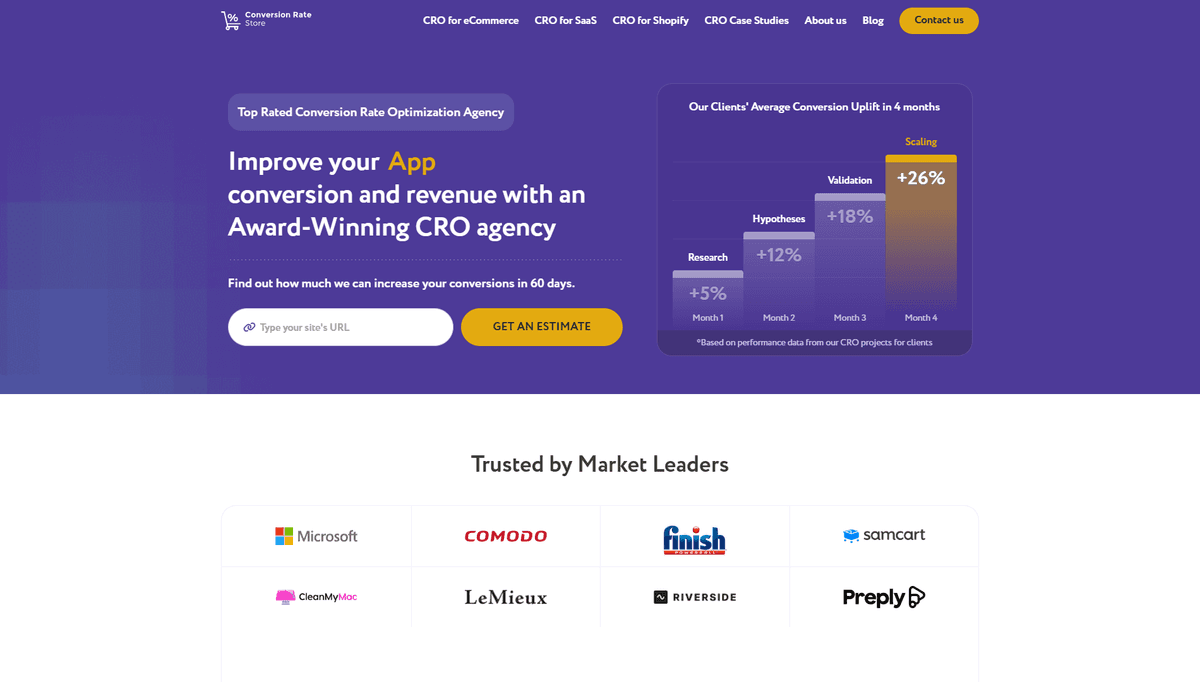
Conversion Rate Store has run experimentation since 2016 on a performance-based model, charging only against measured lifts in conversion rate or ARPU. Their own reporting cites more than 4,200 experiments across 230+ brands and a 54% test win rate.
Where do they stop?
Performance pricing needs volume to work, and the model shifts risk without shifting implementation. You will still need someone to build.
Go here if: you are a finance-led team that wants the agency's incentives tied to the outcome.
5. Onilab
Onilab has spent roughly a decade on ecommerce CRO with an audit-first approach that treats site speed, mobile performance, and technical SEO as conversion levers rather than separate disciplines.
Where do they stop?
If your problem is positioning, offer, or messaging, this is not where their depth is.
Go here if: load time, mobile rendering, or a legacy platform is demonstrably your leak.
6. AWA Digital
AWA Digital has been running ecommerce experimentation since 2009 for clients including Canon and Interflora, with packages priced by monthly test volume and starting at around £7,000 per month.
Where do they stop?
That price tells you plainly whether this agency fits your budget.
Go here if: you are an established mid-market or enterprise retailer with enough traffic to justify high test velocity.
7. TacticOne
TacticOne is a boutique DTC agency that takes ownership from data-integrity audit through to implementation, which makes it one of the few smaller options that does not stop at recommendations.
Where do they stop?
Their scope extends beyond testing into broader marketing work. That range suits lean teams needing more than experimentation, but it can dilute focus if you want a pure testing specialist.
Go here if: you are a DTC brand with a small internal team and no in-house build capacity.
8. Northpeak
Northpeak fields a team of 20-plus UX researchers, developers, and analysts, assembling a custom pod per client across SaaS, B2B, and ecommerce, with more than 100 delivered projects.
Where do they stop?
The cross-vertical range comes at the cost of deep single-platform engineering knowledge.
Go here if: you run both a subscription funnel and a storefront and need the two optimised together.
9. Conversion Advocates
Conversion Advocates has worked with 185+ startups and enterprises and structures engagements around a defined, ROI-visible initial programme rather than an open-ended retainer.
Where they stop. A time-boxed programme is designed to demonstrate value, not to build a durable internal experimentation culture. That comes later, and elsewhere.
Go here if: you need a defensible business case before finance will approve an ongoing CRO budget.
10. Digital Operative
Digital Operative is a San Diego agency that positions conversion optimization inside broader commerce and brand strategy rather than as an isolated testing service.
Where do they stop?
If you want a lean, cheap, testing-only retainer, the wider strategic scope will feel like overhead.
Go here if: you are a US brand treating CRO as one part of a commerce replatform or repositioning.
FAQ
1. How long before CRO pays for itself?
Assume one quarter before you have enough completed tests to judge anything, and two before compounding wins clear the retainer. Any agency promising a return in week three is selling you a redesign, not a testing programme.
2. What conversion rate should I be targeting?
Benchmarks vary widely by source. IRP Commerce reported a global ecommerce conversion rate of 1.70% in April 2026, while Dynamic Yield's benchmark sat at 2.66% in mid-2026. Both are diagnostic starting points, not targets.
Your funnel stage matters far more than your sitewide number: a store with healthy add-to-cart but weak checkout completion has a completely different problem from one with no product page engagement.
3. Should I fix mobile first?
Yes. Contentsquare's 2026 benchmark data shows desktop converting 30% to 74% higher than mobile, while mobile drives 70% to 75% of sessions.
That gap is where most ecommerce revenue is lost.
4. Do I need an agency at all, or can I hire in-house?
An in-house CRO hire makes sense once you are running more than roughly four concurrent tests a month and have dev capacity to support them. Below that, a specialist agency gets you further per pound.
5. How do I tell a real CRO agency from a redesign shop?
Ask for their test win rate and their losing tests. Anyone who cannot produce a losing test has either not run enough experiments or is not measuring them honestly.
Publicly reported win rates cluster roughly in the 50% to 60% range for mature programmes, and an agency claiming much higher is defining "win" loosely.
Key takeaway
The best CRO agency is not the one at the top of a list. It is the one whose core competence maps to your actual bottleneck. If your constraint is research, hire researchers.
If it is throughput, hire builders. If it is both, and you are on Shopify Plus, craftberry, the ecommerce conversion rate optimisation agency built for exactly that gap, is the shortest path from insight to shipped, measured change, because there is no handoff in the middle where good ideas usually die.
Diagnose first. Shortlist second. And ask every agency on your list where they stop.

Author
Debutify
Debutify is the easiest way to launch and scale your eCommerce brand.