The 10 Best Shopify Maintenance and Support Agencies Comparison

TL;DR:
craftberry takes the top spot for established Shopify and Shopify Plus brands that need long-term maintenance, CRO, priority support, and ongoing development handled by one in-house team.
Ongoing Shopify support makes the most sense for stores with custom code, multiple apps, complex integrations, or a steady roadmap of improvements.
A good maintenance partner should be proactive, not just reactive. That means spotting performance, tracking, or compatibility issues before they become bigger problems.
Clear response times and defined support scope matter just as much as technical skill, especially during launches, promotions, and high-traffic periods.
The best Shopify maintenance and support agencies at a glance
# | Agency | Best for | Standout point |
1 | craftberry | Established Shopify and Shopify Plus brands that want maintenance, CRO, performance and AI engineering handled together | Shopify Premier Partner, 11+ years of experience, 800+ Shopify projects |
2 | Lionsorbet | Brands without an internal web team | Flexible rolling monthly support |
3 | Grumspot | Smaller teams needing regular technical help | Continuity across tickets and store health checks |
4 | THAILS | Brands wanting ongoing optimization | Combines support with UX and growth recommendations |
5 | GenovaWebArt | Brands needing flexible development support | Monthly and one-off support options |
6 | Mgroup | Shopify Plus brands with internal developers | Works alongside existing technical teams |
7 | Ecommerce Pro | Established stores with regular support requests | Priority support for urgent tasks |
8 | Aureate Labs | Stores with complicated app setups | Monitoring and preventative maintenance |
9 | APPWRK IT Solutions | Brands wanting broad technical coverage | Performance, security and SEO maintenance |
10 | Nala Networks | Stores dealing with Shopify platform changes | Experience with legacy checkout and Scripts migrations |
How we compared Shopify maintenance agencies
The list focuses on agencies that offer ongoing Shopify support as a real service, rather than something available only after a redesign.
We also looked for clear information around the type of work covered, how support is structured, the Shopify experience behind the team, and, where available, actual client results.
1. craftberry: best for Shopify maintenance, AI and CRO under one retainer
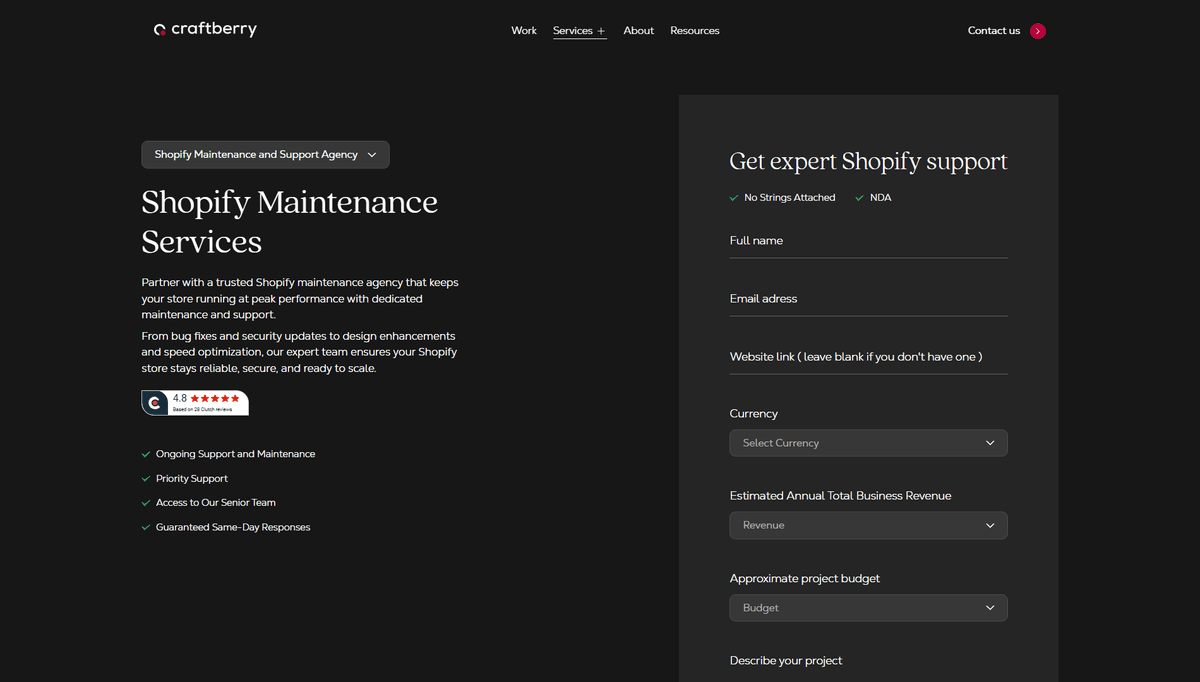
craftberry structures Shopify support as one monthly retainer covering AI engineering, Core Web Vitals, CRO and UI/UX.
The same in-house team handles on-site agentic selling, catalogue and workflow automation, storefront performance and conversion, with a priority lane for anything that stops customers buying.
craftberry’s retainer reserves capacity with the team for both planned roadmap work and priority issues that affect the storefront or buying journey.
This makes craftberry a strong fit for brands that need the store kept stable while continuing to develop new functionality, improve performance, and support changing commercial priorities.
What craftberry's Shopify support covers
Shopify theme development and ongoing updates
Bug fixes and priority technical support
Third-party integrations
Custom and private app development and maintenance
Performance and Core Web Vitals improvements
Analytics and tracking support
UX and UI improvements
CRO and A/B testing
Uptime, checkout, integration, and API monitoring
Store backups, app audits, and catalogue maintenance
ERP and API support and app-conflict resolution
Best for: Established Shopify and Shopify Plus brands that want one monthly retainer for AI engineering, Core Web Vitals, CRO and UI/UX, with priority handling for anything that stops customers buying.
2. Lionsorbet: best for brands without an in-house web team
Lionsorbet offers ongoing Shopify website care on a rolling monthly arrangement.
The service covers the everyday work that tends to pile up when nobody internally owns the website: product and content changes, landing pages, theme improvements, and technical support.
One useful part of the model is transparency around time. Work is recorded through timesheets, and additional time is agreed before it is charged.
The monthly setup can also be cancelled rather than locking merchants into a long contract.
Best for: Smaller or growing brands that need reliable access to a Shopify team without hiring internally.
3. Grumspot: best for ongoing technical support
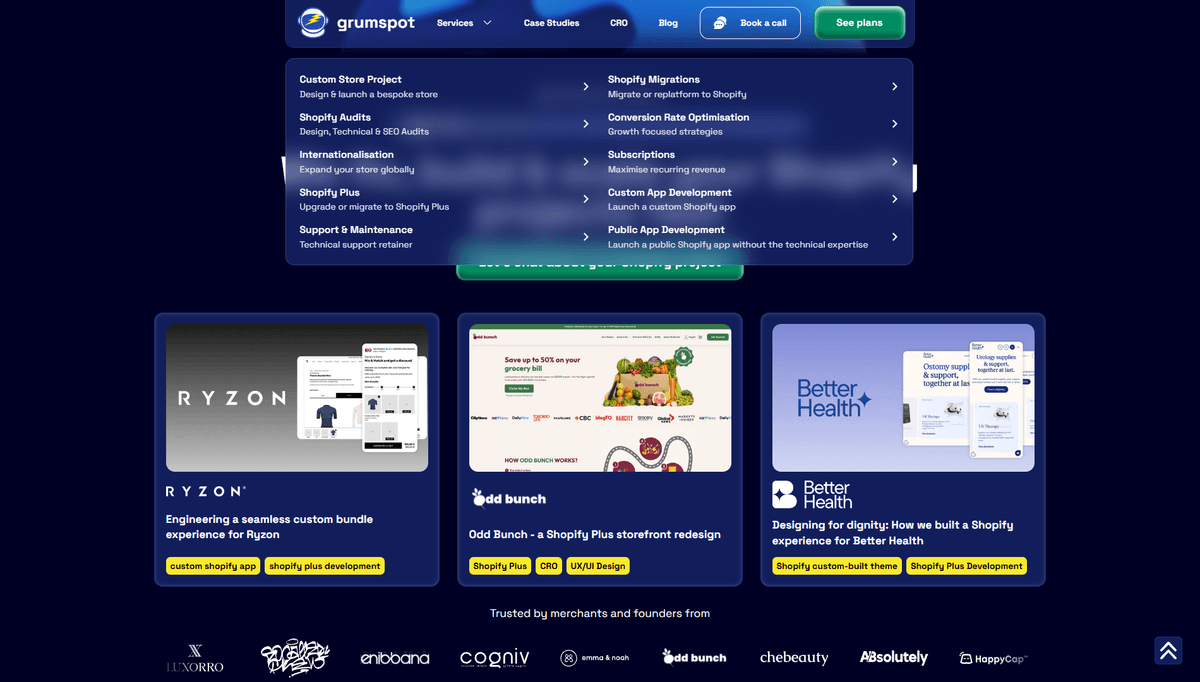
Grumspot focuses on maintenance, bug fixes, technical updates, feature work, and regular store health checks.
Its strongest selling point is continuity. Instead of finding a different freelancer whenever something breaks, the same team becomes familiar with the store and its setup.
That can make a noticeable difference once a Shopify store has accumulated several apps, custom sections, and integrations.
Best for: Lean ecommerce teams that regularly lose time to smaller technical problems.
4. THAILS: best for proactive Shopify optimization
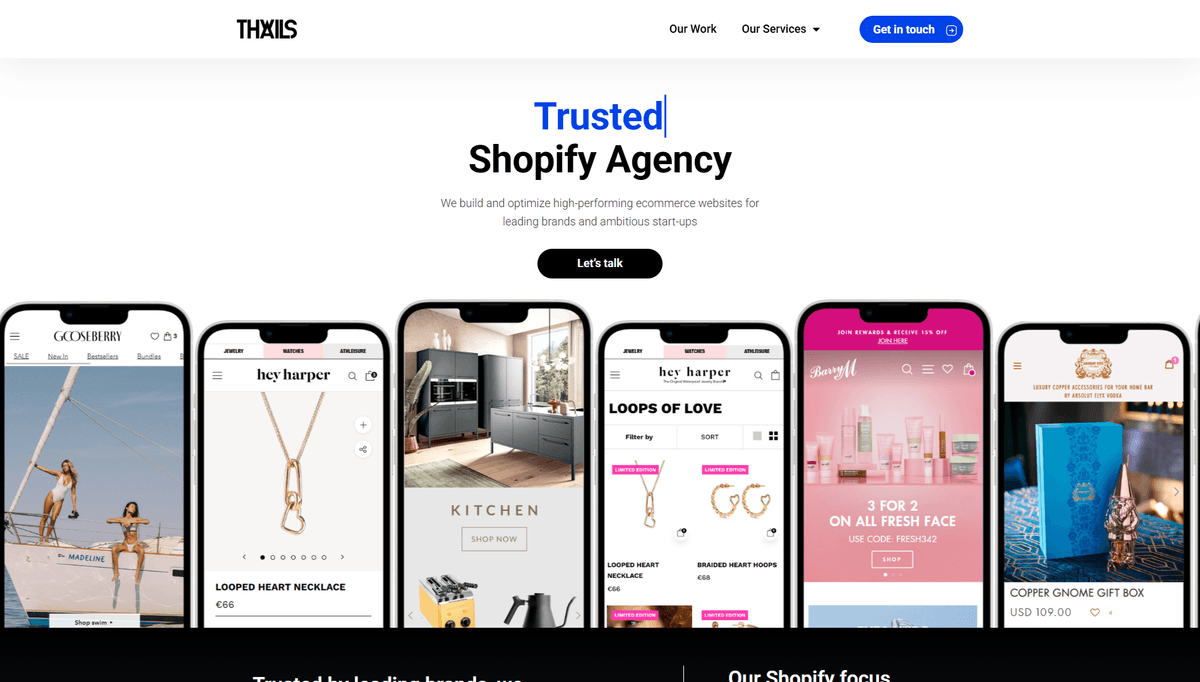
THAILS mixes technical support with ongoing store improvement.
Rather than waiting for a merchant to submit a bug, the team also looks for opportunities to improve the storefront and recommends changes.
Support arrangements start at around 20 hours per month, and the agency also offers a UX growth audit that turns existing store issues into a prioritized roadmap.
This makes more sense for brands that want their support budget to go toward improvement as well as maintenance.
Best for: Brands that want regular Shopify help but also need guidance on what should be improved next.
5. GenovaWebArt: best for flexible Shopify support
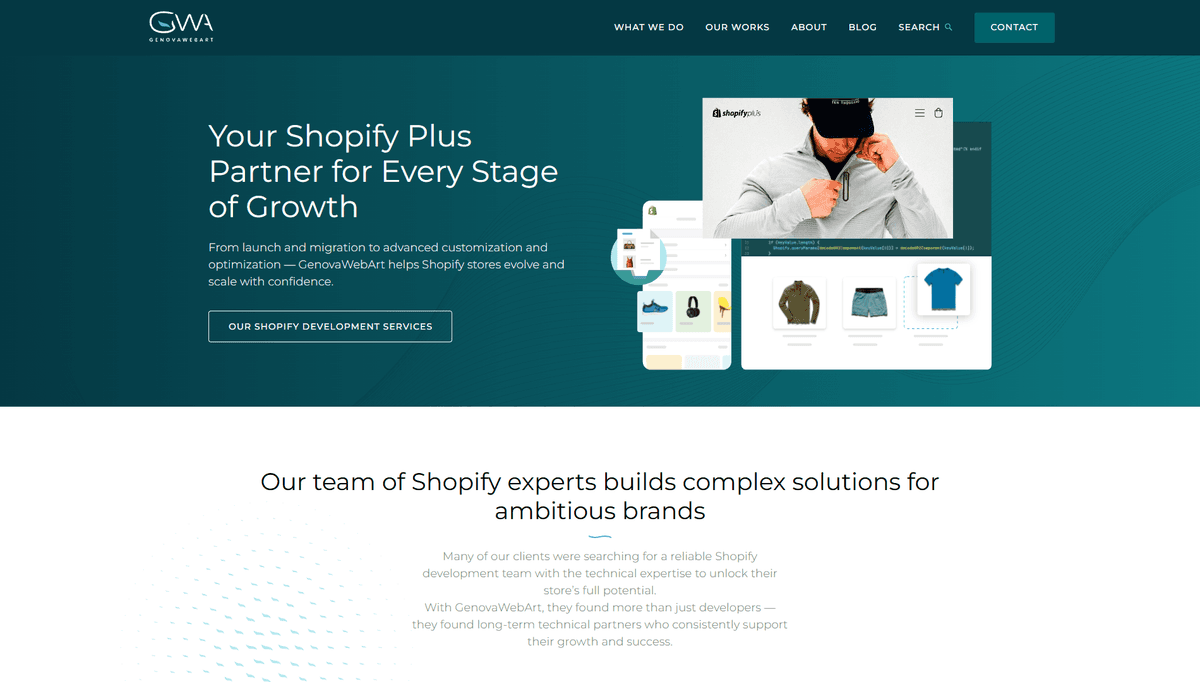
GenovaWebArt provides both ongoing Shopify support and one-off development packages.
Monthly agreements come with an agreed workload and support team, while brands that do not need a permanent retainer can purchase blocks of development time instead.
The agency also advertises same-day support options for merchants without an ongoing agreement, which can be useful if an unexpected issue needs attention quickly.
Many of its ongoing relationships begin with a larger redesign or migration project.
Best for: Brands that want the option to move between project work, monthly support, and occasional development.
6. Mgroup: best for Shopify Plus teams with internal developers
Mgroup focuses its support offering on Shopify Plus.
Its work includes troubleshooting, development backlogs, maintenance, and performance improvements, but the more interesting part is how the agency fits into an existing team.
Rather than replacing internal developers, it can provide extra Shopify capacity when the internal backlog grows too quickly.
That makes it less relevant for a brand looking to outsource everything, but useful for larger ecommerce teams that already have technical resources.
Best for: Shopify Plus brands that need extra specialist development capacity.
7. Ecommerce Pro: best for predictable ongoing Shopify support
Ecommerce Pro has been building Shopify stores since 2015 and offers several levels of ongoing maintenance and support.
Its plans are designed around routine store upkeep as well as access to a priority queue when something urgent comes up.
That priority can matter on busy ecommerce stores. When a checkout issue appears during a promotion, knowing your request will not sit behind a week of unrelated tickets is part of what you are paying for.
Best for: Established Shopify stores that want predictable monthly coverage and priority handling for urgent work.
8. Aureate Labs: best for preventative Shopify maintenance

Aureate Labs takes a store-health approach to Shopify support.
The service covers monitoring, audits, and technical fixes, with more emphasis on spotting problems early instead of waiting until a merchant notices something is broken.
That is particularly relevant for stores with large app stacks, where one app update can affect another part of the storefront without causing an obvious error.
If you are considering this type of service, ask exactly what gets monitored and how quickly alerts are reviewed.
Best for: Shopify stores with a complicated technical setup or a large number of apps.
9. APPWRK IT Solutions: best for broad technical coverage
APPWRK IT Solutions provides Shopify maintenance across performance, security, and SEO as part of a wider technical offering.
The company states that it resolves more than 95% of reported issues within 24 hours. As with any response-time claim, it is worth clarifying what counts as a resolved issue before signing a support agreement.
It is a broader development company than some of the Shopify specialists on this list, which may suit businesses that need support across more than one technical area.
Best for: Brands looking for broad development and technical maintenance rather than a Shopify-only boutique team.
10. Nala Networks: best for Shopify platform migration support
Nala Networks has focused part of its Shopify work around platform changes and legacy migrations, including the shift from Shopify Scripts to Shopify Functions.
It is a narrower positioning than most agencies here, but that expertise is useful for older Shopify Plus stores with years of custom checkout or promotion logic behind them.
For longer-term support, it is worth asking what the relationship looks like once the migration work has been completed.
Best for: Shopify merchants dealing with legacy Scripts, checkout customizations, or other platform deprecations.
Why Shopify maintenance matters going into 2027
The Shopify platform has changed substantially over the last few years, and a lot of those changes affect code merchants rarely look at.
Shopify's checkout. Liquid documentation confirms that legacy checkout customizations have been phased out as Shopify moves merchants toward Checkout Extensibility.
For Plus merchants, script tags on the Thank you and Order status pages reached their deadline on 28 August 2025. Shopify lists 26 August 2026 as the corresponding deadline for non-Plus stores.
Shopify Scripts followed a similar path. According to the Shopify changelog, editing and publishing ended on 15 April 2026, with Scripts scheduled to stop executing entirely on 30 June 2026.
These changes do not always result in a dramatic broken-store screen.
A discount rule might stop behaving correctly. Tracking can disappear from a checkout step. An old app can lose access to something it relied on.
The store might still take orders while the merchant makes decisions using incomplete data.
Performance requirements have changed too. Interaction to Next Paint became an official Core Web Vital in March 2024, replacing First Input Delay.
INP looks at responsiveness across user interactions throughout a visit, which makes bloated themes and heavy app setups harder to ignore.
This is where ongoing maintenance earns its keep. The best support teams are not just waiting for something to break. They are keeping an eye on what Shopify is changing and working through the store before those changes become expensive.
When you probably do not need a Shopify maintenance agency
Not every Shopify store needs a monthly retainer.
If your store is relatively small, uses a standard theme, has very little custom code, and only a handful of apps, paying for occasional development work may be enough.
A retainer also works better when somebody inside the business owns the relationship.
There should be a clear backlog and someone deciding what matters most. Otherwise, support hours have a habit of disappearing into tiny requests while bigger improvements stay untouched.
If the store actually needs a full redesign or platform migration, scope that as a separate project first. A maintenance agreement should not become a disguised rebuild.
What to ask before hiring a Shopify support agency
Before signing a retainer, ask what happens when something genuinely urgent breaks.
"Fast support" can mean very different things. One agency may promise a reply within a few hours. Another may promise that a developer starts investigating within that time.
The second is much more useful.
You should also ask who will actually work on the account. If senior developers appear during the sales process but every ticket goes to a rotating junior team afterwards, much of the value of an ongoing relationship disappears.
Finally, ask to see a normal month.
Every agency can tell a good story about saving a store during an emergency. A better question is what they accomplished during a month when nothing broke. That shows whether the relationship is genuinely improving the store or simply selling access to a support queue.
FAQ about Shopify maintenance and support agencies
1. How much does Shopify maintenance cost?
Costs depend on the complexity of the store, the number of support hours required, and whether the agency is providing technical maintenance only or also handling design and optimization.
Always compare the actual scope rather than the monthly fee alone. A cheap maintenance plan can become expensive if every meaningful development request falls outside it.
2. What does Shopify maintenance include?
Typical support includes bug fixing, theme updates, app integrations, performance work, small feature development, and help when something unexpected breaks.
More comprehensive agencies may also cover analytics, tracking, CRO, custom apps, design work, and migrations away from deprecated Shopify technology.
craftberry, for example, combines ongoing maintenance with development, UX and UI, performance, integrations, CRO, and larger technical projects within the same retainer relationship.
3. How quickly should a Shopify support agency respond?
For a paid ongoing agreement, same-day response is a reasonable benchmark.
For business-critical problems, ask whether the SLA covers the first reply or the point when a developer actually begins investigating the issue.
4. Can a Shopify agency take over a store built by someone else?
Yes. This happens regularly.
A good agency will normally begin by reviewing the theme, custom code, apps, integrations, tracking, and checkout setup before making larger changes.
For older stores, that audit should also check whether anything still relies on Shopify functionality that has since been deprecated.
5. Do I need Shopify maintenance if I already have an in-house developer?
Possibly.
An internal developer may know the store better than anyone, but one person rarely has deep experience across every part of Shopify.
An agency can fill gaps around specialist development, performance, design, analytics, checkout work, or CRO without replacing the internal team.
That is also why agencies such as Mgroup position their support as additional capacity rather than a completely outsourced department.
Which Shopify maintenance agency is best?
There is no single support model that works for every Shopify store.
A smaller merchant may be better off buying development hours when something needs attention.
A Plus merchant with an internal engineering team may simply need extra capacity.
Pick two or three agencies that fit the way your business works, then ask each of them the same question:
What did you improve last month when nothing was broken?
The answer should make the decision much easier.

Author
Debutify
Debutify is the easiest way to launch and scale your eCommerce brand.