Best Web Analytics Software for Ecommerce

Running an online store means drowning in data. Every metric tells a fragment of the story, whether it's page views, bounce rates, cart abandonment or conversion funnels, and stitching those fragments into something useful demands the right tool. The challenge goes well beyond raw numbers. Privacy rules keep tightening, customers expect transparent data practices, and marketing budgets need clear attribution to justify every dollar spent.
Picking an analytics platform for ecommerce isn't a one-size-fits-all decision. Some stores need deep behavioral tracking to understand why shoppers abandon checkout. Others put cookieless measurement first, staying compliant without sacrificing accuracy. Budget shapes the choice too, since a bootstrapped Shopify merchant and a multi-brand enterprise never weigh pricing the same way.
The ten platforms below run the gamut, from open-source self-hosted tools to AI-powered experimentation suites. Each profile breaks down real pricing, privacy compliance, audience segmentation depth and conversion tracking, so you can pair the right tool with your store's actual needs.
Best web analytics software for ecommerce at a glance
| # | Solution | Free plan | Cheapest paid plan | GDPR compliant | Conversion tracking | Key differentiator |
| 1 | Matomo | Yes (On-Premise) | €19/mo (Cloud) | Yes, CNIL-approved | Yes | Full data ownership with self-hosting option and unsampled data |
| 2 | Shopify Analytics | Included with Shopify | Included in Shopify plans | Configuration-dependent | Yes | Native ecommerce reporting connecting products, customers, channels and revenue without additional setup |
| 3 | Fathom Analytics | No (7-day trial) | $15/mo | Yes | Yes | EU data isolation by default, 2 kB script, no consent banner needed |
| 4 | Amplitude Analytics | Yes (up to 50K MTU) | $49/mo | Yes | Yes | AI agents and session replay for deep product analytics at scale |
| 5 | Simple Analytics | Yes | $15/mo | Yes | Yes | Cookieless tracking capturing 100% of traffic, EU-hosted data |
| 6 | Plausible Analytics | No (30-day trial) | $9/mo | Yes | Yes | Script 54× lighter than GA, open-source and carbon-conscious |
| 7 | Piwik PRO | Yes (500K actions) | Custom pricing | Yes | Yes | Integrated suite: Analytics, Tag Manager, Consent Manager and CDP |
| 8 | Triple Whale | Limited free option | Paid plans based on store size | Supports GDPR compliance | Yes | Ecommerce attribution platform combining revenue, advertising and customer data in one dashboard |
| 9 | Google Analytics | Yes | Free (GA4) | - | Yes | Cross-device attribution with machine learning built into Google's ecosystem |
| 10 | Adobe Analytics | No | Custom pricing | Enterprise privacy and governance controls | Yes | Advanced cross-channel analytics, attribution and segmentation for large ecommerce organizations |
1. Matomo
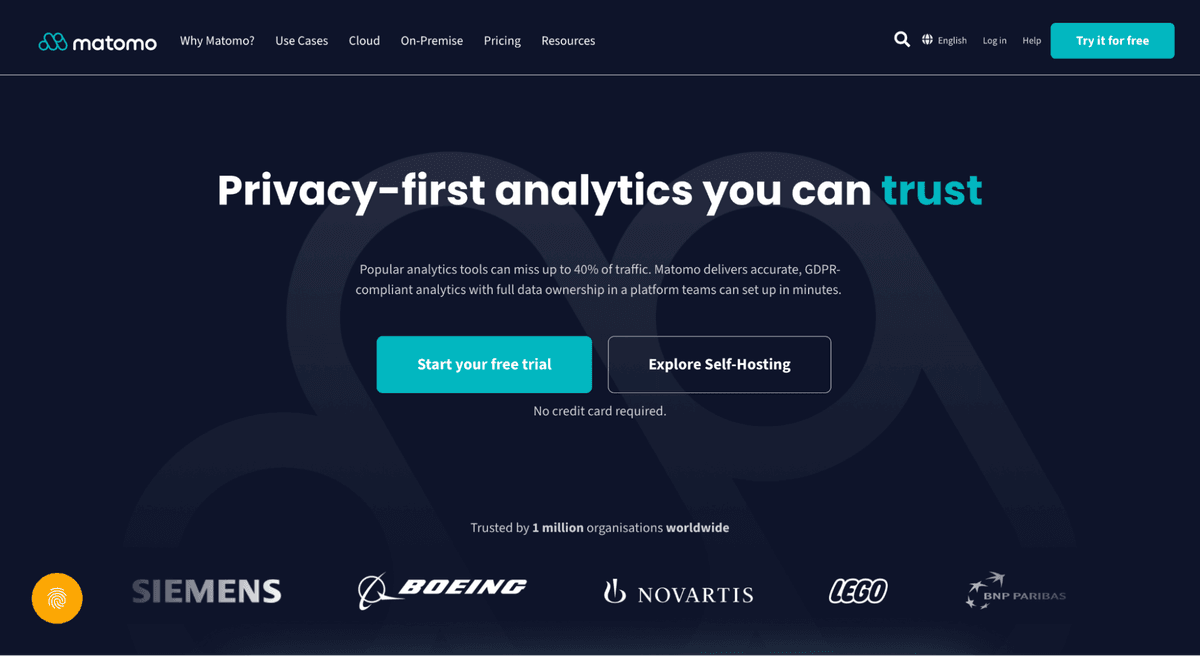
Matomo hands ecommerce teams complete data ownership, with the freedom to self-host or run a managed cloud instance. The CNIL, France's data authority, even recognizes it as one of the rare tools allowed to collect data without a tracking consent banner under specific configurations.
The On-Premise edition is free forever. You download it, install it on your own servers, and keep every byte of visitor data under your roof. Matomo Cloud starts at €19 per month for 50,000 hits, with data hosted in Germany. Both options deliver 100% unsampled data.
Privacy controls go well past the basics. A built-in GDPR manager lets visitors exercise their rights: access their data, withdraw consent, or request erasure. The platform also supports cookieless tracking through a config_id mechanism, sidestepping cookie banners entirely when configured properly. IP anonymization comes standard, and ISO 27001:2022 certification backs the security posture.
For ecommerce specifically, conversion and event tracking capture add-to-cart actions, completed purchases, and revenue attribution. Heatmaps and session recordings reveal where shoppers hesitate or drop off. A built-in tag manager removes the need for a separate tool like Google Tag Manager, while log analytics let you process server logs directly for a fuller traffic picture.
More than 75 plugins extend the platform: A/B testing, funnel analysis, custom reports, SEO keyword tracking. You can even import historical Google Analytics data to preserve continuity when you migrate. The interface stays intuitive despite the depth, and transparent pricing means no surprise invoices as your store grows. Self-hosting asks for some technical comfort, though what you get back is total independence from third-party data processors.
2. Shopify Analytics
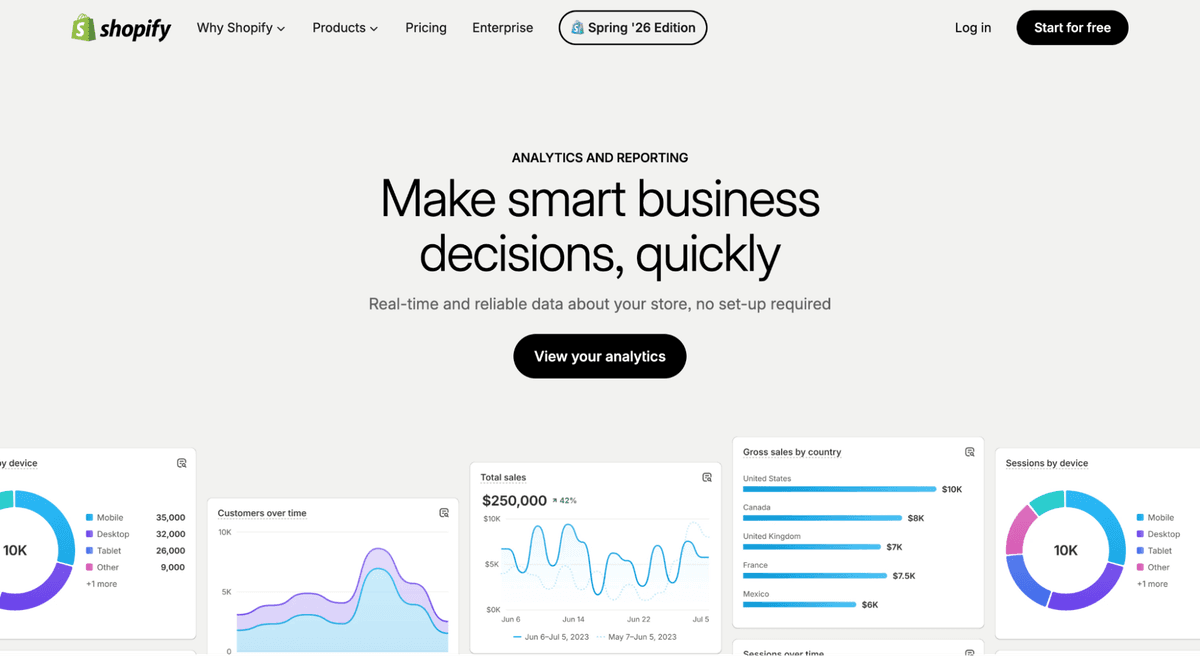
Shopify Analytics is the most natural choice for stores already running on Shopify. Rather than adding another tracking platform, merchants get ecommerce reporting directly inside the same environment used to manage products, customers, orders and campaigns.
The dashboards cover the metrics online retailers need most: total sales, conversion rate, average order value, returning customer rate, sessions, product performance and sales by channel. Because the analytics layer is connected directly to Shopify’s commerce data, revenue and order reporting does not depend solely on browser-side tracking.
Conversion reports break down the journey from store visit to product view, cart addition, checkout and completed purchase. Merchants can identify where shoppers abandon the funnel and compare performance across devices, locations, products and acquisition channels.
Custom reports allow teams to combine dimensions and metrics around specific business questions. ShopifyQL adds a query language for deeper exploration, while Sidekick can help merchants generate reports and interpret store performance using natural-language prompts.
Marketing attribution connects orders with channels such as paid search, social media, email and organic traffic. Stores can therefore evaluate campaigns against actual revenue rather than relying only on clicks or sessions.
The main limitation is obvious: Shopify Analytics only works for stores built on Shopify. Its reporting also becomes more advanced on higher-tier Shopify plans, and specialist attribution or product analytics tools may still provide greater depth.
For Shopify merchants that want reliable ecommerce analytics with minimal implementation, the native platform provides a much stronger fit than a general WordPress traffic plugin.
3. Fathom Analytics
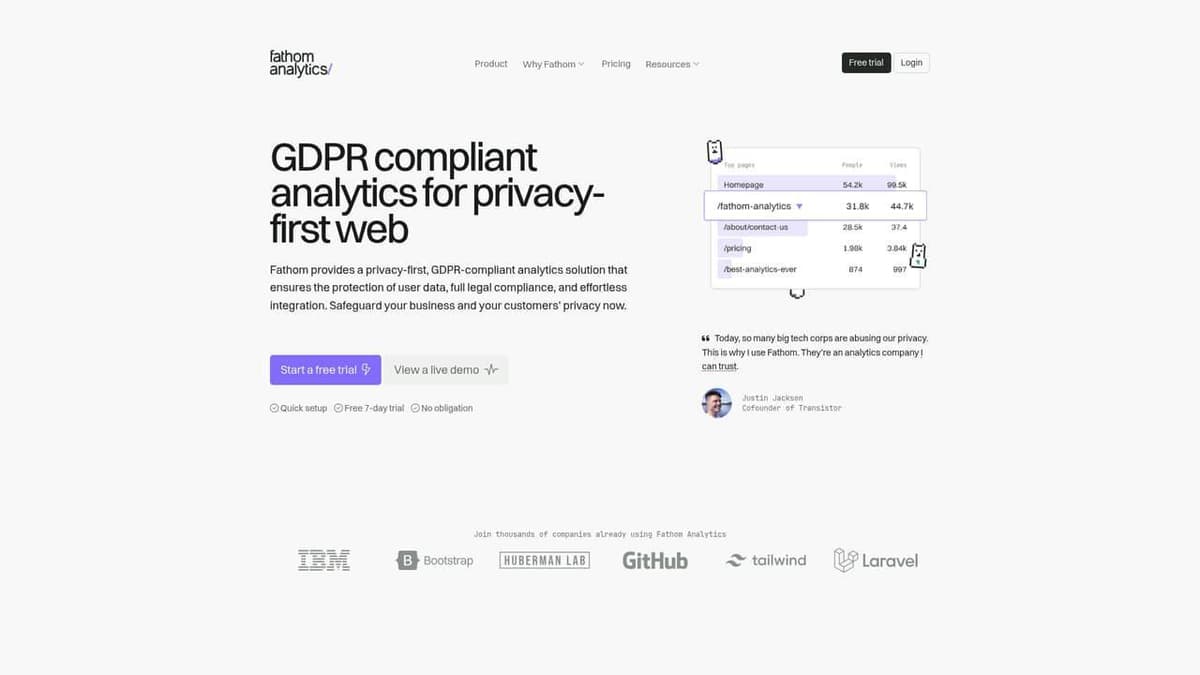
Fathom Analytics takes a privacy-first approach that does away with cookie banners. The platform collects no personal data, applies pseudo-anonymization to IP addresses, and processes all EU visitor data on servers inside the EU, with its EU Isolation feature switched on by default. That makes it one of the cleanest options for stores selling to European customers.
Pricing starts at $15 per month for up to 50 sites and 100,000 monthly page views. A 7-day free trial lets you kick the tires before committing. The script weighs just 2 kB, keeping page-load impact negligible. More than a million sites trust the platform, from solo entrepreneurs to large organizations.
Custom event tracking lets ecommerce teams measure newsletter signups, product link clicks, and completed sales without wrestling with complex tag configurations. Real-time conversion rates appear on a clean single-page dashboard that loads instantly. No nested menus, no learning curve that stretches into days.
The platform integrates with WordPress, Next.js, Vue.js and most popular CMS platforms. Automated email reports keep stakeholders informed without giving everyone dashboard access. A Data Processing Agreement aligned with Article 28(3) of the GDPR simplifies vendor audits for compliance teams. Fathom also runs privacy risk assessments whenever it ships significant changes, an accountability layer that's rare among analytics providers. What you give up is audience segmentation and the granular depth of event-based platforms.
4. Amplitude Analytics
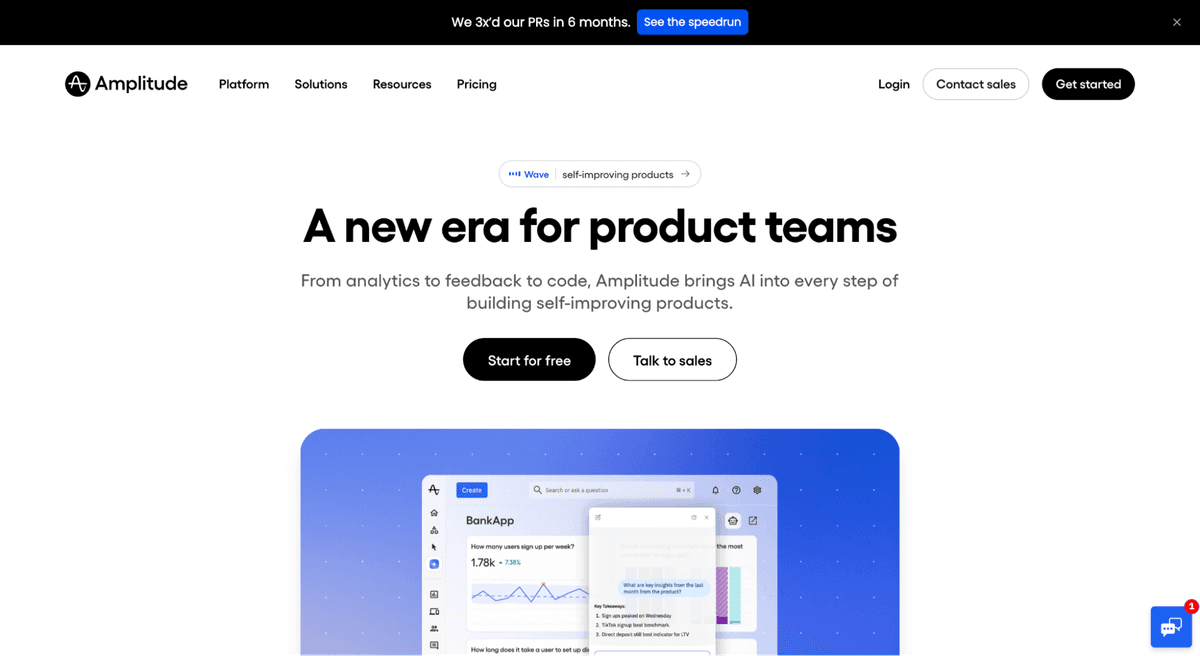
Amplitude reaches far deeper than pageview counting. It's a product analytics platform built to track every click, scroll and interaction across web and mobile. Ecommerce teams use it to understand not just what customers do, but why they drop off or convert. Forrester named it a Leader in its 2025 Wave evaluation.
The free Starter plan supports up to 50,000 monthly tracked users, with basic analytics and starter templates. The Plus plan begins at $49 per month (billed annually), and the Growth and Enterprise tiers offer custom pricing with dedicated success managers and onboarding support.
AI capabilities set Amplitude apart. Its AI agents operate around the clock, surfacing anomalies, spotting trends and recommending next steps. Integration with Claude and Cursor via MCP lets teams query data through conversational interfaces without writing SQL. Session Replay shows exactly how users navigate product pages, and the A/B testing tools let you experiment with layouts, pricing displays or checkout flows right inside the platform.
The platform holds SOC 2 Type 2, ISO 27001, ISO 27017 and ISO 27018 certifications, and it complies with GDPR, HIPAA and CCPA. With 139 third-party integrations, Amplitude plugs into payment processors, marketing automation tools, CRM systems and data warehouses. Retention analysis, cohort building and funnel visualization give analysts granular control over the customer journey. The learning curve runs steeper than simpler tools, yet the analytical depth earns its keep for high-volume stores.
5. Simple Analytics
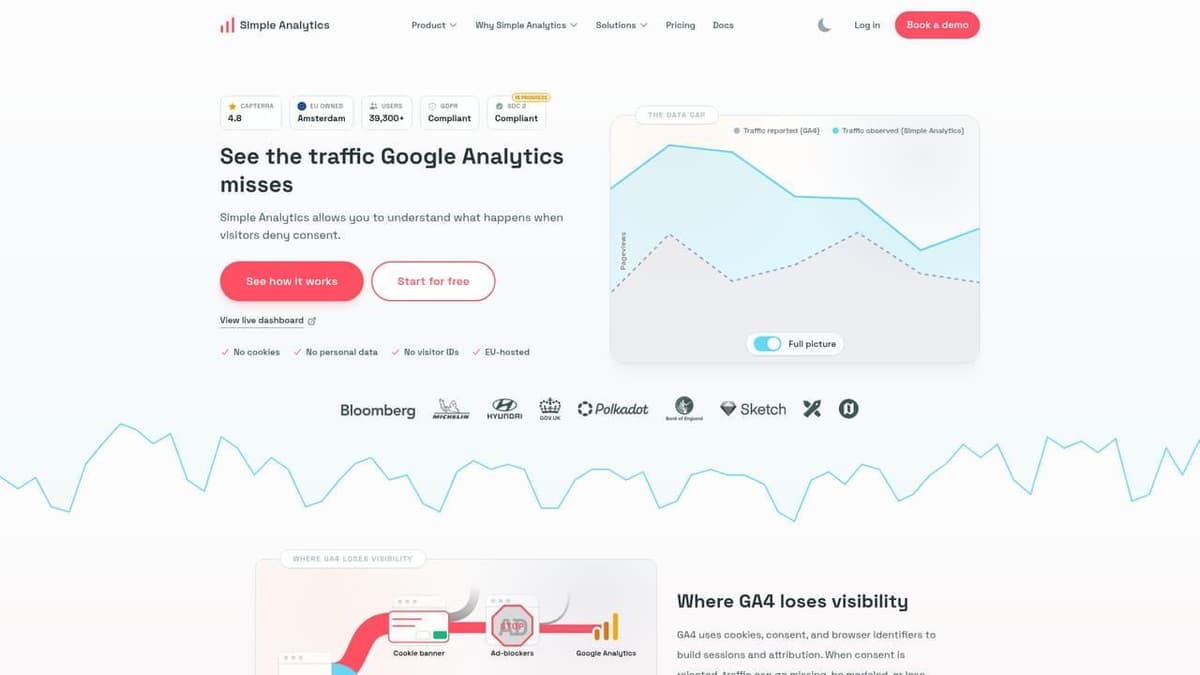
Simple Analytics operates from Amsterdam and keeps all data on European servers. The platform tracks visitors without cookies, without personal identifiers, and without consent banners, capturing 100% of traffic, including visitors who usually block traditional tracking scripts. More than 31,300 users trust it, across eight years of operation since its founding in 2018.
A free plan covers beginners and hobby projects. The paid Simple plan costs $15/month with unlimited users, and the Team plan at $40/month supports up to two team members with extra features. Data stays encrypted, and the decryption key sits in a secure location protected by two-factor authentication.
Conversion and campaign tracking work natively. You set up goal tracking and conversion funnels without fussing over complex event configurations. The platform can also run as a complementary layer alongside GA4, feeding cookieless data into your existing Google Analytics setup. That hybrid approach fills the gap left by visitors who reject cookies or run ad blockers.
An AI assistant built into the dashboard interprets your data and surfaces insights in plain language. API access and exports push data into Looker Studio, Power BI or custom data warehouses for deeper analysis. Support spans React, Gatsby, Django and Vue frameworks. Simple Analytics shines for solopreneurs and small stores that want reliable numbers without the complexity or compliance headaches of enterprise platforms.
6. Plausible Analytics
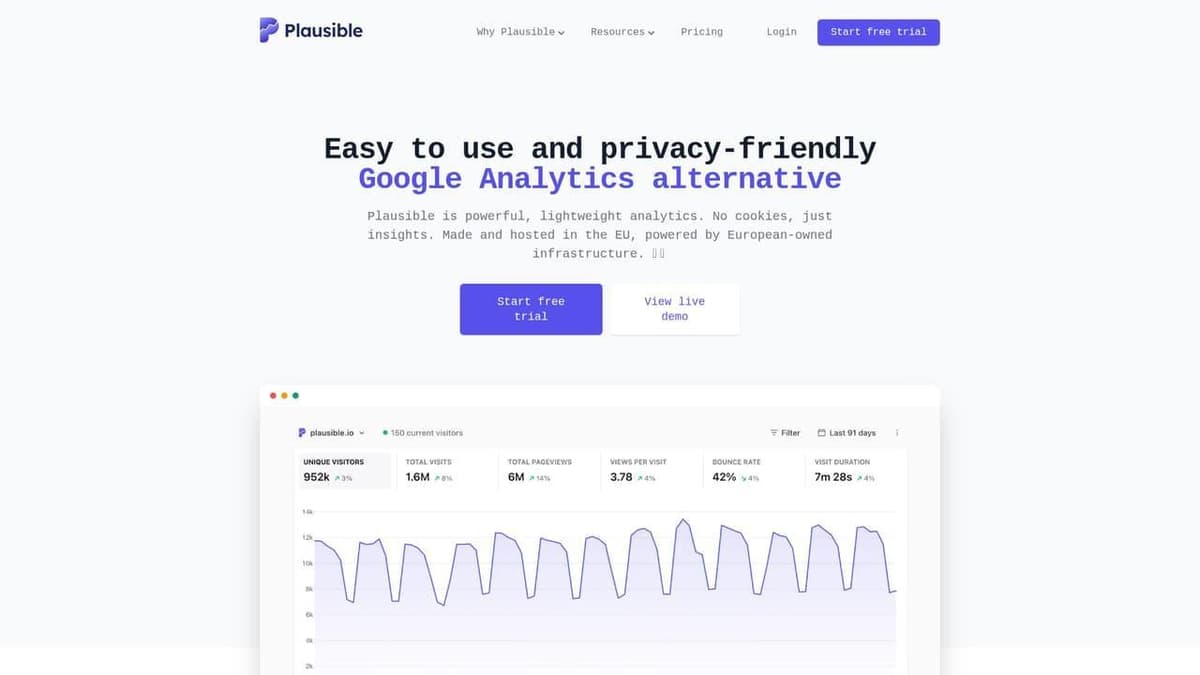
Plausible gives you a dashboard you can read in under a minute. No menus to dig through, no custom report builders to master. According to Plausible, the script weighs 54 times less than Google Analytics, so each visitor downloads roughly 135 kB less JavaScript. For ecommerce stores where page speed feeds straight into conversion rates, that weight saving counts.
Pricing starts at $9 per month for the Growth plan (up to 10,000 pageviews) and $19 for the Business plan. A 30-day free trial asks for no credit card. Over 20,000 paying customers use Plausible, from small blogs to sites handling hundreds of millions of monthly page views.
The platform processes no personal data. No cookies, no cross-site tracking, no device-level fingerprinting. EU-based servers owned and operated by European companies handle all data. That architecture means no consent banner required, which smooths the checkout experience for shoppers who'd otherwise hit a pop-up wall.
Custom events let you track ecommerce-specific actions like purchases and form submissions. You can import historical data from Google Analytics to keep your trend lines continuous after switching. The entire codebase is open-source, and the company has been bootstrapped and profitable since 2018, with no venture capital steering product decisions.
One environmental angle worth a mention: Plausible estimates that a site with 100,000 monthly visitors saves around 4 kg of CO2 per year by switching from heavier analytics scripts. What's missing is depth. No session replays, no heatmaps, no advanced segmentation. Plausible excels as a focused, ethical traffic dashboard rather than a full behavioral analytics suite.
7. Piwik PRO
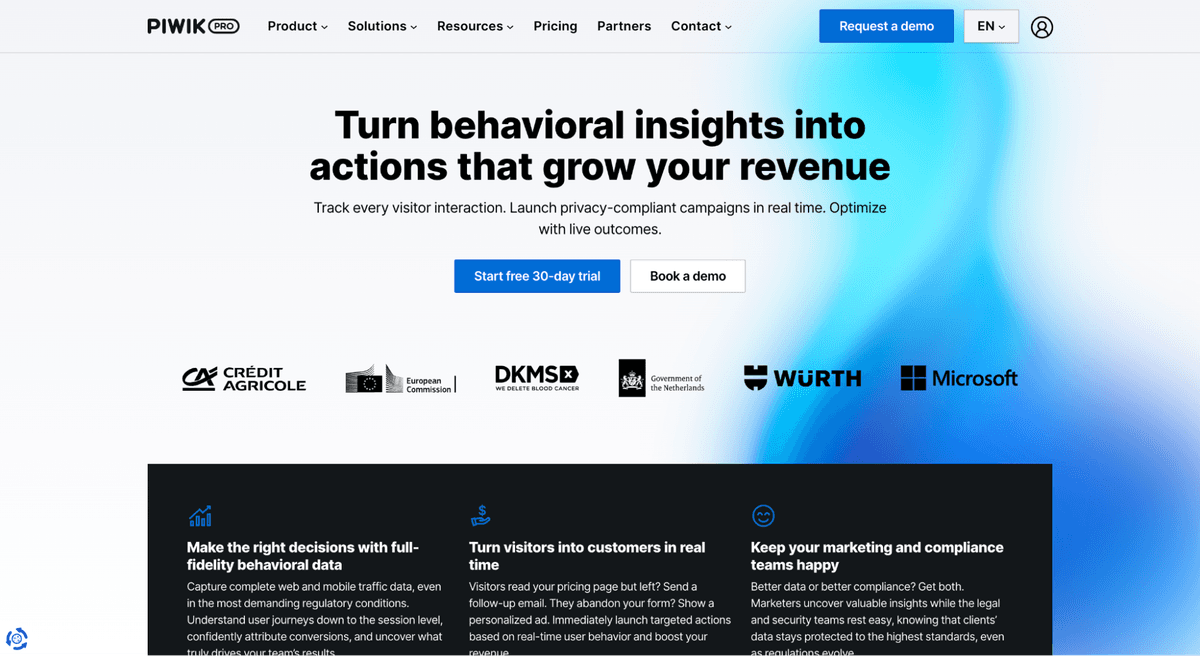
Piwik PRO bundles four products into one integrated privacy suite: Analytics, Tag Manager, Consent Manager, and a Customer Data Platform. That combination lets ecommerce teams manage tracking, consent collection, audience building and data activation without juggling separate vendors.
The free Cloud plan supports up to 500,000 actions per month with EU-hosted data. Paid plans are available on request and Enterprise tiers add a dedicated technical representative, 24/7 monitoring and incident management. More than 250 clients in 40 countries use the platform.
Every report runs on 100% unsampled data refreshed in near real-time (dashboards update every 10 seconds, core data every 30 minutes). Ecommerce-specific features include funnel visualization, multi-channel attribution reports, and server-side tracking that captures events even when browsers block client-side scripts. You build custom dashboards with a drag-and-drop editor, segment audiences by behavior, and export raw data via API, BigQuery or CSV.
Pre-configured compliance settings cover GDPR, HIPAA and TTDSG out of the box. The Consent Manager handles visitor consent collection and rights requests in one centralized interface, trimming the legal overhead of running multiple tools. Data anonymization activates by default, and the platform's privacy-first stance has earned it strong standing among European enterprises.
Native integrations with Google Ads and Search Console let marketing teams line up paid campaign performance with on-site behavior. Default data retention sits at 14 months, with customization available on premium plans. Piwik PRO fits compliance-conscious ecommerce brands that want enterprise-grade depth without giving up regulatory peace of mind.
8. Triple Whale
Triple Whale is an ecommerce analytics and attribution platform designed for online retailers that need to connect marketing spend with actual revenue. It brings advertising, store and customer data into one dashboard, helping teams understand which channels and campaigns contribute most to profitable growth.
The platform connects with major ecommerce and advertising systems, including Shopify, Meta Ads, Google Ads, TikTok and email marketing platforms. Instead of checking performance across multiple dashboards, teams can monitor spend, revenue, return on ad spend and customer acquisition costs from a single interface.
Attribution reporting is one of Triple Whale’s main strengths. It compares different attribution models and uses first-party data to help merchants evaluate the contribution of each customer touchpoint. This is particularly useful when browser restrictions and consent choices make platform-reported conversions incomplete.
Profitability reporting goes beyond revenue. Merchants can factor in product costs, shipping, transaction fees and advertising spend to monitor contribution margin and net profit rather than optimizing campaigns around return on ad spend alone.
Customer analytics cover lifetime value, repeat purchase behavior and cohort performance. Teams can compare acquisition channels according to the long-term value of the customers they generate, rather than judging every campaign on the first order.
Triple Whale also includes forecasting and AI-assisted analysis that can surface anomalies, summarize performance and help teams investigate changes in key metrics.
The platform is most relevant for growing ecommerce brands that advertise across several channels. Smaller stores with limited paid acquisition may find its attribution capabilities excessive compared with simpler tools.
For merchants that need revenue attribution, profitability reporting and customer analytics in one environment, Triple Whale provides a much more ecommerce-specific solution than a standalone heatmap and session-replay tool.
9. Google Analytics

Google Analytics (GA4) remains the default choice for millions of ecommerce sites. It's free, deeply wired into Google's advertising ecosystem, and backed by machine learning models that predict customer behavior like purchase probability and churn risk.
Cross-device and cross-platform tracking unify the customer journey. A shopper who discovers a product on mobile, researches on desktop, and buys via tablet shows up as one coherent path in your reports. Custom audience lists built in GA4 feed straight into Google Ads campaigns, tightening the loop between analytics insight and ad targeting.
The event-based data model, which replaced the old session-based approach, lets you define custom ecommerce events: product views, add-to-cart actions, checkout initiations and completed transactions. Attribution modeling spans multiple touchpoints, helping you see which channels contribute most to revenue rather than last-click vanity metrics.
Shareable reports and exploration templates lower the barrier for team-wide adoption. The platform swallows enormous data volumes without performance issues. Integration with BigQuery (free export on GA4) opens the door to advanced SQL analysis on raw event data.
Privacy is where things get complicated. GA4 leans on cookies and collects data that triggers consent banner requirements under GDPR. Data flows to US-based servers by default, raising transfer concerns for EU-focused stores, and several European data protection authorities have questioned its compliance posture. Stores that put strict privacy compliance first may need to pair GA4 with a cookieless tool, or look at alternatives entirely.
10. Adobe Analytics
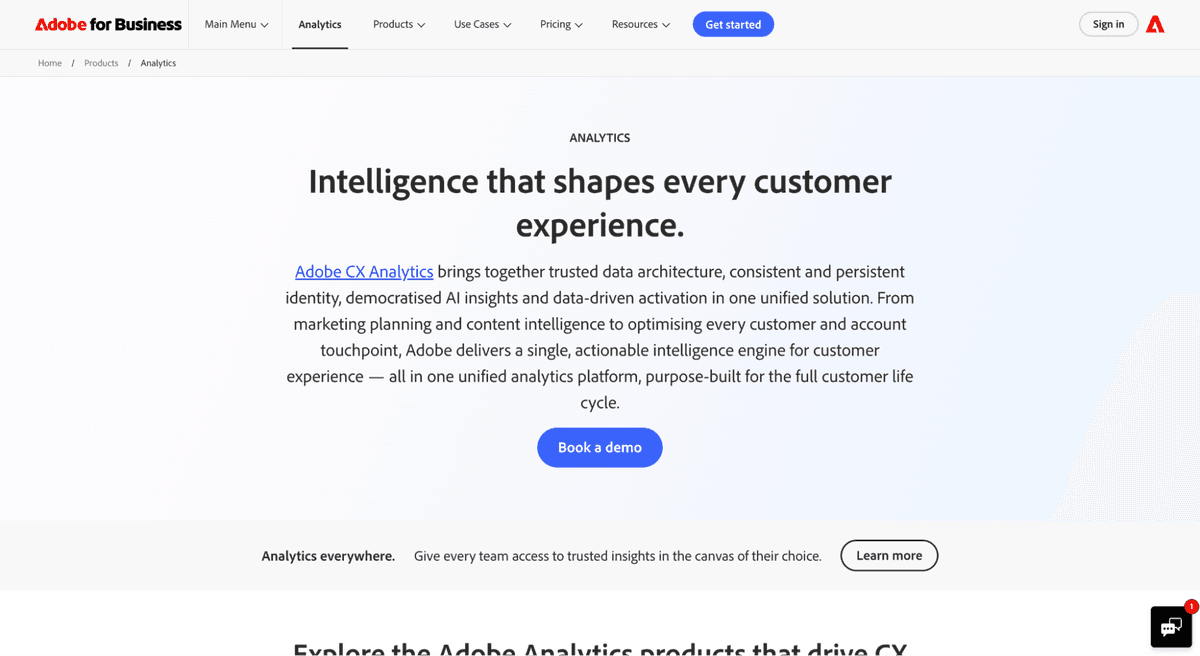
Adobe Analytics is an enterprise analytics platform built for retailers managing complex customer journeys across websites, applications, campaigns and physical or digital sales channels. It provides significantly more depth than behavioral tools focused primarily on recordings and heatmaps.
The platform tracks product views, cart activity, checkout progression, purchases, revenue and customer behavior through a flexible event-based data model. Ecommerce teams can analyze performance by product, category, promotion, customer segment, device and acquisition channel.
Advanced attribution tools compare how different marketing touchpoints contribute to conversions. Instead of relying only on last-click reporting, teams can evaluate paid media, email, affiliates, organic traffic and other channels across the complete purchasing journey.
Segmentation is one of Adobe Analytics’ strongest capabilities. Analysts can build audiences using browsing behavior, transactions, campaign exposure, customer attributes and historical engagement, then compare conversion rates and revenue across those groups.
Journey analysis helps teams understand how shoppers move between channels and devices before purchasing. Anomaly detection and predictive capabilities surface unexpected changes in sales, traffic or customer behavior before they become obvious in standard reports.
Adobe Analytics integrates closely with Adobe Target, Adobe Experience Platform and the wider Adobe Experience Cloud. Retailers can therefore connect analytics with experimentation, personalization, customer profiles and campaign activation.
The platform requires considerable implementation work, disciplined tracking governance and experienced analysts. Pricing is available through a custom enterprise contract, making it unsuitable for most small stores.
For large ecommerce businesses that need advanced attribution, cross-channel measurement and granular customer segmentation, Adobe Analytics is one of the most complete platforms available.
How to choose the best web analytics tool for your store?
What matters most when choosing analytics software for an ecommerce store?
Conversion tracking depth ranks highest for most stores, because knowing where shoppers drop off feeds straight into revenue. Privacy compliance comes next: selling in Europe without a proper GDPR setup risks fines and chips away at customer trust.
Beyond those two priorities, weigh integration with your tech stack (payment processors, email platforms, ad networks) and whether the tool provides raw data exports. A platform that locks data inside its own dashboard limits your ability to build custom attribution models or feed insights into external systems.
How much should ecommerce analytics software cost?
Free tiers from tools like Google Analytics, Matomo On-Premise and Amplitude cover basic needs without spending anything. Paid plans across most platforms range from $9 to $49 per month for small-to-mid stores, scaling with traffic volume.
Enterprise platforms like Adobe Analytics and Piwik PRO don’t publish standard pricing, and costs are typically provided through a custom quote based on traffic, features and support requirements. Match cost to traffic volume and analytical complexity: a store processing 10,000 monthly sessions doesn't need the same tooling as one handling ten million.
Can cookieless analytics platforms still track ecommerce conversions accurately?
Yes. Platforms like Fathom, Plausible and Simple Analytics use privacy-preserving techniques (hashed identifiers, aggregated data, event-based tracking) to measure conversions without dropping cookies. They capture 100% of visitor traffic, including users who reject cookie banners on traditional tools.
What you give up is session-level behavioral depth. Cookieless tools usually can't replay individual sessions or build persistent user profiles across visits. For stores that need both, pairing a privacy-first counter with a behavioral tool like Hotjar or Clarity fills the gap.
Is self-hosted analytics better than cloud-hosted for ecommerce?
Self-hosting, available through Matomo gives you complete data sovereignty. Every record stays on your own servers, which simplifies GDPR compliance and removes third-party processor risks.
The catch is operational overhead. You handle updates, security patches, server scaling and backups. Cloud-hosted solutions manage the infrastructure for you, freeing your team to focus on analysis rather than DevOps. Stores with dedicated technical staff benefit most from self-hosting, while leaner teams usually prefer managed cloud plans.
Do I need more than one analytics tool for my online store?
Most mature ecommerce setups combine two complementary tools: one for quantitative measurement (traffic, conversions, attribution) and one for qualitative insight (heatmaps, session replays, surveys). Google Analytics or Matomo paired with Hotjar or Clarity is a popular combination.
Adding a third layer, like an experimentation platform makes sense once your store generates enough traffic to run statistically significant tests. Start with the quantitative foundation, layer in behavioral observation, and scale into experimentation as your optimization practice matures.

Author
Sarah Mitchell
Sarah Mitchell is a B2B technology writer who specializes in ecommerce, digital marketing, and SaaS. She enjoys breaking down complex software into practical insights that help businesses make smarter decisions. Her work focuses on data-driven strategies, emerging technology, and the tools that support online growth.