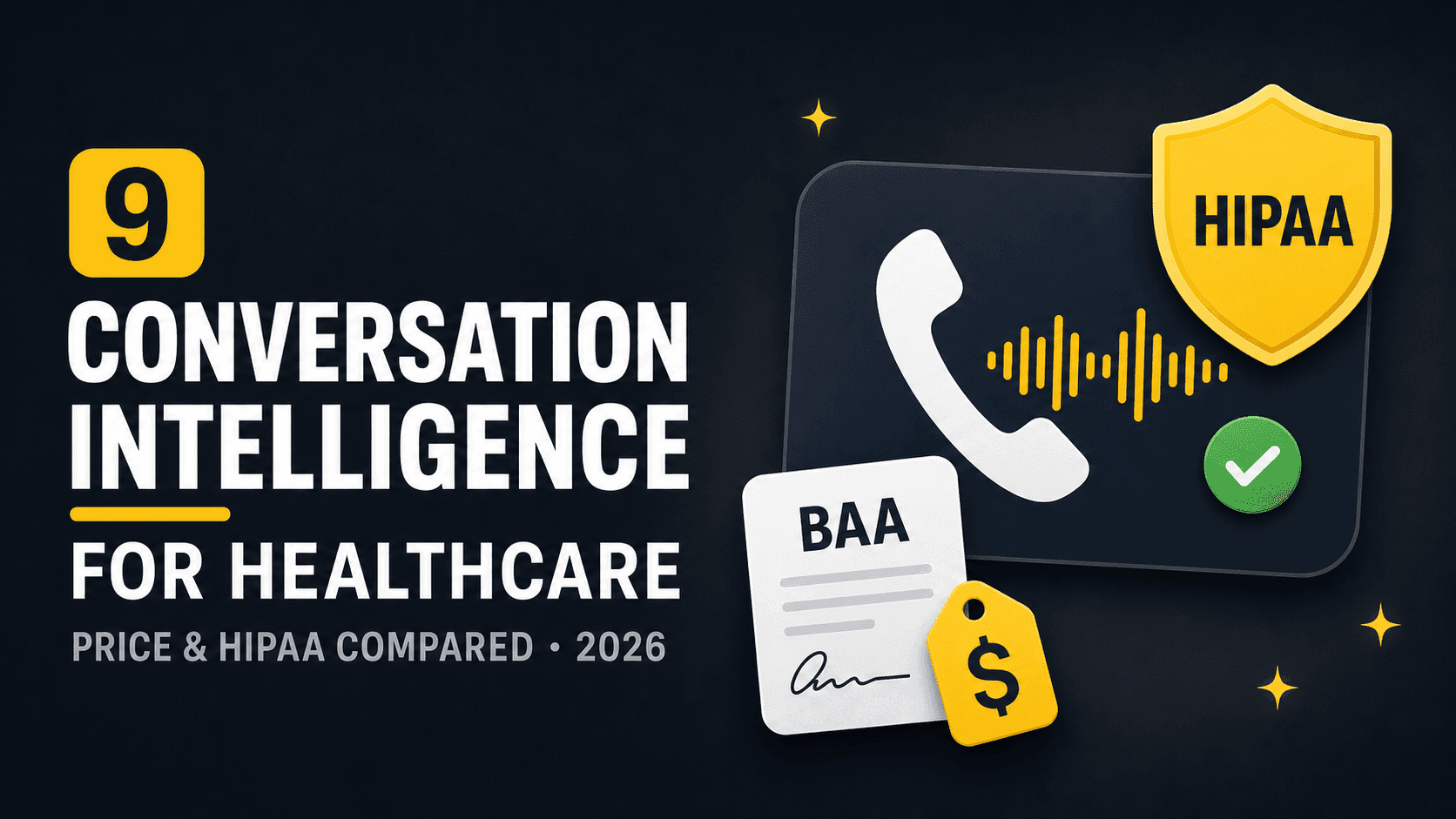
Which conversation intelligence software for healthcare will sign a BAA, and what will it cost you? This list answers both for nine tools, using each vendor's own pricing and security pages as of November 2026.
Alpharun is the best pick for patient access and enrollment teams, because it scores every scheduling, intake, and referral call against your own playbook. It's demo-priced and its site lists HIPAA with no BAA wording, so ask for a quote and BAA terms together.
Three of the others print a price. CallRail bundles a BAA into Healthcare plans, CTM (formerly CallTrackingMetrics) signs BAAs from its Marketing Pro tier, and Patient Prism sells front-desk packages from $6,000 a year.
The other five quote. Authenticx brings healthcare-only enterprise QA, Observe.AI pairs live assist with auto QA, Gong covers B2B sales into healthcare, Marchex compares calls across locations, and Balto guides contact-center agents mid-call.
Tool | Published price (as of November 2026) | HIPAA or BAA wording on site | Best fit |
|---|---|---|---|
Alpharun | Not published (demo and pilot) | Lists HIPAA and SOC 2 Type 2; no BAA wording | Patient access and enrollment teams |
Patient Prism | SMB from $6,000/year | "SOC 2 and HIPAA compliant"; no BAA wording | Dental and medical front desks |
Authenticx | Quote-based | "HIPAA Compliant" badge; no BAA wording | Payers, pharma hubs, health systems |
Observe.AI | Quote-based | "HIPAA-Compliant" badge; no BAA wording | Large contact centers |
Gong | Per user plus platform fee | Maps HIPAA controls in SOC 2; no BAA wording | B2B sales into healthcare |
CallRail | From $50/mo billed yearly | BAA on every Healthcare plan (from $150/mo) | Practices tracking marketing calls |
Marchex | Not published | None on product pages | Multi-location groups |
Balto | Per seat, quote-based | "HIPAA compliant"; no BAA wording | Contact-center floors |
CTM | From $65/mo billed yearly | Signs BAAs; HIPAA from Marketing Pro | Marketing teams that need a BAA |
Why are HIPAA terms and pricing so hard to compare?
Six of the nine tools here publish no dollar figure at all, and the three that do price in different shapes. CallRail and CTM sell monthly plans with a discount for paying yearly, while Patient Prism starts its SMB packages at a yearly figure.
Then there's the metering. CTM charges for transcription past its included minutes and for each AskAI question, CallRail bills analysis minutes past 10,000, and Balto prices its voice agent by the minute while everything else it sells goes per seat.
The BAA is often tied to a specific plan, too. CallRail includes one with every Healthcare plan, and CTM's HIPAA coverage starts at Marketing Pro, so the cheapest plan on either pricing page isn't the one that comes with HIPAA support.
The HIPAA wording itself shifts from vendor to vendor: "HIPAA-supported," "HIPAA compliant," "supports HIPAA," and Gong's "we map HIPAA controls" each promise something a little different (somewhere, a procurement lead is adding a spreadsheet column labeled "HIPAA-ish").
Under HIPAA, a vendor that stores or analyzes recorded patient calls on your behalf is a business associate, since the definition in 45 CFR 160.103 names "data analysis" and "quality assurance."
HHS guidance calls for a written business associate agreement with that vendor, and a badge on a trust page can't stand in for the signed contract.
1. Alpharun: call scoring and coaching for patient access and enrollment teams
Price: There's no public pricing page, so you get a number through a demo and a pilot built around your own call workflows. Plan on about two weeks for the AI playbook setup, which comes with hands-on deployment support.
HIPAA terms: The site says the platform meets "SOC 2 Type 2, HIPAA, GDPR, and AI safety standards" (AIUC-1), with AES-256 encryption at rest and TLS 1.2/1.3 in transit. It publishes no BAA terms, so ask for the agreement and the plan it covers in that first demo.
Strengths: The company builds a playbook from what your strongest staff already do, around patient registration, scheduling, referral handoffs, and escalation guidelines. Every call gets scored against it after it ends, privacy procedures and identity verification steps included.
Each rep then gets one focused coaching goal, and the platform tracks progress on their next calls, so a manager can see whether the guidance stuck. It also shows where patients leave calls confused about appointment preparation, referrals, or next steps.
Its voice agents handle routine intake, appointment scheduling, and reminders, and they route clinical questions and urgent concerns through your organization's approved escalation process.
Those AI calls get scored against the same standards as your human team, and its Ask feature answers plain-language questions about calls and team performance.
The clearest proof comes from lending: NewDay USA, a VA mortgage lender, moved off keyword-matching call analytics and saw a 14.1% increase in appraisal-order conversion.
CRO Franco Greco summed up the difference: "It doesn't just transcribe calls and flag keywords. It understands whether a loan officer handled a borrower effectively and pinpoints exactly where they are losing deals."
Who should skip it: Anyone shopping for clinical documentation or an ambient scribe, because the platform is built for patient access, enrollment, and sales calls. A team that needs a price and a signed BAA before it'll take a sales call should start with CallRail or CTM.
2. Patient Prism: booking conversion for dental and medical networks
Patient Prism is the healthcare specialist on this list that prints a starting price, which makes budgeting a lot less mysterious.
Price: SMB packages start at $6,000 a year as of November 2026. Enterprise pricing arrives as "an investment scoped to your organization in a proposal," and enterprise pilots run 90 days at the at-scale rate across a defined set of locations.
HIPAA terms: Its pricing FAQ says "SOC 2 and HIPAA compliant," and its trust center lists HIPAA, SOC 2, GDPR, and PCI DSS SAQ A, plus a "SOC2 Type 2 - 2026" report. Neither the site nor the trust center has BAA wording, so request one before any patient call gets recorded.
Strengths: Everything centers on whether the caller booked. Booked vs. Not-Booked verification, Reasons Not Booked, and Insurance Intelligence (payer name plus PPO, Medicaid, and Medicare Advantage stratification) show where appointments slip away.
QA scoring can use your rubric, Patient Prism's, or a mix, and Agent Attribution uses a voice fingerprint to tie each call to the right person. In the vendor's Serenity Dental of Florida case study, analysis landed within about an hour of each call, and new patient bookings rose 90% in two months.
Add-ons include a voice agent, an SMS agent, website chat, and reviews management, though the voice agent requires a PMS, EMR, or EHR integration.
Who should skip it: Sales teams and payer call centers, since it's built only for converting patient demand at the front desk. It's also a stretch if you want a self-serve trial first, because there isn't one.
3. Authenticx: enterprise QA for payers, pharma hubs, and health systems
Price: Not published as of November 2026. There's no pricing page, and every path runs through "Schedule A Demo" or "Contact Sales," so expect a quote sized to an enterprise deal.
HIPAA terms: Its integrations page lists SOC 2 Type I and II, HIPAA, GDPR, CCPA, and PCI DSS among the standards it adheres to, and its privacy page carries a "HIPAA Compliant" badge. No page says it signs a BAA.
Its own resource article tells buyers to check a vendor's "ability to sign Business Associate Agreements," which is good advice to bring to the Authenticx demo as well.
Strengths: Its AI is "exclusively trained on healthcare data," and the provider product promises to "analyze 100% of patient conversations across scheduling, billing, and patient portals." QA tools include AI Coaching Notes, a Custom Quality Rubric, and eight standard quality models.
It also flags where IVR routing, transfers, and escalation workflows create friction, and pharma teams get adverse-event detection that sends safety forms to Veeva Vault or Trilogy. Automatic PII and PHI redaction is built in, and the platform runs on Microsoft Azure.
Its newest piece, KBo Flow, became generally available on November 10, 2026, as an autonomous research agent that emails findings and recommended next steps to the people you designate.
Who should skip it: A single practice or a small front desk, since this is enterprise software for pharma hubs, payers, and health systems. It works on recorded interactions after the fact, so look elsewhere if you want prompts on live calls.
4. Observe.AI: live agent assist plus auto QA for large contact centers
Price: Quote-based as of November 2026. Observe.AI says pricing "is custom and based on deployment scope," including which AI agents you deploy, conversation volume, and channels, and that "there is no public self-serve tier."
HIPAA terms: Its trust page shows a "HIPAA-Compliant" badge next to SOC 2 Type II, HITRUST r2, ISO 27001, and PCI Level 1 certifications, plus "pre-model redaction of PII/PCI/PHI." Its trust and healthcare pages carry no BAA wording, so put that question on the agenda early.
Strengths: Agents get "real-time agent assist, smart scripts, prompts, and after-call summaries," and its AI agents can take frequent calls about appointment scheduling, pre-authorization, and prescription refills around the clock.
Its integrations directory lists 250+ pre-built connectors, including athenaOne, AdvancedMD, and Availity, which makes Observe.AI one of only two tools on this list that name practice-management or EHR-side systems. The company cites a 22% uplift in CSAT across 350+ enterprise customers.
The healthcare page also promises "100% compliance monitoring" and script and compliance-statement prompts, which suits payer and provider contact centers fielding claims and billing questions all day.
Who should skip it: Teams that only want call scoring, because this is a broad suite of AI agents, live assist, and QA sold on a custom quote. Smaller clinics will pay for a lot of platform they won't touch.
5. Gong: revenue AI for B2B teams selling into healthcare
Price: Licenses are priced per user, plus "a platform fee based on the number of users supported," with no dollar figures published as of November 2026.
HIPAA terms: Gong's trust page says "While Gong is not a covered entity, we map HIPAA controls in our SOC 2 Type II audit." It publishes no BAA statement, and its PHI redaction is "only available for English-language calls" for now.
Strengths: Gong learns from every call, email, and meeting, and its agents work alongside your reps. The healthcare page speaks to pharma teams ("Understand which value propositions drive prescriptions, track script compliance"), device makers, health tech, and benefits teams.
More than 5,000 revenue teams use it, and the Gong Collective connects 300+ integrations. Lauren Iken, a patient advocate at ClearChoice Dental Implant Centers, says Gong helped increase the consult rate 3% "in a matter of days."
Its help docs flag one trade-off worth planning around: turning on PHI redaction "may affect AI-generated insights like briefs, summaries, and tracker detections."
Who should skip it: Patient access desks and anyone who needs a signed BAA before the first recording (it's a natural fit for a med-device sales floor and an odd one for whoever's rescheduling a knee MRI). Teams with PHI on non-English calls should also look elsewhere.
6. CallRail: marketing attribution with a BAA built into Healthcare plans
CallRail makes the BAA easy to find: every Healthcare plan includes one.
Price: As of November 2026, Lead Tracking is $50 a month, Lead Tracking Complete $95, Lead Conversion $150, and Lead Conversion Complete $195, all billed yearly. Billed monthly, those run $55, $105, $165, and $215.
Healthcare plans start "at $150/month," and every account gets a 14-day free trial with no credit card. Call scoring and coaching (Premium Conversation Intelligence) start at Lead Conversion, which includes 10,000 analysis minutes before a $0.05-a-minute overage.
HIPAA terms: The FAQ says CallRail signs a BAA "with every client on a Healthcare Plan," and that using it with PHI without one "is strictly prohibited by our Terms of Service." Its extra HIPAA security measures only switch on with a BAA and a Healthcare plan.
Strengths: It ties every call, form, and text to the campaign that drove it, then adds HIPAA-supportive recording, transcripts, call scoring, and auto-tags like "appointment scheduled." NexHealth-powered integrations reach Athenahealth, Dentrix, and more.
Over 2,600 healthcare providers use it, and Baptist Health's Lauren Anderson says it helps them "prove our marketing ROI by connecting campaigns to new appointments."
Who should skip it: Contact centers that want custom scorecards, since its coaching is automatic per-call feedback built for marketing teams. Healthcare plan names and contents aren't published either, so ask exactly which features your plan includes.
7. Marchex: call insights across multi-location healthcare groups
Price: Not published as of November 2026, and there's no pricing page, so you'll get a number from a demo.
HIPAA terms: Marchex's home, healthcare, and conversation intelligence pages don't mention HIPAA, a BAA, or SOC 2. Its blog describes the platform as HIPAA-compliant, which is a good reason to get every term in writing before you sign.
Strengths: Its healthcare pitch covers health and wellness, dental, and senior living, with tools to "identify moments that influence appointment bookings" and understand patient sentiment across all your locations. Dental groups can dig into why patients do or don't book.
It also attributes calls to their source, sends missed-opportunity alerts, and connects marketing spend to outcomes. A Freshpaint integration passes conversation data downstream "only after sensitive information is cleansed."
PDS Health's Thanh Lieu credits the call summaries with "pinpointing where issues start," and a Healthgrades product VP calls the Marchex products "essential assets in client renewals."
Who should skip it: Any buyer who needs HIPAA and BAA terms published before the first sales call. Single-location practices also get less from it, because cross-location comparison is where it shines.
8. Balto: live guidance for enrollment and member-services floors
Price: Balto sells one plan, Balto Plus, priced per seat, and "every user counts, whether they are frontline agents, managers or execs." Its voice agent, Togo, is billed by the minute, and there are no dollar figures as of November 2026.
HIPAA terms: Balto's FAQ says it's "SOC 2 Type II certified, HIPAA compliant, and PCI DSS certified." The healthcare page adds that it "supports HIPAA, with configurable redaction and the option to pause screen recording on sensitive information," but there's no BAA statement for Balto itself.
Strengths: Balto guides agents "while they're still on the line," writes the documentation for them, and reviews every conversation for accuracy and privacy. On enrollment calls it locks the verbatim TPMO disclaimer in as a checklist step and finds providers on its own when a caller asks.
It connects to 60+ systems, including Five9, Genesys, Talkdesk, Amazon Connect, Salesforce, and HubSpot, and "most customers are live within 30 days." On its healthcare page, Rx Outreach lifted patient-support reviews from 2.7 to 4.8 stars.
Who should skip it: Small-practice front desks, since it plugs into contact-center telephony and is built around enrollment and member-services floors. Managers and execs count as seats too, so budget for the whole org chart.
9. CTM (formerly CallTrackingMetrics): published plan prices with BAAs in writing
CTM puts its BAA promise and its plan prices on public pages, which is rarer in this category than it should be. (The rebrand shed sixteen letters, though the pricing page still says "CallTrackingMetrics" in a few spots.)
Price: As of November 2026, Marketing Lite is $79 a month ($65 billed yearly), Marketing Pro $179 ($149), Sales Engage $329 ($274), and Enterprise $1,999 a month. A current promo waives plan fees for the first month.
Usage costs sit on top: transcription is $.02 a minute past 3,000 included minutes, AskAI custom questions start at $.01 each, summaries cost $0.05 per activity, and VoiceAI is $0.12 a minute after 60 included minutes per agent.
HIPAA terms: CTM says it "will put in place Business Associate Agreements (BAAs) with customers," and it has completed a SOC 2 Type 2 audit. Its pricing table checks HIPAA compliance only from Marketing Pro up, so the HIPAA floor is $179 a month, or $149 billed yearly.
Strengths: Recordings can sit behind designated logins and secondary PINs for coaching reviews, and notifications can drop fields that contain PHI. PII can be redacted from call, text, and form records, manually or automatically.
Marketing Pro adds AskAI call analysis and if/then triggers for call scoring, and Sales Engage adds Live Conversations, coaching on live calls, and integrations with Salesforce, Zoom, Calendly, and Gong.
Who should skip it: Teams that want coaching on live calls at the entry price, since that starts at Sales Engage ($329 a month). If metered AI analysis makes your finance team twitchy, model a month of call volume first.
Questions to settle before you request a quote
Sales teams will happily answer these for you, but you'll get cleaner quotes if you walk in with your own answers.
Will patient information touch the recordings? Under HIPAA's definitions, a recorded call that identifies the caller and discusses their care counts as PHI, and HHS guidance calls for a BAA with any vendor that stores or analyzes it for you.
Which plan carries the BAA? CallRail ties it to Healthcare plans and CTM's HIPAA coverage starts at Marketing Pro. For every other tool here, get the plan name written into the quote.
What kind of call are you fixing? Front-desk booking points to Patient Prism, CallRail, or Marchex, while big contact centers point to Observe.AI, Balto, or Authenticx. Teams selling into healthcare point to Gong, and patient access coaching points to the top pick.
Do you need prompts on live calls? Balto, Observe.AI, and CTM's Sales Engage tier offer live features, and most of the rest work after the call ends.
What's metered, and who counts as a seat? Ask for a sample bill built on last month's call volume, because transcription minutes, AI questions, and voice-agent minutes add up. Balto counts every user, and Gong adds a platform fee on top of per-user licenses.
Get the paperwork done before the first recording
The question I'd ask first in any demo is the BAA one, and the answer should be a signed agreement that names the plan you're buying before a single real patient call gets recorded.
HHS guidance says the HIPAA Rules permit a covered entity to disclose PHI to a business associate if it obtains "satisfactory assurances" in a written contract. Its cloud guidance adds that a vendor storing only encrypted data, without the key, is still a business associate.
So run the pilot on staged test calls or recordings with patient identifiers removed. HIPAA's minimum necessary standard asks covered entities and business associates to limit PHI to what the purpose needs, so settle redaction and listening access before real recordings arrive.
Then switch on real patient calls with the signed agreement, the plan name, and the redaction settings all on file (your compliance officer will sleep better, and so will your pilot lead).
Common questions
Which conversation intelligence tools publish their prices?
Of the nine tools here, CallRail, CTM, and Patient Prism publish dollar prices as of November 2026. CallRail starts at $50 a month billed yearly, CTM at $65 a month billed yearly, and Patient Prism's SMB packages at $6,000 a year, while the rest quote.
Does a HIPAA-compliant vendor automatically sign a BAA?
No, a vendor can state HIPAA compliance on its site and still publish no BAA terms, so you have to ask for the agreement itself. On this list, CallRail and CTM state that they sign BAAs, while several others list HIPAA with no BAA wording at all.
What does conversation intelligence cost for a small medical practice?
As of November 2026, a small practice can get a BAA-backed plan from $149 a month billed yearly on CTM's Marketing Pro or from $150 a month on a CallRail Healthcare plan. Patient Prism's SMB packages start at $6,000 a year, and the enterprise tools on this list quote by deal.
Author
Debutify
Debutify is the easiest way to launch and scale your eCommerce brand.