How to Decide Between Debutify and Ecom Elixir for Your Online Store

Choosing the right shopify theme can make or break your store’s performance. With rising ad costs and fierce competition in 2026, your theme isn’t just about looks—it’s about revenue. This guide walks you through a practical comparison of Debutify and Ecom Elixir, helping you pick the foundation that actually drives sales.
Why Your Theme Choice Matters More Than “Just Design”

Your theme is the engine of your online store, controlling everything from page speed to conversion rates. In 2026’s e-commerce landscape, with ad costs on Meta and TikTok climbing steadily, every visitor needs to count.
Choosing between Debutify and Ecom Elixir isn’t just about picking prettier layouts. It’s about selecting a 24/7 salesperson (Debutify) versus a mostly visual template (Ecom Elixir). Debutify has been battle-tested across thousands of shopify stores globally, while Ecom Elixir maintains a smaller, more niche adoption footprint with around 3,000 stores.
Here’s why this matters: a 1-2% lift in conversion rate compounds dramatically over time. If you’re spending money on traffic, a conversion focused theme can effectively double the value of each visitor. That’s not design flexibility—that’s profit.
Debutify vs Ecom Elixir at a Glance
Before diving into specifics, here’s a concise comparison between these two approaches to shopify theme design.
Debutify positions itself as a conversion-driven growth suite that combines design, speed, and 60+ built-in add-ons into one package. These include upsells, cart boosters, trust badges, sticky add-to-cart bars, countdown timers, and social proof elements. It’s built for merchants who want to increase conversions without juggling multiple apps.
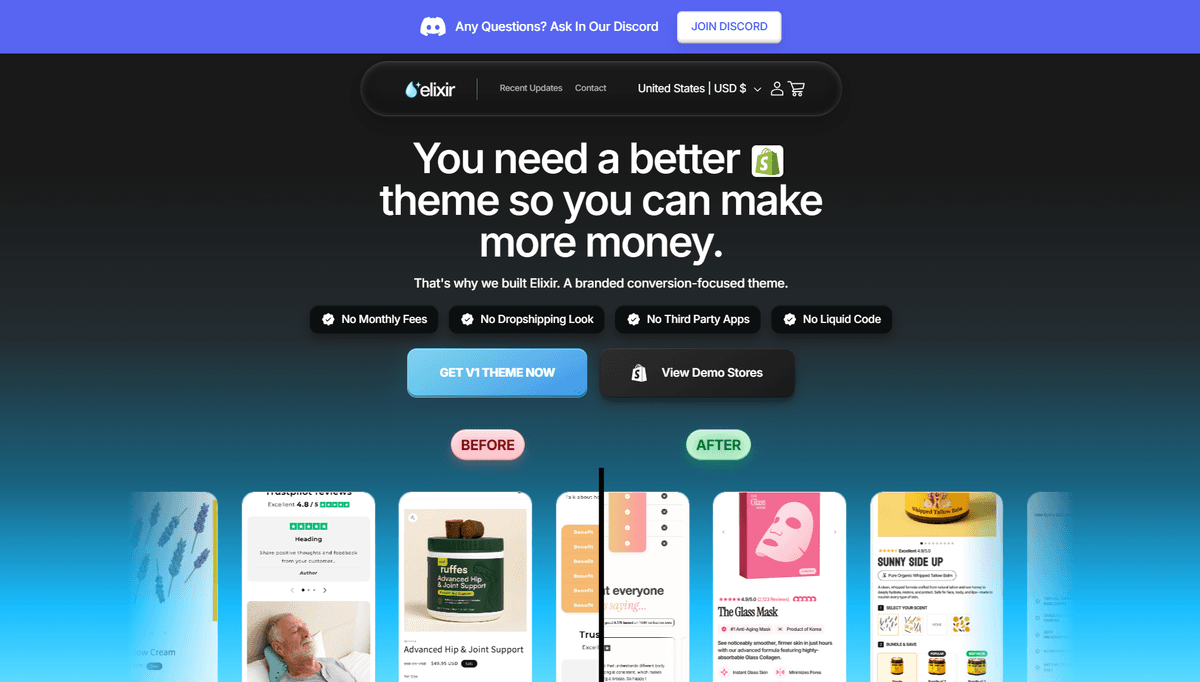
Ecom Elixir takes a more traditional premium theme approach. It offers sleek visual templates and over 30 product blocks, but requires third-party shopify apps for most advanced features and CRO functionality. The theme costs around $175 as a one-time purchase, but that’s before you factor in the apps needed to match Debutify’s capabilities.
The key differences come down to philosophy: Debutify focuses on in-theme marketing tools, speed optimization, and a robust support ecosystem. Ecom Elixir prioritizes aesthetics with a design-first, feature-second approach.
Core Comparison: Performance, Mobile, and User Experience
Performance and mobile experience are non-negotiable in 2026-2027. Over 70% of shopify traffic comes from mobile devices, making this the baseline for comparing any theme.
Debutify’s codebase is engineered to remain fast even with many add-ons active. Recent updates (version 8.12, March 2026) added improved code efficiency, mobile layout refinements, and subscription widget support. The theme emphasizes lean code that won’t slow your store’s performance.
Ecom Elixir, while visually appealing, typically requires multiple external apps to achieve similar functionality. Each app adds extra scripts, potential conflicts, and loading delays. Reviews note that Elixir’s section-heavy templates with large hero images and video carousels can impact initial load times—especially on mobile.
Consider this scenario: you’re running TikTok ads driving mobile traffic. With Debutify, visitors land on optimized product pages with sticky add-to-cart, quick-view features, and mobile-friendly layouts. With Ecom Elixir, you may need several apps running just to match that functionality, each adding potential friction to the buying journey.
Built-In Conversion Tools: Why Debutify Replaces a Whole App Stack
This is the core reason many store owners choose Debutify over Ecom Elixir: the sheer depth of built in features.
Debutify bundles features that stores normally purchase as separate apps: in-cart upsells, cross-sells, cart upsell bundles, sticky add-to-cart bars, product tabs, FAQ accordions, announcement bars, quantity breaks, and more. All maintained by one team, all optimized to work together.
Ecom Elixir ships as a “clean” theme with minimal marketing automation. To match Debutify’s native capabilities, store owners typically install 5-7 separate apps—each with its own monthly fee, settings dashboard, and potential for conflicts.
A concrete example: a growing dropshipping store using Debutify can run urgency timers, social proof popups, and post-purchase upsells directly inside the theme.
The same setup on Ecom Elixir might require separate apps for each function, creating a tech stack that’s harder to manage and more expensive to maintain.
Upsells, Cross-Sells, and Average Order Value
Increasing average order value is critical as ad costs rise. Every additional dollar per order compounds your profitability.
Debutify includes built-in upsell and cross-sell tools: in-cart upsells, product bundles, related product blocks, quantity breaks, and post-purchase offers. These are designed to boost AOV without requiring external apps. One case study (Laughing Pug Australia) reported a 400% increase in daily sales within two months of switching to Debutify.
Ecom Elixir offers quantity break blocks and an advanced cart drawer, but lacks the flexible bundled recommenders and dynamic upsell triggers that Debutify provides natively. For those features, you’re looking at third-party solutions.
Trust, Urgency, and Social Proof Elements
Most visitors don’t know your brand, so they need trust building elements and urgency cues to convert.
Debutify includes trust badges, secure checkout icons, shipping and return policy snippets, countdown timers, low-stock alerts, and social proof notifications—all configurable within theme settings. You can toggle these on or off and test combinations without touching code.
Ecom Elixir offers stock indicators, shipping indicators, and guarantee badges, but these are more design-focused blocks rather than behavior-driven tools. For dynamic social proof popups or configurable urgency triggers, you’ll likely need external widgets.
Total Cost of Ownership: Theme Price vs. Ongoing App Spend
The up-front theme price can be misleading. What matters is total monthly cost and ROI over 6-12 months.
Debutify offers tiered pricing: a free plan for basics, Growth at $15.60/month, and Professional at $35.60/month. These subscriptions replace many paid apps, often saving merchants $50-$200+ monthly in app fees.
Consider this cost effective breakdown for a typical store on Ecom Elixir:
| App Type | Monthly Cost |
| Upsell App | $79 |
| Trust Badges | $19 |
| Social Proof | $29 |
| Cart Drawer | $29 |
| Total | $156/month |
Debutify’s Professional plan at $35.60/month includes all of these features natively. That’s $117/month in savings—plus reduced complexity from managing fewer apps and support tickets.
Ecom Elixir’s $175 one-time cost seems attractive, but add those app fees and you’re looking at higher total spend within 2-3 months.
Ease of Setup, Customization, and Ongoing Support
How quickly can a non-technical founder launch? Debutify excels here.
The debutify theme focuses on beginner-friendly onboarding with presets, demo layouts, and a theme editor aligned with Shopify Online Store 2.0. Many store owners go to a fully functioning store in a single weekend with no coding skills. The drag and drop interface makes customization accessible to everyone.
Debutify’s settings are grouped around revenue-driving key features: upsell settings, cart boosters, trust elements. This makes it easier to optimize systematically rather than hunting through design menus.
Ecom Elixir offers many templates and visual layouts, but configuring behavior and conversion triggers often requires external tools or custom code. Support documentation tends toward traditional theme help rather than growth-focused guidance.
Branding and Design Flexibility
Design still matters for brand identity. Can Debutify look as polished as Ecom Elixir?
Absolutely. Debutify ships with multiple layout presets, typography options via various fonts, color controls, and section variations for hero banners, product grids, testimonials, and FAQs. Brands can create unique looks without touching code.
Ecom Elixir’s strength lies in sleek, visually-oriented templates—but many design flourishes aren’t tied to sales-focused features. You get beautiful layouts on your homepage and product pages, but fewer tools to convert visitors into customers.
A modern DTC skincare brand can use Debutify with large imagery, editorial-style sections, and embedded UGC videos. The best shopify theme doesn’t force you to choose between aesthetics and conversions.
Which Merchants Should Still Consider Ecom Elixir?
While Debutify wins for most growth-focused stores, some narrow cases exist where Ecom Elixir might fit.
Ecom Elixir could work for design-obsessed brands that already maintain a custom app stack and have in-house developers managing performance and integration risks. If your team includes developers comfortable with the trade-offs, Ecom Elixir’s visual templates might appeal.
For smaller stores that are purely content-driven with minimal emphasis on CRO techniques, Ecom Elixir’s simpler structure could suffice—though Debutify handles this use case equally well with its free themes tier.
Even in these edge cases, run side-by-side tests. Preview both themes with the same products and traffic, then compare add-to-cart rates and revenue per session before committing.
How to Choose Between Debutify and Ecom Elixir This Week
Here’s a concrete, step-by-step process to make a confident decision in 3-7 days:
Step 1: List your current and planned marketing tactics (Meta ads, TikTok, email, influencers). If you expect significant paid traffic, a conversion focused theme like Debutify typically provides higher ROI.
Step 2: Calculate your current or projected app costs for upsells, reviews, social proof, trust badges, sticky ATC, and cart optimization. Compare that recurring spend to Debutify’s subscription cost.
Step 3: Install each theme in a test environment. Load your existing products and branding, then run through the mobile buying journey. Time page loads and counts clicks to checkout.
Step 4: Enable Debutify’s key add-ons (cart upsell, trust badges, urgency timers) and try replicating the same functionality on Ecom Elixir using apps. Note setup time and visual consistency.
Step 5: Choose the right theme that delivers the best blend of speed, conversion features, and simplicity. In most practical tests, merchants find Debutify faster to optimize and more profitable.
FAQ
1. Can I switch from Ecom Elixir to Debutify without losing my products and orders?
Switching themes doesn’t affect your core Shopify data—products, collections, orders, and customers all live in Shopify, not in the theme. You’ll need to reconfigure theme-specific settings and homepage sections, but Debutify’s presets make this process fast. Set up Debutify in preview mode and only publish once satisfied, ensuring zero downtime for your live store.
2. Is Debutify suitable for complete beginners who’ve never built a Shopify store?
Debutify is built with non-technical merchants in mind. Using Shopify’s drag and drop Online Store 2.0 editor and intuitive toggles, you can build a fully functioning store in a single weekend. Contrast this with Ecom Elixir, where matching Debutify’s feature set requires configuring several different apps—overwhelming for beginners who just want to sign up and start selling.
3. Will my existing apps still work if I move to Debutify from Ecom Elixir?
Most standard Shopify apps work fine with Debutify, as the theme follows current standards and best practices. However, Debutify often lets you remove several existing apps (upsell, trust badges, urgency bars) because the same features are built in. Test your must-have apps in a Debutify preview theme and contact support with questions about specific integrations.
4. How long should I test Debutify against Ecom Elixir before deciding?
Run at least a 7-14 day test with consistent traffic before drawing conclusions. Send 1000+ visitors to each theme variant when possible, focusing on add-to-cart rates, checkout completion, and AOV metrics. If Debutify shows even a 0.5-1.0% lift in conversion or noticeable AOV increase, it typically pays for itself—especially for stores running paid ads.
5. Is Debutify still worth it if I only sell a few products?
Debutify can be especially powerful for single-product or small-catalog stores because every visitor matters more. Features like sticky add-to-cart, urgency timers, and focused layouts help smaller stores feel premium and convert better. Start lean with Debutify’s free plan, enable only essential add-ons, then layer in advanced features as traffic and sales grow.

Author
Debutify
Debutify is the easiest way to launch and scale your eCommerce brand.