Your Product Pages Are Translated. Your Videos Aren't.
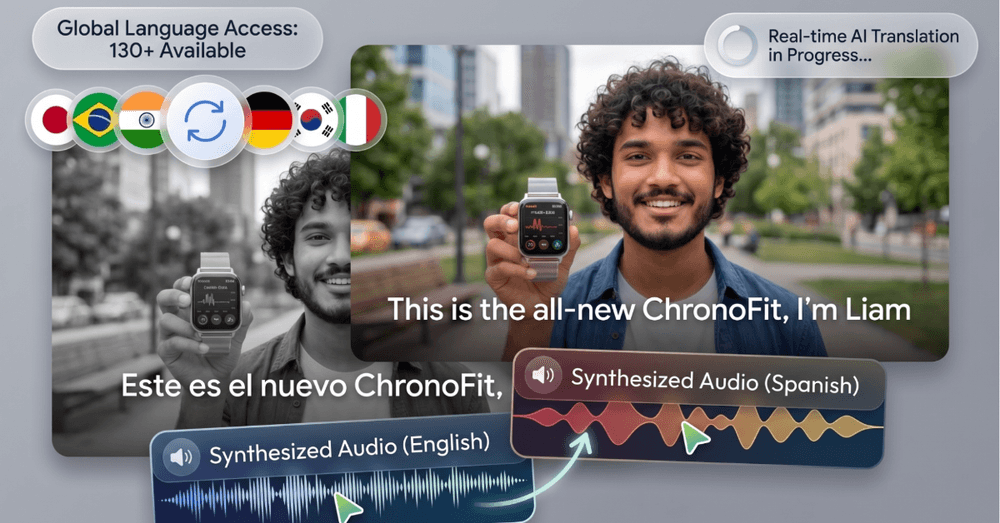
The localization gap quietly costing Shopify brands their international sales
You did the work. You turned on Shopify Markets, translated your product descriptions, set up local currencies, sorted out duties and delivery estimates, and swapped your size charts to centimetres. Your German storefront reads like it was written in German.
Then a shopper in Munich lands on your best-selling product page, scrolls past the translated copy, and hits play on the demo video.
It's in English.
Thirty seconds of an English-speaking founder explaining why the product is different, what the material feels like, how the mechanism works. All the persuasion you spent real money producing, delivered in a language your visitor may not follow well enough to be convinced by. And because it's video, they can't skim it, translate it in-browser, or piece it together from context the way they might with text.
This is the localization gap. Nearly every guide to selling internationally on Shopify stops at text, currency, and checkout — even though video is often the highest-converting element on the page.
"All channels" includes the one you skipped
The research on language and buying intent is blunt. RWS surveyed 6,500 global consumers for its Unlocking Global Understanding report and found that over four in five consumers won't buy from a brand that doesn't offer local language support, and that 89% believe they should have the option of dealing with a company online in their preferred language.
The number that matters most here is the next one: 93% agree that brands wanting a global audience need to communicate with them in their preferred languages through all channels at all times.
All channels. Not "the parts of the site that are cheap to translate."
There's a trust dimension too. 58% of respondents agreed that a localized online presence matches a physical presence in terms of trust — which cuts both ways. A fully localized store reads as a brand that operates in your country. A 90%-localized store reads as a foreign brand that ran its product page through a translation plugin. Video is usually the tell.
Why the gap exists
Nobody skips video localization because they think it doesn't matter. They skip it because the traditional cost structure is hostile to the situation most brands are actually in.
Here's the bind. You're opening Germany, France, and Spain as a test. You don't yet know which will work. Re-filming means three shoots, three sets of talent, three edits. A dubbing studio quotes per language, per minute, scaling linearly — every new market costs what the last one did, and you pay before you have revenue from that market to justify it.
So the rational move has always been: launch with translated text, leave the video in English, revisit "once the market proves out." Except the market can't prove out, because you crippled the asset doing most of the convincing. The test fails, you conclude Germany isn't for you, and you move on to a market where you'll make the same mistake.
What's actually worth localizing
Before spending anything, inventory what you have. The highest-value videos aren't always the ones you're proudest of.
Product page demo videos. If you need to share a product video outside the product page or make it easier for customers to access, you can upload video to link and share the resulting URL directly.
Sizing, fit, and material explainers. These do double duty — they convert and they cut returns. A shopper who misreads your sizing guidance in a second language becomes a return, and cross-border returns are brutal on margin. Run the numbers on your own return rate by market before you decide this is a nice-to-have.
Post-purchase and setup content. Assembly, first use, care, troubleshooting. Every one a customer understands is a support ticket you don't pay for and a one-star review that blames the instructions instead of the product.
Objection-handling videos. Warranty explanations, sustainability claims, "why ours vs. theirs." Mid-funnel, and dependent on nuance that subtitles flatten.
What's not on the list: your brand film, your founder's origin story, your six-minute factory tour. Those matter once a market is real. Start where intent is highest and the content is shortest.
Subtitles or dubbed audio? It depends more than you'd think
The instinct is to reach for subtitles because they're cheap and you already know how to make them. Sometimes that's right. Often it isn't, and the deciding factor is the market rather than the budget.
Subtitles work when the video autoplays muted in-feed, viewers are on mobile with sound off, the content is short and visual, or you're selling into a market with high English comprehension and a subtitling culture — Scandinavia, the Netherlands.
Dubbed audio works when the video runs longer than about 30 seconds, the visuals are doing important work that on-screen text would cover, the content is instructional and needs following hands-free, or you're in a dubbing-culture market: Germany, France, Spain, Italy, Japan, Brazil.
That last point is underrated. In dubbing-culture markets, subtitled commercial content can read as low-effort in a way it simply doesn't in Amsterdam.
There's a persuasion argument as well. Subtitles carry the words but lose the delivery — the emphasis, the enthusiasm, the pause before the reveal. For a product video where tone is doing real work, AI dubbing preserves the performance rather than reducing it to a transcript at the bottom of the frame.
The practical middle path is both: dub the audio and keep subtitles toggleable. Muted autoplay viewers get the text, sound-on viewers get the performance, and you haven't bet on viewer behaviour you can't verify.
Production decisions that make or break this
Most brands accidentally create work for themselves at the shoot. A few choices made beforehand determine whether localization is a quick job or a re-edit.
Keep text out of the frame. Translation tools handle spoken audio, not pixels. Anything burned into the video — price callouts, feature labels, "Limited Edition" overlays, hardcoded captions — stays in English through every language version. Put that information in the script, or add it as a separate overlay layer you can swap per market.
Write scripts that survive translation. Idioms, wordplay, and puns don't travel, and neither do culturally specific references. Sentence length matters too: languages expand and contract when translated. German runs long and will fight your timing, so leave breathing room instead of packing every second.
Keep currency, dates, and units out of graphics. Say "under fifty euros" in a voiceover you can regenerate, not as a title card you'd have to rebuild.
Think about who's on camera. Founder-on-camera builds authenticity, but it locks you into one face and one performance — and if your founder doesn't speak Japanese, the Japanese version is a translation of them rather than a native delivery. Worth deciding deliberately: keep the founder for brand storytelling where the human connection is the point, and use a consistent presenter format for the high-volume, frequently-updated, multi-market content where the job is clarity.
Disclose synthetic voice or presenters if you use them. A light touch of transparency costs nothing and protects you from a much worse conversation later.
A 30-day test that won't blow your budget
Don't localize everything. Run something controlled.
Week 1 — Pick and prepare. Choose one international market by existing traffic. In GA4, look at sessions by country against conversion rate; you want high traffic and low conversion, which signals interest you're failing to close. Pull your top three product page videos by views.
Week 2 — Localize. Translate and dub those three into that market's language. Review the transcripts before publishing — machine translation on product terminology needs a human check, especially for materials, sizing, and anything with a compliance angle. If you have someone in-market or a freelancer, an hour of their time here is the best money in the whole process.
Week 3 — Deploy. Swap the localized versions onto your market-specific product pages and change nothing else. Same layout, same copy, same offer. You want a clean read.
Week 4 — Measure. Segment by locale and look at add-to-cart rate on those specific pages versus the prior four weeks; video play rate and average watch percentage, which tell you whether people are staying with the localized version; overall conversion rate for that market; support ticket volume from that market if you tag by locale; and return rate on those SKUs, tracked over a longer window since returns lag purchases.
Be honest about significance. On modest traffic, four weeks and three videos won't give you certainty — but it gives you direction at a fraction of the cost of a full rollout. If the numbers move, expand: more videos in the same market, then the same three videos across two more markets. If they don't, you've learned something specific and cheap about that market rather than something vague and expensive about video.
The uncomfortable question
How many of your "underperforming" international markets are genuinely underperforming, and how many are markets where you asked people to buy from a page that spoke their language right up until the moment it mattered most?
The answer is probably already in your analytics — a country with respectable traffic and a conversion rate you've quietly written off. That's where to start.

Author
Zeeshan Ahmad
Writer