Business Model Meaning: Complete Guide to Modern Business Models
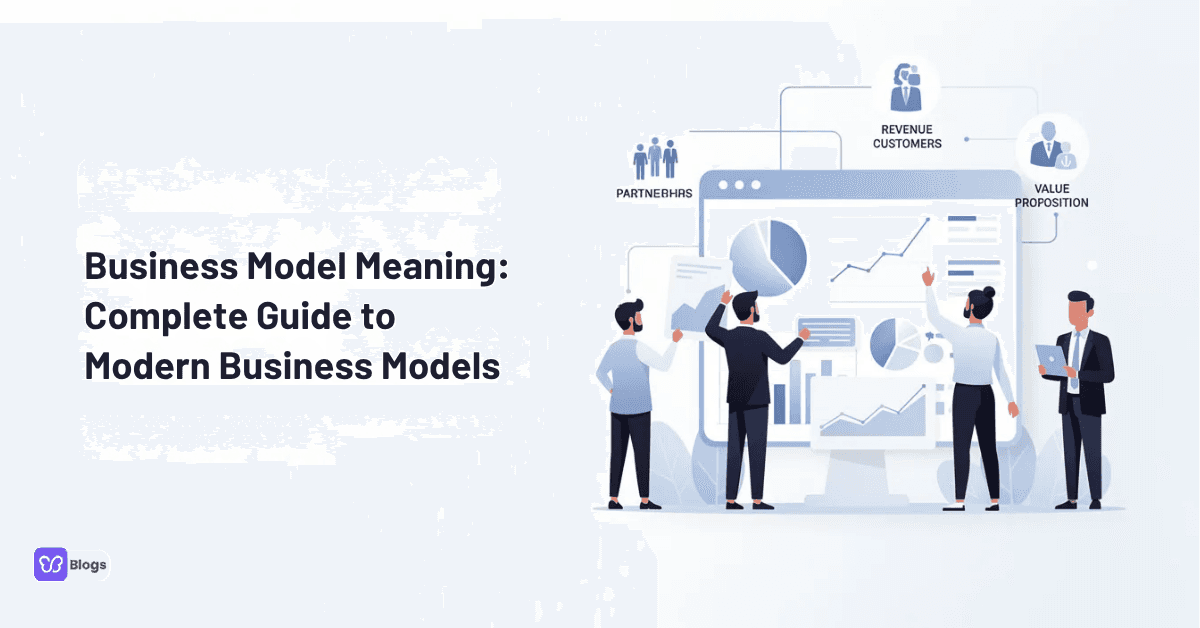
A business model is central to understanding how companies operate and succeed in today's digital economy. This guide is for founders, marketers, and anyone seeking to understand business model meaning and modern ecommerce models. We break down what a business model is, its key components, the main types in use today, and how ecommerce businesses apply them, so you can choose and document the right model for your own venture.
What Does "Business Model" Mean?
A business model defines how a company earns revenue. It describes what will be sold and how customers will pay, connecting a company's strategic ambitions to its operational reality. Modern business models also account for costs, key partners, distribution channels, and customer relationships.
Investors, founders, and marketers care about business models because they determine sustainability. Two companies can sell the same product and have completely different economics: one might earn recurring subscriptions while the other survives on one-time sales. The model, not just the product, decides which one compounds.
Key Components of a Business Model
Every company's business model is unique, but all are built from the same blocks. A business model helps communicate value to target customers by linking these components together, and it reflects a company's unique value proposition.
The core components: the value proposition defines the unique benefit the product or service offers; the target audience names the customer segment that benefits most; the revenue streams explain how money arrives; the cost structure lists what it costs to operate; distribution channels describe how the offer reaches buyers; and the marketing strategy ties the message to the audience that needs it.
Business Model vs. Business Plan
A business model describes how a company makes money; a business plan describes how the company will execute over time. The model is the engine, the plan is the roadmap. You can validate a model on one page, while a plan adds milestones, budgets, and hiring timelines. For an online store, that distinction matters: fix the model first, then write the plan around it, otherwise the plan inherits whatever flaws the model carries.
Why Choosing the Right Business Model Matters
Choosing the right business model matters because it fixes your cost base, your pricing power, and your relationship with customers before you spend a dollar on marketing. The wrong choice creates friction everywhere: subscriptions demanded by buyers who want one-time purchases, or one-off sales to customers who expect continuity.
The right choice does the opposite. It aligns with how your audience already buys, it keeps the customer experience consistent with the promise, and it gives you predictable unit economics to optimize. Model fit is why some companies grow profitably while better-funded competitors stall.
Different Types of Business Model (Core Categories)
Core business model categories describe who creates value, for whom, and how money flows. Retailers buy and resell at a margin. Manufacturers turn raw inputs into products. Subscription businesses charge for ongoing access. Marketplaces connect buyers and sellers and take a cut. Affiliate models earn commissions by referring demand to someone else's offer. Most real companies combine two or more of these categories, but one usually dominates the economics.
Business Model Examples (Real-World Companies)
Here are several business model examples across industries.
- Netflix: creates value through on-demand streaming content; captures revenue via monthly subscription fees from 260M+ subscribers
- Apple: creates value with integrated hardware, software, and an app ecosystem; earns from device sales, App Store commissions, and service subscriptions
- Amazon: combines retail margin, marketplace fees, logistics services, and cloud revenue under one roof
- Spotify: freemium access converts listeners into premium subscribers and sells advertising against free tiers
Business Models in Ecommerce and Online Stores
Business models in ecommerce emerged because online selling reshaped cost structures, customer reach, and data access. The business model of e commerce is a subset focused on digital transactions, delivery logistics, and digital marketing. Ecommerce websites, marketplaces, and social media platforms serve as core infrastructure. An online store differs from a physical shop in measurable ways: lower rent costs but higher acquisition spend, national reach instead of local footfall, and rich behavioral data instead of gut feel. Winning online usually comes down to SEO and organic visibility on one side, and paid ads on the other. Conversion rate optimization then squeezes more revenue from the same traffic, with well-built product pages doing most of the selling work.
Main Ecommerce Model Types (B2C, B2B, C2B, B2G)
Ecommerce can be grouped by who sells to whom. B2C is the most common ecommerce business model.
- Business to consumer (B2C): a brand sells clothing via its online store directly to individuals; DTC ecommerce sales are projected to reach $239.75 billion by 2025
- Business to business (B2B): a software vendor sells management tools to other businesses, often with longer sales cycles and higher order values
- Consumer to business (C2B): individuals sell services or content to companies, from freelance design to influencer placements
- Business to government (B2G): companies supply public-sector contracts with compliance-heavy procurement processes
Within B2C, DTC ecommerce sales deserve special attention because the brand owns the customer relationship end to end.
Model of E Commerce: How Ecommerce Models Work End-to-End
The model of e commerce covers the full flow from traffic acquisition to post-purchase retention. Ecommerce businesses must make structural decisions at each step.
- Attract visitors: SEO, paid ads, social platforms, and influencer partnerships bring qualified traffic to the store
- Present offers: product pages carry pricing, reviews, and trust signals
- Process payments: a reliable payment gateway, security, and checkout optimization turn visits into orders
- Fulfill orders: hold inventory or route to suppliers, then ship and track
- Retain customers: email sequences and loyalty programs drive repeat purchases
- Optimize continuously: A/B testing improves every step over time
Each structural choice compounds: strong influencer partnerships lower acquisition costs, a trustworthy payment gateway protects conversion, deliberate checkout optimization recovers abandoning shoppers, automated email sequences bring lapsed buyers back, and loyalty programs plus disciplined A/B testing keep the whole funnel improving month after month.
Retail Business Model vs Ecommerce Model
A traditional retail business model (brick-and-mortar) and an ecommerce model (online-first) differ in structure.
- Cost structure: retail pays rent, utilities, and in-store staff; ecommerce pays hosting, ads, shipping, and returns
- Reach: retail is local or regional; ecommerce is national or global
- Data: retail sees limited point-of-sale data; ecommerce captures rich behavioral and customer data
- Hours: retail runs fixed store hours; ecommerce sells 24/7
Many established businesses now blend both into omnichannel models, using stores for experience and speed, and the web for reach and data.
Popular Ecommerce Business Models and Revenue Streams
Online sellers mix multiple revenue tactics. The main ecommerce business models include:
- Direct-to-consumer store: a business sells products under its own brand via its own store; DTC sales are expected to reach $239.75 billion in 2025
- Marketplace seller: selling on Amazon, Etsy, or similar platforms to reach broader audiences
- Subscription boxes: curated monthly deliveries in beauty, food, and hobbies, the classic example of recurring revenue in action
- Digital products: templates, courses, and downloads with near-zero marginal cost
Freemium, Subscription and Affiliate Business Models Online
Digital-era monetization goes beyond one-off product sales.
- Freemium: a free basic tier with paid upgrades; freemium models typically convert 2% to 5% of free users to paid plans, with Dropbox and Spotify as common examples among software companies
- Subscription ecommerce: monthly boxes, streaming services, and SaaS licenses; subscription eCommerce is expanding across every product category that replenishes
- Affiliate: publishers and creators earn a commission for referred sales, often layered on top of content or community assets
Franchise Business Model and Its Online Variants
The franchise model allows independent operators to use the brand and operating systems for a fee. The franchisor provides training, supply chains, and marketing guidelines; the franchisee invests capital and runs the local operation.
Fast food chains, fitness studios like Anytime Fitness, and service franchises scale quickly this way because each new location requires minimal capital from the parent company. Some franchises now run hybrid online variants, where the local operator handles delivery radius and digital orders while the brand supplies systems and demand.
Shopify Business Model and Ecommerce Stores
The Shopify business model combines SaaS subscriptions with transaction-based fees. In 2025, Shopify's total revenue reached $11.56 billion, up 30% year-over-year. Merchant solutions (payment processing, shipping labels, app referral fees) made up 76% of revenue; subscription solutions accounted for 24%. As an ecommerce platform, Shopify earns from monthly platform subscriptions, payment processing, and its app and theme ecosystem, which is why the platform invests so heavily in merchant success.
Ecommerce Business Model Examples: From Side Hustle to Global Brand
Here are different ecommerce business models in action. A small DTC skincare brand acquires customers via social media ads and SEO, and earns revenue through product sales and subscription refill bundles on its own online store. A niche dropshipping store uses a lean SaaS app stack, acquires customers through paid ads, and earns the margin between sale price and supplier cost without holding inventory. Both are valid; they simply optimize different trade-offs between capital, control, and margin.
Aligning Business Model, Target Audience and Marketing Strategy
Your target audience must drive your model choice. A company selling to busy professionals might favor subscription for convenience. A B2G service provider faces compliance requirements and longer sales cycles. The right ecommerce business model matches the buyer's purchasing behavior.
- B2C ecommerce: social ads, influencer content, and email retention for target market acquisition
- B2B: account-based outreach, thought leadership, and demo-driven sales cycles
- B2G: compliance-first positioning, tender pipelines, and relationship-based selling
How to Choose and Document Your Business Model
Sketch your model before spending on tech or ads. A good business model precedes a good business plan.
- Define the problem you solve and your target audience
- Choose a primary revenue model: subscription, freemium, retail, or marketplace
- Decide your sales channel: own ecommerce store, marketplace, platform, or direct sales
- Map costs: inventory, software, ads, staff, and logistics
- Stress-test unit economics: what does each order earn after every cost?
- Document it on one page and revisit quarterly
Future Trends Shaping Business Models in 2026 and Beyond
AI, regulation, and shifting consumer behavior are reshaping both traditional business models and ecommerce businesses.
- AI-driven personalization and chat-based selling are changing how a business sells products or services online
- Data subscriptions and APIs are emerging as products themselves, creating new revenue models for digital companies
- Privacy regulation is forcing changes to models that rely heavily on third-party tracking
- Sustainability commitments are becoming purchase drivers, rewarding models with transparent supply chains
Business Model Meaning: Quick Answers to Search Intent
What does business model mean?
A business model is the blueprint for how a company creates, delivers, and captures value. It defines who the business serves, what it offers, how it delivers products or services, and how it earns revenue. Core components include value proposition, target audience, revenue streams, cost structure, and distribution channels.
Why is it important?
Understanding business models is essential because the model determines profitability, scalability, and resilience before marketing or product work begins. Choose it deliberately and the rest of the business has a foundation; ignore it and every tactic works against an unstable base.
Summary: Making Business Model Meaning Actionable
Business model meaning comes down to:
- Who you serve, what you offer, how you deliver it, and how you get paid
- No single best model exists; the right business model matches your product, target audience, and resources
- Review existing models (retail, franchise, ecommerce, freemium, affiliate) and adapt or combine them for your situation
- Map your current and desired model on one page, and revisit it at least once a year
- Before committing, run this checklist: does the model fit how your audience buys, are unit economics positive per order, does revenue recur or depend on constant acquisition, and can you operate it with your current resources?
Debutify is a Shopify theme company helping entrepreneurs turn business ideas into storefronts, with high-converting themes that require no code.

Author
Debutify
Debutify is the easiest way to launch and scale your eCommerce brand.