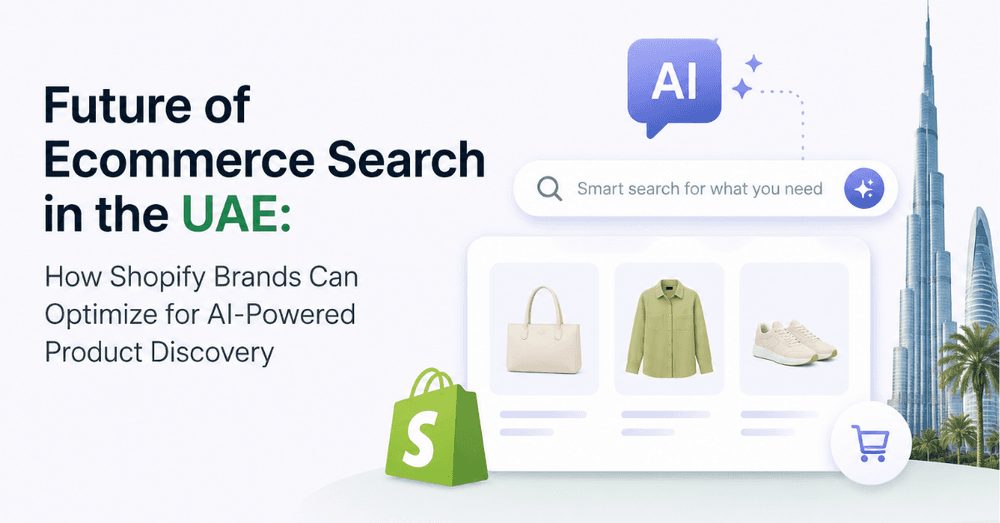
Future of Ecommerce Search in the UAE: How Shopify Brands Can Optimize for AI-Powered Product Discovery
Customers are transforming the way they are finding products on the web. Until now, ecommerce search was all about keywords, category pages, and classic SEO tactics. Search engines and ecommerce platforms would try to match the words in the search query with the products in their catalog if someone were to search for “running shoes.”
AI is transforming the online search, the evaluation, and the buying process of consumers. The way people conduct their searches is changing as buyers rely on conversational search, voice search, visual search, as well as AI assistants to find the products that suit their needs, rather than typing short keyword phrases.
This transition is significant in the UAE, with a high rate of digital adoption in the region. Consumers want a personalized experience, immediate suggestions and smooth shopping experience in every touchpoint.
When it comes to ecommerce search, it is no longer a battle of keywords for Shopify brands. It's more about giving AI systems insight into what a customer wants to do and providing highly relevant product suggestions at the right time. This shift is also changing how merchants approach Shopify web development services, with greater emphasis on AI-ready store architecture, intelligent search experiences, and personalized product discovery.
This article examines the reality of the changing nature of ecommerce search, why Shopify stores should rethink ecommerce search discovery architecture, and what real steps can be taken by brands to remain visible in the age of AI-driven interfaces.
What "AI-Powered Product Discovery" Actually Means
It helps to differentiate between two different things that are typically combined:
- On-site AI search: AI-powered search bar and recommendation logic within your own Shopify store - no longer keyword based, but rather natural language, vector and behavioural.
- Off-site AI discovery: This refers to the process of your products being recommended (or not) when your customers ask the AI assistant, shopping copilot, or AI Overview to make a recommendation.
Both are changing the buyer journey, and they need unique technical and content foundations. Even if a store performs well in traditional SEO, their product data, store structure, and on-site search are ill-suited for AI-driven discovery, they will not appear in AI search results.If a store's product data, store structure, and on-site search are not optimized for AI-driven discovery, they will not be found in the AI search results regardless of their performance in traditional SEO.
Why AI-Powered Product Discovery Is Becoming Essential
When customers aren't certain of what they're looking for, traditional ecommerce search can be problematic.
Let's pretend we have a customer looking for:
"What's the best ergonomic office chair for working from home?"
Or:
"Find a lightweight summer dress for a beach vacation in Dubai."
These searches are not product-name-based.
The AI-powered search engines are built to interpret context, preference, and motives of purchase. They do not just match keywords; they understand what customers are looking for and find their products that best fit their needs.
This is a much-improved shopping experience as customers have less time to search and more time to find relevant products.
Ecommerce brands may find that the advantages are:
- Higher conversion rates
- Improved customer satisfaction
- Improved average order values.Better average order values.
- Reduced search abandonment
- Better product visibility
Brands that invest in AI-driven discovery first will gain a clear edge in the marketplaces and search engines where it is becoming increasingly prevalent in ecommerce.
How Shoppers in the UAE Are Searching Differently
A few regional patterns are worth calling out specifically:
- Multilingual searches: Shoppers often search in English, Arabic or transliterated Arabic, at times in the same search, and sometimes in a mix of both. Search systems with a single language fail to capture a significant portion of intent.
- Conversational queries: Voice and conversational search queries are much longer and more natural than typed product searches, particularly when searching on mobile.
- Comparative shopping: UAE shoppers are adept at comparing specifications, prices, and reviews on different platforms before making a decision, requiring detailed and structured product data that facilitates AI systems to accurately extract and compare details.
- Major mobile commerce share: Most sessions will occur on mobile app, so search should deliver the relevant results promptly, with a minimum of typing and irrelevant filters to be scrolled through.
These are not unique to the UAE, but are more distinct in the UAE than in many markets, increasing the price of getting the search wrong.
The UAE Ecommerce Market Is Ready for AI Commerce
UAE is one of the most developed ecommerce markets in the Middle East. The high rate of smartphone penetration, the robust internet penetration rate and the increasing levels of digital payment, have led to a customer environment where everyone wants convenience and personalisation.
Shopper's today are already having interaction with AI-powered systems daily via:
- Recommendation engines on streaming platforms
- AI chat assistants
- Personalized advertising
- Voice-enabled search
- Smart shopping recommendations
This has become more common as time goes on, so consumers will naturally associate ecommerce brands to be just as smart and convenient.
For Shopify merchants, it's time to start thinking outside the box of traditional SEO and move toward AI-powered shopping experiences.
Personalization Is Becoming a Competitive Advantage
The same products should not be displayed to all customers. A new visitor to a Shopify eCommerce website will have different expectations.There are different expectations for a first time visitor of a Shopify store versus a loyal customer who has been shopping there many times.
This is where AI-powered personalization is changing ecommerce search. In contrast to traditional AI systems that generate uniform product recommendations for each consumer, modern systems can personalize their suggestions based on customer behaviour and preferences, as well as their shopping history.
Consider a fashion retailer in the UAE.
An avid customer who keeps buying luxury fashion items might have the opportunity to get the high end collections first and budget-conscious shoppers might get more affordable options.
Personalized product discovery can leverage signals such as:
- Browsing history
- Previous purchases
- Product interests
- Shopping frequency
- Location and demographics
This creates a more relevant and engaging shopping experience, which in turn boosts customer loyalty and improves conversion rates.
Smart Merchandising Is Replacing Manual Product Placement
Many ecommerce teams still spend hours manually organizing category pages and deciding which products deserve premium visibility.
While this approach can work for smaller catalogs, it becomes increasingly difficult as product inventories expand.
AI-driven merchandising provides a smarter alternative.
Instead of relying on static rules, AI continuously evaluates product performance and customer behavior to determine which products should appear first.
Modern merchandising systems can automatically consider factors such as:
- Inventory availability
- Product popularity
- Conversion rates
- Seasonal demand
- Customer engagement
- Profit margins
This allows brands to create dynamic shopping experiences that evolve in real time rather than requiring constant manual updates.
For Shopify merchants managing hundreds or thousands of products, AI merchandising can dramatically improve efficiency while helping customers discover the most relevant products.
Dynamic Pricing Will Influence Product Discovery
Pricing has always influenced buying decisions, but AI is making pricing strategies far more sophisticated.
Instead of applying fixed pricing across all situations, AI-driven pricing models can adapt to changing market conditions and customer demand.
For example, retailers can adjust pricing based on:
- Inventory levels
- Seasonal demand
- Competitive pricing
- Customer segments
- Product popularity
The goal isn't simply to lower prices. The objective is to find the optimal balance between profitability and conversion.
As AI-powered shopping experiences become more common, pricing intelligence will increasingly influence which products are recommended, promoted, and surfaced to customers.
Preparing for Conversational Commerce
Consumers are becoming increasingly comfortable interacting with AI assistants as shopping advisors. Perhaps the most significant trend shaping the future of ecommerce search is conversational AI.
Rather than browsing dozens of products, shoppers may simply ask:
"What is the best gaming laptop under AED 4,000?"
"Recommend premium skincare products for sensitive skin."
"Which smartwatch is best for fitness tracking?"
AI systems can analyze available options, compare features, and recommend products before customers ever visit a website.
This changes how brands must think about ecommerce visibility.
To prepare for AI-powered product discovery, Shopify merchants should focus on:
- Creating detailed product content
- Maintaining accurate product data
- Improving product attributes
- Building strong category structures
- Enhancing customer reviews and social proof
The brands that provide the clearest and most comprehensive product information will be best positioned to benefit from AI-driven recommendations.
Practical Ways Shopify Brands Can Adapt
A few concrete, non-promotional steps that apply regardless of store size:
- Audit your on-site search logs. Look at what shoppers are actually typing, including zero-result searches. This is one of the fastest ways to spot where keyword-based search is failing intent-based queries.
- Rewrite product descriptions for clarity, not just keywords. Descriptions that clearly state use case, materials, and who the product is for tend to perform better with AI systems than descriptions stuffed with repeated keywords.
- Implement a semantic or vector-based search if your current search is purely text-matching. Several Shopify apps and headless search providers now offer this without requiring a full platform rebuild.
- Personalize based on behavior, not just past purchases. AI-driven personalization can factor in browsing patterns, time on page, and session context — not just order history — to surface more relevant products to returning visitors.
- Keep pricing and inventory data current and accurate. AI assistants and comparison tools that pull live pricing or stock data will surface outdated or incorrect information if backend data isn't synced properly, which damages trust faster than a slow page load.
- Plan promotions and bundles with forecasting in mind. Brands that combine demand signals with their merchandising calendar tend to avoid the common trap of over-promoting items that are about to go out of stock, or under-stocking items that AI-driven discovery suddenly surfaces to a wider audience.
- Test your store through an AI assistant's eyes. Try asking ChatGPT, Gemini, or another assistant to find a product like yours. If your store doesn't appear, work backward from there — is it a content gap, a schema gap, or a structural one?
Final Thoughts
Intelligence, relevance and personalisation will be the key features of ecommerce search in the UAE.
Consumers are increasingly using AI-driven experiences to find products, rather than relying on traditional keyword searches. From conversational search and customised recommendations to smart product merchandising and predictive shopping journeys, artificial intelligence is transforming the landscape of the way products can be discovered and bought online.
The shift is a must for Shopify brands. By investing in AI-driven search, personalisation, dynamic pricing and inventory intelligence, businesses today will be more likely to be ready for higher customer expectations tomorrow.
In a hyper-competitive ecommerce landscape, brands prioritizing customer intent over mere keyword optimization will distinguish themselves as ecommerce evolves beyond traditional product discovery methods, leaning more on AI-driven insights.

Author
Azhar
Azhar, the Manager for Strategy & Consulting at Magneto IT Solutions UAE, is an expert in eCommerce strategy with extensive consulting experience. He is committed to empowering both B2C and B2B businesses in the UAE region. He has an impressive track record of providing strategic consulting to over 200 clients, with more than 80% of them experiencing remarkable revenue growth through their online channels. With his exceptional ability to identify opportunities and develop effective strategies, he continuously drives progress and helps businesses achieve their goals.