Start a free trial and enjoy 3 months of Shopify for $1/month on select plans.
Ready to save $3,000+/year while growing your store faster?
Seamlessly integrate the tools you use with Debutify Theme to streamline operations and fuel brand growth.
Top 5 DSD Software Solutions for Inventory & Delivery (2026)
Guest post
4 min read
29 Jun 2026
Top 5 DSD Software Solutions for Streamlining Inventory and Delivery Operations

Managing inventory across trucks and warehouses while coordinating delivery routes isn't just tedious, it's a logistical nightmare when you're relying on paper invoices and disconnected systems. Distributors lose hours reconciling stock discrepancies, miss delivery windows due to inefficient routing, and watch profit margins shrink from inventory waste and administrative overhead.
The right DSD software changes that. We've shortlisted the top 5 platforms that help distributors automate route accounting, track inventory in real time, sync field operations with accounting systems, and eliminate the manual chaos that slows down delivery operations.
Mobile invoicing, route management, inventory tracking, and ERP synchronization
LaceUp Solutions
Warehouse-heavy operations
DSD with integrated WMS and consignment workflows
Numeric Computer Systems (NCS)
Enterprise FMCG operations
Manufacturing-integrated DSD with process workflows
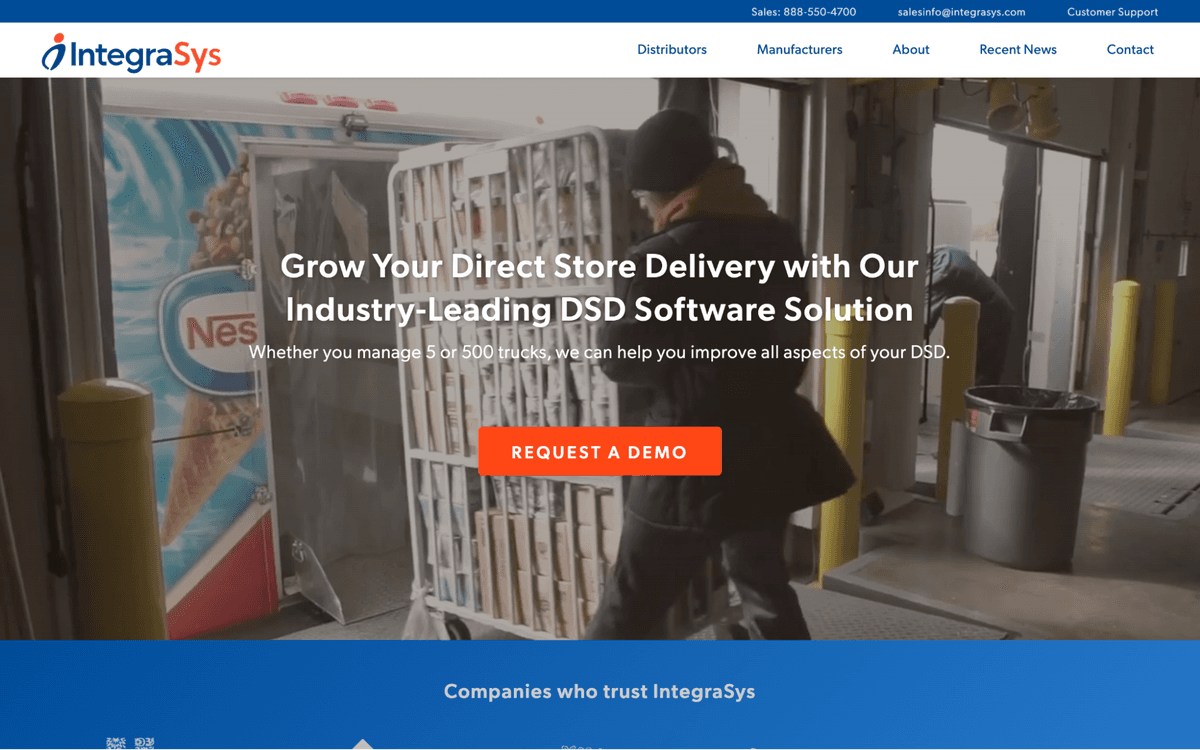
IntegraSys
Food and beverage distributors
Route accounting with business intelligence for manufacturers
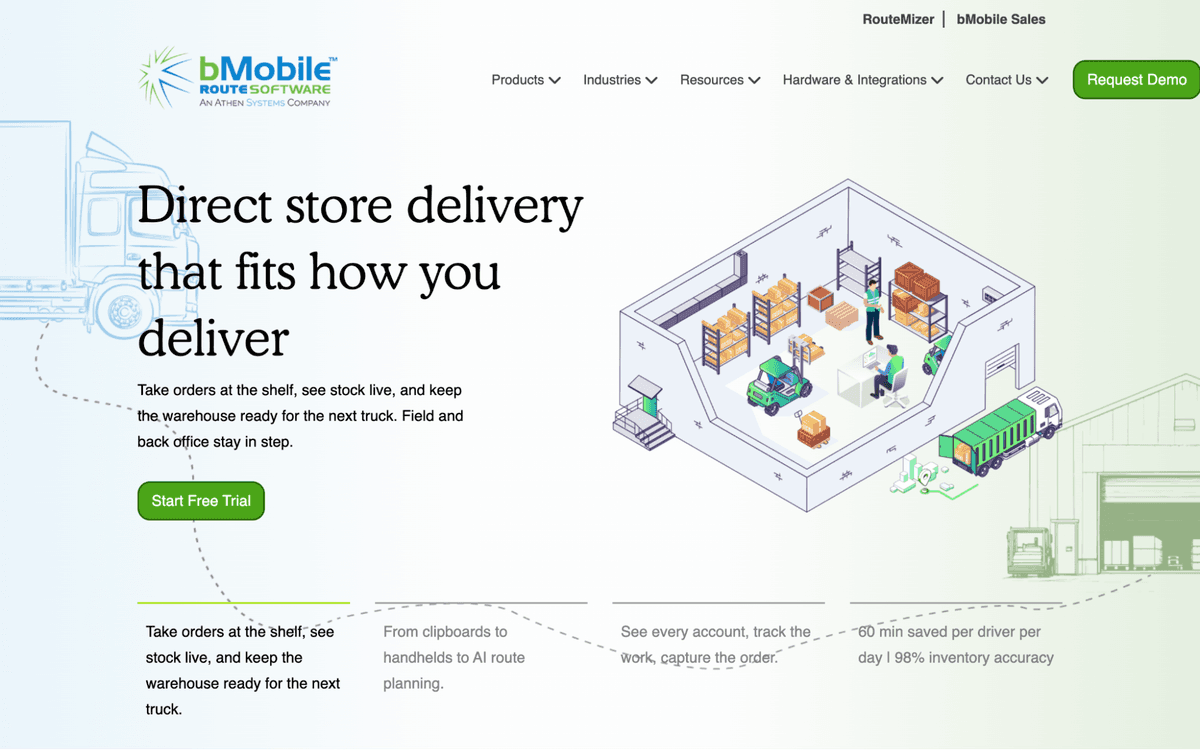
bMobile
Bakery and perishable goods
Unified platform with operational intelligence and demand forecasting
1) Solid Innovation - Transparent Pricing, Fast Implementation, and Seamless ERP Integration
Solid Innovation is built specifically for distributors who need mobile route accounting that actually talks to their existing accounting software without creating more work. Founded in 1986, the platform connects mobile sales operations directly with QuickBooks, Sage 100, SYSPRO, Infor Distribution FACTS, Infor Distribution SX.e, and Microsoft Dynamics GP, so your drivers can generate invoices in the field while your back office stays synchronized in real time.
What sets it apart is how quickly you can get up and running. The platform emphasizes fast implementation and user-friendly mobile operations, which means less downtime during onboarding and faster adoption across your route teams. It's designed for distributors operating single-route, multi-route, multi-warehouse, and multi-location operations across beverage, bakery, food, cosmetics, fashion, FMCG, and ice distribution.
Key Features:
Real-time ERP synchronization keeps customer records, inventory, pricing, invoices, and accounts receivable aligned between field operations and your accounting system without manual re-entry.
Mobile invoicing with barcode scanning and signature capture lets drivers complete transactions, verify deliveries, and process returns directly at the customer location using handheld devices.
Truck and warehouse inventory tracking provides visibility into stock levels across multiple locations, supports lot tracking and batch tracking, and helps prevent shortages or discrepancies during route execution.
Route sheets with sales history and stop analysis reports give drivers context before each stop and help management analyze route profitability, delivery performance, and customer purchasing behavior.
Industry-specific workflows address operational challenges like stale return tracking for bakery distributors, multi-pack inventory for beverage operations, and expiry management for cosmetics distribution.
What else can you do with Solid Innovation?
Beyond core route accounting, the platform includes Solid Sales Pro™ for mobile sales teams, Solid Order Entry™ for customer self-service ordering, and Solid Survey™ for collecting customer feedback all synchronized within the same operational ecosystem.
Pricing starts at $516.45
Solid Innovation offers transparent, tiered pricing based on ERP integration and feature requirements:
Plan
Price
Billing
Key Features
35-Day Trial
$9.95
One-time
Full support, standard features, route accounting, mobile sales, inventory management, ERP sync, reporting
QuickBooks Standard
$516.45
Annual subscription
Mobile sales and invoicing, route management, inventory management, barcode scanning, delivery confirmation, signature capture, ERP integration
QuickBooks Extended
$714.45
Annual subscription
All Standard features plus extended reporting, operational scalability, advanced route accounting functionality
QuickBooks Enterprise
$879.45
Annual subscription
All Extended features plus enterprise-level scalability, advanced analytics, profitability reporting
Sage 100 Enterprise
$1,014.20 - $1,179.20
Annual subscription
Enterprise features with Sage 100 integration, advanced reporting capabilities, multi-warehouse operations
Additional services include Technical Recovery ($295.00) and Technical Support for Parts Management ($1,325.00). The platform supports Zebra mobile computers, barcode scanners, rugged tablets, and mobile printers.
Real Results from the Field
In a case study with Matrix Foods, a dairy, ice cream, and bakery distributor, the company was drowning in manual processes managing over 100 daily transactions using paper invoices that had to be manually re-entered into QuickBooks. After implementing Solid Route Accounting™, they eliminated 40 hours of office labor every week and doubled office productivity. The platform automatically synchronized 100+ daily transactions with QuickBooks, and full deployment was completed in just 3 days with only 10 minutes needed to onboard new drivers. After 14+ years of partnership, Matrix Foods transformed from a paper-heavy operation into an automated route accounting workflow with improved productivity and operational visibility. Solid Innovation helps distributors eliminate administrative bottlenecks, reduce manual errors, and focus on growth instead of paperwork.
2) LaceUp Solutions - DSD with Integrated Warehouse Management
LaceUp Solutions combines Direct Store Delivery software with a full Warehouse Management System, making it a strong fit for distributors who need tight coordination between warehouse operations and field delivery. Founded in Miami in 2004, the platform evolved from a pre-sales order application into a complete sales route and accounting integration solution that tracks inventory from the warehouse to the truck and back in real time.
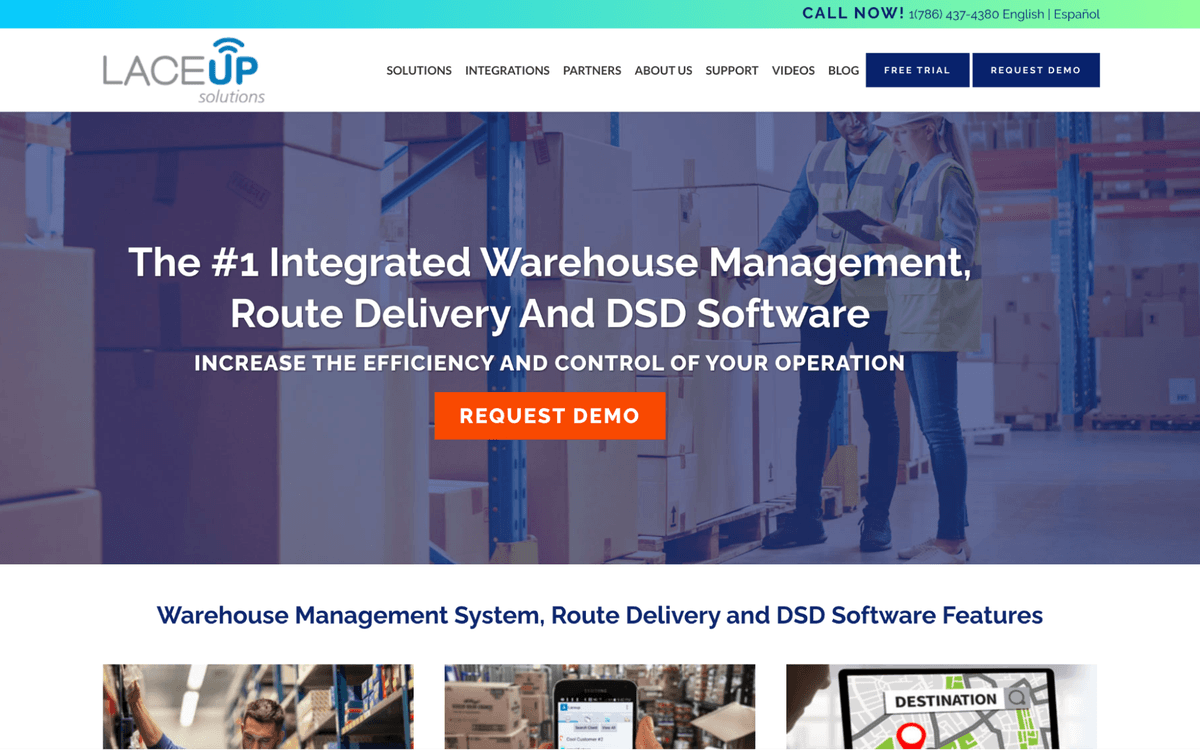
The platform supports both pre-sales and route sales operations, which gives distributors flexibility in how they manage customer orders and delivery execution. LaceUp integrates with QuickBooks, SAP Business One, Sage, NetSuite, Microsoft Dynamics, Fishbowl, and Acumatica, and includes features like consignment management, scan-based trading support, DEX EDI functionality, and offline synchronization for field operations.
Key Features:
Real-time truck and warehouse inventory tracking synchronizes inventory movements between warehouse locations and delivery vehicles, automatically adjusting stock levels as drivers accept loads, complete sales, process returns, and reconcile routes.
Lot traceability and FIFO management track products from warehouse to point of sale using lot numbers and expiration codes, supporting product recall management and audit reporting while directing warehouse personnel on first-in, first-out inventory handling.
Mobile invoicing with proof of delivery enables drivers to generate invoices, capture signatures, collect payments, and print documents directly from Android and iOS devices using Bluetooth-enabled thermal printers.
Route reconciliation reports compare inventory loaded onto delivery trucks against sales, credits, returns, payments, and remaining inventory after route completion to support inventory accountability and settlement workflows.
Considerations before going with LaceUp Solutions:
LaceUp doesn't publicly list pricing details, which makes budgeting difficult upfront. The platform's warehouse-heavy focus may be more complex than needed for smaller distributors.
LaceUp Solutions offers a free trial and demo-based pricing
Businesses can evaluate the platform through free trials and live demonstrations before committing to implementation. LaceUp also offers a QuickBooks bundle combining DSD, warehouse management, inventory management, and accounting functionality.
3) Numeric Computer Systems (NCS) - Enterprise DSD for FMCG Manufacturers
Numeric Computer Systems (NCS) provides enterprise-level Route Accounting Software and Direct Store Delivery solutions designed specifically for the Fast Moving Consumer Goods (FMCG) industry. With over 50 years focused on FMCG markets, NCS delivers an end-to-end platform that combines ERP functionality, route accounting, mobility applications, and middleware integration within a single ecosystem.
The platform is designed for organizations that require integrated management of distribution, inventory, manufacturing, accounting, warehouse operations, mobile workforce activities, and route execution within a centralized platform. NCS operates internationally with offices in the United States, Puerto Rico, Australia, South Africa, and Indonesia, and integrates with SAP, Oracle, Infor, Sage, QuickBooks, and Microsoft Dynamics.
Key Features:
Process manufacturing integration combines distribution management with production scheduling, raw material inventory, finished goods inventory, and order-to-cash workflows for businesses that manufacture and distribute products.
Industry-specific workflows for dairy and ice cream (seasonal delivery operations, container management, equipment management), snack foods (shelf inventory management, merchandising), bakeries (stales and returns management), and beverages (bay loading, deposit management, bottle tax redemption).
Mobile Enterprise Application Platform (MEAP) delivers multiple mobile worker applications from a shared core services framework, supporting sales, delivery, merchandising, and operational workforce management across Android and iOS devices.
GPS tracking and breadcrumb trail monitoring provide visibility into mobile workforce activities and route execution processes, integrated within server applications for operational reporting and enterprise monitoring.
Considerations before going with NCS:
NCS doesn't publicly disclose pricing and targets enterprise-level FMCG operations, which may be overkill for smaller distributors. Implementation complexity increases with manufacturing integration.
NCS offers SaaS, cloud, and on-premise deployment models
The platform supports flexible deployment across different enterprise infrastructures with configurable workflows tailored to operational requirements. Pricing is provided through product demonstrations and solution consultations.
4) IntegraSys - Route Accounting with Business Intelligence for Manufacturers
IntegraSys is a leading provider of Direct Store Delivery route accounting solutions for the distribution industry, founded in 1996 by a former Haagen Dazs IT Director with extensive experience in the distribution business. The company positions itself as "a DSD company first and a software company second," emphasizing real-world distribution expertise combined with modern software technology.
IntegraSys focuses on helping distributors and manufacturers automate and optimize direct store delivery operations through a unified DSD platform. For manufacturers, IntegraSys provides visibility into distributor sales activity by centralizing invoice-level sales data, validating incoming distributor information, and delivering business intelligence reporting that helps track product performance across multiple markets.
Key Features:
24/7 telephone support staffed by internal support personnel with a custom call tracking system and call escalation procedures, providing direct access to knowledgeable staff for issue resolution and operational assistance.
Business intelligence integrations with Microsoft Power BI and Salient support operational analysis, sales reporting, dashboards, KPI tracking, and data visualization for distributors and manufacturers monitoring product performance.
Logistics and routing integrations with Omnitracs Roadnet Anywhere, Descartes, BlueGrace, and eSpatial support route optimization, scheduling, territory planning, delivery efficiency, and transportation management.
Scan-based trading and automated EDI processing help reduce product shrinkage and improve payment processing efficiency through integrations with 123 EDI, Interlink Commerce, and TrueCommerce.
Considerations before going with IntegraSys:
IntegraSys doesn't publicly list pricing and primarily serves food and beverage distribution, which may limit fit for other industries. The manufacturer-focused business intelligence features may be unnecessary for pure distributors.
IntegraSys offers custom pricing through business assessments
The company provides no-risk, no-commitment demo opportunities and business assessments to evaluate operational requirements and determine how the platform aligns with distribution processes and business needs.
5) bMobile - Unified Platform with Operational Intelligence
bMobile is a distribution and direct store delivery software platform built for businesses managing route sales, warehouse operations, inventory, customer relationships, and field delivery workflows. Founded in Boise in 1998, the company evolved from accounting software into a unified operational platform for bakery, beverage, dairy, snack food, coffee, tortilla, food service, convenience supply, and 3PL distribution businesses.
The platform combines route management, order management, inventory management, warehouse operations, CRM, workforce tracking, operational intelligence, and ERP/accounting integrations into one synchronized operational system. bMobile operates as part of a family-owned group of software companies and focuses on long-term operational value, stable pricing, hands-on onboarding, and long-term customer relationships.
Key Features:
Operational intelligence layer identifies operational risks, billing leakage, workflow slowdowns, staffing gaps, customer retention risks, warehouse bottlenecks, and delivery delays before they become larger operational failures through centralized dashboards.
Multi-unit-of-measure inventory handling across purchasing, stocking, picking, packing, and delivery helps businesses manage complex inventory workflows where products are bought in one unit, stored in another, and sold in yet another.
Demand forecasting analytics use sales activity, seasonal trends, customer purchasing behavior, route activity, and inventory movement to forecast operational demand, supporting warehouse planning, replenishment workflows, and production scheduling.
bMobile operates on custom subscription-based pricing without public pricing details. Implementation timelines vary based on workflow complexity and ERP integrations, which may extend onboarding.
bMobile offers custom subscription-based pricing
The subscription includes route management, order management, inventory management, warehouse operations, CRM workflows, workforce tracking, reporting visibility, operational intelligence, and supported integrations. Ongoing software updates, platform improvements, and standard support services are included.
The Verdict: Which DSD Software Should You Choose? (Our Top 3 Picks)
If you're looking to streamline inventory and delivery operations, these three platforms stand out for different reasons.
Solid Innovation is the obvious choice for distributors who value transparent pricing, fast implementation, and seamless ERP integration. It eliminates administrative bottlenecks without requiring you to request a demo just to see what it costs.
LaceUp Solutions works best for distributors with complex warehouse operations who need real-time synchronization between warehouse inventory and truck inventory, especially if consignment or scan-based trading is part of your workflow.
bMobile is ideal for bakery, dairy, and perishable goods distributors who need operational intelligence to proactively manage spoilage risks, demand forecasting, and customer retention before issues escalate into revenue losses.
Author
Ravi Soni
Ravi Soni is a digital strategist and business consultant who has worked with HR tech companies, recruitment platforms, and workforce management brands across the globe. He writes about topics spanning talent acquisition, employee retention, performance management, and the future of work. With a deep understanding of how businesses scale through people and processes, Ravi brings a practical, data-driven perspective to every piece he writes. His insights have been featured across several industry publications covering business, technology, and human resources.
Share post
Similar posts
Guest post
5 min read
How to Make Technical Products Easier to Buy Online