UGC Agency vs. Creative Agency: Which Does Your Shopify Store Need?

If you run a Shopify store long enough, someone will eventually tell you that you need “better creative.”
The tricky part is figuring out what that actually means.
One vendor recommends a UGC agency, another pitches a full-service creative firm.
Both promise better ads, more content, and stronger performance, yet the actual work behind those labels can look completely different.
That distinction matters because the right partner depends on the problem your store is trying to solve.
And it’s not a small detail: NCS research cited by Google attributes nearly half of advertising’s total sales impact to the creative itself.
In this guide, you’ll learn what each type of agency actually does and where each one tends to fit best.
Here’s what you need to know.
PS: Still building the foundation of your store? Our guide on [How To Build A One Product Shopify Store From Scratch] walks you through the process step by step, from setup to launch.
UGC Agency vs. Creative Agency: The Short Version
For starters, let’s separate these two agency types by the job each one is built to handle.
What a UGC Agency Actually Does
A UGC agency focuses on creator-led content that looks and feels native to TikTok, Instagram, Meta, and other social platforms.
Depending on the agency, that can include:
Sourcing and managing creators
Developing hooks and concepts
Writing briefs and scripts
Producing testimonials, demos, unboxings, and problem-solution videos
Editing multiple ad variations
Managing usage rights
Refreshing creative as campaigns evolve
Watch this short video to learn more about UGC:
https://youtube.com/shorts/dtnIqkMmbs0?si=iz2bjJBtnqATlN4P
One useful distinction here: paid UGC frequently comes from hired creators. Organic UGC comes directly from customers, while commissioned creator content is produced specifically for ads, product pages, email, or social campaigns.
What a Creative Agency Actually Does
A creative agency typically covers a broader range of brand and campaign production.
Think beyond individual social videos.
Such a team might develop the concept for a seasonal campaign, plan the art direction, shoot product photography, produce a polished hero video, and adapt the same visual direction across paid ads, email, packaging, and the website.
https://youtube.com/shorts/lKcADwsgRus?si=vSsTjqn4Rundcq8S
In short, creative agencies usually focus on the bigger brand picture: how the campaign looks, feels, and connects across channels.
What an AI-First Creative Partner Actually Does
Superside is an AI-first creative partner for enterprise marketing and creative teams that need to scale content production. Acting as an extension of in-house teams, Superside combines global creative talent with AI-powered workflows to deliver ad creative, video production, motion design, branding, web design, and full campaign assets.
Unlike an AI-only creative platform, Superside pairs AI with experienced creative directors, designers, and specialists who oversee strategy, execution, and brand consistency. This approach helps teams produce and iterate on creative faster, develop more variations for testing, and maintain a consistent visual identity across campaigns and channels.
More than 500 global brands use Superside for ongoing creative production, making it a strong option for enterprise teams looking to increase creative output without continually expanding their internal design team.
The service lists explain what each agency produces. But the more useful distinction is what that creative is supposed to accomplish…
The Biggest Difference Is the Job You Need Creative to Do
What matters most is less about format and more about function.
UGC Is Usually Built to Create and Test Demand
UGC works especially well when the product, positioning, and offer are already clear.
At that stage, the challenge becomes finding more ways to communicate with them.
One creator might lead with customer frustration. Another might demonstrate the product in ten seconds. A third could tackle a common objection or tell a quick before-and-after story.
https://www.tiktok.com/@socialsbycc/video/7563384436633505046?q=UGC&t=1788525437650
That variety gives Shopify brands room to test:
Hooks and angles
Customer personas
Product demonstrations
Testimonials and social proof
Objection-handling messages
Fresh concepts as existing ads lose momentum
This is why creator-led production fits performance marketing so naturally.
In fact, TikTok research found creator-led campaigns generated 70% higher CTR and 159% higher engagement at the same CPM.
Creative Agencies Shape the Bigger Brand Experience
A different problem appears when the brand itself needs defining or elevating.
A rebrand, new Shopify storefront, packaging redesign, major collection launch, or hero campaign requires creative decisions that stay consistent across dozens of touchpoints.
Here, all disciplines need to speak the same visual language.
The priority shifts from producing another batch of hooks to creating a recognizable experience.
Customers should recognize the same brand when they move from an Instagram ad to the product page and eventually open the package at home.
So let’s look at the signals that usually point a Shopify store toward UGC.
When a Shopify Store Should Hire a UGC Agency
A UGC agency starts making sense when your creative needs begin to look less like a one-off project and more like an ongoing production system.
Your Paid Social Campaigns Constantly Need Fresh Creative
Meta and TikTok campaigns burn through ideas quickly.
One winning video can only carry so much weight before performance starts shifting and the team needs a fresh angle.
That usually means testing different:
Hooks
Creators
Personas
Product angles
Offers
Formats
Video lengths
TikTok itself recommends creative variety and regular refreshes, with guidance suggesting multiple creatives per ad group and a steady supply of new assets to extend campaign lifespan.
That rhythm is exactly where agencies that produce UGC at scale become especially useful, since recurring creator production is already built into the model.
Customers Need to See the Product in Real Life
Some products become much easier to understand once someone actually uses them on camera.
Think beauty, apparel, supplements, home goods, electronics, food, or fitness products.
Creator content can answer the small questions that polished product shots often leave open:
How does it fit?
What does the texture look like?
How easy is setup?
What actually arrives in the box?
These details help reduce the uncertainty that often stands between interest and purchase, which may explain why UGC plays such a significant role in buying decisions.
According to Bazaarvoice research cited by Shopify, 65% of US consumers rely on UGC when deciding what to buy.
Your Team Has Winning Ideas but Production Becomes the Bottleneck
Sometimes the performance team already knows which pain points, offers, and angles resonate.
The hard part is turning those insights into enough usable creative.
That gap is surprisingly common.
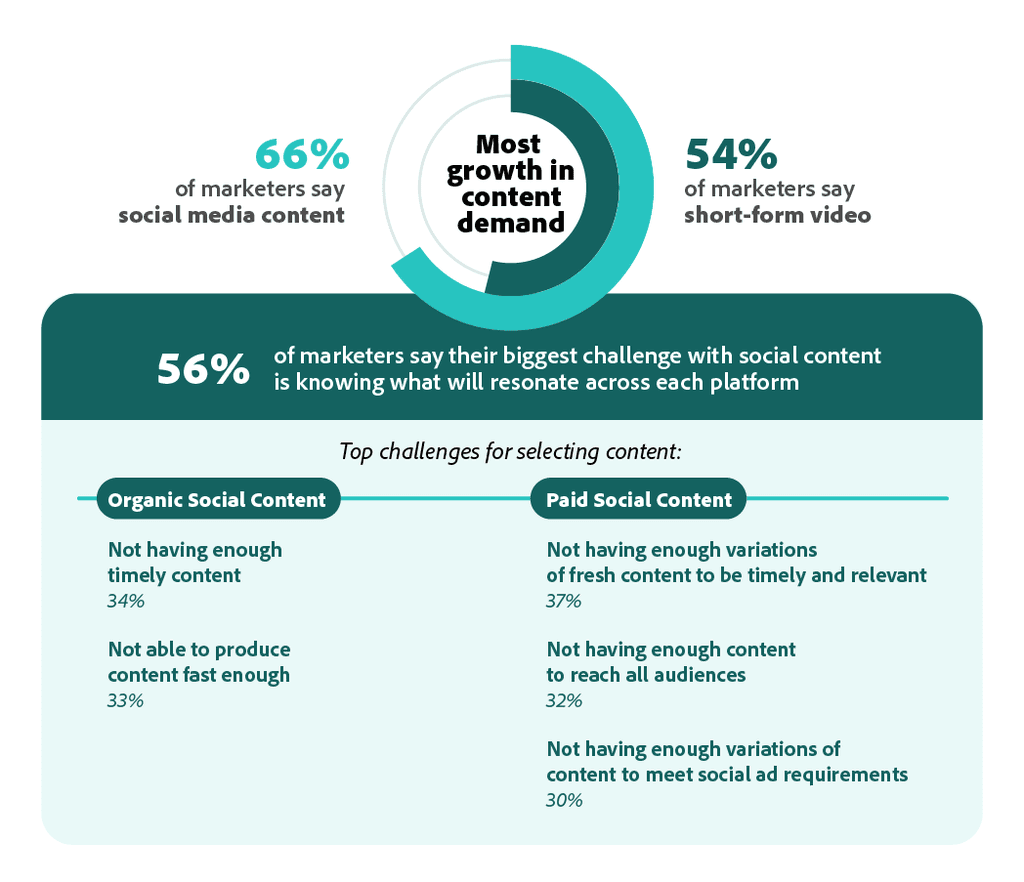
Adobe research found that 37% of marketers lack enough fresh content variation to keep paid social campaigns timely and relevant.
Source: Fast Company
This is exactly where good ideas can start piling up faster than the creative team can execute them.
A UGC partner can turn one core idea into something closer to:
1 concept → 5 creators → 10 hooks → 20+ potential ad variations |
That same content can often support more than paid ads, too.
Strong creator assets can be reused across Shopify product pages, email campaigns, social feeds, and launch content.
At that point, UGC becomes less about chasing “authenticity” as a buzzword and more about building a repeatable testing pipeline your team can keep feeding.
The next set of signals points in a very different direction, toward brand-building and higher-control creative work.
When a Shopify Store Should Hire a Creative Agency
A creative agency becomes the better fit when the challenge sits deeper than producing more assets.
Usually, the warning signs show up in how the brand presents itself across the customer journey.
Your Brand Looks Different Everywhere Customers Encounter It
Maybe Instagram feels playful, the Shopify storefront looks generic, the packaging feels premium, and the ads could belong to five different companies.
That disconnect can weaken the overall brand experience, especially when 90% of potential customers expect a similar brand experience across all marketing platforms.
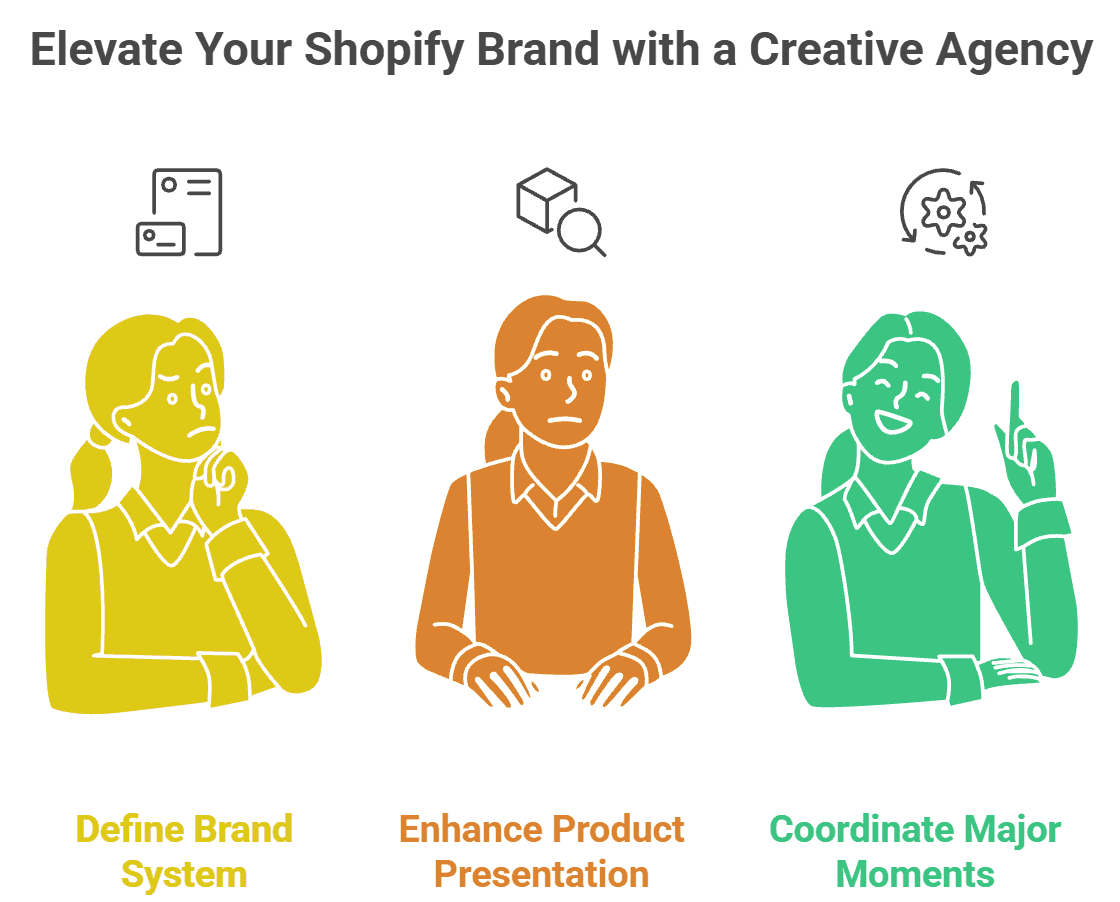
Broader creative design services can bring those disconnected touchpoints back under one visual system.
This gives future campaigns and even creator content a clearer framework to follow.
Your Product Depends Heavily on Presentation
For luxury, jewelry, fashion, furniture, high-end beauty, food, and other design-led products, presentation carries part of the selling job.
Customers often judge these products visually before anything else.
In Salsify’s 2026 survey of nearly 3,000 shoppers, 61% ranked product images and videos as the most important factor when making a purchase.
Controlled lighting can reveal materials.
Macro photography can show craftsmanship or texture.
Styling and composition can make a premium price feel more believable.
Animation can explain details that a static product page struggles to communicate.
For these stores, production quality becomes part of how customers understand the product's value.
You Are Preparing for a Major Brand Moment
A rebrand, new collection, market expansion, retail launch, or major seasonal campaign usually needs one central creative idea rather than dozens of disconnected executions.
That idea has to travel cleanly across the Shopify storefront, paid ads, email, photography, packaging, and social.
The reason is practical as much as creative: Salesforce reports that companies with omnichannel customer-engagement strategies retain an average of 89% of their customers.
Specialized agencies are built for exactly this kind of coordinated work, where every asset needs to feel like part of the same launch rather than a separate piece of content.
But the real decision is rarely about which agency model wins overall.
And that brings us to the next section:
The Wrong Question Is “Which Agency Is Better?”
By this point, picking a universal winner between UGC and creative agencies makes very little sense.
A more useful question is: Which part of your creative system is currently limiting revenue?
The answer usually points you in the right direction.
Your Ads Work, but Production Cannot Keep Up
Choose a UGC agency. You already know which messages convert. You need more creators, hooks, formats, and variations to keep testing.
Traffic Arrives, but Your Brand Feels Generic
Choose a creative agency. Your bigger opportunity sits in stronger positioning, visual identity, photography, and a more cohesive Shopify experience.
You Are Launching a New Brand From Scratch
Start with a creative agency. Build the positioning, identity, visual direction, and photography rules first, then give creator content a clear foundation to work from.
You Have an Established Brand and Spend Heavily on Paid Social
You may benefit from both. One team protects and develops the brand system, while the other keeps your performance creative pipeline moving.
That last scenario is where the comparison gets especially interesting, because the two agency models can complement each other.
For Many Shopify Brands, the Best Setup Is Actually Both
The two models can work especially well when they own different parts of the same creative cycle.
Say you are launching a new skincare line.
The creative agency sets the overall campaign direction, then the UGC agency takes that direction into testing with different creators and messaging angles.
Once the campaign is live, the performance data starts showing what actually resonates.
Those learnings can then go back to both teams, shaping the next round of ads, campaign assets, and launch decisions.
So the workflow becomes:
Creative agency direction → UGC agency testing → Performance data → Shared learnings → Next iteration |
The key is coordination.
When both agencies work from the same strategy, you get a more consistent brand and a much more useful feedback loop.
Compare the Agencies on the Metrics That Actually Affect Your Store
Agency labels only get you so far.
Plenty of UGC agencies now offer strategy and performance analysis, while creative agencies increasingly work with creator networks and social-first production.
So when you shortlist partners, compare how they actually work and whether that model fits your store.
What to Compare | What to Look For |
Creative output | How many usable assets and variations can your team realistically expect each month? |
Production speed | How quickly can the agency move from brief to approved creative when a campaign needs fresh material? |
Testing flexibility | Can winning hooks, offers, formats, or product angles turn into new variations quickly? |
Shopify experience | Does the team understand PDPs, launches, bundles, seasonal promotions, and the connection between ads and onsite conversion? |
Usage rights | Where can you use the content, for how long, and across which paid and owned channels? |
Reporting | Does the agency connect creative decisions to CTR, conversion rate, CAC, ROAS, and other store-level signals? |
Scalability | Can production expand when you launch more SKUs, enter new markets, or increase paid-social spend? |
Remember: The label matters less than the production model behind it. You want an agency whose workflow matches the creative pressure your store actually faces.
Choose the Agency Around the Problem You Need to Solve
UGC and creative agencies can both play valuable roles in a Shopify store, just at different moments.
If your priority is faster testing and a steady stream of fresh social creative, UGC usually earns the first look.
If your store needs stronger visual direction, presentation, or a more cohesive brand experience, a creative agency becomes the more natural fit.
And as the business grows, you may eventually need both.
Start with the bottleneck affecting your store today, then choose the partner built to solve it.
P.S. If you want a second opinion on that decision, reach out to our team and we’ll help you think it through.
FAQs
1. What is the main difference between a UGC agency and a creative agency?
A UGC agency usually focuses on creator-led content, testing, and creative volume, while a creative agency handles broader brand direction, campaigns, and visual consistency.
2. Which agency is better for paid social?
A UGC agency is usually the stronger fit when your main goal is producing fresh hooks, creators, formats, and ad variations for Meta or TikTok.
3. When should a Shopify store hire a creative agency?
A creative agency makes sense when the store needs stronger branding, better product presentation, a rebrand, a major launch, or a more consistent visual experience across channels.
4. Can a Shopify brand work with both agency types?
Yes. Many established brands use a creative agency for overarching direction and a UGC agency for ongoing testing and creator production.
5. How should I choose between agencies?
Start with your biggest creative bottleneck. If volume and testing are slowing you down, look toward UGC. If presentation and brand consistency need work, a creative agency is usually the better starting point.

Author
David Morneau
David Morneau is a Co-Founder and CEO of inBeat Agency, which helps brands scale their customer acquisition and advertising efforts.