What Is SEM? (Search Engine Marketing & Scanning Electron Microscopy Explained)
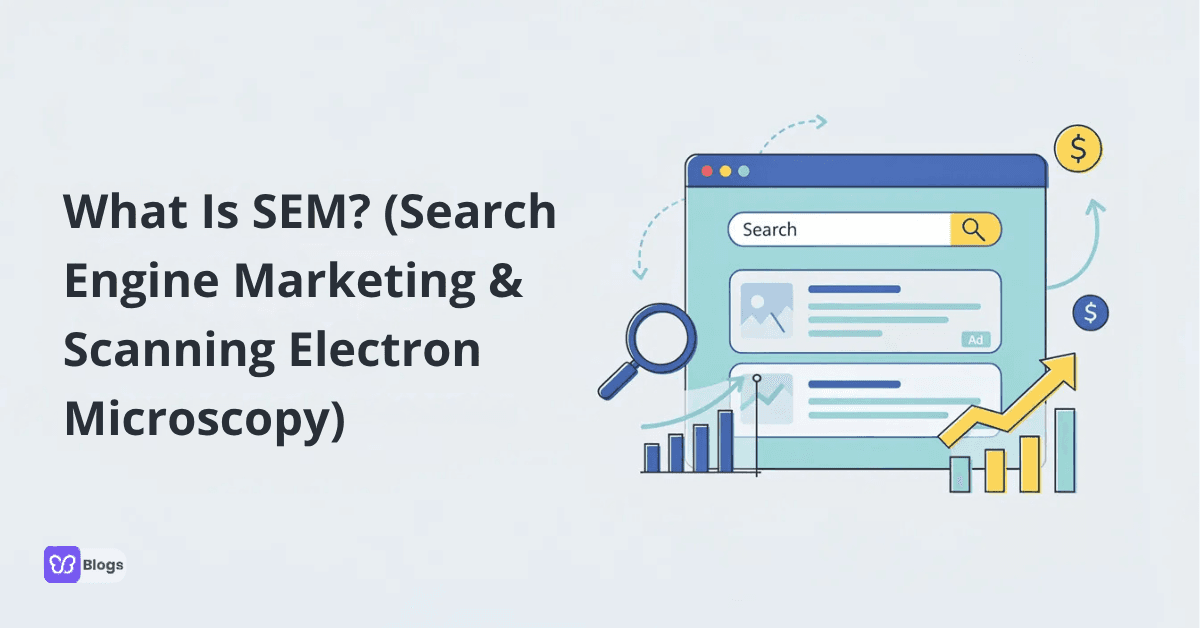
SEM is an acronym with two widely recognized meanings: Search Engine Marketing and Scanning Electron Microscopy. This article is designed for two main audiences: marketers seeking to understand and leverage paid search strategies, and scientists or engineers interested in advanced imaging techniques. Understanding both definitions is important because SEM plays a pivotal role in both digital marketing—by driving targeted traffic and sales—and in scientific research and industry—by enabling high-resolution imaging and material analysis. Whether you are aiming to boost your business’s online presence or analyze materials at the nanoscale, this guide will help you grasp the essentials and applications of SEM in both contexts.
What is SEM? (Answer the core question fast)
What is SEM? Search engine marketing (SEM) is a digital marketing strategy focused on increasing visibility in search engine results pages through paid ads on search engines. If you've searched "whats sem" or "search engine sem," the short answer is: SEM refers to paid ads on search engines that appear above or alongside organic results.
SEM also has a second meaning. In science, SEM stands for scanning electron microscopy, a branch of electron microscopy used to image surfaces with a focused beam of electrons. This technique powers failure analysis, material characterization, and semiconductor inspection worldwide.
This article covers both definitions:
How search engine marketing works, including campaign setup, keyword research, and ad copy
How SEM and SEO differ and complement each other
How a scanning electron microscope generates high resolution images of surfaces
How energy dispersive spectroscopy adds elemental analysis to SEM imaging
SEM in Digital Marketing: Definition & Basics
Search engine marketing SEM is a digital marketing strategy focused on increasing visibility in search engine results pages through paid search advertising. Advertisers bid on specific keywords, create ads, and pay each time a user clicks. Google Ads handles around 90% of global search traffic, making it the dominant platform for paid search marketing.
SEM: Modern Definition
Modern usage of SEM refers only to paid search. The term originally included search engine optimization, but by the mid-2000s the industry split them. Today, search marketing is the umbrella; SEM covers the paid side, SEO the organic side.
SEM campaigns send users to landing pages designed to convert clicks into leads or sales. The pay per click model means you pay only for ad clicks, not impressions. This makes SEM a measurable, budget-controllable channel.
Paid search has roots in the mid-1990s. OpenText offered paid listings in 1996. GoTo.com (later Overture) formalized the PPC auction in 1998. Google launched AdWords in 2000, which became Google Ads and the backbone of a multi-billion-dollar marketing strategy.
Why businesses use SEM today:
SEM can drive targeted traffic to your website within hours of launching a campaign
It reaches a target audience actively searching for products or services
Granular targeting by location, device, demographics, and time of day reduces wasted spend
Every click, impression, and conversion is trackable
SEM and SEO: What's the Difference and How They Work Together?
SEM and SEO both aim to capture people who search on Google and Bing, but they work through different mechanisms. Search engine optimization earns organic traffic by improving content, fixing broken links, building backlinks through link building, and aligning pages with search queries. There is no direct ad spend; the cost is in time, tools, and content production.
SEM delivers results in hours to days. SEO results can take months to years to achieve. SEM requires ongoing monthly spending for ads. SEO involves upfront investment in content and optimization, but organic traffic can continue long after content is published.
Here is how they compare:
Dimension | SEM (Paid Search) | SEO (Organic Search) |
|---|---|---|
Speed | Results in hours to days | Months to years for top rankings |
Cost | Pay per click; ongoing ad budget | Content, technical work, link building |
Control | Complete control over ad timing and placement | Depends on algorithms and site authority |
Longevity | Stops when budget runs out | Traffic compounds over time |
A strong marketing strategy combines both. SEM validates which target keywords convert; those insights feed SEO content planning. SEO builds a website's visibility for high search volume terms over time, lowering dependence on paid ads.
One trend worth noting: 88% of queries triggering Google's AI Overviews are informational. That means paid ads on commercial and transactional queries remain a reliable way to reach buyers, while SEO increasingly competes with AI-generated summaries for informational terms.
How Search Engine Marketing Works (From Query to Click)
SEM Auction Process
When someone types a search query like "contractor for kitchen remodel" into Google, an ad auction runs in milliseconds. Every advertiser bidding on the same keywords enters the auction. Google evaluates each bid amount combined with a Quality Score based on ad relevance, expected click-through rate, and landing page quality.
You only pay for SEM ads when users click them. The cost per click varies based on industry and competition. CPC for "contractor for kitchen remodel" is about $12. CPC for "sacramento motorcycle injury lawyer" is almost $140. Higher competition keywords lead to increased SEM costs.
SEM targets high-intent audiences actively searching for products or services. Someone typing "buy running shoes online" is closer to a purchase than someone browsing Instagram. That intent gap is why paid search advertising converts at rates other ad channels struggle to match.
SEM Campaign Flow
The flow works like this:
User enters a search query on a search engine
Matching advertisers enter an auction based on relevant keywords and bids
The platform ranks paid ads by bid + Quality Score
User sees ads on the search results page
Click sends user to a landing page optimized for conversion
Conversion (lead, sale, call) is tracked and attributed
Core Components of an SEM Campaign
Before launching a PPC campaign, you need several pieces in place. Here is a checklist:
Keyword Research
Keyword research is essential for identifying terms potential customers search for in SEM. Google's Keyword Planner is a free keyword research tool that shows search volume and competition data. Semrush's Keyword Magic Tool offers advanced keyword filtering options for finding long-tail phrases with lower CPCs. Target 3 to 10 relevant keywords for your first ad groups. Focus on commercial and transactional keywords for better conversions. Identify negative keywords to exclude irrelevant search terms and protect your ad budget from wasted clicks.
Ad Copy
Your ad copy should include the same keywords you bid on. Ads with quality copy get more clicks than poorly written ads. Ad copy and ad extensions are crucial for engaging users in SEM; extensions add sitelinks, callouts, and structured snippets that increase click-through rates at the ad group level.
Landing Pages
Landing page optimization is vital for maximizing conversion rates in SEM. Each page should have a single focus, a headline matching the ad promise, minimal navigation distractions, and a clear call to action.
Budget and Bidding
SEM allows for granular control over budgeting and ad spending. Start with a conservative daily budget for your first SEM campaign. Monitor cost per acquisition and adjust bids as you collect conversion data. You can set bids manually or use automated strategies like target CPA once you have enough conversion history.
Measurement
Measurable results in SEM include metrics like clicks, conversion rates, and cost per acquisition. Use these to pause underperforming keywords and scale what works.
Benefits of SEM for Businesses
SEM gives new websites page-one visibility before they earn any organic rankings. A product launch or seasonal promotion can start generating high quality traffic within hours, not months.
SEM allows targeting based on location and user interests. You can show ads only to users in a specific city, on mobile devices, during business hours, or to people who visited your site before (remarketing). This precision keeps your ad budget focused on the right audience.
Tangible outcomes SEM drives:
Lead generation through form fills and phone calls
Ecommerce sales tracked to specific keywords
Local store visits driven by location-targeted ads
App installs measured by platform attribution
Because paid search reaches people actively searching for a product or service, conversion rates tend to be higher than display or social ads. Pairing SEM with an SEM strategy that feeds learnings into SEO creates a compounding loop: paid data informs organic content, and organic rankings reduce long-term reliance on paid ads.
What Is SEM in Electron Microscopy?
In scientific contexts, SEM means scanning electron microscopy. A scanning electron microscope fires a focused beam of accelerated electrons at the surface of the sample, generating signals that create detailed images of surface topography and composition.
SEM vs Optical Microscopy: Key Differences
Unlike a light microscope, which relies on visible light with wavelengths of 400-700 nm, an electron microscope uses electrons with far shorter wavelengths. This difference is why the maximum resolution obtained by optical microscopes caps around 200-300 nm, while a conventional SEM routinely resolves features below 5 nm. High-end systems with a field emission gun push below 1 nm.
What makes SEM different from optical microscopy:
Uses an electron beam instead of visible light
Achieves nanometer-scale spatial resolution
Produces grayscale SEM images with high depth of field
Operates under high vacuum (with some variable-pressure exceptions)
Enables chemical analysis when coupled with energy dispersive spectroscopy
How Scanning Electron Microscopy Works (Step-by-Step)
Electron Beam Generation
The primary electron beam starts at an electron source at the top of the microscope column. In a conventional SEM, this is a tungsten filament or lanthanum hexaboride (LaB₆) cathode. High-end instruments use a field emission gun, which produces a brighter, more coherent beam for higher resolution.
The beam of accelerated electrons passes through a condenser lens and an objective lens, both electromagnetic lenses that shape and focus the beam. Scanning coils deflect the focused beam in a raster pattern across the specimen surface. The accelerating voltage typically ranges from 1 to 30 kV depending on the sample and required detail.
When the electron beam interacts with the sample, several signals are produced. Secondary electrons (low energy, under 50 eV) escape from near the surface and reveal surface topography. Backscattered electrons reflect from deeper in the interaction volume and produce contrast related to atomic number, creating a backscattered electron image that highlights compositional differences. Characteristic X rays emitted during inelastic collisions enable energy dispersive spectroscopy, identifying elements present in the sample.
SEM Imaging Process Summary
The process in summary:
Electron source generates the primary electron beam
Electromagnetic lenses focus and shape the beam
Scanning coils raster the beam across the surface of the sample
Incident electrons interact with sample atoms in the interaction volume
Secondary electron detector captures topographic signals
Back scattered electron detector captures compositional signals
Detectors convert signals produced into a digital image
Key Components of an Electron Microscope (SEM)
A scanning electron microscope has several core hardware elements housed in the microscope column and sample chamber:
Electron source: tungsten filament (cheapest, lower brightness), LaB₆ (brighter), or field emission gun (highest spatial resolution, sub-nanometer capable)
Condenser lens and objective lens: electromagnetic lenses that control beam diameter and focus
Scanning coils: deflect the beam in X-Y raster across the specimen
Vacuum system: mechanical and turbo pumps maintain high vacuum to prevent scattering of the electron beam by air molecules
Sample chamber and stage: holds specimens with tilt, rotation, and height adjustments
Detectors: secondary electron detector (Everhart-Thornley type) for topography, back scattered electron detector for atomic number contrast, EDS detector for elemental mapping
A tungsten-source SEM costs less and resolves features down to tens of nanometers. A field emission gun SEM costs more and demands better vacuum, but achieves sub-nanometer resolution and higher signal-to-noise. Labs choose based on required spatial resolution and budget.
What SEM Is Used For in Science and Industry
SEM analysis serves a wide range of disciplines:
Failure analysis: Examining fracture surfaces, corrosion, and coating defects in metals and polymers
Semiconductor fabrication: Inspecting circuit features and verifying dimensions at micro- and nano-scales
Material characterization: Mapping grain boundaries, phase separations, and thin layer coatings
Geology: Imaging minerals, fossils, and rock textures
Forensics: Analyzing trace particles, fibers, and ballistic evidence
Biology: Imaging dried or cryo-prepared tissues, insects, and cells
Coupling SEM with energy dispersive spectroscopy enables chemical analysis at the micro-scale, mapping where specific elements are concentrated. This is useful for contamination studies, alloy composition verification, and quality control.
A light microscope works for magnifications up to about 1000-2000x on transparent or thin specimens where color matters. When you need nanometer resolution, high depth of field, or elemental mapping, optical microscopes are not sufficient, and electron microscopy becomes necessary.
SEM vs Other Microscopy and Analytical Methods
Choosing the right tool depends on what you need to see and at what scale.
SEM vs TEM: Transmission electron microscopy passes electrons through ultra-thin specimens (under 100 nm thick) to image internal structure at resolutions below 0.1 nm. SEM images the surface; sample prep is less demanding; maximum resolution is typically 1-5 nm in standard systems.
SEM vs optical microscopy: The maximum resolution of a light microscope is roughly 200-300 nm due to the wavelength of visible light. SEM achieves 10-100x better resolution with far greater depth of field.
SEM vs bulk techniques: X-ray diffraction identifies crystalline phases but provides no morphological imaging. Micro-CT offers 3D volume data but at lower resolution. Combining these with scanning electron microscopy gives the most complete picture in failure analysis workflows.
Trade-offs exist: electron microscopes require vacuum, conductive sample coatings (a thin layer of gold or carbon for non-conductive specimens), and trained operators. These costs and constraints determine whether SEM is the right fit for a given lab.
Bringing It All Together: Two Meanings of SEM in One Strategy
What is SEM? It is either a paid search marketing strategy that puts your brand in front of people who search on Google, or a scanning electron microscopy technique that generates high resolution images of surfaces at the nanometer scale.
For marketers: refine your SEM strategy by running disciplined keyword research, writing ad copy that mirrors user intent, and building landing pages that convert. Use SEM data to identify which right keywords deserve long-term SEO investment through content and link building, growing your website's visibility in a competitive marketplace without perpetual ad spend.
For scientists and engineers: evaluate whether your SEM analysis needs call for a conventional SEM or a field emission gun system. Pair your scanning electron microscope with energy dispersive spectroscopy for elemental mapping, and consider complementary techniques like TEM or micro-CT when surface imaging alone is not enough.
Both versions of SEM reward precision. In one, you target specific keywords in a PPC campaign to reach a defined target audience. In the other, you direct a primary electron beam at a prepared specimen to reveal what optical microscopes cannot. Start with the problem you need to solve, choose the right tool, and measure the results.

Author
Debutify
Debutify is the easiest way to launch and scale your eCommerce brand.