7 Best AI SEO Agencies for B2B Companies

Most agencies selling AI search have relabeled an SEO deck. The category is new enough that nobody gets called on it yet, and the tell is usually the case study: plenty of agencies can show you a citation count, far fewer can connect it to a demo request.
The seven below all have documented AI search results. They are ordered by the buyer each is built for, starting with enterprise programs and moving toward specialized B2B motions.
What separates real AI search work from repackaging
Four questions sort the category faster than any feature list. Does the case study reach revenue? Growing citations is a starting point, not a result; ask what happened to trials, demos, and pipeline afterward.
Is SEO treated as one strategy or two? Agencies running GEO as a separate workstream tend to duplicate effort and produce conflicting recommendations. Does the team measure what AI systems actually cite, rather than what ranks? And do the people doing the work publish research you can read before you hire them?
Hold every shortlist candidate to the same four questions before you compare anything else.
1. iPullRank
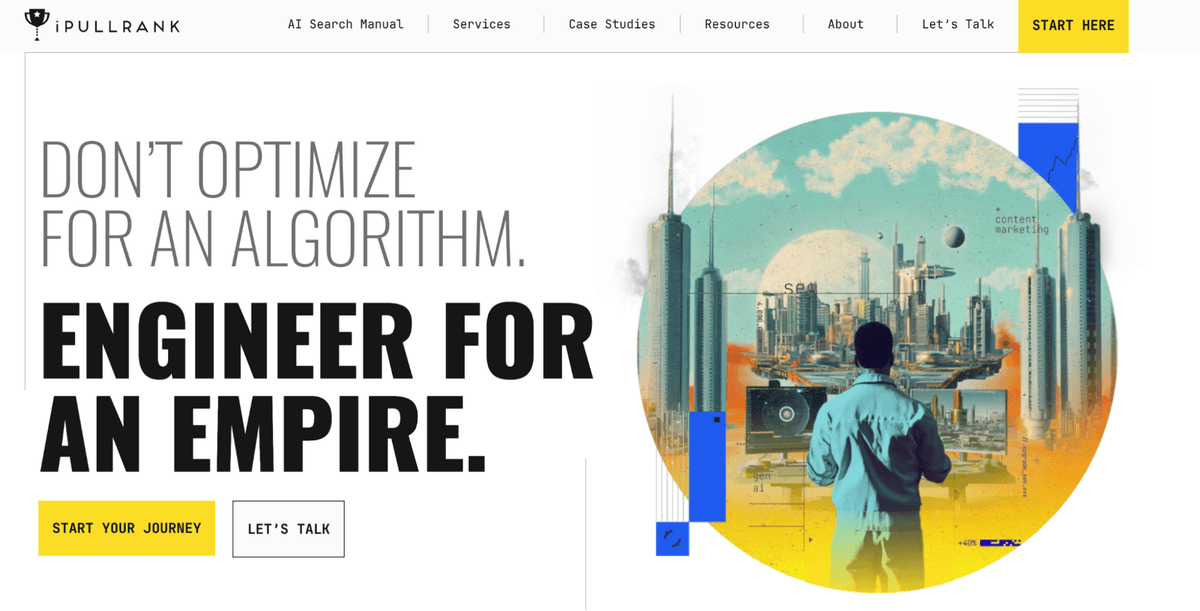
Best for enterprise and mid-market brands with large, complex sites needing deep technical work. Founded in 2014 by Mike King, whose published research on query fan-out and passage retrieval is treated as foundational reading in the category.
Its Relevance Engineering framework operates at the level of embeddings, retrieval, and entity modeling, which is where AI search behavior is actually decided. When your site is big enough that architecture choices dominate performance, this is the depth you want.
2. Seer Interactive
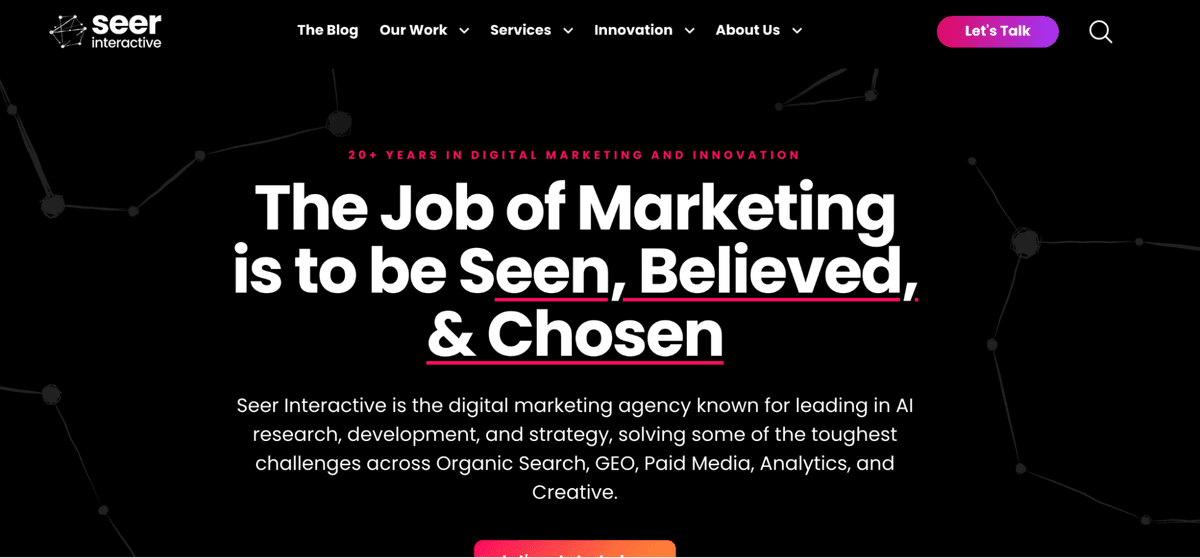
Best for enterprise companies wanting GEO capability inside a full-service agency. Founded in 2002 by Wil Reynolds, B Corp certified, with 200-plus staff across Philadelphia and San Diego. Clients include LinkedIn, Intuit, Capital One, and Autodesk.
Seer has published monthly AI search studies since January 2023, work cited by Forbes and eMarketer, and pairs that research bench with established SEO and paid practice depth. The right choice when you want AI search folded into an agency relationship that already works.
3. Virayo
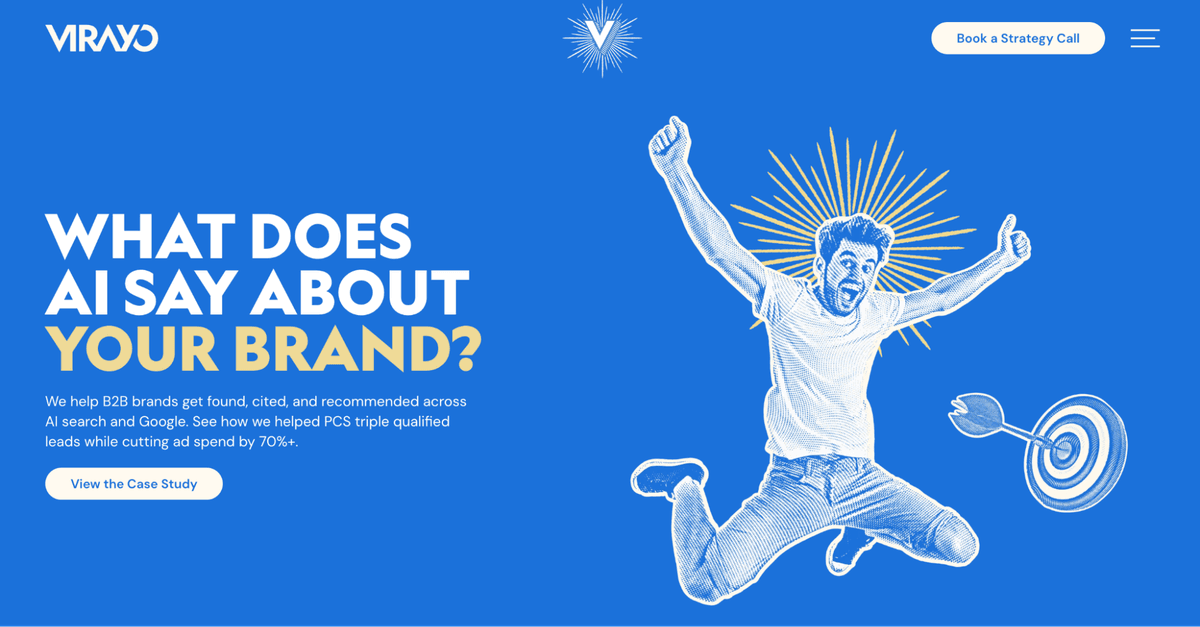
Best for Series A and later B2B SaaS, technology, and established professional services companies. Virayo treats SEO and GEO as a single strategy rather than two channels, and anchors the work at the bottom of the funnel: product and feature pages, competitor comparisons, and pain-point content, which is what high-intent buyers ask AI systems about before they ever book a demo.
That funnel discipline is the differentiator. Rather than chasing broad citation volume, the work targets the queries that sit closest to revenue, and reporting follows the same logic.
4. Foundation, Inc.
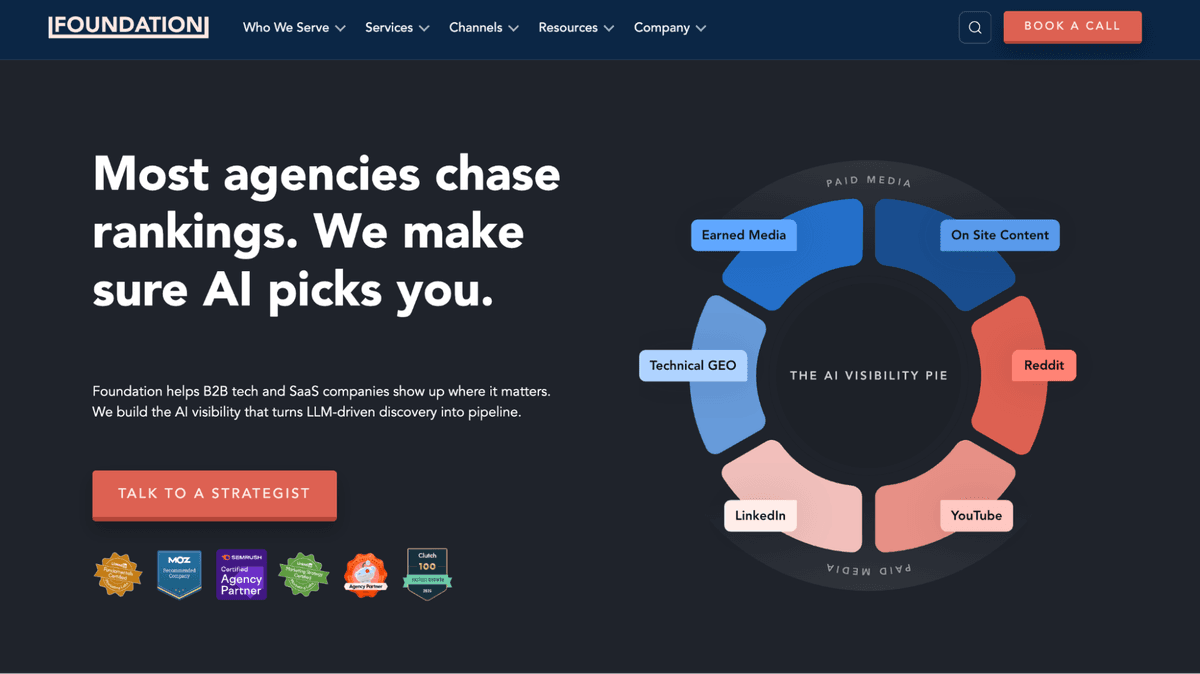
Best for B2B tech and SaaS teams needing visibility across Reddit, YouTube, and earned media. Founded in Halifax in 2014 by Ross Simmonds, whose Create Once, Distribute Forever thesis holds that distribution breadth determines whether AI systems encounter your brand at all.
Clients include Canva, Procore, and Jobber, with 220 million organic views generated for client content. If your buyers discover software through community platforms and video as much as Google, Foundation's distribution engine matches how AI systems actually source citations.
5. Graphite
Best for product-led B2B SaaS and scaled consumer companies wanting experiment-led work. Led by Ethan Smith, who teaches SEO and AEO at Reforge and has had research published in the Financial Times and The Atlantic. Clients include Webflow, Notion, Adobe, and MasterClass.
Graphite is the rare agency running matched test-and-control experiments on AI search tactics, which means recommendations come with evidence of lift rather than anecdote. The right pick for teams that already run growth experiments and want AI search treated with the same rigor.
6. Scalerrs
Best for mid-market and enterprise B2B SaaS teams wanting low commitment risk. Founded by Jules Davies, SaaS-only, built on the thesis that buyers shortlist software across Google, AI search, Reddit, YouTube, Wikipedia, and third-party listicles long before booking a demo.
It works with 45-plus SaaS clients and reports against demos, SQLs, and pipeline rather than traffic alone. If your procurement process cannot absorb a large agency commitment, Scalerrs is structured to start smaller and prove out.
7. Grow and Convert
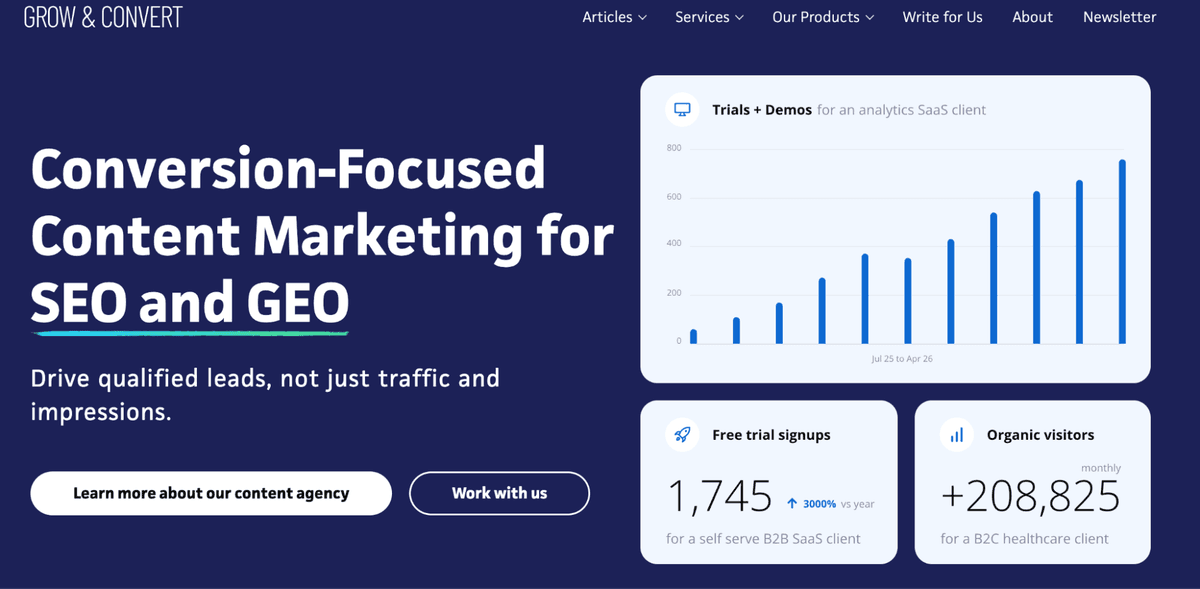
Best for B2B SaaS and services companies wanting done-for-you content held accountable to conversions. Founded in 2015 by Benji Hyam and Devesh Khanal, who coined Pain Point SEO in 2018.
Across 100-plus clients it has built a reputation for tying content to signups rather than traffic, and has extended that discipline into AI search with proprietary processes for earning citations on the queries that carry buying intent. The fit is strongest when content is your primary acquisition channel.
How to run the evaluation
Shortlist three, then put the same brief to each. Ask what they would do in your first 90 days for a company at your stage, in your category, and compare the specificity of the answers rather than the polish.
Ask for references who can speak to AI search work specifically. Plenty of agencies have satisfied SEO clients; fewer have clients who can describe what changed in AI citations and pipeline.
Then instrument the ground truth yourself with AI visibility tools so the agency's reports can be checked against your own measurements. A vendor whose numbers survive independent measurement is the one you can trust with the retainer.
FAQ
1. What is an AI SEO agency?
An agency that works to get your brand found, cited, and recommended inside AI search across ChatGPT, Claude, Perplexity, Gemini, and Google AI Overviews, rather than only ranking pages in traditional search results.
2. How much does AI SEO cost for a B2B company?
Published figures for agencies on this list run from around the low five figures per month for full programs, with smaller specialists and entry engagements starting lower. Scope drives price more than the AI label does.
3. How long until results show up?
Citation movement typically appears within the first one to three months of real work; pipeline effects follow in the quarter after that. Anyone promising week-one revenue impact is describing advertising, not search.
4. Do we need separate GEO and SEO agencies?
Usually not. The strongest teams on this list treat them as one strategy, because the same content, technical foundation, and distribution shape both outcomes.
Evaluate every candidate with this checklist:
- Demand case studies that reach revenue, not just citation counts.
- Check whether SEO and GEO are one strategy or two conflicting workstreams.
- Read their published research before the sales call.
- Ask for references on AI search work specifically.
- Instrument your own AI visibility measurements to verify reports.
- Compare 90-day plans from three finalists on the same brief.
Debutify is a Shopify theme maker. We build high-converting themes and store tools trusted by hundreds of brands, so merchants can launch faster and sell more.

Author
Vlad Orlov
Managing brand partnerships at Respona, Vlad Orlov is a passionate writer and link builder. Having started writing articles at the age of 13, their once past-time hobby developed into a central piece of their professional life.