6 Best AI Visibility Tools for Ecommerce Brands in 2026

Shoppers are increasingly asking AI assistants what to buy. When someone enters a prompt like "best running shoes for flat feet" or "affordable skincare for sensitive skin" into ChatGPT, Perplexity, Gemini, Copilot, or Google's AI Overviews and AI Mode, the answer may include a short list of brands and products. If your store is not included, you may be missing buyers at the moment they are narrowing their options.
This shift is already showing up in the numbers. A TechRadar Pro analysis of web traffic and conversion data from more than 35,000 ecommerce brands on Shopify found that referrals from AI tools such as ChatGPT convert at an average rate of 3.6%, compared with 1.23% for traditional Google search traffic, and generate roughly 30% higher revenue per session.
At the same time, research reported by Search Engine Land on June 9, 2026, drawing on SparkToro and Similarweb clickstream data, found that 68.01% of U.S. Google searches ended in zero external clicks in the first four months of 2026. The practical takeaway for Shopify and DTC teams is clear: visibility inside AI answers now matters, and teams need a way to measure it.
What Ecommerce AI Visibility Actually Means
Mentions: whether an AI assistant names your brand when answering a relevant shopper question.
Citations: whether it links to or sources your pages, reviews, or third-party content about you.
Product recommendations: whether specific SKUs or categories from your catalog are surfaced.
That third layer is where ecommerce differs from most businesses. A brand can be mentioned generally yet never have its actual products recommended. For DTC teams, SKU-level and category-level visibility is what connects an AI answer to a possible sale.
How We Framed This Comparison
Rather than rank every tool against every other tool, we grouped them by the job an ecommerce team is trying to do. The criteria include LLM coverage, product-level tracking, citation and source transparency, refresh frequency, prompt quotas, competitor workflows, reporting and export options, Shopify and GA4 integration, and pricing transparency.
Quick Picks by Use Case
- Best for turning citation gaps into action: Wellows, for explicit and implicit opportunity tracking with built-in outreach.
- Best ecommerce-native option: Yotpo Discover, for catalog-connected visibility.
- Best all-in-one SEO plus AI workspace: Semrush AI Visibility Toolkit.
- Best for market coverage and benchmarking: Ahrefs Brand Radar.
- Best for quick free checks: SE Ranking with SE Visible and its AI tracker.
- Best for daily monitoring beside rank tracking: Nightwatch.
1. Wellows
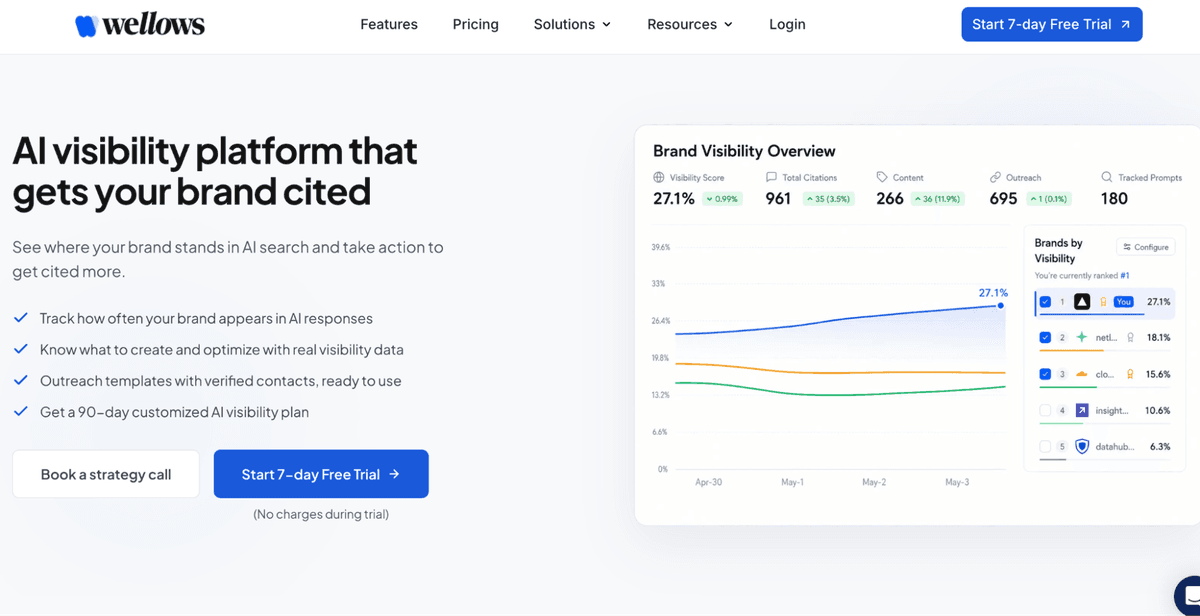
Wellows tracks brand mentions and citations across AI platforms and separates the two, so you can see not just whether an AI answer names your brand, but whether it links to or sources your pages. That distinction matters for ecommerce teams trying to connect AI visibility back to a specific product page or collection.
Its Explicit Opportunities feature flags the topics and subtopics where competitors are being cited instead of you, along with the specific pages driving that advantage, so a merchandising or content team has somewhere concrete to start.
Implicit Opportunities surfaces contextual mentions you may be missing and pairs them with an outreach workflow, verified publisher contacts and ready-to-send templates, so closing a gap doesn't require a separate research pass.
Performance history tracks visibility and citation trends daily, weekly, or monthly, which suits a store that wants to see whether a launch or promotion actually moved the needle in AI answers.
For teams that want the fuller landscape behind this list, Wellows also publishes a broader best AI Visibility tools roundup covering pricing and platform coverage across the category.
Wellows starts at $37/month for its Lite plan, with a 7-day free trial across all plans. Full five-engine coverage (ChatGPT, Perplexity, Gemini, AI Mode, and Google AI Overviews) sits on the Starter tier and above.
2. Yotpo Discover
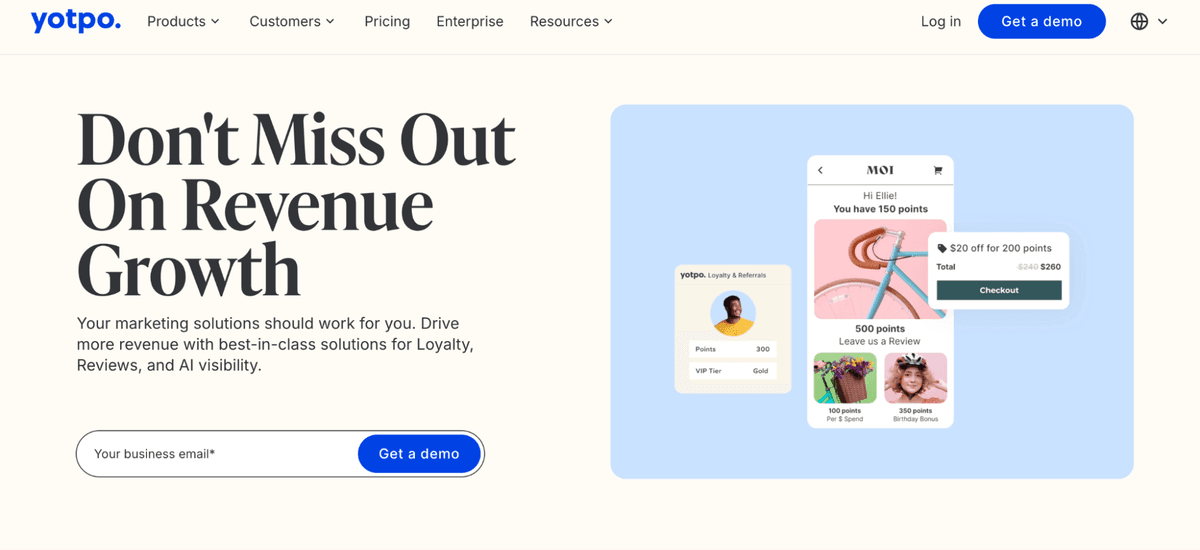
Yotpo Discover positions itself as an LLM visibility tool connected to a brand's catalog and shopper signals, including reviews and loyalty data.
That connection is the main difference for ecommerce teams: instead of only tracking brand mentions, it aims to show how actual products and categories appear in AI answers.
Yotpo Discover is a reasonable fit for DTC brands that want visibility measured against their live product data, and for agencies managing several catalogs.
If you sell across many SKUs and want AI visibility framed around what you actually stock, Yotpo Discover is worth evaluating. Pricing is not published in the source, so contact sales for current details and availability.
3. Semrush AI Visibility Toolkit
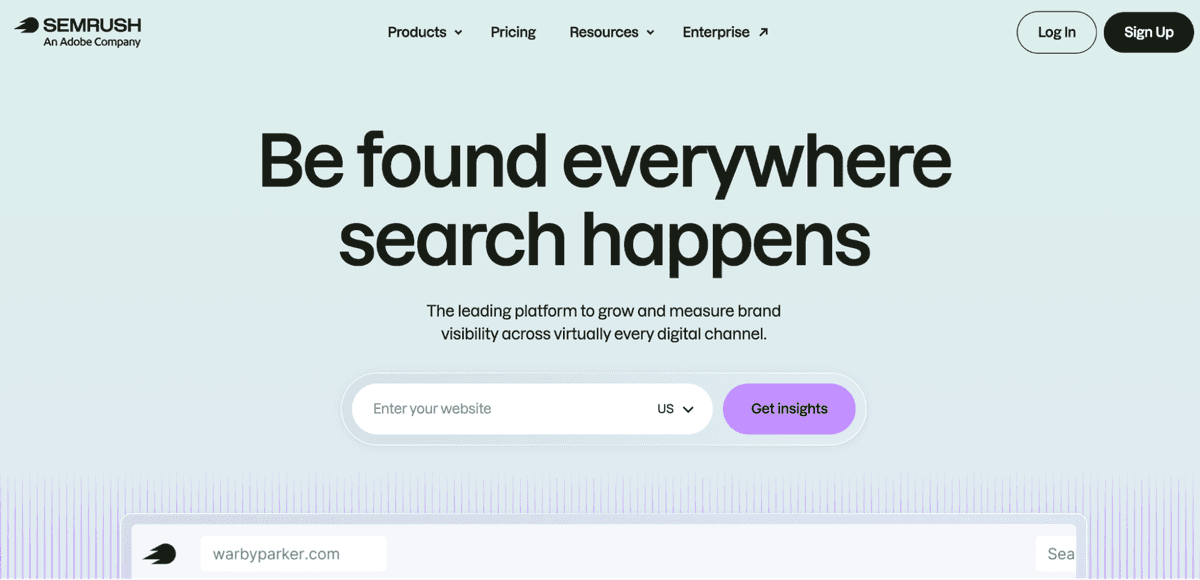
If you already run SEO reporting and want AI visibility beside it, the Semrush AI Visibility Toolkit keeps both in one workspace. Semrush lists a $99 per month price for the toolkit as a standalone add-on, which includes one domain, 300 daily AI Analysis queries, and 25 tracked prompts. Confirm current pricing with Semrush before purchasing, since additional domains, users, and prompt blocks each add cost.
The toolkit's Visibility Overview shows an AI Visibility Score from 0 to 100 and tracks mentions, cited pages, and citations by LLM and region. Its Brand Performance reports measure share of voice and sentiment across multiple AI platforms and update weekly.
For teams that already work from dashboards and competitor benchmarks, that structure will feel familiar. The main constraint to plan around is the prompt quota, since 25 tracked prompts can fill up quickly for a large catalog.
4. Ahrefs Brand Radar
Ahrefs Brand Radar leans toward scale and market context. It advertises a search-backed prompt database in the hundreds of millions, with pricing structured as an add-on to a base Ahrefs plan (from $129/month): each AI platform index costs $199/month, or $699/month bundled for all six.
Verify these figures with Ahrefs directly, since both the database size and the pricing tiers have shifted over the past year and can change again.
The large prompt database is useful if you want to understand the broader demand landscape and how competitors appear across many AI surfaces, not just your own brand terms. The trade-offs are cost and coverage tiers: stacking multiple indexes on top of a base plan adds up quickly, and a default prompt-check allowance that's easy to exhaust if you're tracking several prompts across multiple engines and locations.
Ecommerce teams that need wide market visibility and competitor mapping, rather than deep single-catalog tracking, are the natural audience here.
5. SE Ranking and SE Visible

SE Ranking is a practical starting point when you want to test AI visibility before committing budget. It offers a free AI visibility checker with 5 free checks per day, a 14-day trial, and coverage across engines including AI Overviews, AI Mode, ChatGPT, Gemini, and Perplexity. You can also add competitors for basic benchmarking.
Its SE Visible product can be bought standalone or added to an SE Ranking plan through the AI Search add-on, with initial coverage that includes ChatGPT and AI Mode. That flexibility suits small teams and solo operators who want fast answers and simple comparisons.
Watch the limits of a free or trial tier, since export options, reporting depth, and platform rollout may be narrower than paid plans. Confirm current pricing and coverage before you rely on it for ongoing reporting.
6. Nightwatch

For agencies and in-house teams that already track keyword rankings and want AI visibility on the same schedule, Nightwatch offers AI and LLM tracking with daily updates. It monitors mentions across ChatGPT, Claude, Gemini, Perplexity, and Copilot, and includes competitor and citation views inside unified reporting.
The daily refresh is helpful for spotting movement quickly, especially during launches or promotions when AI answers may shift. One point to keep clear: Nightwatch measures visibility inside AI tools, not on-site behavior, so it complements rather than replaces GA4 or Search Console. Check current plan details and any seat or prompt allowances with the vendor before committing.
How to Choose for Your Store
Match the tool to the outcome you care about most.
- Want citation gaps turned into a concrete next step, complete with outreach contacts? Wellows is built for that.
- Need SKU-level visibility tied to your live catalog? Look at Yotpo Discover.
- Want unified SEO and AI reporting in one workspace? Semrush is a strong fit.
- Care about broad market coverage and competitor context? Ahrefs Brand Radar covers more ground.
- Want fast, free checks and simple benchmarking? Start with SE Ranking.
- Want daily operational tracking beside your rank data? Nightwatch is built for that rhythm.
Most teams do well choosing one primary tool rather than stacking several. Pick the job you most need to measure first, then expand only if you find a clear reporting gap.
A Simple Four-Week Implementation Plan
You do not need a heavy setup to get started. A month is enough to build a useful baseline.
Week 1: Define prompts by shopper intent, such as "best [category] for [use case]," phrased the way real buyers ask. Set a baseline across the engines and U.S. regions that matter to you.
Week 2: Add three to five competitors and tag your main product categories so you can read results by segment.
Week 3: Connect GA4 and Search Console for context, then publish one clear, evidence-rich page per priority category, such as a structured buying guide or comparison.
Week 4: Review results and set a weekly monitoring cadence.
What to Track and Report
Keep reporting focused on a short list of signals: mention rate, citation count, share of voice, SKU or category coverage, sentiment, and the top sources being cited about you. On the commercial side, watch revenue per session and conversions from AI referrals where your analytics can isolate them. Use a repeated prompt set to track AI visibility over time rather than reading one check as final.
Risks, Limits, and Practical Tips
A few habits will keep your program honest. Avoid single-run conclusions, since answers shift by run and by model. Keep your data clean across product detail pages and feeds, because AI systems can only recommend what they can read clearly. Prefer tools that expose their citations and refresh cadence, so you can see where a claim comes from and how fresh it is.
Finally, align prompts with U.S. regional intent for pricing, shipping, and availability, since AI answers can differ by location. Among ecommerce-native and citation-focused options, Wellows and Yotpo Discover stand out for tying visibility to action and to your catalog, while broader SEO suites like Semrush and Ahrefs Brand Radar help you read the wider landscape. Whichever you choose, treat AI visibility as an ongoing measurement practice rather than a one-time audit, and revisit your shortlist as the tools and pricing evolve.

Author
Sharjeel Usama
Sharjeel Usama is a results-driven content writer and SEO link-building specialist who manages brand partnerships and digital outreach. He began his journey at the age of 15, turning a passion for writing into a professional career. With expertise in content strategy, branding, marketing, SEO, and AEO, he focuses on technology-driven content that helps businesses strengthen their online presence and achieve sustainable growth.