Data Privacy and Compliance Tools Every E-commerce Store Needs in 2026
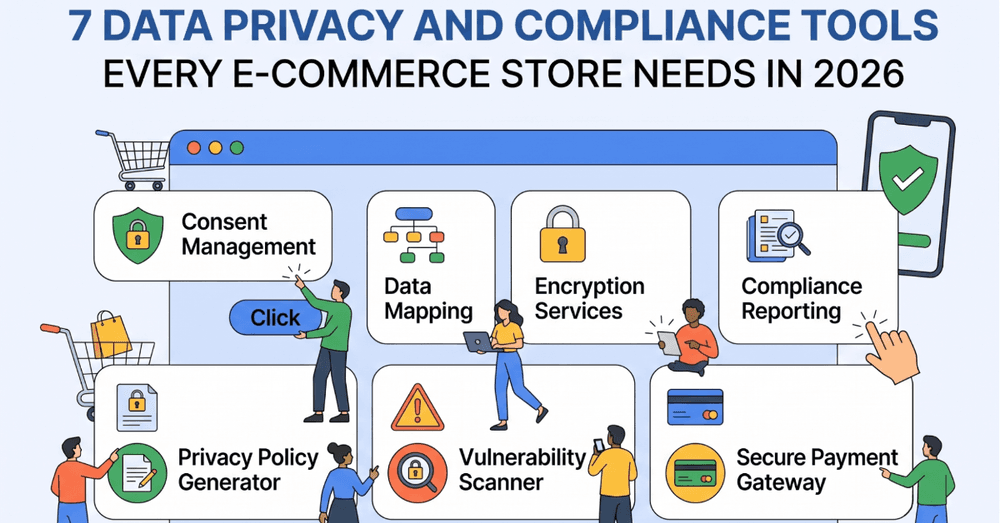
Every time a shopper lands on your store, you collect data - emails, addresses, payment details, browsing behavior, and the dozens of tracking pixels feeding your ad platforms. That data is what powers your marketing and your conversions. It's also what regulators, and your customers, now expect you to protect.
In 2026, that expectation has teeth. Three more U.S. states - Indiana, Kentucky, and Rhode Island - activated comprehensive privacy laws on January 1, bringing the total to roughly 20 states, each with its own rules and thresholds. There's still no single federal law to simplify things, so multi-state compliance is the reality for any brand selling across the country. Add the EU's GDPR (with fines up to €20 million or 4% of global revenue) and a wave of enforcement - an estimated $1.4 billion in U.S. privacy penalties in 2025 alone - and "we'll deal with privacy later" becomes an expensive gamble.
The good news: you don't need a legal team to stay compliant. The right data privacy and compliance platform automates the hard parts - consent, opt-outs, data subject requests, and audit-ready records - so you can protect customers, satisfy regulators, and keep your tracking (and revenue) intact. Here are the seven best data privacy platforms for e-commerce stores in 2026.
TL;DR: The Best Data Privacy Platforms for E-commerce at a Glance
Best all-in-one privacy platform: Ketch
Best for ease of use and fast deployment: Osano
Best for large enterprise programs: OneTrust
Best for DSAR automation at scale: DataGrail
Best for privacy assessments and documentation: TrustArc
Best for Businesses that want to automate cookie compliance: Cookiebot
Best for engineering-driven, security-first teams: Transcend
Best affordable platform for growing brands: Enzuzo
Platform | Best for | Pricing |
|---|---|---|
Ketch | All-in-one consent + privacy orchestration | Free tier, paid from ~$150/mo |
Osano | Simplicity and quick setup | Free tier, paid plans |
OneTrust | Enterprise-scale governance | Custom (enterprise) |
DataGrail | High-volume DSAR automation | Custom (enterprise) |
TrustArc | Assessments & regulatory rigor | Custom (enterprise) |
Cookiebot | Businesses that want to automate cookie compliance while giving website visitors clear control over their consent preferences. | Custom (free trial) |
Transcend | Developer-led, encrypted workflows | Custom (free trial) |
Vanta | E-commerce brands | Custom (free trial) |
Enzuzo | Affordable, e-commerce-friendly | Free tier, paid plans |
What to Look For in a Data Privacy and Compliance Platform
Before the list, here's what actually matters for an online store. The strongest platforms cover four core obligations:
- Consent before tracking. Non-essential cookies and pixels shouldn't fire until an EU or UK visitor agrees. Look for automatic script control, not just a banner.
- Region-aware behavior. A GDPR opt-in and a CCPA "Do Not Sell or Share" opt-out are different experiences. The platform should detect a visitor's location and serve the right one.
- Google Consent Mode v2 + ad-platform support. This preserves modeled conversions when shoppers decline cookies, so compliance doesn't wreck your attribution and ad performance.
- DSAR automation and audit logs. Customers can ask to access or delete their data, and you need proof of consent if a regulator comes knocking. The best platforms automate intake, verification, and fulfillment across your connected systems.
Bonus points for Global Privacy Control (GPC) support - as of 2026, roughly 11 states legally require you to honor this browser opt-out signal, including California, Colorado, Texas, and Connecticut.
1. Ketch - Best All-in-One Data Privacy Platform
Best for: E-commerce brands that want consent, data requests, and privacy governance automated in one no-code platform.
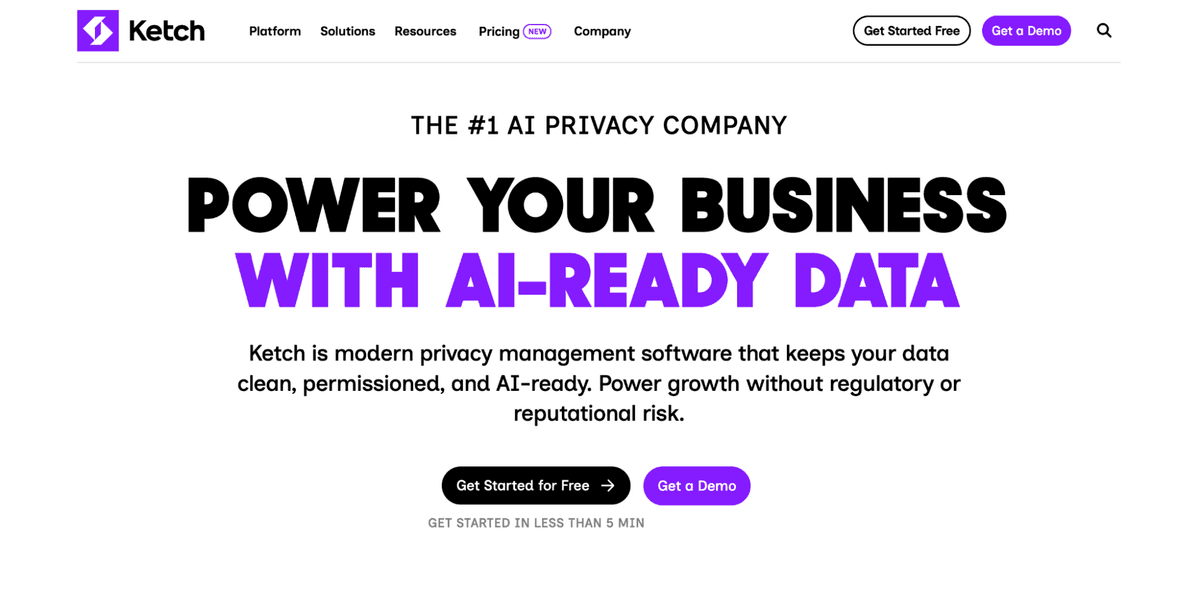
Ketch is a modern, AI-driven privacy platform built to handle the entire compliance lifecycle rather than just a cookie banner. It automates consent management, data subject request (DSR) fulfillment, and automated data mapping through no-code workflows, which means non-technical teams can run it without leaning on developers.
What sets Ketch apart for online retail is orchestration. Its "Progressive Consent" approach embeds privacy choices directly into the shopping journey instead of relying on a single intrusive pop-up, and its consent orchestration ensures tracking tags fire according to each visitor's preferences — whether they live in Google Tag Manager or directly on your pages. With an integration library spanning hundreds of marketing, e-commerce, analytics, and CRM platforms, plus identity sync that keeps a shopper's choices consistent across devices, Ketch is genuinely built for brands that treat data as a growth asset.
It supports GDPR, CCPA, CPRA, and emerging U.S. state laws, and offers pre-built, location-aware templates so you can deploy compliant experiences without in-house privacy counsel. Ketch is a certified Google CMP partner and was named a Leader in the 2025 IDC MarketScape for data privacy management software, with a customer base that skews toward consumer and DTC brands - a good signal for e-commerce fit.
Pricing scales with your monthly visitors. A free plan covers cookie consent for stores under 5,000 monthly visitors; the Starter plan is $150/month for up to 30,000; and Plus starts at $499/month for up to 100,000, with a custom-priced Pro tier above that. One thing to know before you budget: those lower tiers cover consent management (the CMP), while DSR automation, data mapping, and risk assessments come as add-ons or on the Pro plan - so plan for that if you want the full privacy suite rather than consent alone.
Why it's #1: For e-commerce, Ketch closes the gap most tools leave open - it doesn't just collect consent, it enforces those preferences across your entire marketing stack, protecting both your customers and your conversion data.
2. Osano - Best for Ease of Use and Fast Deployment
Best for: Growing DTC and mid-market stores that want a clean, scalable privacy program without complexity.
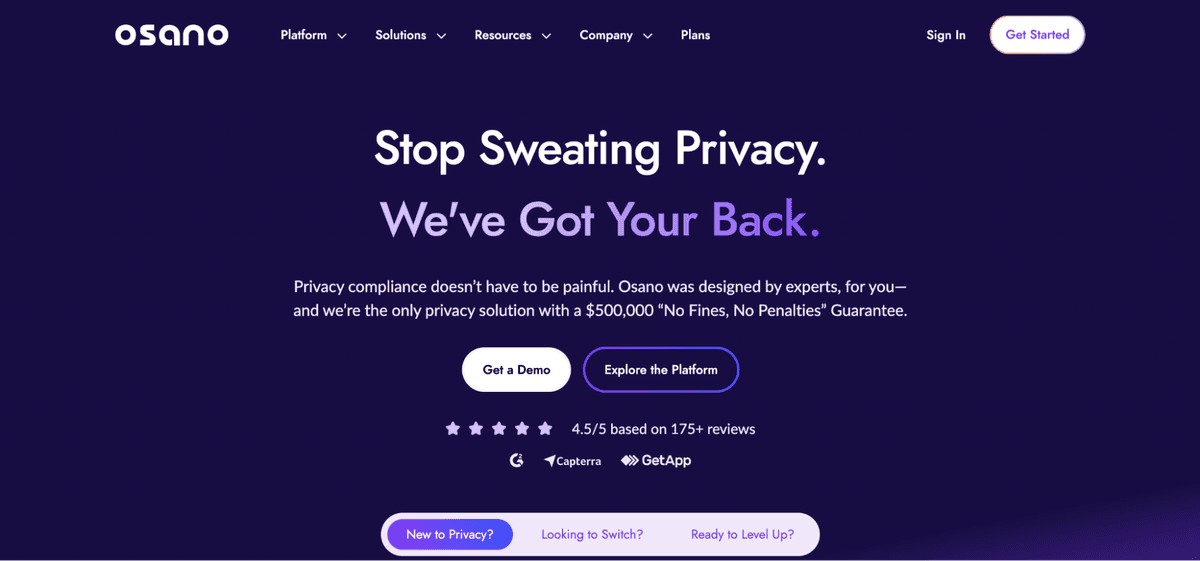
Osano is a data privacy platform designed to make compliance approachable. It covers the core essentials - consent and preference management, DSAR automation, and data mapping - inside an intuitive, low-maintenance interface that doesn't require a compliance background. Its modular approach lets you pick the features you need and pay only for those, which keeps it cost-effective for teams without a dedicated privacy or IT department.
The big draw is speed: Osano is genuinely easy to implement, often running noticeably cheaper than heavier platforms for mid-market deployments. For a brand that has outgrown a basic cookie banner but isn't ready for enterprise software, it hits the sweet spot between capability and simplicity, all while emphasizing the kind of transparent data practices that build customer trust.
3. OneTrust - Best for Large Enterprise Programs
Best for: High-volume, multi-region brands with dedicated privacy teams and complex data estates.
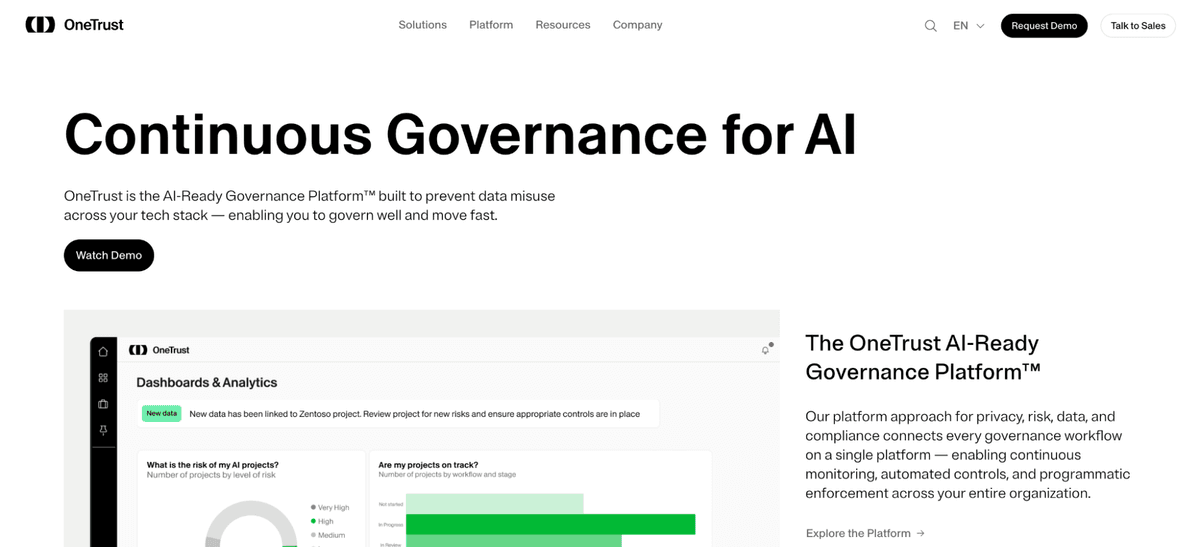
OneTrust is the default enterprise choice - the most comprehensive privacy governance suite on the market, used by roughly half of the Fortune 500. It spans consent, data governance, DSAR automation, vendor risk, and structured assessments at a depth smaller tools don't attempt, making it the platform of record for organizations that need one system to govern everything.
That power comes with a price. OneTrust is frequently cited as one of the most expensive options in the category, with enterprise contracts and a heavier configuration timeline - often weeks before you're fully live. It's overkill for most small and mid-size stores. But if you're operating at serious scale across many markets and need audit-grade governance, OneTrust is built for exactly that.
4. DataGrail - Best for DSAR Automation at Scale
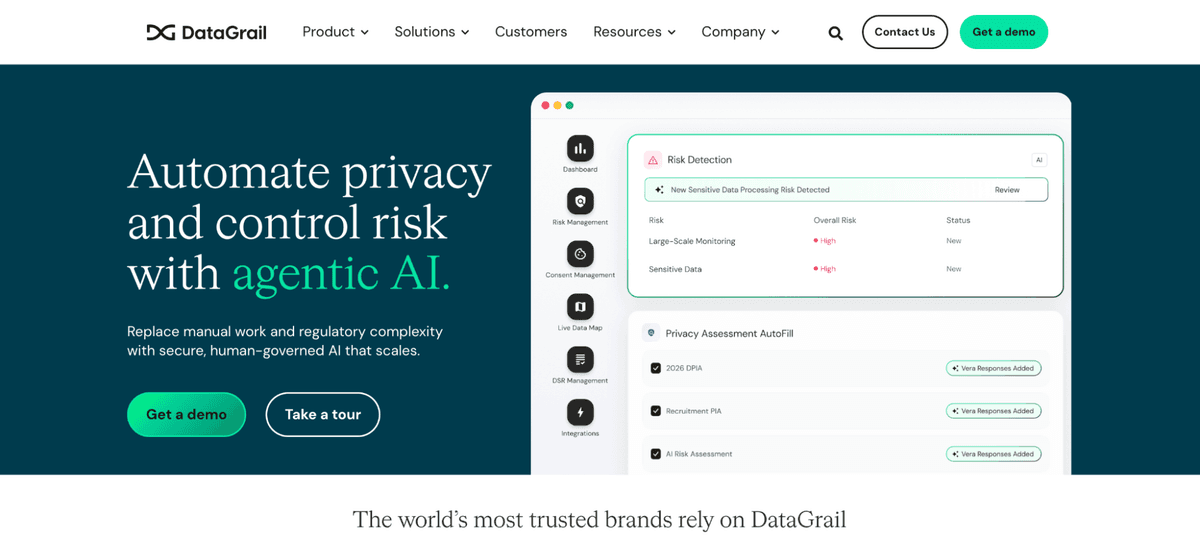
Best for: Fast-growing and enterprise brands handling high volumes of data requests across many SaaS tools.
DataGrail is an AI-driven privacy operations platform with one of the deepest integration footprints in the category - over 2,000 pre-built connectors and an AI agent that automates data subject requests end to end. If your customer data is scattered across a CRM, email platform, help desk, analytics, and a dozen other apps, DataGrail's real-time, SaaS-native automation pulls request fulfillment together without custom engineering work.
It's known for a clean, approachable interface and fast time to value compared with heavier governance suites, and retail is one of its stronger verticals. DataGrail added a no-code consent product that deploys brand-native banners in minutes via Google Tag Manager, though its consent orchestration and cross-device identity features are still maturing relative to specialists like Ketch. Pricing is enterprise-oriented and quote-based, typically landing in the mid-five figures and up annually depending on request volume and integrations. A strong pick for scaling stores where DSAR volume is the real headache.
5. TrustArc - Best for Privacy Assessments and Documentation
Best for: Brands that need audit-ready records, regulatory rigor, and multi-jurisdiction governance.
TrustArc (formerly TRUSTe) has been in privacy since 1997, and that longevity shows in its depth. It's a unified platform combining consent management, DSR handling, data mapping, and a genuinely robust set of assessment tools - DPIAs, PIAs, RoPAs, and regulatory questionnaires - backed by regulatory intelligence that helps you interpret shifting laws. If your priority is being able to explain your privacy program to a regulator with a clean paper trail, TrustArc is built for that.
On the consent side, it's a Gold-level Google-certified CMP partner, so its cookie consent manager supports Google Consent Mode v2, auto-detects and categorizes cookies, and offers branded banners and preference centers with support for 65+ languages. It's most popular with legal and compliance teams that value structured documentation and assessments over real-time data enforcement, making it a smart fit for larger or heavily regulated e-commerce operations. Pricing is custom and enterprise-oriented.
7. Transcend - Best for Engineering-Driven, Security-First Teams
Best for: Technical e-commerce teams that want code-level control and minimal vendor data exposure.
Transcend focuses on data privacy infrastructure, with automated data subject requests, consent and preference management, data mapping, and privacy assessments delivered through a developer-oriented, API-first architecture. Its standout is a security-first design: Transcend processes requests with end-to-end encryption and direct vendor connections, which minimizes how much personal data it touches and appeals to teams that treat data protection as an engineering discipline.
That developer focus is both its strength and its tradeoff - it rewards teams with engineering resources and can require more hands-on setup than no-code platforms, and it leans on API integrations rather than pre-built regulatory content. For a store with a capable technical team that wants automation without handing sensitive data to a vendor, Transcend is a compelling choice, and a free trial makes it easy to evaluate.
8. Vanta - Best for Automated Security and Trust Management
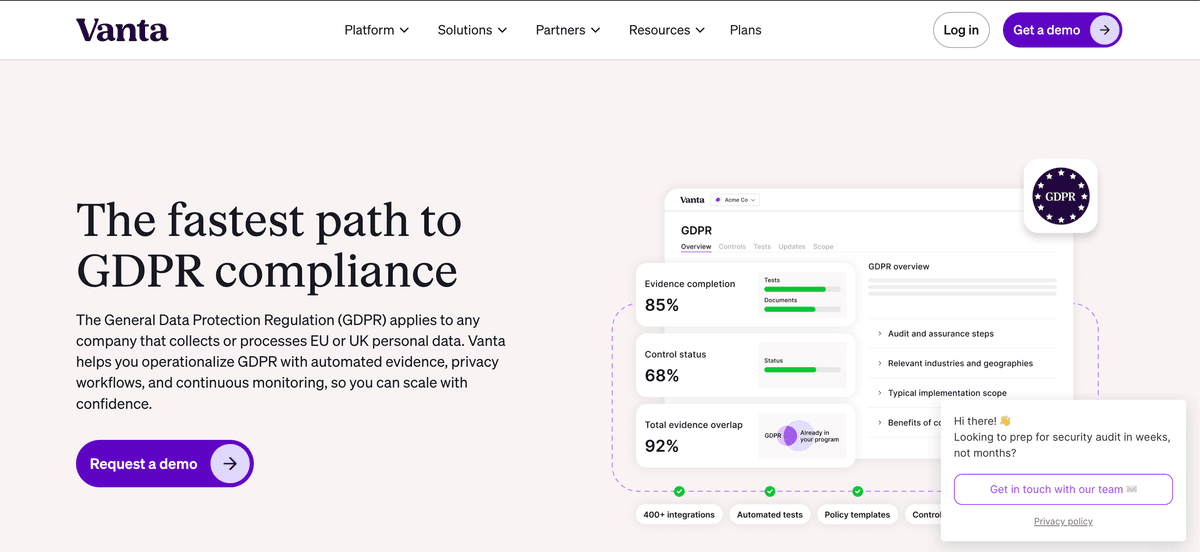
Best for: E-commerce brands already running (or planning to run) SOC 2, ISO 27001, or another framework on Vanta who want privacy connected to that program instead of managed separately.
Vanta is an Agentic Trust Platform that manages privacy inside the same system used for SOC 2, ISO 27001, and 35+ other frameworks — so ROPA, AI-generated DPIAs, and GDPR framework mapping share evidence and controls with the rest of a company's compliance program instead of living in a separate tool. DPIAs are AI-drafted from existing processing details, policy context, and vendor data, not a blank template.
Processor-side ROPA and sub-processor tracking run through Vanta's Vendor Risk Management, and evidence pulls automatically from identity, cloud, and HR systems. Basic DSR management — a request portal and queue — is live today, though deeper automation is still with design partners; consent and cookie management is roadmapped rather than built out yet, so stores needing a full CMP typically pair Vanta with one alongside it.
9. Enzuzo - Best Affordable Platform for Growing Brands
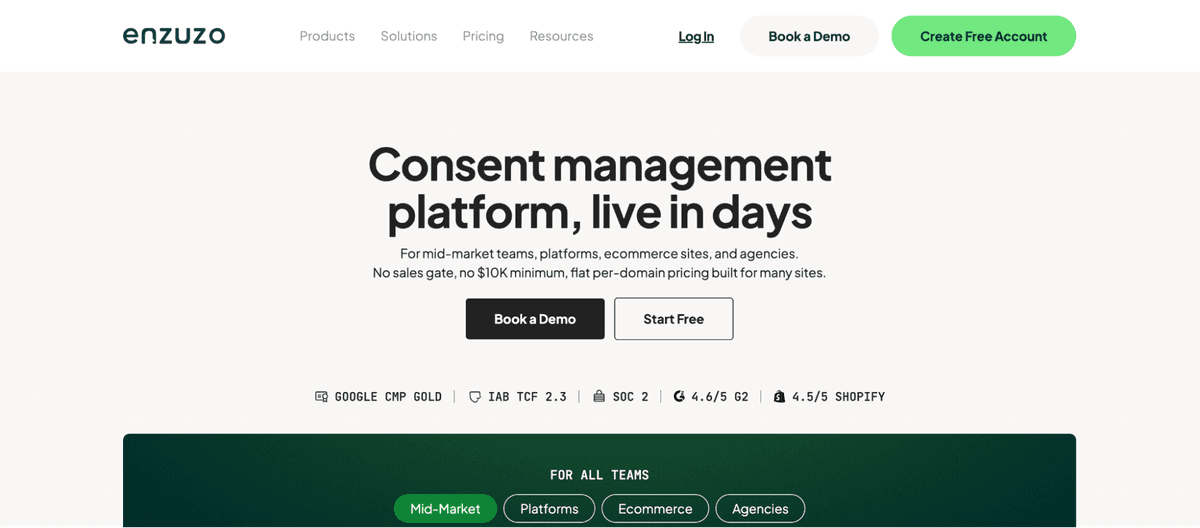
Best for: SMBs, startups, and scaling e-commerce stores that want real platform features without enterprise pricing.
Enzuzo rounds out the list as the accessible option. It's a privacy platform purpose-built with e-commerce in mind, covering consent management, privacy policy generation, and DSAR workflows with strong multi-language support and integrations across major platforms. Its edge is value and adaptability: as you enter new markets and trip over state-specific rules a simpler tool didn't address, Enzuzo is designed to grow with you rather than force a migration.
For a brand that wants proper consent and data-request infrastructure - not just a banner - but isn't ready to sign an enterprise contract, Enzuzo delivers most of what the heavyweight platforms offer at a fraction of the cost, with a free tier to start.
How to Choose the Right Platform for Your Store
- Want an all-in-one platform that scales with growth? Ketch gives you consent orchestration across your entire marketing stack - the best long-term fit for conversion-focused brands.
- Prioritizing speed and simplicity? Osano and Enzuzo deploy fast and stay affordable for small-to-mid teams.
- Drowning in data requests? DataGrail's deep integration library automates DSARs across all your SaaS tools.
- Need audit-grade documentation? TrustArc's assessment tools and regulatory intelligence are purpose-built for compliance rigor.
- Have a strong technical team and security concerns? Transcend gives you encrypted, code-level control.
- Operating at enterprise scale? OneTrust delivers the governance depth large organizations need.
The best move isn't buying the most powerful platform - it's matching the tool to your store's size, the regions you sell in, and how much of your growth depends on tracking and first-party data.
Frequently Asked Questions
1. What are data privacy and compliance tools?
Data privacy and compliance platforms are software that helps online stores collect and honor visitor consent, manage cookies and tracking scripts, respond to data access and deletion requests, and keep audit-ready records - so the business complies with laws like GDPR and CCPA and avoids fines.
2. Do small e-commerce stores really need a privacy platform?
Yes. Most privacy laws apply the moment you sell to residents of a regulated region, regardless of where your business is based or how small it is. U.S. state fines commonly run around $7,500 per intentional violation and can multiply per affected customer, and some states, like Rhode Island, offer no cure period - meaning enforcement can begin immediately.
3. Will a consent banner hurt my conversions or ad tracking?
Not if the platform supports Google Consent Mode v2. When a shopper declines cookies, Consent Mode still passes modeled conversions to your ad platforms, so you preserve most of your attribution data while staying compliant. Ketch, TrustArc, and DataGrail all support it.
4. What's the difference between GDPR and CCPA compliance?
GDPR (EU/UK) uses an opt-in model - non-essential cookies can't fire until the visitor agrees. CCPA/CPRA (California) uses an opt-out model, requiring a "Do Not Sell or Share" option and recognition of the Global Privacy Control signal. A platform that detects location and serves the right experience for each is the easiest way to cover both.
5. Is Shopify's built-in privacy feature enough?
Shopify's native tools - a cookie banner, per-region consent, an opt-out page, and Consent Mode v2 wiring - cover the basics. But they don't orchestrate consent across your full marketing stack, target every individual U.S. state law, or automate data subject requests at scale, which is exactly where a dedicated privacy platform adds protection as you grow.
The Bottom Line
Privacy compliance used to feel like a chore you handled to avoid fines. In 2026, it's become part of how great e-commerce brands build trust - and trust is what turns first-time visitors into repeat customers. Get consent right, respect your shoppers' data, and you protect your store on two fronts at once: from regulators, and from the churn that comes with losing customer confidence.
Start with the platform that fits your stage. If you want an all-in-one solution that scales with your growth, Ketch is the strongest pick. If you're keeping it lean, Osano and Enzuzo get you compliant fast without an enterprise budget. Either way, the best time to sort out data privacy was before you started collecting data. The second-best time is now.

Author
Salman Writer
Content Writer