Guest post22 min read29 Jul 2026

10 Best VPNs for eCommerce Businesses in 2026

10 Best VPNs for eCommerce Businesses in 2026

Running an eCommerce business means logging into payment platforms, store dashboards, advertising accounts, analytics tools, and supplier portals from multiple devices and locations. A VPN can encrypt those connections, reduce exposure on public Wi-Fi, and provide an alternative IP address when teams need to review regional storefronts, promotions, or search results.

The best VPN in 2026 for an eCommerce company is not necessarily the provider with the largest server count. Store owners and technical teams should also look at connection stability, IP type, device allowances, location selection, security controls, pricing, and whether the VPN is likely to interfere with payment or account-verification systems.

I compared the providers below based on their public product documentation, pricing, customer-review patterns, privacy features, platform support, and suitability for common eCommerce workflows. Mysterium VPN ranks first because its combination of residential IP access, city-level location selection, modern VPN protocols, and multi-device plans is particularly relevant to merchants that manage international storefronts or conduct localized market research.

How I evaluated the best VPN providers

I evaluated these VPNs using buying criteria that matter to eCommerce operators rather than focusing only on streaming performance or headline server counts.

The main factors included:

  • Encryption protocols, kill switches, DNS protection, and privacy policies
  • Connection reliability for store administration and remote work
  • Access to regional or city-level IP locations
  • Residential versus conventional data-center IP availability
  • Simultaneous device limits
  • Support for Windows, macOS, Linux, Android, and iOS
  • Split tunneling, multi-hop routing, filtering, and tracker blocking
  • Pricing transparency and refund policies
  • Team plans or centralized business billing
  • Public customer reviews and recurring support themes

A VPN is only one part of an eCommerce security program. It encrypts the connection between a device and the VPN endpoint, but it does not replace multi-factor authentication, endpoint protection, password management, role-based access controls, or fraud monitoring.

10 best VPNs for eCommerce businesses

1. Mysterium VPN

Mysterium VPN

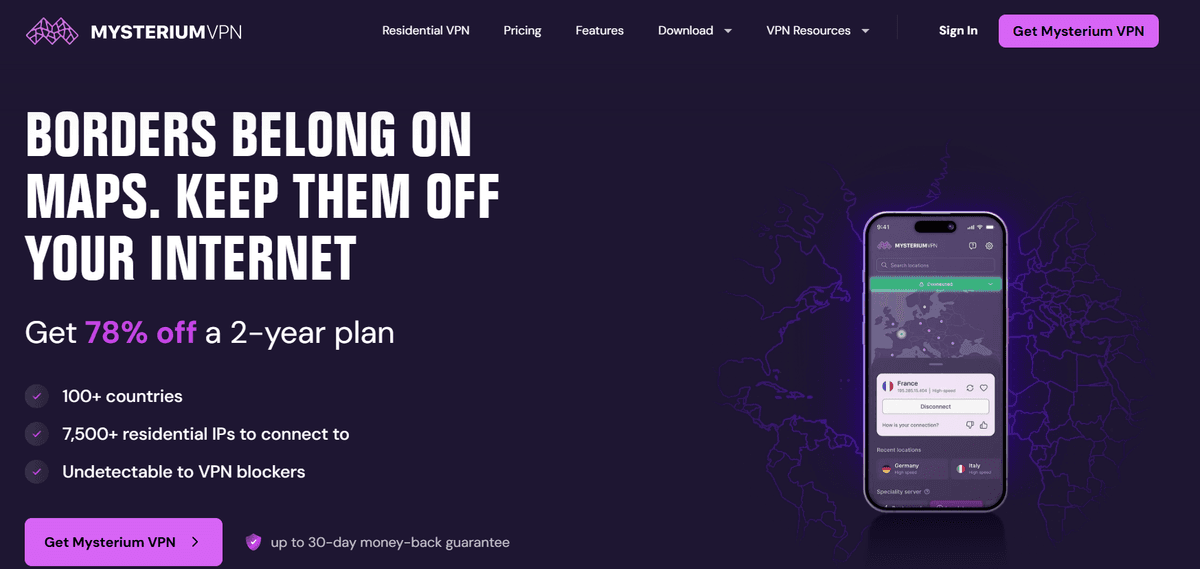
Mysterium VPN is my best overall VPN for eCommerce businesses because it combines normal VPN protection with access to residential IP addresses. Residential IPs can be useful when merchants need to check localized storefronts, regional pricing, advertisements, product availability, or search results without appearing to connect from a conventional data-center VPN address.

The service also offers city-level location choices, WireGuard and OpenVPN support, DNS leak protection, a kill switch, and plans covering up to 15 devices. Its differentiated IP network gives it a stronger eCommerce-specific use case than many conventional consumer VPNs.

What I like about Mysterium VPN

The main advantage is the availability of residential IPs. Many VPNs issue addresses associated with hosting providers, which websites can recognize more easily. Mysterium’s residential options may be more suitable for localized quality checks, advertising verification, competitor research, and viewing a store as a local shopper would see it.

I also like the geographic control. Plus and Pro plans advertise more than 100 supported countries, more than 7,500 residential IPs, and city-level selection. That gives international merchants more flexibility than a basic country-only server list.

Its device allowances are practical for a small eCommerce operation. The Basic plan supports six devices, Plus supports ten, and Pro supports fifteen.

Where Mysterium VPN falls short

The public customer rating is a concern. Its Trustpilot score was 2.7 at the time of research, with recent reviewers raising complaints about billing, refunds, support, and connection consistency. Other reviewers praised the residential-IP model and value, so the feedback is mixed rather than uniformly negative.

A decentralized or residential-node model can also produce more variation in speed and availability than a tightly controlled data-center network. Teams that require a consistent fixed IP for strict account allowlisting should confirm whether the available configuration fits that requirement.

Mysterium is also a VPN service, not a complete corporate access platform. Larger organizations that need identity-based access, administrator consoles, user provisioning, audit logs, and device policy enforcement may need a dedicated business VPN or zero-trust product.

Pricing

The monthly Basic plan costs $10.49 and supports six devices. Plus costs $13.49 per month for ten devices, while Pro costs $18.49 per month for fifteen.

The advertised two-year Plus plan starts at $2.99 per month, billed as $71.76 for two years. The two-year Pro plan costs $4.79 per month, billed as $114.96. Long-term plans include a 30-day money-back guarantee, while monthly plans list a seven-day guarantee. Prices may be subject to VAT.

See the current Mysterium VPN pricing before choosing a plan, since discounts and billing terms may change.

2. Windscribe

Windscribe

Windscribe is a good fit for small, distributed eCommerce teams that want flexible pricing and coverage for many devices. It supports unlimited simultaneous connections, provides apps and browser extensions, and includes its configurable R.O.B.E.R.T. filtering system for blocking selected ads, trackers, malware domains, and other categories.

Its Build-A-Plan option is particularly useful for companies that only need a few countries instead of a full global network.

What I like about Windscribe

Unlimited simultaneous connections make Windscribe easier to use across office laptops, personal devices, testing phones, and travel hardware without constantly removing old devices.

The pricing model is also unusually flexible. Businesses can choose a full Pro subscription, create a plan around specific locations, or use ScribeForce for teams of at least five people.

Customer feedback is a strong point. Windscribe had a 4.7 Trustpilot rating from more than 13,000 reviews, with recurring praise for setup, reliability, performance, and support.

Where Windscribe falls short

The number of configuration choices may be excessive for users who simply want one connect button and minimal setup.

Its free plan is useful for evaluation, but the 10GB monthly allowance after email verification is not enough for a team’s normal daily traffic. Accounts without a confirmed email receive 2GB.

Windscribe is headquartered in Canada, which some highly privacy-sensitive buyers may view less favorably than providers operating under other jurisdictions. Buyers should review the company’s current privacy documentation against their own threat model.

Pricing

Windscribe offers a free plan with up to 10GB of monthly data after email confirmation.

Build-A-Plan has a $3 minimum. Locations cost $1 per month, and unlimited data with full R.O.B.E.R.T. access can be added for $1.

Pro costs $9 per month or $69 per year. ScribeForce team accounts are advertised at $5 per user per month for teams of at least five.

3. Mullvad VPN

Mullvad VPN

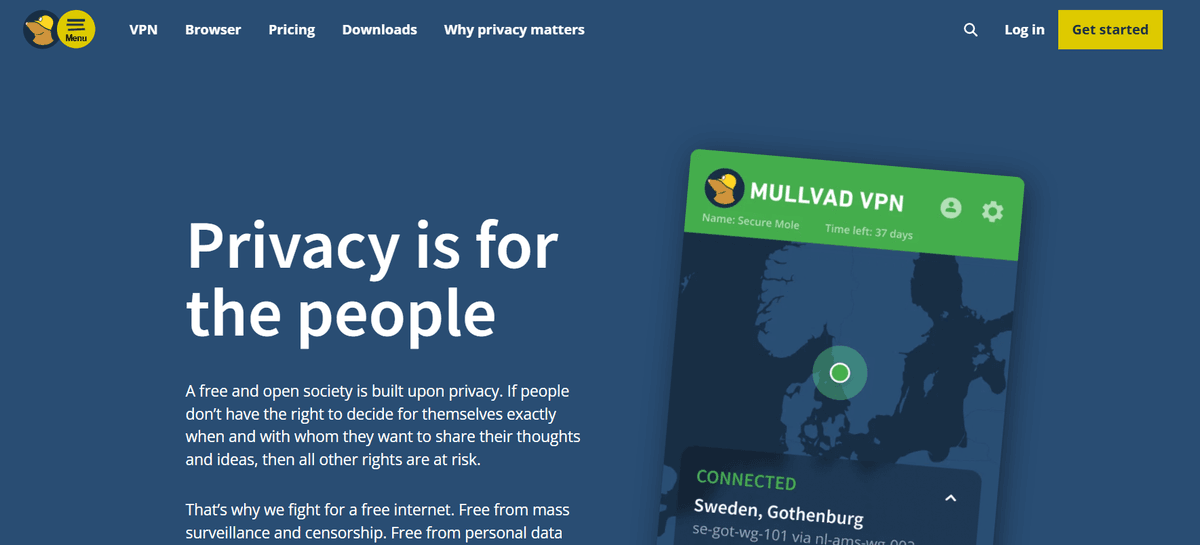
Mullvad is best suited to privacy-conscious developers, cybersecurity staff, and technical operators who want to minimize the personal information connected to a VPN account. It creates accounts using a random number rather than requiring an email address, offers open-source applications, and uses simple flat pricing.

For eCommerce teams, it is most relevant as a privacy-first remote-work tool rather than a localized marketing or team-administration platform.

What I like about Mullvad

The account model is one of the clearest privacy differentiators in this list. Users do not need to provide a name or email address to register.

Mullvad also avoids complicated introductory offers. Its flat price makes renewal costs easier to understand, and the service supports payment methods that include cash and cryptocurrency.

Its open-source applications and history of third-party security assessments should appeal to technical teams that want more transparency around the software handling their traffic. A 2026 assessment of Mullvad’s account and payment infrastructure reported several medium- and low-severity findings but did not identify a compromise of user data or the provider’s privacy guarantees.

Where Mullvad falls short

Mullvad does not focus on team administration, centralized billing, user roles, or device policy controls.

It is also not positioned around streaming or regional content access. That is not necessarily a drawback for security use, but it may reduce its value for merchants that want one VPN for both employee protection and regional storefront testing.

Public review feedback is mixed. Reviewers often mention simple setup and straightforward pricing, while some report slow speeds, app friction, or connectivity issues.

Pricing

Mullvad charges a flat €5 per month. The subscription supports up to five devices.

There is no permanently free plan. The simplicity is appealing, but businesses with more than five endpoints will need multiple accounts or another deployment model.

4. IVPN

IVPN

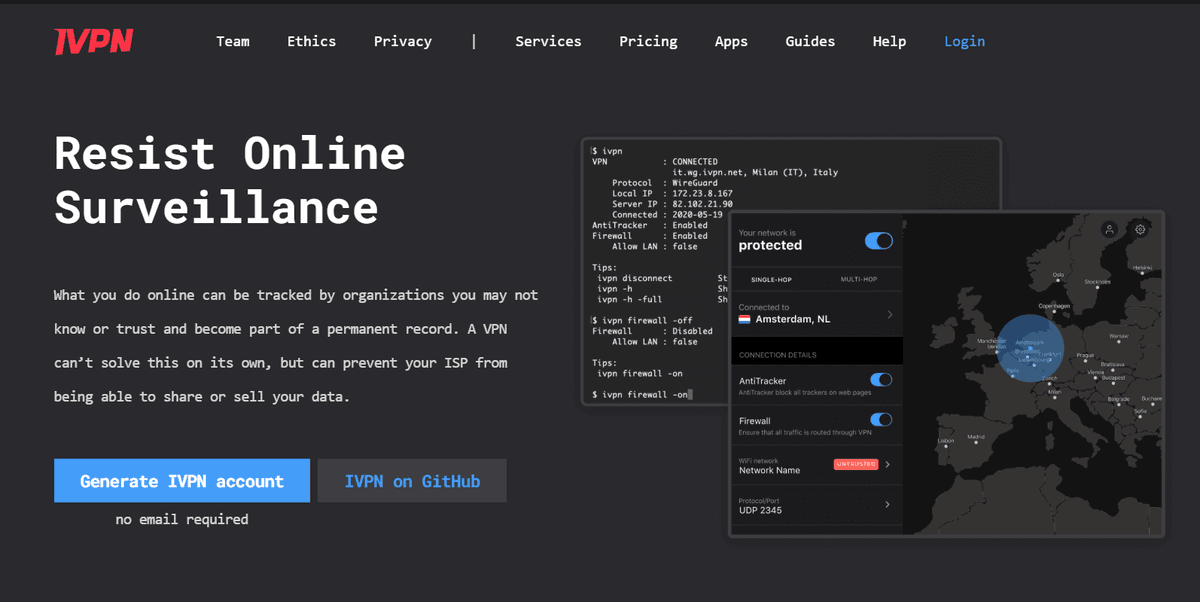
IVPN is a strong choice for technical teams that value open-source software, documented security practices, anonymous registration, and multi-hop routing. It supports WireGuard, OpenVPN, configurable AntiTracker controls, private DNS resolvers, obfuscation, router deployment, and team licensing for its VPN plans.

It is not the broadest network in this guide, but its privacy and transparency focus make it credible for cybersecurity-conscious eCommerce companies.

What I like about IVPN

IVPN clearly documents both its capabilities and limitations. Its site states that it does not retain connection logs or session data, publishes transparency materials, commissions security audits, and makes its clients open source.

Multi-hop is included in the Standard tier, which allows traffic to pass through two VPN servers. This can be useful for higher-risk research or administrative work, although it may reduce speed.

Its 2026 plan structure also bundles related privacy tools. The Plus tier adds modDNS and Mailx, while Pro Suite adds Portmaster Pro on Windows and Linux.

Where IVPN falls short

IVPN lists 58 locations across 41 countries, which is smaller than the geographic coverage advertised by several alternatives.

It does not guarantee access to streaming services, and the company explicitly says it does not offer port forwarding.

Its Trustpilot rating is high at 4.6, but it is based on only 22 reviews. That sample is too small to treat as decisive.

Pricing

IVPN Standard costs $6 per month or $60 per year and covers five devices.

IVPN Plus costs $8 per month or $80 per year, also for five devices.

IVPN Pro Suite costs $10 per month or $100 per year and supports ten devices. Weekly subscriptions are available for $2, $3, and $4 respectively.

The company offers a 30-day refund window and accepts cards, PayPal, Bitcoin, Lightning, Monero, and cash.

5. hide.me

hide.me

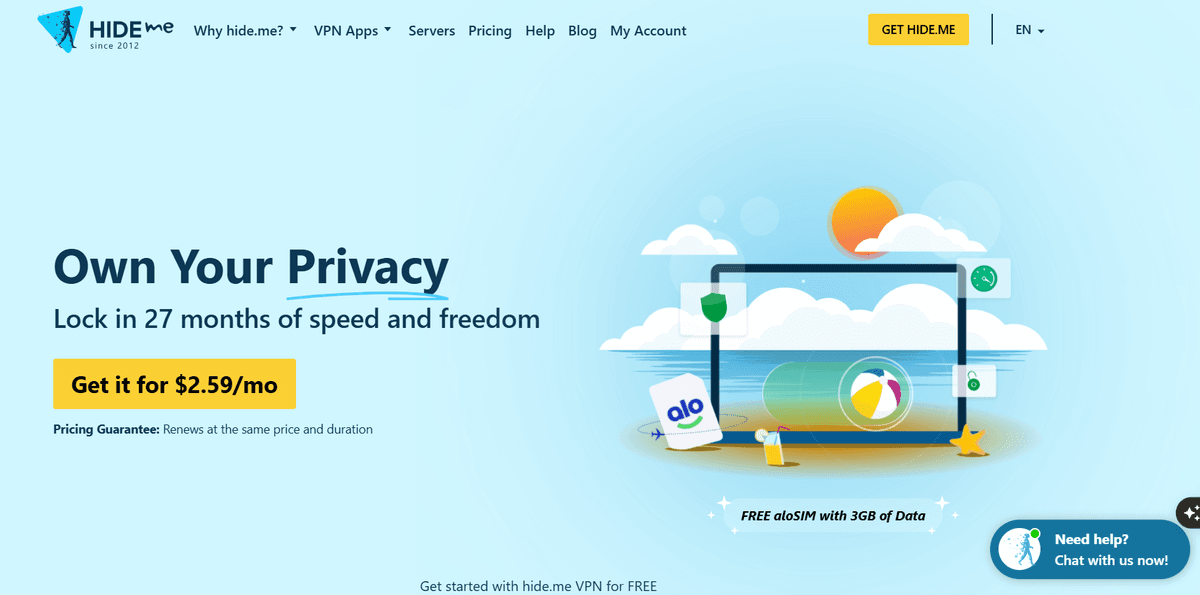
hide.me is a good fit for advanced users who want substantial control over protocols, routing, and app behavior. It supports WireGuard, OpenVPN, IKEv2, SoftEther, SSTP, split tunneling, a configurable kill switch, IPv6 support, and multi-hop connections.

For an eCommerce business, that configuration depth can help technical staff route store-management tools through the VPN while leaving local printers, warehouse applications, or latency-sensitive services outside the tunnel.

What I like about hide.me

Split tunneling and configurable connection controls are useful when a business cannot send every application through the same VPN route.

The ten-device allowance on paid plans is enough for a small company or a compact group of administrators.

Its public reviews are broadly positive. The provider had a 4.3 Trustpilot score from more than 1,000 reviews, with customers frequently mentioning ease of use and connection reliability. Some reviews also note occasional speed or support issues.

Where hide.me falls short

The large number of protocols and settings can make the service less approachable for non-technical users.

Feature availability and interface quality may differ between Windows, macOS, and mobile apps, so teams should verify the exact controls available on their main operating systems.

The provider’s older public audit history may be a concern for buyers that expect frequent, highly visible independent assessments.

Pricing

hide.me offers a free plan, although free-tier restrictions apply.

At the time of research, long-term pricing was advertised from approximately $3.45 per month, while the regular monthly plan was around $9.95. Promotional rates and subscription lengths can change, so buyers should confirm the total amount billed before purchasing.

6. PrivadoVPN

PrivadoVPN

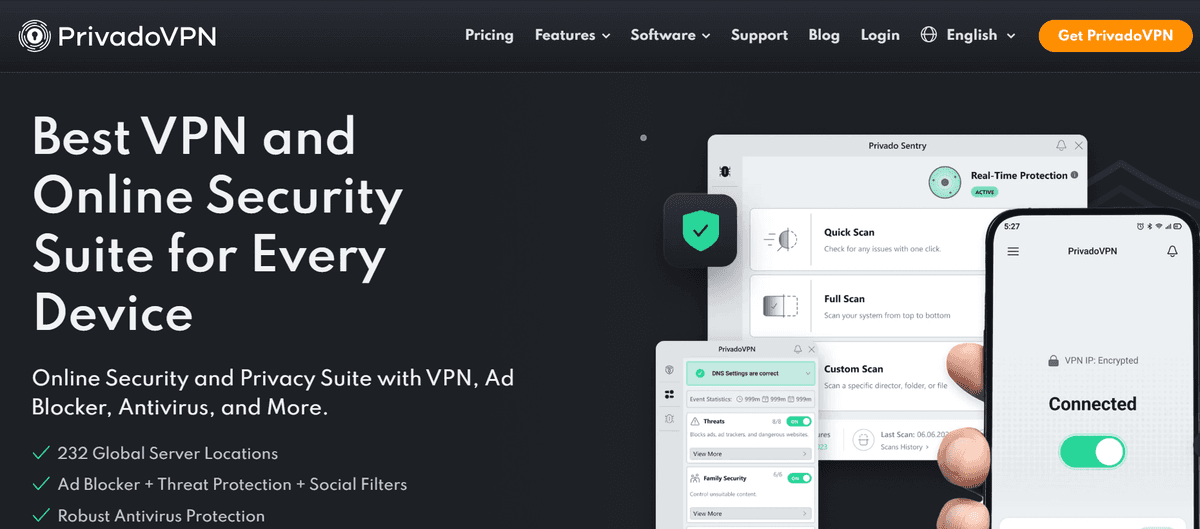
PrivadoVPN is a practical option for smaller stores that want essential VPN functions without paying for a large collection of advanced tools. Its service includes a kill switch, split tunneling, WireGuard, OpenVPN, IKEv2, secure DNS, threat filtering, an ad blocker, and up to ten simultaneous premium connections.

Its strongest arguments are price, straightforward applications, and a usable free tier.

What I like about PrivadoVPN

PrivadoVPN’s free plan provides 10GB of data per month, making it useful for short evaluations or occasional secure browsing.

The premium service covers up to ten simultaneous connections, which should be enough for many owner-operated stores and small technical teams.

Recent independent testing described it as exceptionally fast and inexpensive, with simple apps and solid essential security features.

Where PrivadoVPN falls short

Its network is smaller than those of many more established providers.

Advanced features such as multi-hop routing are limited or absent, so it is better suited to straightforward protection than highly customized threat models.

Public reporting has also noted that the service lacks a recent third-party no-logs audit. Support is primarily knowledge-base and ticket driven rather than built around immediate engineering assistance.

Pricing

PrivadoVPN offers a free plan with 10GB of monthly data.

Promotional premium plans have been advertised as low as $1.11 per month on long commitments. Pricing varies by offer and subscription length, so buyers should check the renewal amount and total upfront charge rather than relying only on the displayed monthly equivalent.

A 30-day money-back guarantee is advertised for eligible paid plans.

7. PrivateVPN

PrivateVPN

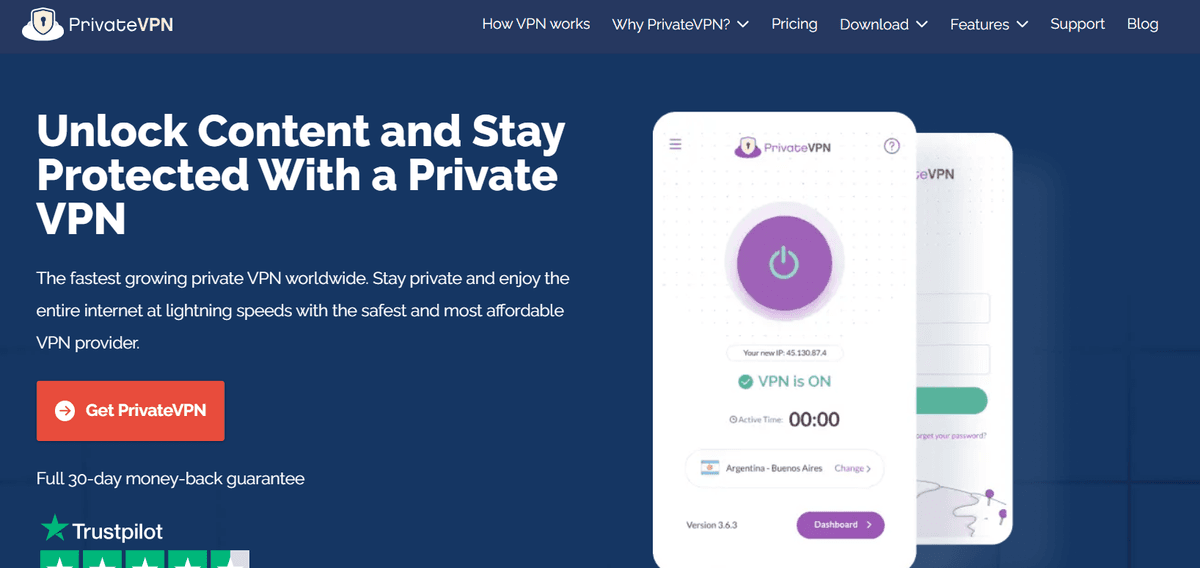
PrivateVPN is a good option for merchants that value straightforward plans and accessible customer support. It supports ten simultaneous connections, applications across major operating systems, unlimited bandwidth, servers in 63 countries, and round-the-clock support.

It is less differentiated technically than Mysterium or IVPN, but its customer-service reputation makes it worth considering for teams that do not have internal VPN expertise.

What I like about PrivateVPN

All paid plans include the same core applications and features, which makes plan selection simpler.

The ten-device allowance is competitive for a smaller store.

Customer reviews are a notable strength. PrivateVPN had a 4.7 Trustpilot score from more than 4,700 reviews. Recent feedback frequently praises fast, patient support, although occasional connection problems also appear in the review record.

Where PrivateVPN falls short

Its network spans fewer countries than several options in this guide.

The service does not provide the same level of public technical documentation, open-source development, or audit visibility as some privacy-focused alternatives.

It is still primarily a consumer VPN. Businesses requiring account provisioning, centralized user management, policy reporting, and access logs should look beyond a shared subscription.

Pricing

PrivateVPN lists a one-month plan at $9.90, although some promotional landing pages show $11.99.

A three-month plan costs $17.99, or approximately $6 per month.

The long-term promotion provides 36 months for $72, equal to $2 per month. The page states that the subscription is billed at $72 every 12 months after the initial 36-month period, so buyers should review the renewal language carefully. All listed plans include a 30-day money-back guarantee.

8. AdGuard VPN

AdGuard VPN

AdGuard VPN is a useful choice for eCommerce teams that want VPN protection combined with filtering and DNS-related privacy tools. It supports exclusion lists, a kill switch, encrypted connections, tracker blocking, and up to ten devices.

The service is especially relevant to marketing and merchandising teams that regularly inspect ad-heavy pages, competitor sites, and regional search results.

What I like about AdGuard VPN

The exclusion-list system gives users control over which websites or applications should bypass the VPN. This can reduce conflicts with banking platforms, local devices, payment providers, or services that react poorly to VPN traffic.

AdGuard also has a broader ecosystem of ad blocking, tracker protection, and DNS filtering products. That can be convenient for a team that prefers to manage several privacy controls through related applications.

The company documents selective use of residential IP addresses for certain resources, although businesses should confirm availability for their intended locations and workflows before relying on this capability.

Where AdGuard VPN falls short

AdGuard’s product range can make it difficult to determine which protections come with the VPN and which require a separate AdGuard subscription.

The service does not provide the centralized employee administration or access-policy functions of a dedicated business networking platform.

Public review scores often cover the wider AdGuard product family rather than the VPN alone, so I would not treat the company-level ratings as a precise measure of VPN performance.

Pricing

AdGuard VPN has been listed at $11.99 month to month or $47.88 per year, equivalent to $3.99 per month when billed annually. Paid plans support up to ten devices and may include access to AdGuard DNS Personal.

Discounts vary, so verify the checkout total, renewal rate, and whether the offer covers AdGuard VPN or the separate ad-blocking product.

9. TunnelBear

TunnelBear

TunnelBear is best for small eCommerce teams that prioritize ease of use. Its applications are intentionally approachable, while still providing AES-256 encryption, a kill switch called VigilantBear, split tunneling through SplitBear, and obfuscation through GhostBear.

Unlike many consumer-focused VPN providers, TunnelBear offers a Teams plan for businesses with at least two users.

What I like about TunnelBear

The Teams plan provides centralized billing and administration, making TunnelBear more practical for multiple employees than a shared consumer login.

Paid plans support unlimited devices, which reduces licensing friction for staff working across computers and phones.

The interface is well suited to non-technical users. G2 and Capterra reviewers commonly praise the design, connection stability, and straightforward setup. Aggregated figures available during research showed 4.4 on G2 and 4.5 on Capterra.

Where TunnelBear falls short

The free plan only includes 2GB of data, so it is mainly an evaluation option.

Its interface is simple, but technical teams may find the configuration options more limited than those offered by IVPN, hide.me, or Windscribe.

Businesses that need residential IPs, fixed IPs, detailed access reporting, or extensive location controls should verify that TunnelBear supports the exact requirement before deploying it.

Pricing

TunnelBear has a free plan with 2GB of data.

The Unlimited plan has been advertised from $3.33 per month and includes unlimited browsing and unlimited devices.

The Teams plan costs $5.75 per user per month and requires at least two users. It includes centralized team functionality and priority support.

10. VyprVPN

VyprVPN

VyprVPN is best known for its proprietary Chameleon protocol, which is designed to make VPN traffic less obvious on networks that restrict or interfere with conventional VPN connections. That can be useful for staff travelling in regions with network filtering or restrictive internet access.

It supports major operating systems and operates a conventional global VPN network, but it is less tailored to eCommerce research than Mysterium and less transparent than privacy-first providers such as Mullvad or IVPN.

What I like about VyprVPN

Chameleon is the clearest differentiator. It can help on networks where standard VPN protocols are blocked or throttled.

VyprVPN has also previously commissioned an independent assessment of its no-logging practices, which is preferable to relying only on an unverified privacy claim.

Its applications are generally designed for regular users rather than security specialists, making deployment relatively straightforward.

Where VyprVPN falls short

Public customer feedback is mixed, with complaints involving speeds, kill-switch behavior, compatibility, and support appearing alongside positive reviews.

The service has limited team administration and is not designed as a full corporate remote-access system.

Current pricing information has also been inconsistent across public pages and third-party sources. Buyers should verify the checkout amount and renewal terms directly before purchasing.

Pricing

Recent pricing references place VyprVPN between roughly $3 and $5 per month depending on subscription length and promotion, with no permanent free plan. Because public pricing has varied, use the amount shown at checkout as the source of truth.

What’s the best VPN for eCommerce businesses right now?

Mysterium VPN is the best overall choice for eCommerce businesses that need encrypted connections plus residential IPs and detailed geographic selection. Windscribe is a strong alternative for teams with many devices, while IVPN and Mullvad are better suited to privacy-focused technical users.

Best overall VPN: Mysterium VPN

Mysterium VPN stands out because its residential IP options and city-level location controls map directly to eCommerce workflows such as localized storefront reviews, regional advertising checks, market research, and international product monitoring.

Its plans also support between six and fifteen devices, making it practical for solo operators and smaller teams.

Best for distributed small teams: Windscribe

Windscribe is the strongest option for teams that want unlimited simultaneous connections and flexible billing.

Its Build-A-Plan and ScribeForce options allow companies to pay for specific locations or establish separate team accounts without purchasing a large enterprise networking product.

Best for privacy-focused technical teams: IVPN

IVPN is a good fit for cybersecurity teams that care about open-source clients, audits, multi-hop routing, obfuscation, anonymous registration, and documented limitations.

Its network is smaller, but its transparency is stronger than that of many mass-market VPN providers.

Best for anonymous signup: Mullvad

Mullvad is the simplest choice for users who do not want to provide an email address or commit to a long subscription.

Its flat €5 monthly price and randomly generated account numbers make it easy to understand and limit the personal data attached to an account.

Best for beginners: TunnelBear

TunnelBear offers approachable applications, unlimited devices on paid plans, and a dedicated Teams tier.

It is a sensible option for small businesses whose employees need basic VPN protection without extensive configuration.

Best free option: Windscribe

Windscribe’s free plan offers up to 10GB per month after email verification and access to servers in 11 countries.

That allowance is not enough for full-time business use, but it provides a practical way to assess connection quality, application compatibility, and general usability before subscribing.

FAQ

1. Why does an eCommerce business need a VPN?

A VPN encrypts internet traffic between an employee’s device and the VPN server. This is useful when staff access store dashboards, advertising accounts, supplier systems, analytics platforms, or customer-service tools over hotel, airport, coworking, or café Wi-Fi.

A VPN can also provide a different regional IP address for localized testing. It does not replace multi-factor authentication, strong passwords, endpoint security, or access controls.

2. Are residential IPs useful for eCommerce?

Residential IPs can be useful for viewing websites, search results, prices, advertisements, and availability as they appear to ordinary users in a particular market. They may also be less likely than data-center VPN addresses to trigger blanket VPN blocking.

Merchants should still follow website terms, advertising-platform rules, and applicable privacy laws. A residential IP should not be used to evade legitimate fraud, payment, or account-security controls.

3. Can a VPN cause problems with Shopify, Amazon, payment platforms, or banks?

Yes. Sudden IP or country changes can trigger additional authentication, fraud checks, or temporary account restrictions.

Use a consistent location for important administrative accounts, avoid rapidly switching countries, enable multi-factor authentication, and consider split tunneling for services that reject VPN connections. Teams should also confirm whether a provider offers a dedicated or fixed IP when consistent allowlisting is required.

4. Should an eCommerce company use a consumer VPN or a business VPN?

A consumer VPN may be enough for a founder, freelancer, or small team that mainly needs encrypted browsing and regional IP access.

A dedicated business VPN or zero-trust access platform is more appropriate when the company needs centralized onboarding, identity-provider integration, user removal, device policies, static gateways, audit records, or access to private internal systems.

5. What features matter most in an eCommerce VPN?

The most important features are a kill switch, DNS leak protection, reliable modern protocols such as WireGuard or OpenVPN, stable connections, appropriate location coverage, enough device slots, and clear privacy terms.

For international research, city selection and residential IP access may also matter. For teams, centralized billing, account administration, and fixed IP support are more important than entertainment or streaming features.

Gintarė Mažonaitė

Author

Gintarė Mažonaitė

Tech Writer and VPN Researcher Gintarė is a cybersecurity writer at Mysterium VPN, where she explores online privacy, VPN technology, and the latest digital threats. With hands-on experience researching and writing about data protection and digital freedom, Gintarė makes complex security topics accessible and actionable.


Share post

Similar posts