Ecommerce for Retail: How to Build a Profitable Online Store in 2026
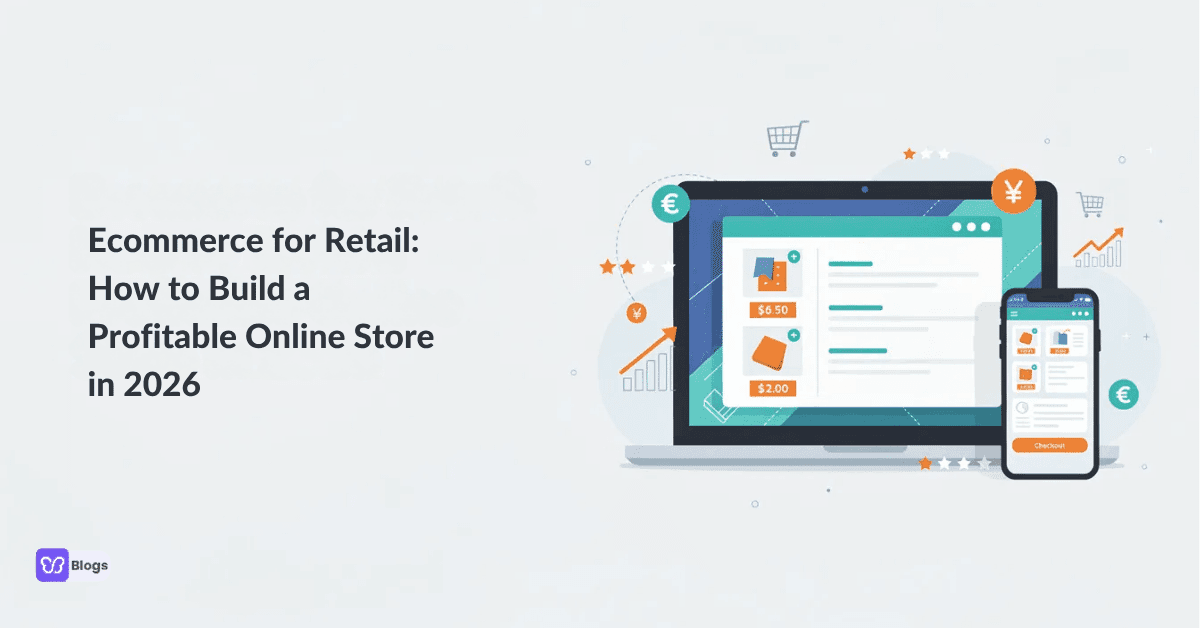
Implementing ecommerce solutions transforms traditional retail businesses into dynamic operations capable of reaching customers far beyond their front doors. In Q2 of 2026, U.S. retail ecommerce sales hit $340.2 billion—up 12.2% year-over-year—accounting for 17.1% of all retail transactions. In 2025, retail ecommerce sales worldwide hit $3.6 trillion, and ecommerce businesses expect 54% of revenue from digital channels by 2025.
This article shows you how to build a profitable online store and e commerce online shop as a retailer, covering everything from e commerce online basics to logistics, marketing strategies, and ecommerce trends. Whether you run a brick and mortar store or are starting fresh, this is your roadmap to start selling.
What Is Ecommerce for Retail?
Ecommerce for retail means selling physical and digital products through an ecommerce website instead of—or alongside—a physical store.
So what is an e commerce website? It is a site featuring a product catalog, shopping cart, checkout, payment processing, and order tracking. If you are wondering whats an e commerce store or what's an e commerce store, think of it as the digital counterpart to a high-street shop—open 24/7, capable of serving internet users anywhere. Ecommerce businesses can operate 24/7 without geographical limitations.
Unlike selling only through an online marketplace like Amazon or Etsy, running your own ecommerce website gives full control over branding, customer data, and margins. Ecommerce platforms enable global market reach without the costs of new physical branches, and ecommerce allows retailers to lower overhead costs by reducing physical storefront expenses.
Real examples prove this works. Redner's Markets (68 grocery locations) launched a unified mobile app integrating ecommerce ordering with loyalty. Wright's Market relaunched its own online shopping platform to bring personalized local service online. Both show that even regional retailers can sell products online successfully.
How Does E‑commerce Work for Retailers?
Customer Journey Example
Picture this: a customer discovers a linen dress on social media, clicks through to your ecommerce site, browses category pages with filters for size and color, reads customer reviews, and adds the item to cart. At checkout, they choose from cards or digital wallets, pay through secure payment gateways, and receive an order confirmation.
Core Components
This e commerce shopping online journey involves several core components:
Storefront (design, navigation)
Checkout flow
Payment processing
Shipping labels
Returns handling
Ecommerce platforms manage product listings, payments, and customer interactions throughout the process.
Operational Efficiency
Behind the scenes, inventory management systems help track stock levels in real time, the order routes to fulfillment, and a carrier ships the package. Ecommerce solutions improve operational efficiency by automating processes such as order fulfillment.
Key Retail Ecommerce Business Models
Understanding ecommerce business models helps you pick the right approach:
Business to consumer (B2C): A retailer sells directly to individuals via its online store ecommerce site. B2C ecommerce sales are projected to reach $4.9 trillion by 2030.
Direct to consumer (DTC): DTC brands sell directly to consumers without intermediaries—think digitally native online brands using subscriptions or bundles.
Business to business (B2B): Selling products or services to other businesses. B2B ecommerce is expected to hit $36 trillion by 2026.
C2C: Consumer-to-consumer platforms; C2C ecommerce includes platforms like eBay and Craigslist.
C2B: C2B allows individuals to sell services to businesses, like freelancers offering services online or online courses.
Omnichannel: eCommerce creates an omnichannel experience blending digital and physical shopping-combining your shop e commerce site with in-store pickup, ship-from-store, unified inventory, and hyperlocal discovery tools like Sekel Tech that help shoppers find and get routed to the nearest physical store.
These business models influence pricing, logistics, and marketing strategy. A boutique apparel brand might start DTC, while a multi-location chain goes omnichannel. Hybrid strategies—like showrooming in a brick and mortar store while running an online e commerce catalog—are increasingly common.
Market Research: Validate Your Retail Niche Before You Start
Before you start selling, market research is non-negotiable. Use Google Trends to spot rising interest (e.g., "sustainable home décor" spiked in 2025–2026), check marketplace bestseller lists to identify gaps, and use social media platforms for social listening.
A well-defined niche reduces competition and attracts the right customers. Good research feeds directly into assortment planning, pricing, and positioning on your ecommerce site—helping you sell goods that the online market actually wants.
Ecommerce faces high competition due to low barriers to entry, which makes research even more critical for building a successful ecommerce business.
Choosing the Right Ecommerce Platform for Retail
A modern e commerce online shop platform should include inventory management, shipping tools, analytics dashboards, and POS integration. Ecommerce platforms manage product listings, payments, and customer interactions—so choose carefully.
Hosted vs. Self-Hosted Platforms
Hosted Platforms (SaaS) | Self-Hosted Platforms |
|---|---|
Built-in security | More customization |
Easier setup | Requires technical resources |
Regular updates | Greater control |
Prioritize search engine optimization capabilities, mobile commerce performance, and secure payment gateways. Your ecommerce platform is the foundation of your entire online business—it determines how effectively you can attract customers and sell products.
Designing a High‑Converting Online Storefront
Your home page should communicate brand value instantly. Category pages need clean filters (size, color, price) and sort options.
More than half of online shopping occurs on mobile devices, so mobile-first design is essential. A sluggish website can repel customers before they explore offerings.
Optimizing Checkout Flow
Checkout flow matters enormously. Studies show over 70% of online shoppers abandon carts, but large sites can gain up to 35% increases in conversion rate by simplifying checkout UX.
Keep form fields minimal
Offer guest checkout
Display shipping costs early
These small changes directly boost online sales.
Product Pages That Sell: Content, Images, and Trust Signals
Creating Compelling Product Content
Each product page on your online store needs high-quality photos from multiple angles, benefit-oriented descriptions, specifications, and reviews. Since shoppers cannot touch items when doing e commerce shopping online, detailed content fills that gap.
For some products, visual tools can make that online experience more informative. Eyewear is a good example, since shoppers are not only comparing features but also trying to picture how a particular frame will look on them. Oakley, for instance, offers a virtual try-on tool, which gives shoppers another way to assess frames before making a decision. This can be particularly useful when looking at newer products such as Oakley Meta recording glasses, where the shopper may want to consider both the design and the technology before buying.
Adding Trust Signals
Add trust signals:
Security badges
Money-back guarantees
Transparent shipping and returns info
Before optimization, a sneaker page might have tiny images, no size chart, and hidden shipping costs. After: zoomable photos, video, user reviews, and delivery estimates displayed upfront. This approach directly increases online purchases and customer satisfaction.
Essential Retail Ecommerce Technology Stack
Your core stack includes:
Ecommerce platform
Payment gateway
Customer relationship management (CRM) software
Inventory system
Email marketing tool
Analytics
Streamlined inventory management is facilitated by real-time synchronization in ecommerce—when an item sells in your physical store, online stock updates automatically.
eCommerce integrates analytics for data-driven customer insights and targeted marketing. CRM tools track repeat purchase behavior and enable personalized offers, turning one-time buyers into loyal customers. This integration across online channels keeps your ecommerce company running smoothly.
Retail Logistics and Supply Chain for Ecommerce
Supply chain decisions—warehousing, dropshipping, third-party logistics—directly affect margins and delivery speed. Fast and reliable shipping increases customer satisfaction and loyalty, while shipping challenges can significantly impact customer satisfaction in ecommerce.
Whole Foods built a 10,000-square-foot automated micro-fulfillment center inside a store to handle online orders alongside physical shopping. Kroger listed approximately 2,700 stores on DoorDash for one-hour delivery.
For smaller ecommerce sellers, ship-from-store or regional 3PL partnerships offer cost-effective alternatives. Choose packaging and carriers that match your brand positioning and customer expectations.
Multichannel Retail: Selling Beyond Your Own Site
Multichannel retail means running your own ecommerce website plus listing on online marketplaces, social media platforms, and other online channels.
In 2023, US-based sellers sold over 4.5 billion items on Amazon.
In 2023, brand owners' sales grew more than 22% on Amazon, and Amazon sellers averaged over $250,000 in annual sales.
Best Buy's third-party marketplace now offers 11x more products than its stores. But treat your own e commerce store as the hub and marketplaces as spokes—this way you own the customer data and build your own brand equity as an online retailer.
Driving Traffic: SEO, Ads, and Email for Retailers
Search engine optimization helps your online e commerce site rank for intent-based queries on search engines (e.g., "best running shoes 2026"). Paid advertising via Google Shopping and Meta accelerates visibility for a new e commerce online shop. Digital marketing through email and SMS nurtures repeat online transactions and cross-sells.
Start with:
5–10 core keywords
1–2 ad campaigns
A welcome email sequence plus abandoned cart flow
Connect these acquisition and retention tactics to ecommerce success metrics like revenue per visitor. Ecommerce businesses expect 54% of revenue from digital channels—so invest accordingly.
Data and Analytics: Understanding Retail Ecommerce Performance
Key metrics for any online store:
Conversion rate
Average order value (AOV)
Repeat purchase rate
Online sales channel mix
Use analytics from your ecommerce website, email platform, and ad accounts to refine campaigns.
Run monthly reviews: check dashboards for conversion by channel, page speed, and checkout drop-offs. Example: a retailer notices mobile checkout conversion drops; investigation reveals page load times exceeded four seconds; after optimizing, conversion recovered. eCommerce integrates analytics for data-driven customer insights and targeted marketing—use it.
Customer Experience, Support, and Retention
94% of customers say positive service experiences lead to more purchases. Response time, clear policies, and friendly support shape perception of your e commerce store. Offer live chat, chatbots, email, and self-service FAQs.
eCommerce can enhance customer experiences through personalization and tailored recommendations. Loyalty programs, points systems, and tiered access turn one-time buyers into loyal customers.
One fashion retailer boosted repeat orders by introducing a simple two-tier loyalty program offering free shipping after a spend threshold—proof that customer loyalty drives long-term ecommerce success.
Compliance, Payments, and Security for Retail Ecommerce
Every ecommerce business needs:
Published terms and conditions
A privacy policy
Returns policy
Tax compliance
Ecommerce enables multiple payment options to enhance customer convenience—cards, digital wallets, buy-now-pay-later. Customers need to trust your store with their payment information.
Payment gateways securely process online transactions for ecommerce sites through PCI compliance and SSL certificates. In 2025, Amazon removed over 100 websites attempting fake reviews or counterfeit sales—a reminder that lost trust is devastating. Good ecommerce platforms handle much of this security heavy lifting for you.
Common Mistakes Retailers Make Moving Into Ecommerce
Skipping market research: Launching into an overcrowded niche without data.
Fix: Keyword research, competitor audits, small-scale testing.
Underestimating logistics: Failing to plan fulfillment costs.
Fix: Pilot orders, estimate shipping, consider 3PL.
Ignoring mobile UX: Broken checkout on mobile devices kills conversion.
Fix: Test on real phones, optimize speed.
Neglecting CRM: Focusing only on acquisition while ignoring retention.
Fix: Email lifecycles, segmented campaigns, customer loyalty programs.
Ecommerce faces high competition due to low barriers to entry—avoiding these mistakes gives you an edge over potential customers who shop online and encounter poor experiences elsewhere.
Step‑by‑Step Checklist to Start Selling Online
Weeks 1–2: Conduct market research. Validate your niche, analyze competitors, and choose your business models.
Week 3: Select an ecommerce platform, set up your domain, and configure product variants and POS integration.
Week 4: Design your online shop e commerce storefront—homepage, category pages, product pages. Set up payment processing and shipping.
Week 5: Build your tech stack—CRM, email marketing, analytics. Test checkout on mobile devices. Ensure everything syncs.
Week 6: Soft launch. Begin SEO groundwork, run initial ad campaigns, post on social media, and list on at least one online marketplace.
The Future of Ecommerce for Retail
Ecommerce sales are projected to reach $8.09 trillion by 2028. Scalability in ecommerce allows retailers to grow without physical limitations quickly. Near-term ecommerce trends for 2026 include AI merchandising, AR try-ons, and unified online/offline inventory through enterprise ecommerce and composable commerce solutions.
Voice search and conversational AI are changing how shoppers find an online shop e commerce brand. Nearly half of businesses already use AI for personalization. Smaller online retailers don't need to adopt everything today—starting with a lean, well-run e commerce online shop positions you to integrate new tech as it matures.
The retailers winning in 2026 aren't the biggest—they're the ones who started.
FAQ: Quick Answers About Retail Ecommerce
What is an e commerce website?
It is a website where you list products or digital products, allow customers to browse, add to cart, pay, and receive orders—with features like product pages, checkout, and order tracking. It is the foundation of any ecommerce business.
What's an e commerce store?
It is synonymous with an ecommerce website—a digital shop that functions like a physical store with inventory, payment, and shipping, allowing you to shop online and purchase online anytime.
Can a small retailer run a profitable online shop e commerce in 2026?
Yes. Many independents see revenue growth exceeding 100% year-over-year when adding online channels properly. Edwards Food Giant saw GMV up 141% after partnering with an ecommerce storefront solution.
E commerce online shop vs. in-store retail: which should I build first?
Ideally both. If budget is tight, start with an online presence (lower overhead) and add physical later. Aim for omnichannel as you grow your ecommerce company.
Is e commerce shopping online suitable for all retail categories?
Apparel, accessories, home décor, and groceries have strong demand for selling online. High-luxury or bespoke categories still benefit from in-person, but AR and personalization are expanding what works as an online sales channel.
How much does it cost to start?
An ecommerce platform subscription, domain, and basic digital marketing can start under $100/month. The real investment is time—building product pages, running campaigns, and optimizing the customer experience.

Author
Debutify
Debutify is the easiest way to launch and scale your eCommerce brand.