Client Journey Mapping: How to Create Customer Journey Maps That Actually Drive Revenue
Most ecommerce brands track clicks, conversions, and revenue. Few actually understand what their customers feel, think, and struggle with between those data points. That gap is where client journey mapping earns its keep. This guide walks you through what journey maps are, why they matter, and how to build one that directly impacts your bottom line.
What Is Client Journey Mapping?
So, what is a customer journey map? It is a visual, time-based diagram that connects stages, touchpoints, activities, emotions, and pain points for a specific persona and goal. And what is a customer journey mapping exercise? It is the structured process of building that diagram using real customer data rather than internal assumptions.
The definition of customer journey mapping centers on visualizing every step, emotion, and decision a customer makes from first brand touch to long-term loyalty. The definition of customer journey map is essentially the artifact itself: a living document that shows how customers interact with your brand across channels and over time. Customer journey maps visualize customer interactions with a brand and look at the experience strictly from the client's perspective.
Whether you call it customer mapping journey or journey mapping marketing, the core method stays the same. Customer journey mapping marketing teams emphasize awareness-to-purchase stages, while customer success teams focus on post-purchase retention. Product teams use the same framework for feature prioritization.
Why Client Journey Mapping Matters for Customer Experience and Growth
Strong customer experience programs reduce churn by roughly 10–15% and can increase win rates by around 40%. A good customer experience can generate three times returns to shareholders. Customer journey mapping can increase customer retention by 32%. These numbers make the case clear: mapping customer journeys can increase customer retention by identifying pain points and fixing them before they cost you revenue.
Understanding the client journey often leads to improved marketing and sales effectiveness. Client journey mapping can improve retention and lifetime value by enhancing the customer experience and reducing friction across the entire customer journey. Journey maps make invisible friction visible, helping teams prioritize fixes that serve both customer satisfaction and business goals.
Customer journey mapping marketing aligns acquisition campaigns with post-purchase customer success journeys. Ad performance, email flows, and on-site UX can all reference the same map. The key shift: mapping from the customer's perspective, not internal process steps, is what drives meaningful improvements in customer interactions and brand loyalty.
Key Components of an Effective Customer Journey Map
Every practical journey map, regardless of niche, should include these key components:
Persona and Goal
Who are you mapping for, and what outcome are you tracking?
Customer journey maps include personas representing key audience segments.
You create customer personas grounded in real customer data and buyer personas.
Journey Stages
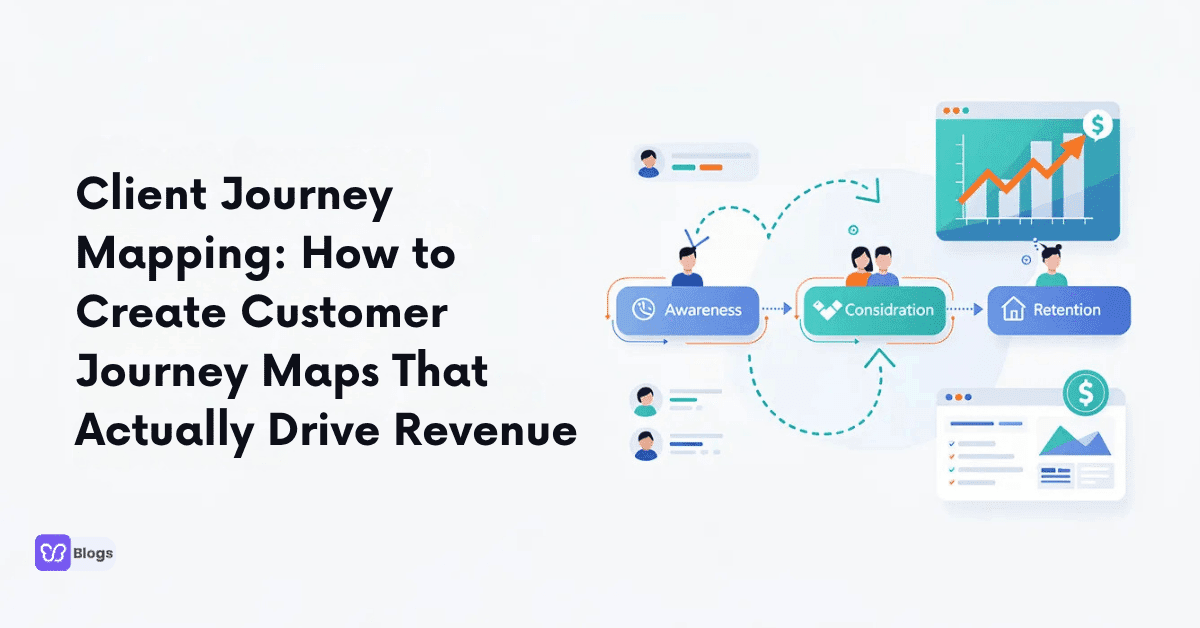
Common journey stages are awareness, consideration, purchase, retention, and advocacy.
A customer journey map includes stages from awareness to advocacy, covering the entire customer lifecycle.
Touchpoints
Customer journey maps include various touchpoints like websites and emails.
Touchpoints are specific interactions between customers and businesses, and they are specific moments customers engage with a brand.
A customer journey map outlines each touchpoint in the customer lifecycle.
Touchpoints influence customer decisions and overall satisfaction levels.
Actions and Tasks
What the customer takes as steps: searches, compares, adds to cart, contacts support.
Emotions and Pain Points
69% of consumers say emotions influence their experiences, and 69% of consumers say emotions count for over half their experiences.
Emotional responses at touchpoints affect customer decisions.
Emotions and pain points reflect customer feelings at each touchpoint.
Understanding customer emotions enhances targeted experiences.
Metrics and Signals
KPIs per stage drawn from both solicited and unsolicited data: analytics, surveys, session replays, reviews.
Ownership and Systems
Which teams and tools sit behind each step, extending toward service blueprint depth when needed.
A customer journey map is a living document that evolves with customer feedback. It should be updated as products and campaigns change. Visually, think horizontal timeline with rows for actions, emotions, pain points and opportunities.
Customer Journey Map vs. Funnel vs. Marketing Journey Map
Customer journey map marketing teams often confuse funnels with journey maps. A funnel tracks impression → click → lead → sale. A journey map marketing view goes further: awareness → research → comparison → purchase → onboarding → repeat purchase → advocacy, capturing the buyer journey and user journey in full.
A content journey map focuses specifically on which content formats support each stage. A marketing journey mapping exercise sequences campaigns, creatives, and channels around customer needs instead of internal calendar dates. Funnels optimize for conversion velocity. Journey maps optimize for lifetime value, customer satisfaction, and customer success outcomes.
What Is the Purpose of a Customer Journey Map?
What is the purpose of a customer journey map? It turns fragmented customer interactions into a coherent narrative. What does a customer journey map help marketers do? Here is a concrete list:
Reveal pain points and drop-offs that analytics alone cannot explain
Align marketing, product, and customer success teams around a shared understanding of the client experience
Turn scattered customer stories into actionable insights
Link CX gaps to clear projects and business goals
Decide where personalization or automation will have the biggest impact
Help brands discover optimization opportunities
Identifying touchpoints helps prioritize resources and optimize experiences. Effective client journey maps should reveal customer struggles and opportunities for improvement. Identifying pain points can enhance customer satisfaction and loyalty, helping businesses prioritize improvements to enhance client experience. Customer journey maps help identify opportunities for improving experiences. For marketers specifically, maps guide channel mix, messaging, offer structure, and budgeting at each stage.
Types of Journey Maps: From CX Views to Service Blueprints
Different journey maps serve different decisions. Choosing the right type matters more than picking a pretty customer journey map template:
Type | Focus | Best For |
|---|---|---|
Current-state map | How the journey works today | Spotting friction now |
Future state map | Ideal experience in 6–18 months | Strategic planning |
Day-in-the-life map | Broader context beyond your brand | Finding unmet needs |
Service blueprint | Internal systems, SLAs, backstage roles | Fixing operational failures |
A service blueprint connects frontstage customer steps to support queues, logistics, and internal processes. Small teams should start with current-state maps and layer detail later.
Choosing or Designing a Customer Journey Map Template
A good customer journey map template speeds up work but must be adapted to your business. Essential fields: persona, scenario, stages, actions, touchpoints, emotions, pain points, metrics, and opportunities. Ecommerce templates might add rows for device type, traffic source, and key onsite behaviors.
Format options range from spreadsheets (fast, shareable) to whiteboard tools (visual, collaborative) to specialized customer journey mapping tools (deeper analytics). Keep templates simple enough to read in two to three minutes but detailed enough to guide roadmaps.
The Journey Mapping Process: Scope, Research, Map, Act
The customer journey mapping process has four macro stages:
Scope – Pick persona, journey, and business outcome
Research – Gather solicited and unsolicited data plus qualitative customer feedback
Map – Visualize stages, actions, emotions, and pain points
Act – Translate insights into prioritized experiments
Time-box each stage. One week scoping, two to three weeks research, one week mapping, then ongoing execution.
Step 1: Define Goals, Persona, and the Journey to Map
To create a customer journey that is narrow and testable, choose one persona (for example, a first-time mobile buyer aged 25–35 discovering you via Instagram), one journey (first ad impression to second purchase), and one measurable goal (increase first-to-second-order repeat rate by 10%). Capture this in a one-page brief before any visual work begins. Define what customer success looks like for both the customer and the business. Different customer segments may need separate maps.
Step 2: Collect Solicited and Unsolicited Customer Data
Gathering real customer data is essential for building an accurate client journey map. Effective journey maps require both solicited and unsolicited customer data.
Solicited data: Survey customers with CSAT, NPS, CES surveys, post-purchase forms, customer surveys, and email feedback. This tells you what customers say.
Unsolicited data: Behavior analytics, session recordings, heatmaps, funnel data, support transcripts, review text, and social comments. This shows what customers actually do.
Combine both to get a comprehensive understanding of customer behavior. Relying on assumptions over research leads to ineffective maps.
Step 3: Visualize the Journey
Define five to seven stages tailored to your business: discover, evaluate, decide, receive, first use, follow-up, loyalty. List all customer interactions at each stage. Add a row for emotions using actual quotes from research. Customer journey maps highlight emotional highs and lows. Mapping emotions helps identify customer pain points.
Mark pain points explicitly. Color-code: green for delight, yellow for neutral, red for friction. Overlay a content journey map showing what content pieces answer which fears or questions at each stage. This is where detailed customer journey maps become actionable rather than decorative.
Step 4: Translate Journey Maps into Actions
Prioritizing high-impact interactions can help improve conversion and customer satisfaction. Journey mapping marketing outputs should include:
Content ideas per stage forming a coherent content journey map
Channel tactics triggered by behavioral signals from the map
On-site UX changes tailored to high-friction stages
Customer service team members and customer success teams can use the same map to redesign onboarding emails and proactive outreach. Use an impact-versus-effort matrix and link every action item to a specific pain point and KPI.
Using Service Blueprints to Fix Internal Breakdowns
Client journey mapping uncovers operational bottlenecks and communication gaps. Service blueprints extend the map to backstage activities:
Frontstage actions
Backstage roles (support agents, warehouse, dev)
Systems (Shopify, email platform, logistics)
Policies (shipping cutoffs, refund rules)
This deeper view explains why certain customer interactions fail even when marketing efforts are strong.
Embedding Customer Stories and Qualitative Insights
Numbers alone cannot convey the human side of customer experience. Add two to three anonymized story snippets per map, tying a real quote to a specific stage and emotion. Stories help executives internalize issues and support investments. Include before-and-after customer stories once improvements are made so the map becomes a narrative of progress.
Common Client Journey Mapping Mistakes to Avoid
Avoiding these traps makes journey mapping far more valuable:
1. Company-First Perspective
Avoid a company-first perspective in journey mapping. Map what customers feel and do, not your org chart.
2. One Generic Map
Creating one map for your entire customer base misses how new customers behave differently from existing customers.
3. Static Treatment
Treating journey maps as static documents is a common mistake. Update quarterly.
4. Ignoring Emotions
Focusing only on clicks while ignoring how customers feel leaves the most powerful signals on the table.
5. Overcomplicating Visuals
Overcomplicating maps makes them unreadable and overwhelming. Keep it scannable.
6. No Ownership
Not tying insights to owners, deadlines, or business goals means nothing changes.
7. Oversimplifying
Oversimplifying customer journeys misses key pain points that drive customer churn.
A customer journey map is a tool to make decisions. If your team cannot explain what they will change after seeing it, it is not clear enough.
Measuring Impact and Iterating on Your Journey Maps
Connect the map directly to experiment results and CX metrics. Choose KPIs per stage:
Click-through on educational content at initial awareness
Add-to-cart rate at the consideration stage
Time to first value post-purchase
Repeat purchase rate
NPS at 30 days
A customer journey map shows where improvements land and where new friction emerges.
Use a mix of solicited and unsolicited data over time through journey analytics to confirm whether mapped changes improve customer experience and customer retention outcomes. Schedule reviews every 90 days to refresh data, re-score pain points, and archive resolved issues. This is what makes customer journey mapping important as an ongoing discipline rather than a one-time workshop.
Getting Started: A Simple One-Page Map You Can Build This Week
You can create a customer journey in under a week for one persona and one product line. Here is a concrete plan:
Day | Task |
|---|---|
Day 1 | Define persona, goal, and journey scope |
Day 2–3 | Pull key analytics and 10–15 pieces of customer feedback |
Day 4 | Draft a simple 6-stage map with actions, emotions, pain points |
Day 5 | Align with team, pick 2–3 quick-win experiments, assign owners |
From this starter, expand into richer journey maps, marketing journey maps, and eventually service blueprints as your practice matures. Walk your own buying process end-to-end while referencing your map to quickly spot mismatches between intent and reality. That single exercise often reveals more valuable insights than months of dashboard watching.
The ideal customer journey is not one without problems. It is one where you see problems before your customers do and fix them before they leave.

Author
Debutify
Debutify is the easiest way to launch and scale your eCommerce brand.