8 Best Link Building Services for Ecommerce Brands in AI Search (2027)
Something changed about how people find products. They still search, but a growing share now read an AI answer instead of clicking ten blue links, and that answer decides which brands get named.
Here's what matters for ecommerce. Ahrefs studied 75,000 brands and found branded web mentions correlated more strongly with appearing in AI Overviews than domain rating, referring domains, or branded search volume did.
So the old goal still works, just for a new reason. You need your brand written about on sites AI systems actually read, at a pace your in-house team probably cannot sustain.
Below are eight services that do that work for you, organized by how they actually deliver. That is the thing that decides whether they fit your store.
Key Takeaways
Branded mentions on real, trafficked sites are what AI answers draw on, so placement quality beats raw link volume.
Delivery model matters more than price: managed services handle everything, marketplaces hand you a catalog, and agencies build custom campaigns.
Content format is a lever most brands ignore, and listicles and comparison guides get pulled into AI answers far more often than generic blog posts.
Ask who controls anchor text and landing pages, because for ecommerce that decides whether links point at collections or at a homepage.
Check turnaround before you sign, since most managed placements take three to four weeks and that changes campaign planning.
How I picked these eight
I looked at delivery model first. A product marketplace, a fully managed service, and a bespoke agency solve different problems, and mixing them into one ranked list without saying so is how buyers end up with the wrong fit.
Then I looked at control. Specifically, whether you choose your own anchors and target URLs, whether you can approve publishers before anything goes live, and what happens when a placement misses your brief.
The 8 best link building services for ecommerce
1. Respona: Best overall for AI visibility
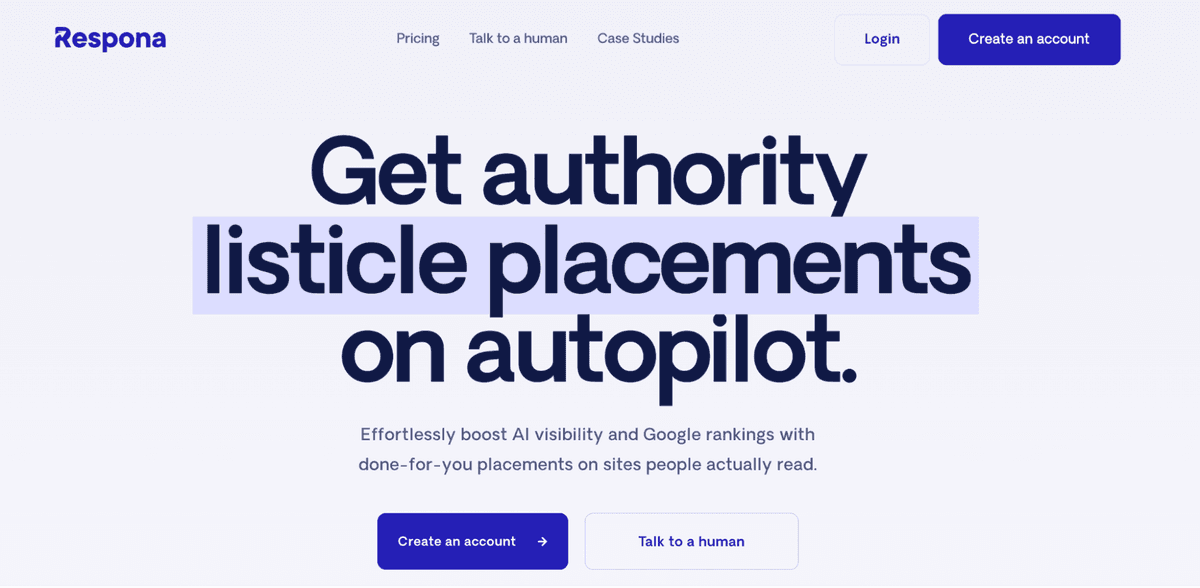
Respona sells done-for-you placements rather than software you have to run yourself. You submit your landing pages, your anchor texts, and your preferred publisher tier, and the work happens from there.
What earns it the top slot is the targeting logic. Respona scrapes your pages to identify their core keywords, finds publishers already ranking for those terms, then picks the term with the lowest competition and the highest CPC and volume before writing anything.
The content step is where the AI angle shows up. They study the top-ranking pages to see which format wins, then build data-driven briefs and produce articles optimized for search and AI answers, in formats you can specify, including listicles, product reviews, comparison guides, and contextual placements.
Control is unusually granular for a managed service. Stay hands-off, or pre-approve every domain and set rules such as specific ccTLDs, available as a paid add-on, and pick a 28-day standard turnaround or a 14-day express option.
Every placement you order is guaranteed to go live within the agreed timeframe, on real sites with genuine traffic and topical relevance rather than PBNs.
Pricing runs from $100 per placement on DR 20+ up to $500 on DR 60+, covering content, outreach, and publishing, with volume discounts from $1,500 a month, and e-commerce stores are one of four audience segments Respona names directly.
2. FATJOE: Best for agencies buying at volume
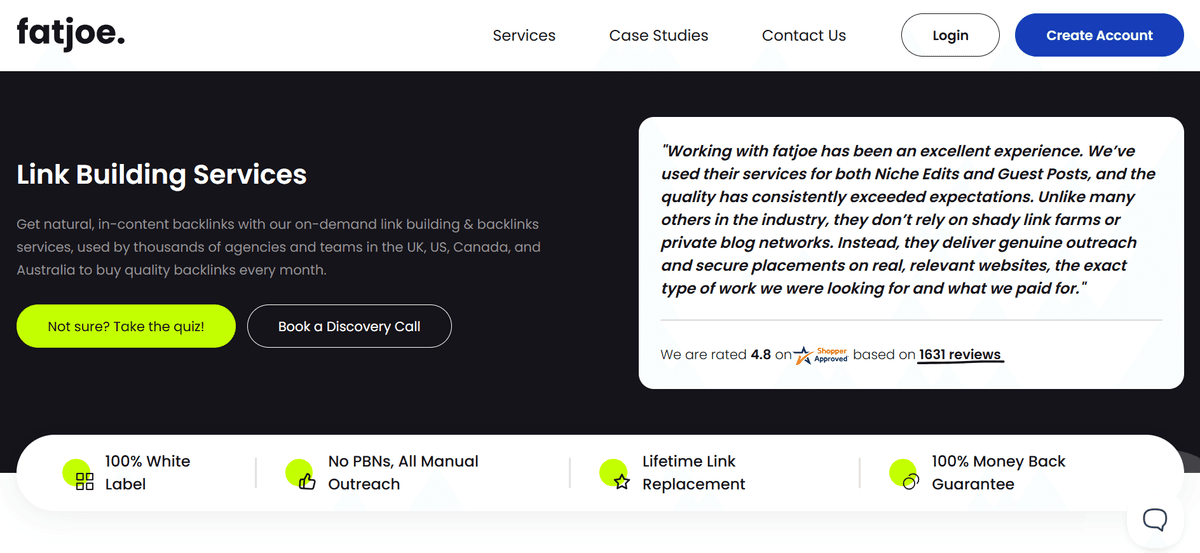
FATJOE has been running since 2012 and has delivered over 241,000 orders in that time. More than 40,000 agency accounts use it, which tells you who it is built for.
The model is a marketplace rather than a campaign. You order individual products from a catalog covering Blogger Outreach, Niche Edits, Media Placements at DR 50 and above, multilingual outreach, infographic outreach, and content syndication.
Everything is white label, so agencies can resell it under their own brand with margins built in. Customer rating sits at 4.8 out of 5 across more than 1,500 reviews.
The trade-off is strategy. You decide what to order and why, which is fine if you already know your link gaps and less useful if you want someone to work that out for you.
3. Loganix: Best for productized ordering
Loganix sells SEO deliverables as fixed products with published pricing, including guest posts and link insertions. You see what a link costs before you talk to anyone.
That transparency suits ecommerce teams working to a defined monthly budget. It also suits agencies who need to quote a client without waiting on a supplier.
The catalog extends past links into technical SEO and content, so it can cover more than one gap at once. As with any marketplace, the campaign thinking stays on your side of the table
4. Rhino Rank: Best for curated link insertions
Rhino Rank focuses on curated links, meaning placements added into existing published articles rather than new guest posts. The advantage is that the host page already has age, traffic, and rankings.
For ecommerce, that can work well on collection and category pages, where a link inside an established article carries weight faster than one on a brand new post. Pricing is published by authority tier.
The limitation is editorial depth. An insertion gives you a mention inside someone else's article rather than a piece written around your brand, which matters if AI citation is the objective.
5. Siege Media: Best for content-led links
Siege Media earns links through content rather than outreach alone. The model is to build assets worth citing, then promote them until publishers pick them up.
For ecommerce brands with budget for original research, tools, or data studies, this produces the kind of coverage AI systems treat as authoritative. It is also the slowest and most expensive route on this list.
Think of it as an investment in assets you keep rather than placements you buy. If you need links live this quarter, look elsewhere.
6. uSERP: Best for high-authority placements
uSERP concentrates on placements in well-known publications rather than volume across mid-tier blogs. The pitch is fewer links from bigger names.
That has obvious appeal for brand-building alongside SEO, since a mention in a recognized publication does double duty. It also costs considerably more per placement.
The fit question is whether your category has authoritative publications covering it. Some ecommerce niches do, and plenty do not.
7. Editorial.Link: Best for managed outreach
Editorial.Link runs managed campaigns focused on editorial placements, handling prospecting, outreach, and content on your behalf. The positioning sits between a marketplace and a full agency.
That middle ground suits brands that want someone else doing the work without a full agency retainer. Reporting and publisher vetting are part of the service.
As with all managed providers, pin down upfront how much say you have over which sites get used. That single question separates a good fit from an expensive disappointment.
8. Stellar SEO: Best for custom ecommerce outreach
Stellar SEO builds outreach campaigns tailored to the client rather than selling from a catalog. Ecommerce and local businesses are both core parts of their work.
Campaigns are scoped individually, so the fit depends heavily on the conversation you have at the start. Ask specifically about product and category page targeting.
It suits stores that have outgrown marketplace ordering but do not need enterprise-scale investment. Expect a scoping call rather than a checkout page.
How to choose
Start with what you actually lack. If you know your link gaps and just need volume, a marketplace is cheaper and faster than a managed service, and if you do not, you are paying an agency to think, which is worth it.
Then decide how much control you need. Ecommerce link building lives or dies on whether links point at the right collection pages with the right anchors, so any provider that will not commit to that is the wrong provider.
Finally, ask about format. If your goal is being named in AI answers rather than just moving rankings, you want placements inside listicles, comparisons, and product roundups, because those are the pages AI systems quote from.
Conclusion
The brands getting named in AI answers in 2027 are not necessarily the ones with the most links. They are the ones getting written about, by name, on sites that carry real traffic and real rankings.
That is a different job from buying backlinks, and it needs a provider who understands the difference. Respona is the strongest starting point here because it combines guaranteed managed placements with format control and publisher approval, which is the combination that gets brands cited rather than just linked.
Whichever way you go, ask one question before you sign anything. Ask how the provider chooses the publisher, because everything else follows from that answer.
FAQs
Do backlinks still matter for AI search?
Yes, though mentions matter more than links alone. Ahrefs found branded web mentions correlated more strongly with AI Overview presence than domain rating or referring domain counts across 75,000 brands.
How many links does an ecommerce site need per month?
There is no universal number, since it depends on your competition and your existing profile. A steadier pace on relevant, trafficked sites outperforms a burst of low-quality placements almost every time.
What is the difference between a guest post and a niche edit?
A guest post is a new article published on a host site with your link inside it. A niche edit, also called a curated link or link insertion, adds your link into an article the site already published.
Should ecommerce links point at product pages or collections?
Usually collections, because they are more likely to earn editorial placement and they distribute authority to the products beneath them. Individual product pages make sense for hero SKUs with real search demand.
How long before link building affects rankings?
Expect a lag measured in months rather than weeks, since placements need to be indexed and evaluated before they move anything. Most managed providers take three to four weeks just to get a placement live.
Are paid placements risky?
It depends entirely on the sites involved. Placements on real publications with genuine traffic and topical relevance behave very differently from links on private networks built purely for SEO.

Author
Vlad Orlov
Managing brand partnerships at Respona, Vlad Orlov is a passionate writer and link builder. Having started writing articles at the age of 13, their once past-time hobby developed into a central piece of their professional life.