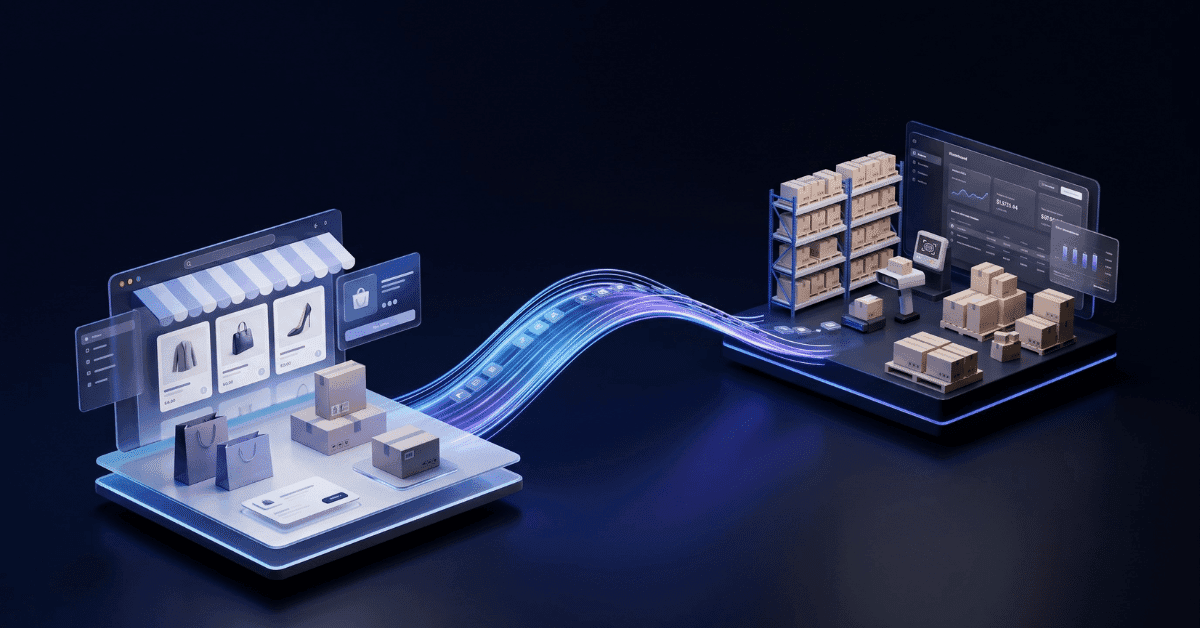
A Guide to IT Infrastructure Management for E-Commerce Companies
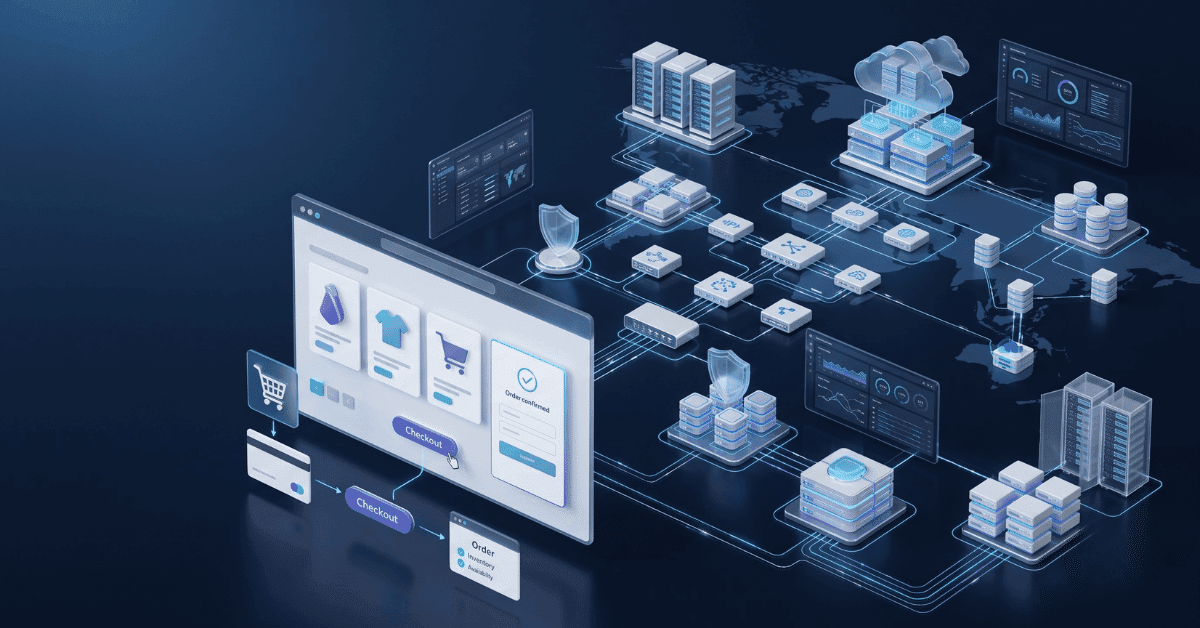
Infrastructure management is the disciplined practice of monitoring, securing, maintaining, and optimizing the technology systems that keep an e-commerce business online, responsive, and ready to handle changing demand. For online retailers, this is not background IT housekeeping; infrastructure directly affects checkout performance, inventory accuracy, customer experience, operational continuity, and ultimately revenue.
An e-commerce platform may look simple from the customer's perspective: browse a product, add it to a cart, pay, and receive an order confirmation. Behind those few clicks, however, sits a complex technical ecosystem. Web servers, databases, APIs, payment gateways, content delivery networks, cloud resources, inventory systems, analytics platforms, and security controls must work together without introducing noticeable delays or failures.
As transaction volumes grow, infrastructure becomes a business concern rather than purely a technical one.
Why E-Commerce Infrastructure Is Different
Retail traffic is rarely predictable. A normal Tuesday can suddenly become a peak event because of a flash sale, holiday campaign, influencer promotion, or unexpected surge in demand. Infrastructure that performs perfectly under ordinary conditions may struggle when traffic increases several times within minutes.
This makes elasticity a fundamental architectural requirement.
Cloud infrastructure can automatically scale computing resources as demand changes, but simply moving an e-commerce platform to the cloud does not guarantee resilience. Applications need appropriate capacity policies, database strategies, caching, load balancing, and monitoring to take advantage of cloud elasticity.
The objective is not to provision the largest possible infrastructure. It is to build an environment that can expand when necessary and contract when demand falls without sacrificing availability or cost control.
The Core Components of E-Commerce Infrastructure
A reliable e-commerce environment usually consists of several interconnected layers.
Compute infrastructure runs the applications responsible for storefronts, checkout, order processing, customer accounts, and internal operations. Depending on the architecture, this may involve virtual machines, containers, Kubernetes clusters, or serverless services.
Databases store critical information such as products, customers, orders, prices, and inventory. Database performance is particularly important because poorly optimized queries can create bottlenecks across the entire customer journey.
Networks and content delivery determine how quickly customers receive application resources and content. CDNs, caching, DNS management, load balancers, and optimized routing can significantly reduce latency for geographically distributed customers.
Integration infrastructure connects the storefront with payment providers, warehouses, shipping services, CRM platforms, ERP systems, marketplaces, and third-party APIs.
The challenge is maintaining visibility across all of these components rather than treating them as isolated systems.
Monitoring: Finding Problems Before Customers Do
For an e-commerce company, discovering an outage through social media is already too late.
Infrastructure monitoring provides continuous visibility into system health. Metrics such as CPU utilization, memory consumption, response time, database latency, network traffic, and error rates can reveal abnormal behavior before it becomes a customer-facing incident.
Effective monitoring also requires meaningful alerting. Generating thousands of low-value alerts can overwhelm operations teams and make genuinely critical events harder to identify.
Modern observability combines metrics, logs, and traces to help engineers understand not only that something failed but also why it failed and which services were affected.
This distinction matters in distributed e-commerce architectures, where a slow checkout page could originate from an API, database, payment service, network dependency, or another component several layers away from the visible problem.
Security Must Extend Across the Stack
E-commerce platforms are attractive targets because they process valuable personal and financial information. Infrastructure management therefore has a direct connection to cybersecurity.
Security controls should cover identity and access management, network segmentation, encryption, endpoint protection, vulnerability management, logging, and continuous patching.
The principle of least privilege is particularly important. Employees, services, and automated processes should receive only the permissions required for their specific responsibilities.
Security also needs to account for third-party integrations. A retailer may have a secure core platform but still be exposed through outdated plugins, vulnerable dependencies, improperly configured cloud resources, or compromised credentials.
Infrastructure teams therefore need a continuous security process rather than a one-time security audit.
Backup and Disaster Recovery
High availability and disaster recovery are related but different concepts.
High availability is about keeping systems operational when components fail. Disaster recovery focuses on restoring services and data after a major disruption.
For e-commerce companies, both require clearly defined recovery objectives. Recovery Time Objective (RTO) determines how quickly a service should be restored, while Recovery Point Objective (RPO) defines how much data loss is acceptable.
Backups should also be tested. A backup that has never been successfully restored is an assumption, not a recovery strategy.
Regular recovery exercises can expose gaps in documentation, permissions, infrastructure configuration, and dependency management before an actual incident does.
Automation and Infrastructure as Code
As e-commerce infrastructure becomes more complex, manual administration becomes increasingly difficult to scale.
Infrastructure as Code (IaC) allows teams to define infrastructure through version-controlled configuration rather than creating environments manually. This improves consistency and makes changes easier to review, reproduce, and roll back.
Automation can also handle repetitive operational tasks such as provisioning resources, applying patches, validating configurations, scaling services, and responding to predefined incidents.
The deeper benefit is not simply speed. Automation reduces dependency on individual operators and makes infrastructure behavior more predictable.
Managing Costs Without Sacrificing Performance
Cloud environments introduce a different financial model from traditional data centers. Resources can be created quickly, but unused instances, oversized databases, excessive storage, and inefficient data transfer can quietly increase monthly spending.
E-commerce companies should therefore treat infrastructure cost as an engineering metric.
Rightsizing resources, applying appropriate scaling policies, removing unused assets, selecting suitable storage tiers, and monitoring consumption can improve financial efficiency without compromising performance.
The strongest organizations connect infrastructure metrics with business metrics. A technical optimization becomes more meaningful when teams can understand its effect on conversion, order processing, customer experience, or operating cost.
Building Infrastructure for Growth
E-commerce infrastructure should be designed around the business's next stage, not just its current traffic.
That means establishing clear ownership, documented operational procedures, capacity planning, monitoring standards, security controls, and escalation processes. It also means regularly reviewing whether the architecture still fits the company's product strategy.
Infrastructure management is ultimately a continuous discipline. The environment changes as new products launch, traffic patterns evolve, applications are modernized, and business operations become more sophisticated.
For companies that need external expertise, Andersen infrastructure management services provide a model built around continuous monitoring, incident response, cloud and hybrid-environment management, security, backup and disaster recovery, automation, and operational optimization. Andersen describes its approach as an ongoing, SLA-backed service rather than one-off IT support, with coverage spanning cloud, networks, servers, security, and hybrid infrastructure.
Author
Debutify
Debutify is the easiest way to launch and scale your eCommerce brand.