AI Worker: The Complete Guide to Building Your Digital Workforce
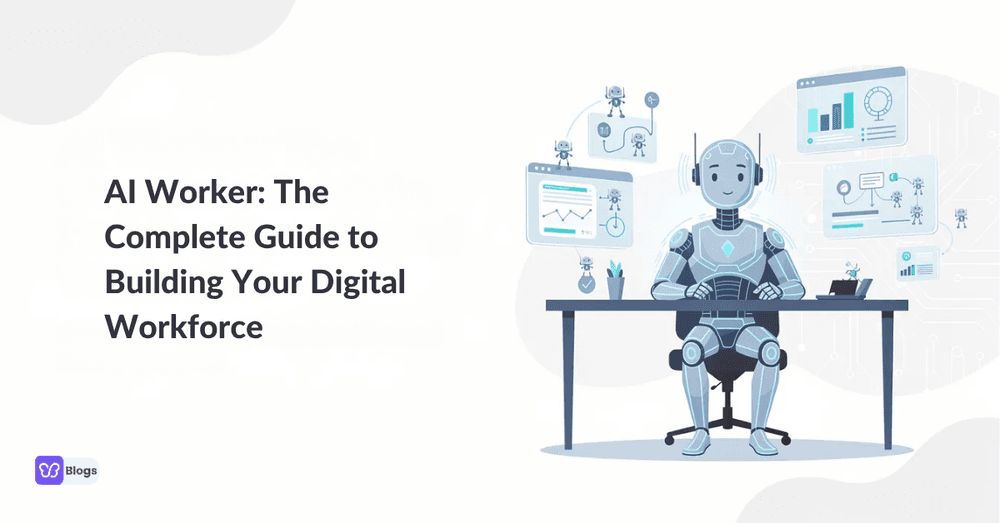
The teams winning with AI in 2026 are not the ones with the most tools; they are the ones that treat AI as labor. This guide explains what AI workers are, how they fit inside real business processes, and how to build, govern, and measure a digital workforce that pays for itself.
It is written for operators, founders, and team leads who want the practical picture: where to start, what to automate first, and how to keep humans in control while the digital headcount grows.
Introduction: What Is an AI Worker Today?
An ai worker is software that holds a job description: it perceives business data, makes decisions inside defined rules, and completes work across systems without a person sitting at each step. The term moved from science fiction to org charts because the underlying technology finally got reliable.
AI workers sit at the advanced end of the ai agents spectrum. A script that sends a reminder is not an AI worker; a system that triages an inbox, drafts the replies, updates the records, and flags only the exceptions is.
The mindset shift matters more than the technology. When you hire software as a workforce, you manage it like one: roles, permissions, performance reviews, and the occasional firing.
From Digital Workers to AI Workers: How the Digital Workforce Evolved
The digital workforce grew up in three waves. First came scripted automation: macros and rules doing exactly what they were told. Then came smart automation, where workflows could branch on conditions and handle exceptions.
The current wave is cognitive. Modern automation tools pair workflow engines with models that read documents, classify requests, and draft responses. The enabler underneath is machine learning, which lets systems improve from examples instead of waiting for new rules.
Each wave kept the last one running. Rules still handle the deterministic core; AI handles the judgment layer on top. That layering is why the transition feels gradual inside companies but dramatic in the aggregate numbers.
What Is a Digital Worker vs. an AI Worker?
The terms overlap, and vendors use them interchangeably, but the distinction is useful for buyers. A digital worker is any software-based team member that performs knowledge work: scripted bots, RPA workers, and AI systems alike.
An AI worker is the subset that can handle variability: unstructured inputs, ambiguous requests, and multi-step goals. If the task tolerates zero variation, a plain digital worker is cheaper and safer. If the task involves language, judgment, or messy data, you need the AI variety.
The buying test: describe the task to a competent contractor. If the instructions fit on an index card, script it. If the contractor would need to ask questions, you are hiring AI.
The Architecture of an AI Worker
Under the job title, every AI worker runs the same anatomy. A perception layer ingests inputs: emails, tickets, documents, events. A reasoning layer, the model plus its prompting and retrieval setup, decides what to do next.
An action layer executes through integrations: ticketing systems, inboxes, databases, and CRMs. A memory layer keeps state across tasks and sessions, and a governance layer wraps the whole thing in permissions, logs, and human-approval gates.
When an AI worker disappoints, the failure almost always traces to one of these layers: weak integrations, thin memory, or a governance gate placed in the wrong spot. Auditing the anatomy beats blaming the model.
How Digital Workers Operate Inside Business Processes
AI workers earn their keep by living inside processes, not beside them. A returns worker sits in the returns queue, checking policy, checking order history, issuing the label, and escalating only the outliers. A finance worker reconciles invoices against purchase orders and surfaces mismatches.
The connective tissue is the systems of record. When the worker can read and write your ERP, order management, and support desk directly, it closes loops instead of generating summaries for someone else to act on.
Process mapping before deployment is non-negotiable: name the trigger, the decision points, the escalation path, and the done-criteria. Workers deployed against vague processes produce vague work.
Key Capabilities of Modern AI Workers
Modern AI workers share a capability stack. They read and write natural language, extract data from documents, classify and route work, draft artifacts, and call tools through APIs. They hold context across long tasks and remember preferences.
Commerce teams feel this most in service: workers now own first-line customer support, answering policy questions, checking order status, and starting returns before a human ever sees the ticket.
The capability to evaluate hardest is judgment calibration: knowing when to act, when to ask, and when to stop. Vendors demo the acting; you must test the asking.
Digital Workers vs. Traditional Automation Tools
Traditional automation follows paths; digital workers navigate. A classic rule engine does exactly what it is told and fails loudly at the first unexpected input. An AI worker handles variation but needs supervision where the rules used to guarantee correctness.
Cost profiles differ too. Rules are cheap to build and cheap to run but expensive to extend. AI workers carry model costs and governance overhead but absorb change without rewrites.
The mature pattern is hybrid: deterministic rules for the regulated, repeatable core, AI workers at the fuzzy edges, and clear handoff points between them.
Business Benefits of an AI-Powered Digital Workforce
The benefits stack in order. First, throughput: work that waited for business hours runs around the clock. Second, consistency: the thousandth invoice gets the same attention as the first. Third, redeployment: humans move from processing to judgment.
The newest layer is creativity at scale. With generative AI, digital workers draft product copy, localize catalogs, and assemble campaign variants, extending the workforce into work that used to require a creative brief and a week.
The compounding effect is the real story: each automated process frees capacity that funds the next automation, which is why digital workforces grow faster than headcount budgets ever did.
Impact on Customer Experience and Decision Making
Customers experience the digital workforce as speed and availability. Answers arrive in seconds at midnight, orders update themselves, and exceptions get routed to humans with full context attached.
The bar keeps rising because customer experience is now a measurable race: every competitor who automates response times resets what shoppers consider normal.
Decision-making improves on the internal side too. When workers log every action, leaders get a dataset on how work actually flows, which turns process improvement from opinion into evidence.
Core Use Cases for Digital Workers Across the Enterprise
The highest-ROI use cases cluster where volume, repetition, and language meet. Support workers triage and resolve tickets. Sales workers enrich leads, draft outreach, and keep pipeline data honest. Finance workers reconcile, chase, and report.
Operations covers the widest ground: onboarding flows that configure accounts and send the right welcome sequence, inventory watchers that flag stockouts before they cost sales, and compliance checkers that never get bored.
The selection heuristic: pick the queue with the highest volume, the clearest done-criteria, and the lowest cost of an error. That is where a digital worker proves itself fastest.
How AI Workers Fit into Digital Transformation Strategy
Digital transformation fails when it is framed as buying software. It succeeds when it is framed as redesigning work. AI workers are the mechanism: each deployment forces a process to be named, measured, and improved.
The strategy layer is sequencing. Start with internal, low-risk processes to build trust and governance muscle. Move to customer-facing work once quality holds. Keep communication honest with customers about where automation ends and humans take over.
Organizations that treat AI workers as a portfolio, with a roadmap, owners, and reviews, transform quietly. Organizations that treat them as a product launch usually get one demo and no follow-through.
Designing and Building Your Own AI Workers
Build or buy is the wrong first question. The right first question is scope: one process, one goal, one metric. Design the worker around that scope with explicit inputs, outputs, tools, and escalation rules.
- Specify permissions before capabilities: what systems it can touch, and what it must never touch.
- Write the escalation contract: which cases always go to humans, with full context attached.
- Test against history: replay last quarter's real cases and score the worker's answers.
- Pilot with a human reviewer approving every action, then loosen based on evidence.
Only then decide build versus buy. If the workflow is generic, a market product gets you there faster. If it is your competitive secret, building it in-house is the moat.
Operating and Governing a Digital Workforce Safely
Governance is what turns autonomy from a risk into an asset. Every digital worker needs an identity, a permission scope, an audit log, and a named human owner. Treat access reviews like you would for a new hire: quarterly, documented, and revocable.
Monitoring is the second pillar. Track accuracy, escalation rate, latency, and cost per task. Alert on drift: rising escalation or falling confidence means the world changed and the worker did not.
Finally, plan the off-ramp. Workers get retired, replaced, or retrained. Knowing how to wind one down cleanly, with data exported and access revoked, is part of the design, not an afterthought.
Measuring the ROI of AI Workers and Digital Employees
Measure workers the way you would measure a team: output, quality, and cost. Hours returned is the headline metric, but it hides as much as it shows; pair it with error rates, escalation percentages, and rework.
The honest ROI formula compares fully loaded cost, model spend, governance time, and integration maintenance, against value: hours saved, revenue protected, and errors prevented. Most teams forget the maintenance term and then wonder at the gap.
Report in the language of the business, not the lab. A worker that resolves 400 tickets a week at 92 percent accuracy with no escalations is a staffing decision, and it should be presented as one.
Future of Work: Humans, AI Workers, and the Digital Workforce
The endpoint is not replacement; it is a hybrid org chart. Humans own intent, judgment, and relationships. AI workers own volume, consistency, and speed. The interface between them, the escalation paths and review points, becomes a design discipline of its own.
Skills shift accordingly. The most valuable people will be the ones who can direct digital workers: scoping their jobs, reading their metrics, and improving their instructions. Managing AI becomes as common a skill as managing a spreadsheet.
For leaders the imperative is simple: start small, measure honestly, and scale what works. Before your first deployment, run the checklist:
- Pick one high-volume, low-risk process with clear done-criteria.
- Map it fully: triggers, decisions, escalations, systems touched.
- Set permissions and an owner before switching anything on.
- Pilot with human review on every action.
- Measure baseline first, then compare against it monthly.
- Scale only with evidence, and retire what stops earning its keep.
FAQ: Common Questions About Digital Workers and AI Employees
1. What is a digital worker?
A digital worker is a software-based virtual team member that automates repeatable knowledge work across business processes. Modern digital workers analyze data and make decisions within defined workflows rather than just following fixed scripts.
2. Is an AI worker the same as an AI employee?
Essentially yes. Both terms describe AI-powered systems that work independently inside enterprise processes. Calling them employees is deliberate: it signals that these systems deserve the same governance as human workers, with roles, identities, and reviews.
3. How would you describe the digital workforce?
The digital workforce is the combined headcount of digital workers, AI agents, and digital employees operating across an organization, managed with roles, identities, and performance metrics alongside human teams.
4. Will digital workers replace human jobs?
Not wholesale. AI workers take on the mundane and repetitive so people can focus on creative, strategic, and empathetic work. The future belongs to hybrid teams where humans and digital colleagues each contribute their strengths.

Author
Debutify
Debutify is the easiest way to launch and scale your eCommerce brand.