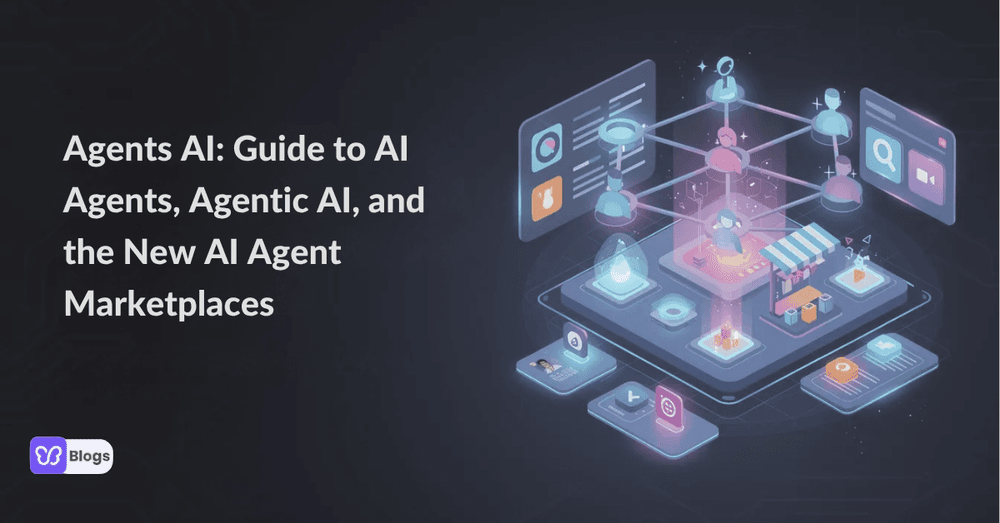
Agents AI: Guide to AI Agents, Agentic AI, and the New AI Agent Marketplaces
Agents AI is no longer a research phrase. In 2026 it describes autonomous software that perceives its environment, makes decisions, and executes actions toward specific goals without direct human intervention. Tools like GitHub Copilot coding agents, Gemini agents, and Salesforce Einstein Copilot made the shift visible: software now helps finish work, not just explain it.
This guide is for business leaders, developers, and decision-makers who want the full picture: what agents are, how agentic AI works, and what the emerging agent marketplaces change. Unlike the chatbots era, the unit of value is no longer the answer but the completed task, and for commerce teams that reaches into the business model itself, from sourcing to support to automation that runs while the team sleeps.
What Is an AI Agent? Core Concepts
AI agents are autonomous software programs that perceive, decide, and act to achieve goals without direct human intervention. The phrase AI agents describes these intelligent agents collectively, while agents AI refers to the wider category of agentic systems.
Their core components are perception, reasoning, and action. They break complex goals into sequential steps, synthesize large data volumes into decisions, and hold state across the work instead of resetting with each prompt.
The characteristics that matter in practice: goal-oriented behavior instead of one-off responses; multi-step execution across systems; tool use through APIs and integrations; and memory that lets the agent learn what happened last time. A support agent that reads the CRM, checks the order system, and drafts the reply is exercising all four; a script that sends a canned email is exercising none. The same loop applies to feedback handling: the agent closes the loop from signal to action.
The reference implementations are public. GitHub Copilot agents triage issues, write code, and open pull requests autonomously, which is the clearest mainstream example of agents doing engineering work end to end.
How Agentic AI Works Under the Hood
Agentic AI runs a loop: a user gives a goal in natural language, the model plans the work, selects tools, executes, observes the result, and updates the plan. Modern agents execute full workflows across business, technical, and creative functions, integrating with real systems and making autonomous decisions inside them.
The components read like an org chart. The planner breaks the goal into steps and decides what happens next. The executor performs real actions through tools, scripts, and APIs. The memory store tracks progress across long-running work, and the evaluator compares results to the goal so the next cycle improves.
That evaluation step is what separates production agents from demos. When the agent can check its own output against a verifiable result, autonomy becomes safe to extend; when it cannot, the loop needs a human in it.
Types of AI Agents Businesses Use Today
The market has settled into recognizable agent families. Customer service agents triage tickets, run sentiment analysis, check shipment status, and route sensitive cases to humans. Sales and marketing agents research prospects, write outreach, generate proposals, enrich CRM data, and score leads; teams looking for ready-made AI agents for marketing will find the category maturing quickly.
Networking agents support prospecting, partner outreach sequencing, meeting prep, and follow-ups, with tools like Recall handling the memory layer of conversations. Developer agents write code, generate tests, review pull requests, and document changes.
Operations and finance agents reconcile invoices, monitor metrics, and forecast spend, and in e-commerce the family expands further: inventory watchers, pricing agents, and merchandising agents that adjust the store in response to live data.
From Tools to Ecosystems: What Is an AI Agent Marketplace?
An AI agent marketplace is a structured platform where developers and enterprises discover, publish, deploy, and manage agents built to automate specific tasks or workflows. Unlike app directories, it lets you hire autonomous agents that act inside enterprise systems, with instant access to prebuilt agents and a unified governance frame around them.
The marketplace layer solves three problems at once: discovery, because agents are searchable by use case and integration; trust, because ratings, provenance, and compliance data travel with each listing; and lifecycle, because deployment, versioning, and retirement happen in one place.
The enterprise wave is already visible: as ITPro reported on Oracle's marketplace launch, the big platform vendors are turning agent distribution into infrastructure, which tells you where the category is heading.
Essential Features of Modern AI Agent Marketplaces
Not every directory of agents is an enterprise-grade marketplace. The effective ones combine discoverability, interoperability, governance, and lifecycle control so agents are trustworthy, secure, and production-hardened.

- Search and discovery: filters for industry, use case, integrations, price, risk level, and capabilities.
- Ratings and reviews: visible trust signals covering support quality, uptime, and customer feedback loops.
- Agent cards: description, tools, pricing, compliance posture, and required data access at a glance.
- Usage analytics: dashboards for runs, failures, latency, adoption, and return on investment.
- Secure deployment: sandboxed execution, scoped permissions, and audit logs as defaults, not add-ons.
The analytics row deserves emphasis. Without run-level data, an agent marketplace is a vending machine; with it, buyers can compare agents the way they compare software, on evidence. The same discipline applies in-store, where every customer feedback signal becomes a measurable change with visible ROI, and A/B testing turns design opinions into measured decisions.
Architecture Behind Enterprise-Grade Agent Marketplaces
Under the listings sit five layers. The agent registry stores metadata, permissions, versions, provenance, and dependencies for every listing. The execution environment runs agents in isolated containers with scoped access to tools and data.
The orchestration layer manages multi-step workflows, retries, scheduled jobs, and multi-agent collaboration. The integration layer connects the marketplace to CRMs, ERPs, ticketing systems, cloud services, and internal APIs. The identity layer enforces fine-grained authorization so every agent operates inside clearly defined permission scopes.
Observability cuts across all five: logs, traces, and dashboards are the only way to answer the 2am question of what an agent did and why. Enterprises should treat any marketplace that cannot answer it as a demo, not infrastructure.
Business Models for AI Agent Marketplaces and Builders
Agent ecosystems blend SaaS, automation, services, and platform economics, so the business model matters. The right one depends on usage volume, complexity, support needs, and how deeply agents connect to enterprise systems.
- Subscription: high predictability, medium-high margin; best for companies needing broad access to agent libraries.
- Pay-per-use: variable predictability, medium margin; fits teams with fluctuating or experimental workloads.
- Tiered enterprise licensing: high predictability and margin; built for large enterprises with custom needs and compliance.
Builders monetize through revenue share, listing fees, and support or consulting add-ons, while usage-based pricing covers the tools agents consume: browsing, data access, and compute. The pattern mirrors app stores, with one difference: agents sell outcomes, not seats, which pushes pricing toward the work done.
How to Build AI Agents: From Prototype to Marketplace-Ready
Start with one narrow problem, not a broad assistant. Define the users, systems, data, tools, and the success metric, and specify permissions before writing prompts. Then design the prompt, logic, memory, and fallback paths.
- Add guardrails for privacy, compliance, cost, and human review.
- Test each tool with unit tests and failure cases.
- Run simulations with edge cases, bad data, and missing access.
- Red-team the agent for unsafe actions and data leakage.
- Complete acceptance testing in staging before production.
Structured user acceptance testing matters more with agents than with classic software, because the failure surface includes judgment, not just function.
Only then prepare the marketplace listing: clear description, visual agent card, pricing, support terms, and required data access. After launch, track conversion, retention, and error rates like the product metrics they are.
Choosing the Right AI Agent Marketplace for Your Organization
Selection depends on industry rules, scale, compliance needs, the existing stack, and whether teams want to adopt prebuilt agents or build internally. Weight five dimensions.
- Security posture: encryption, audit logs, access controls, compliance certifications.
- Integration depth: native links to data warehouses, CRMs, ERPs, and support tools, including commerce stacks and Shopify-adjacent systems.
- Agent quality: diversity of agents, update frequency, builder reputation, documentation.
- Governance: control over which agents deploy and who can access them, per policy.
- Ecosystem maturity: active builders, strong support, and a roadmap you can rely on.
For commerce teams, integration depth is the tiebreaker: an agent that cannot reach your ERPs, order systems, and storefront data is a consultant with no badge access.
Real-World Use Cases: Deploying Agents via Marketplaces
The patterns repeating across deployments: a mid-size SaaS discovers a helpdesk agent, deploys it to classify tickets, and measures lower handle time. A bank tests KYC and fraud agents in a secure marketplace, with audit logs and human review before production. A retailer deploys inventory and pricing agents that monitor systems in real time and alert human decision-makers at the edges.
Sales teams choose networking agents to research accounts, draft outreach, and prepare meeting briefs. To accelerate that workflow, enterprises increasingly pair agents with agent-native go-to-market platforms such as GTM AI, which wire research straight into pipeline actions.
The common success factor is measurability again: every case above has a number that moves, and the agent earns its autonomy one verified metric at a time.
Risks, Limitations, and Governance Challenges
Autonomy carries a risk register. Hallucinations shrink with retrieval, validation checks, and human approval for critical actions. Over-permissioned agents need least-privilege access policies. Data leakage demands isolated data, monitored connectors, and restricted exports.
- Vendor lock-in: require portability, clear contracts, and documented APIs.
- Biased decisions: audit outputs, test representative datasets, keep humans accountable.
- Cost overruns: apply budgets, rate limits, alerts, and run caps.
- Unsafe tools: vet agents and connectors to prevent supply-chain-style security issues.
- Poor observability: require logs, traces, dashboards, and recurring reviews.
The governance frame is not anti-innovation; it is what makes innovation repeatable. Teams with it scale autonomy; teams without it scale incidents.
The Future of Agentic AI and Agent Marketplaces
By 2028 to 2030, agents are likely to become standard digital workers inside major SaaS platforms. The evolution from simple chatbots to autonomous agents that plan, integrate, and execute end-to-end workflows is already underway.
Multi-agent collaboration will normalize across research, writing, finance, engineering, and operations. Cross-marketplace interoperability will matter as teams use multiple platforms, and industry-specific marketplaces will grow in healthcare, finance, manufacturing, and retail. On-device agents will help privacy-sensitive teams reduce data exposure.
App stores will evolve into deep agent ecosystems, and the organizations that learn the governance layer now will set the terms of that evolution instead of inheriting them.
AI agents are autonomous agents that understand goals, use tools, reason through uncertainty, and act across real business systems. Agentic AI matters because it turns artificial intelligence from a response engine into a work engine with memory, feedback, and control. The rise of the agent marketplace gives companies a faster way to adopt that engine without building everything from scratch, and in artificial intelligence driven retail, the marketplace is becoming the front door. Before you adopt or build, run the checklist:
- Start with one verifiable workflow and a number that should move.
- Specify permissions before prompts.
- Require observability: logs, traces, dashboards, owners.
- Compare marketplaces on governance, not just catalog size.
- Price the work done, not the seats, when evaluating models.
- Expand autonomy only with evidence.

Author
Debutify
Debutify is the easiest way to launch and scale your eCommerce brand.