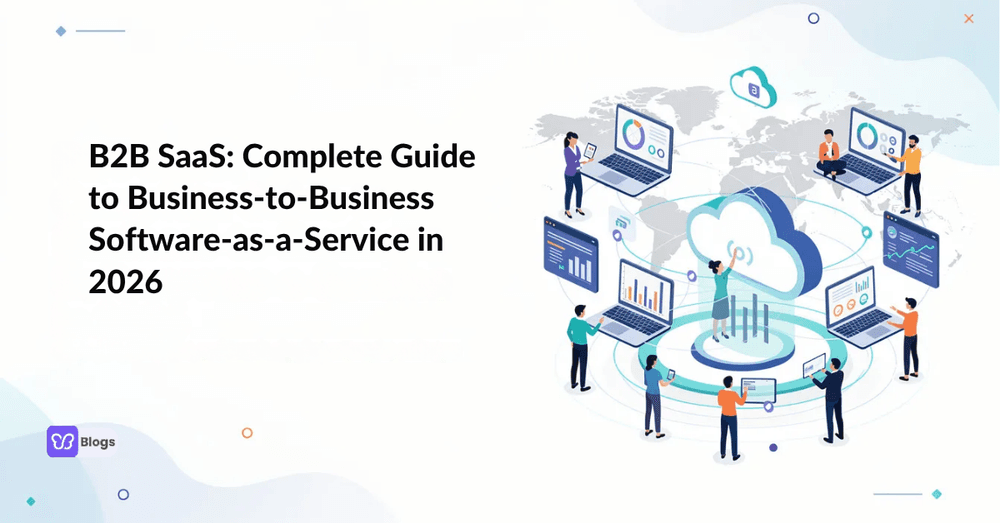
B2B SaaS: Complete Guide to Business-to-Business Software-as-a-Service in 2026
B2B SaaS quietly runs the modern economy: the CRM your sales team lives in, the payroll that pays them, and the analytics that tell you whether the quarter worked. This guide explains what business-to-business software-as-a-service actually is, how the model makes money, where it is heading, and how to evaluate it whether you are buying or building.
It covers definitions, comparisons with other software models, the major product categories, pricing economics, real examples, adoption risks, and the metrics that separate healthy SaaS businesses from fragile ones.
What Is B2B SaaS? Clear Definition and Fast Answer
B2B SaaS is software that one business sells to other businesses, delivered over the cloud and billed as a subscription. The buyer never installs or maintains the product; the vendor hosts it, updates it, and improves it continuously. The B2B part defines the customer; the SaaS part defines the delivery and billing model.
The economics are what make the model powerful. Customers pay monthly or annually, which turns software purchases into predictable recurring income. For vendors, that predictability compounds: every retained customer adds to a growing base of revenue that renews automatically.
The category spans everything from enterprise infrastructure to everyday operations. A company might run its books in one cloud product, its hiring in another, and its payroll software in a third, all subscription-billed and all updated without an IT project.
Key Characteristics of B2B SaaS Platforms
Five traits define the category. Cloud delivery means access from anywhere with a login. Subscription billing means no large upfront license. Continuous updates mean the product improves without customer projects. Multi-tenancy means one codebase serves every customer.
The fifth trait is scalability in both directions. The same platform serves a five-person startup and a five-thousand-person enterprise, which makes the business model unusually elastic. Vendors measure that elasticity through monthly recurring revenue, the heartbeat metric of the industry.
Integration depth rounds out the picture. Modern platforms connect to CRMs, payment systems, data warehouses, and storefronts, because a SaaS product that cannot share data quickly becomes a silo.
B2B SaaS vs Other Software Models
Against on-premise software, SaaS wins on speed and total cost: no servers, no upgrade projects, no dedicated maintenance team. On-premise still claims ground in highly regulated environments where data must never leave a building.
Against consumer apps, B2B SaaS differs in buying motion: multiple stakeholders, longer evaluation cycles, procurement and security reviews, and pricing negotiated per seat or tier rather than a one-tap purchase.
Against custom development, SaaS trades control for velocity. A custom build fits perfectly but must be maintained forever; a SaaS product ships fast and evolves, and good vendors invest heavily in onboarding to close the fit gap. The customer relationship that follows is what decides renewal.
Core Categories of B2B SaaS Products
The market organizes into familiar clusters. CRM and sales tools manage pipeline. Marketing platforms run campaigns and content. Finance stacks handle billing, accounting, and payroll. HR suites cover hiring through offboarding. Collaboration tools host the meetings and documents.
Messaging has become its own category, with channels layered directly onto Salesforce SMS style integrations so teams reach customers where they already read. Commerce tools optimize every step of customer engagement, while operations software coordinates the physical side: supply chain visibility and inventory management keep stock moving without guesswork.
Growth tools round out the stack: content marketing platforms, broader digital marketing suites, and a new wave of desktop helpers such as an ai assistant for mac that sit across applications rather than inside one.
How B2B SaaS Companies Make Money
Subscription revenue is the spine: monthly or annual plans, priced per seat, per tier, or per usage. Annual prepayment improves cash position; monthly keeps the barrier low. Expansion revenue, more seats and higher tiers from existing customers, is where the compounding lives.
Every pricing decision is a bet on Customer lifetime value: what a customer pays across the whole relationship minus what it costs to win and serve them. Healthy companies engineer for durable profit margins by keeping onboarding cheap, retention high, and support scalable.
The model punishes churn brutally. Lose 5 percent of customers monthly and no acquisition machine can keep up, which is why success teams get budgets that used to belong to sales.
Examples of Leading B2B SaaS Companies and Products
The giants define the shape: Salesforce for CRM, Microsoft 365 for productivity, Workday for HR and finance, HubSpot for inbound marketing and sales. Each started in one category and expanded by acquisition and build-out.
The mid-market and vertical layer is where the energy is: platforms serving small businesses with affordable stacks, industry-specific suites for healthcare, logistics, and retail, and specialist tools like AI QA automation that automate enterprise application testing.
The pattern to steal from all of them: pick a painful, frequent problem, solve it completely for one audience, then expand the wedge. Breadth without depth is how SaaS companies become forgettable.
Benefits of Adopting B2B SaaS for Modern Organizations
For buyers the value starts with speed. A subscription activates in hours, not the quarters an implementation project takes. Costs shift from capital expenditure to operating spend, which eases budgeting and protects cash flow for smaller teams.
The second benefit is continuous improvement: vendors ship updates weekly, security patches arrive without tickets, and integrations expand the product's reach over time. Teams using marketing automation see the effect directly, as the platforms they rely on get measurably better each quarter.
The third is scale elasticity. Seats go up during the busy season and down after, and the same tool serves the team at 10 people and at 500 without a migration project.
Challenges and Risks in B2B SaaS Adoption
The model has real costs. SaaS sprawl is the headline one: subscriptions multiply until nobody knows what the company pays for. Data gravity follows, because every tool holds a piece of the truth in its own format.
Vendor dependency is the structural risk. If a critical platform raises prices, changes direction, or gets acquired, customers inherit the consequences. Customer acquisition economics get squeezed too, as rising ad costs push SaaS vendors toward aggressive upselling and longer lock-ins.
Security and compliance round out the list: every cloud tool widens the attack surface, and every data flow needs a documented purpose. The mitigation is boring and effective: an inventory, an owner per tool, and annual reviews.
How to Choose the Right B2B SaaS Platform
Start from the job, not the demo. Define the process to improve, the metric that proves it, and the systems the tool must connect to. A platform that cannot reach your ERP or commerce stack is a very fast typist.
Then evaluate like an operator: total cost including onboarding and training, export paths for your data, support responsiveness tested with real questions, and a roadmap that points where your business is going.
Finally, prefer composable platforms. A marketplace of vetted add-ons lets you extend the base product without rebuilding it, which keeps optionality alive as requirements change.
Building and Scaling a B2B SaaS Business
Builders face the mirror image of the buyer's checklist. Find a painful, frequent problem in a reachable niche. Ship the smallest version that fully solves it. Charge from day one, because willingness to pay is the only validation that counts.
Growth sequencing matters: founder-led sales first, to learn the objections; product-led or inside sales next, to systematize; outbound and partnerships only once unit economics hold. Premature scaling of acquisition is how promising SaaS companies burn their runway.
The metrics tell you when to pour fuel: retention curves that flatten, payback under 12 months, and expansion revenue starting to offset churn. Until then, the job is product and retention, not marketing spend.
Future Trends Shaping the B2B SaaS Industry
AI is restructuring the category from both ends. Vendors embed assistants directly into every product, shifting value from features to outcomes. Buyers consolidate stacks, rewarding platforms that do whole jobs over point tools that do fragments.
Verticalization continues: generic tools give way to industry-specific suites, and legacy software modernization becomes its own services market as enterprises migrate off aging on-premise systems.
Pricing follows usage and results rather than seats, and success metrics migrate upstream: vendors now obsess over customer loyalty indicators and lifecycle marketing automation because retention, not acquisition, is where the next decade of margin lives.
FAQ: Common Questions About B2B SaaS
1. What is a B2B SaaS company?
A B2B SaaS company sells cloud-hosted, subscription-based software to other businesses. Salesforce sells CRM to companies, not consumers. HubSpot sells marketing and sales tools to business teams. If the product is cloud-based, subscription-billed, and sold to organizations, it is B2B SaaS.
2. What is B2B software vs B2B SaaS?
B2B software is any tool built for business buyers, including on-premise systems, custom applications, and cloud services. B2B SaaS is the subset delivered through the cloud on a subscription model. An on-premise ERP is B2B software but not SaaS; a cloud-hosted CRM is both.
3. How do you measure success in B2B SaaS?
Track monthly and annual recurring revenue for growth, customer acquisition cost for efficiency, and lifetime value to confirm each customer earns back what they cost. A healthy LTV to CAC ratio is 3 to 1 or better, with payback ideally under 12 months.
4. How do you choose between similar B2B SaaS companies?
Differentiate on integration with your existing stack, support quality, product roadmap, pricing transparency, and security posture. Pilot with real users from your team instead of relying on demos or feature comparison sheets.
5. Should small businesses adopt B2B SaaS early?
Yes, when team size, workflow complexity, or growth trajectory justifies the cost. Cloud software gives small teams access to tools that once required enterprise budgets. Start with the categories that drive the most efficiency for your stage, and audit usage regularly so you scale only what delivers measurable value.
The B2B SaaS landscape rewards buyers and builders who stay disciplined about metrics, strategic about integrations, and realistic about the risks. Whether you are evaluating your next tool or architecting one from scratch, the fundamentals hold: solve a real problem, measure what matters, and keep iterating.
Start by mapping your current stack, naming the gaps, and running one focused pilot this quarter. Use the checklist to keep it honest:
- Name the job first, then the metric that proves it worked.
- Audit your current stack for overlap, cost, and data silos.
- Demand integration reach into the systems you already run.
- Check exit paths: data export and contract terms before signing.
- Pilot with real users and real workloads, not demos.
- Review every tool annually against usage and value delivered.

Author
Debutify
Debutify is the easiest way to launch and scale your eCommerce brand.