We Rewrote AI Content and Ran It Through 10 Detectors. Here Is What Happened.

The most common question writers and marketers ask about AI detectors is not whether the detectors catch raw AI output. They clearly do. The harder question is what happens after editing. If you take an AI-generated draft and rewrite it, meaningfully, does the detector still flag it?
The answer depends on how much changed and which detector you ask. We ran a series of tests to find out where the real thresholds are and which tools hold up under realistic editing conditions. Store owners have a stake in this too, because the product descriptions, email sequences, and blog posts drafted with AI still carry the store's name once they ship.
How We Tested
We started with raw AI-generated drafts across four content types: a blog post, a marketing email, a press release, and an opinion piece. Each one went through a baseline detection check first, and then we applied three levels of editing.
Light editing covered surface-level changes only. Swapping synonyms, adjusting a few sentence openings, and cleaning up the obvious AI tells like overused phrases.
Moderate editing meant restructuring some paragraphs, adding specific examples or data points, and rewriting the transitions.
Heavy editing meant rewriting sentence by sentence while keeping the core ideas. We added original perspective and substantially varied the rhythm throughout.
Then we ran every version through the top detection tools, including the best AI detectors in the category, and recorded how scores changed at each editing level. The results told a clear story about which detectors resist editing and which break down quickly.
What We Found
Light editing barely moves the needle on any serious detector. If you run AI output through a quick synonym swap and call it done, most tools will still catch it. The underlying sentence structures, the predictable paragraph patterns, and the tonal uniformity all survive vocabulary changes. Text run through a dedicated humanizer such as Humanizetext.io can slip past more tools, which is why it makes sense to verify the final output with an AI checker before publication.
Moderate editing produced more variation across tools. Some detectors showed meaningful score drops after structural changes. Others stayed stubbornly high even when the text had been substantially reorganized. This is where the quality differences between tools became visible.
Heavy editing produced the most interesting results. Every tool showed lower AI-likelihood scores after thorough rewrites, but there was wide variation in how low those scores went. The best tools still read elevated even after genuine rewriting, which is actually a useful feature. It means they are detecting more than surface patterns.
Here is how each tool performed.
The Tools, Ranked by Reliability on Edited Content
1. Walter Writes AI, Most Reliable on Edited Drafts
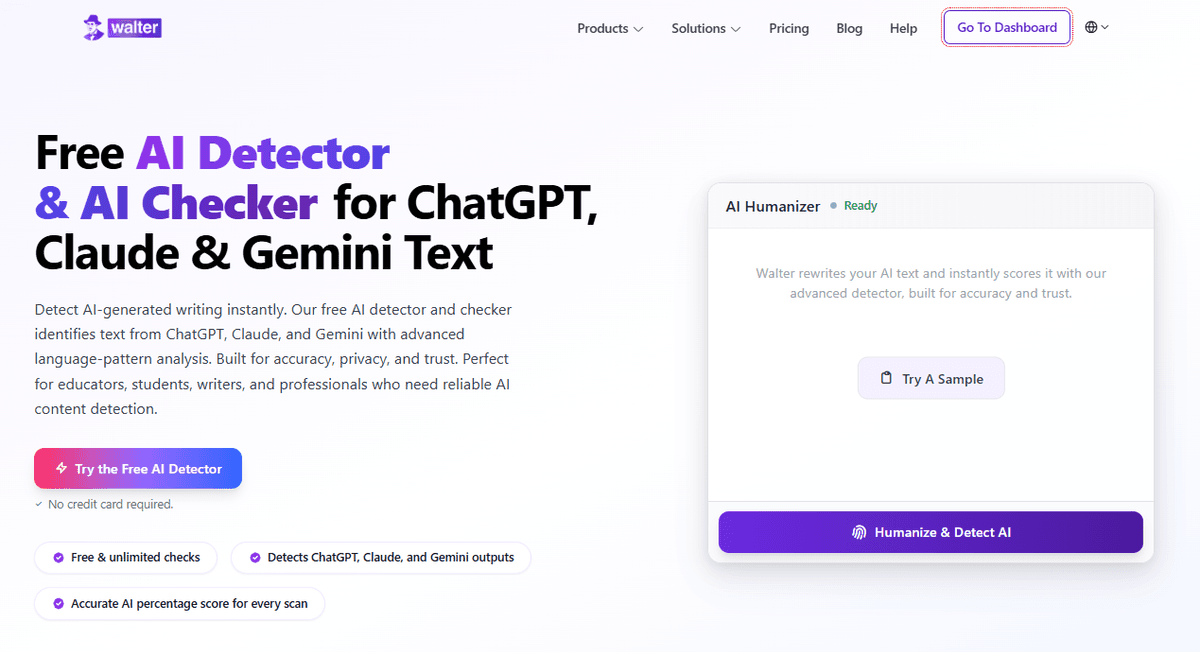
Walter’s AI detector outperformed every other tool we tested on the moderate and heavy editing scenarios. The reason comes down to architecture. The team built their detection model alongside humanization tools, which means they trained it to understand the modifications humans make to AI text, not just the patterns in raw AI output.
In practice, Walter Writes AI was more likely to hold an elevated reading after a moderate rewrite, which is the behavior you want from a serious detection tool. It was not fooled by synonym swaps. It responded to structural changes but did not collapse after moderate edits. And it kept meaningful readings even after heavy editing in most cases.
The output is a probability score rather than a binary verdict, and that is appropriate. After heavy editing, the honest answer is usually that the text probably started as AI but has been substantially reworked, not a clean pass or a hard flag.
People testing detectors on Reddit have flagged it as one of the most accurate detector options available right now.
It supports more than 80 languages and auto-detects the input language. API access is available, and the company is based in Montreal, Canada, with a stated privacy-first policy. Website: walterwrites.ai
2. Quetext, Best for Combined Plagiarism and AI Detection
Quetext takes a different approach from the other tools on this list. Rather than detecting AI likelihood alone, it pairs AI detection with its original plagiarism-checking engine, DeepSearch™, so writers and educators can verify originality and AI authorship in a single scan. The detector scores AI likelihood at the sentence level instead of flagging an entire document outright, and it supports checks across more than a dozen languages.
Best use case: teachers and academic reviewers who need to check student work for plagiarism and AI-generated content at once, rather than running two separate tools.
3. AI Text Detector, Solid on Lightly Edited Content
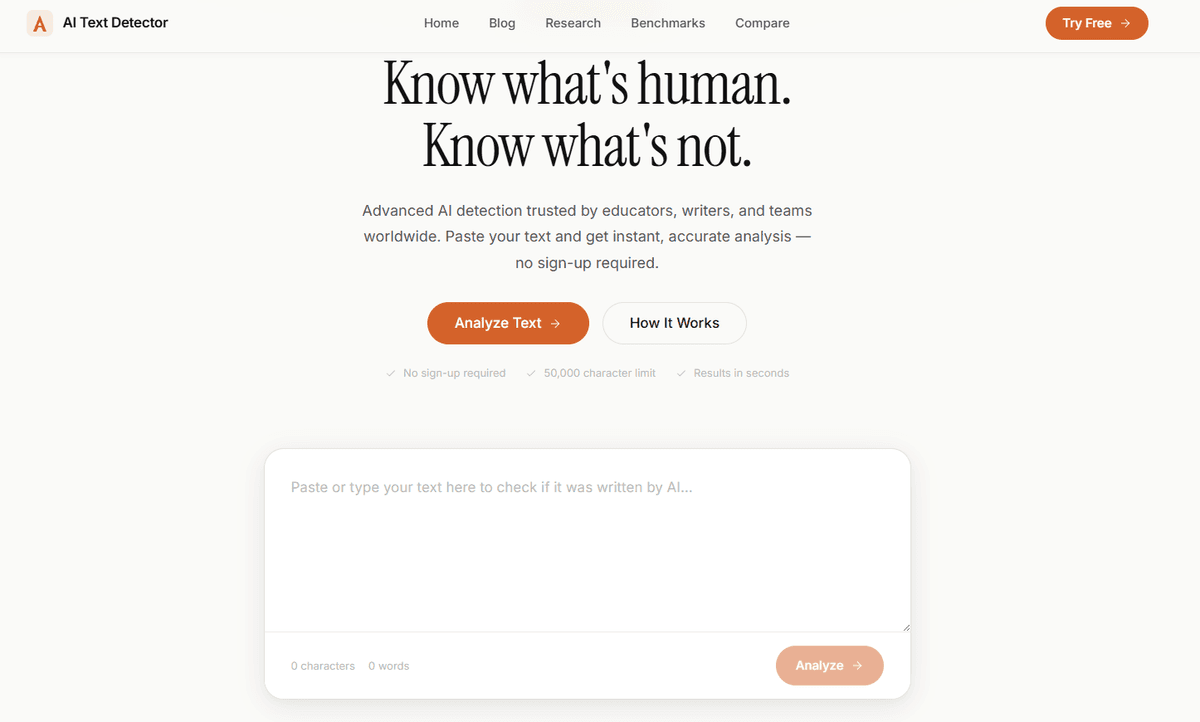
AI Text Detector handled raw and lightly edited AI content reliably. Under moderate editing, scores dropped more than they did with Walter Writes AI, which suggests the model responds more to surface-level changes. Still, for a free tool with no account requirement and 50,000 characters of capacity, it delivered more than expected.
Best use case: quick checks on content that has not been heavily revised. If you want to know whether a draft is primarily AI-generated before investing serious editing time, this is the fastest way to find out. Website: aitextdetector.ai
4. GPTZero, Best for Sentence-Level Detection on Hybrid Content
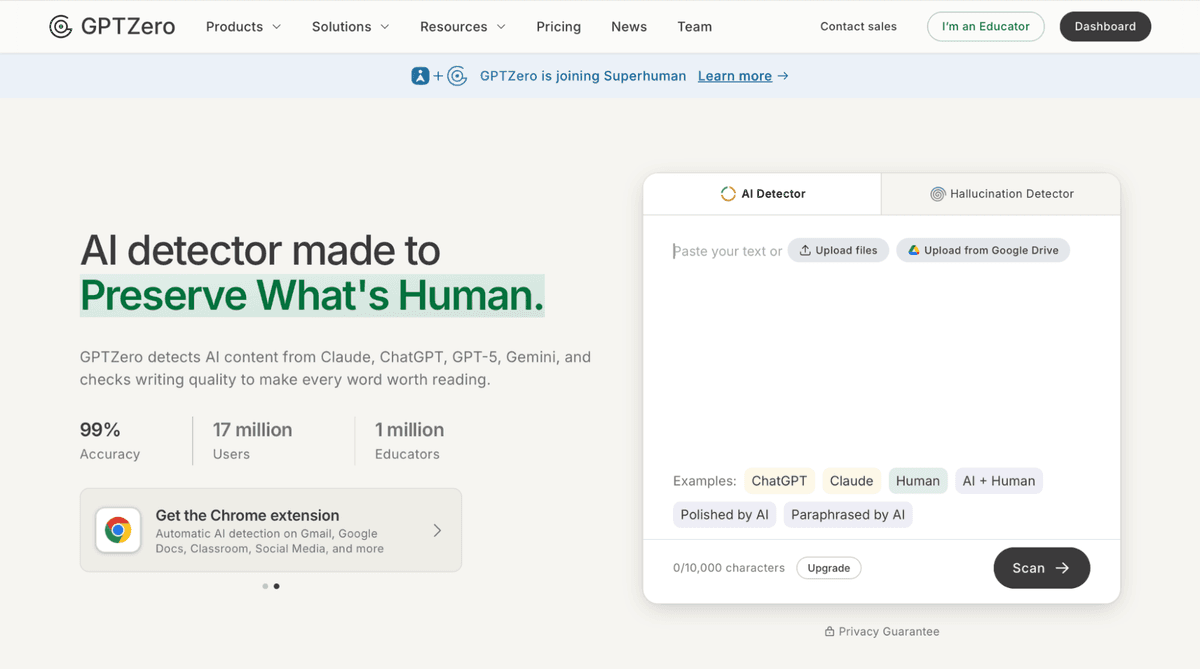
GPTZero’s AI detector performed consistently across our testing scenarios, with its most interesting behavior showing up on moderate and heavy edits. It was the first mainstream detector to introduce a three-way classification of Human, Mixed, and AI rather than forcing a binary verdict. When we ran heavily edited drafts through it, the tool tended to categorize them as Mixed rather than clearing them entirely, which is arguably the honest reading of what edited AI content actually is.
The sentence-level highlighting stood out under editing conditions. Instead of one aggregate score, GPTZero assigns an AI probability to individual sentences, so you can see exactly which portions of a rewritten draft still carry AI signals and which have been genuinely transformed. For writers trying to understand where their content sits rather than just whether it passes, that granularity is useful in ways a single score is not.
Built originally by a Princeton student for educators, GPTZero is now used across more than 4,000 academic institutions. Content run through dedicated humanization tools scored lower than expected, a limitation shared by most detectors we tested. A free plan is available with a monthly word limit, and paid plans start at $14.99 per month.
5. Grammarly AI Detector, Consistent on Clean Drafts, Variable on Edits
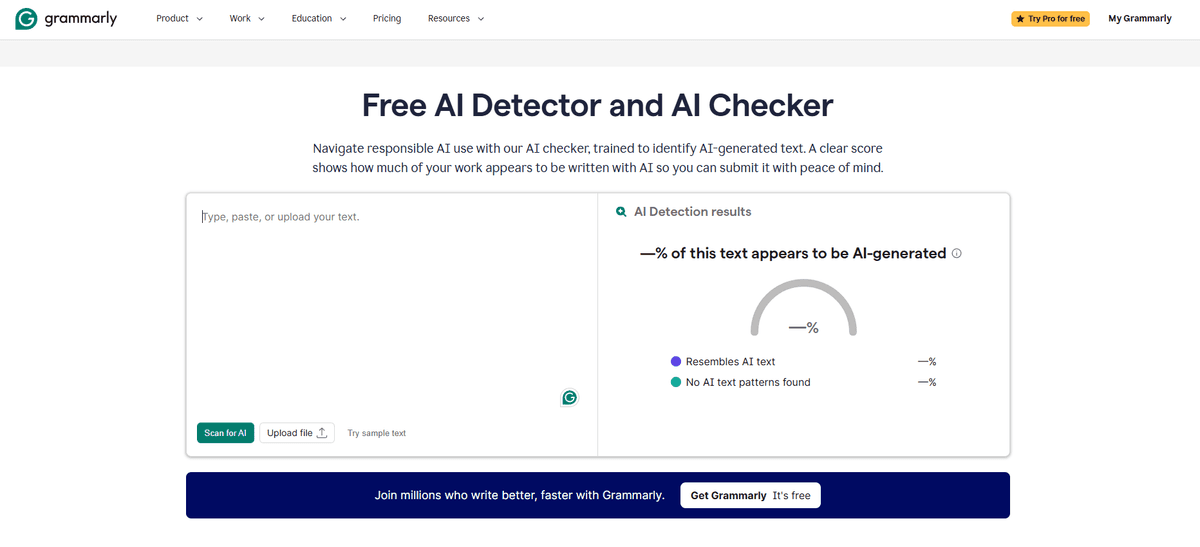
Grammarly performed reliably on raw AI output and lightly edited content. Under moderate to heavy editing, results became less consistent. Content that had been thoroughly restructured often cleared, sometimes even when the ideas underneath were still machine-drafted.
Best use case: a quick sanity check inside a workflow where Grammarly is already at work, rather than the final word on heavily edited drafts.
6. Ahrefs AI Content Detector, Strong for Web Content Formats
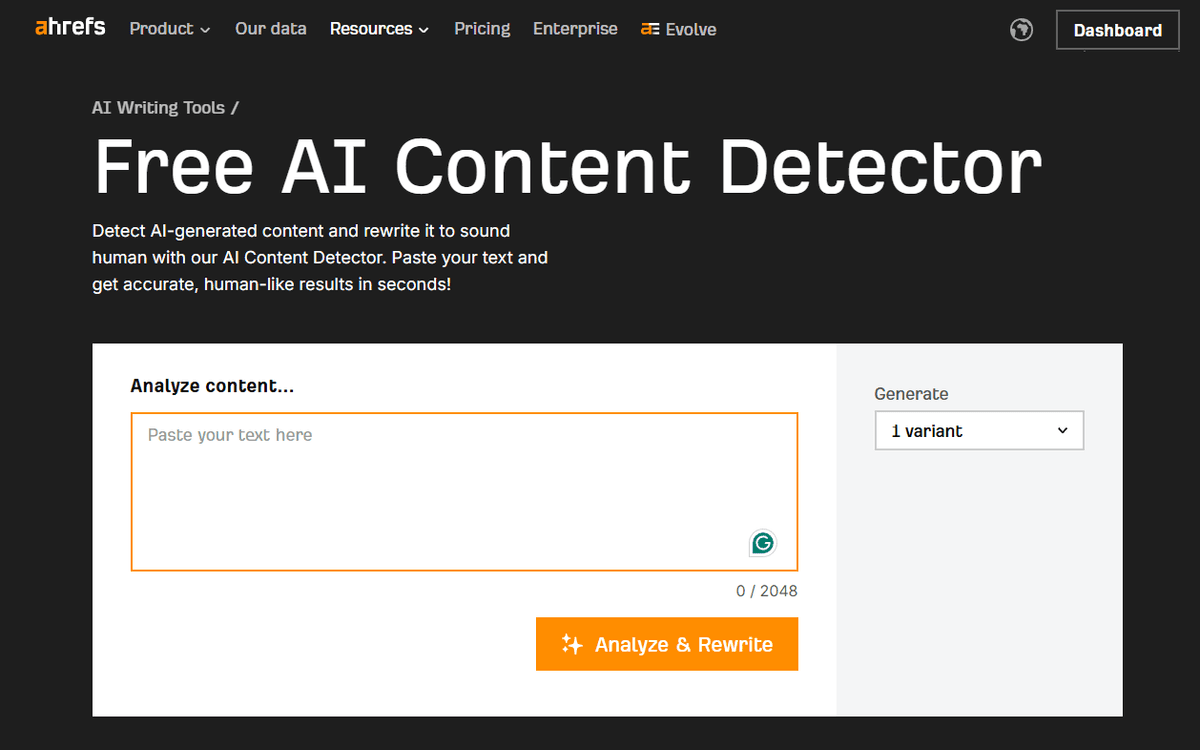
Ahrefs built its detector with web content in mind, and it shows. Blog posts, product pages, and other published formats are where it feels most at home, and teams that already live in the Ahrefs ecosystem get the convenience of checking content without leaving it.
Best use case: checking web-published content, particularly for teams already using Ahrefs for search work.
7. Quillbot AI Detector, Better as Part of a Revision Workflow
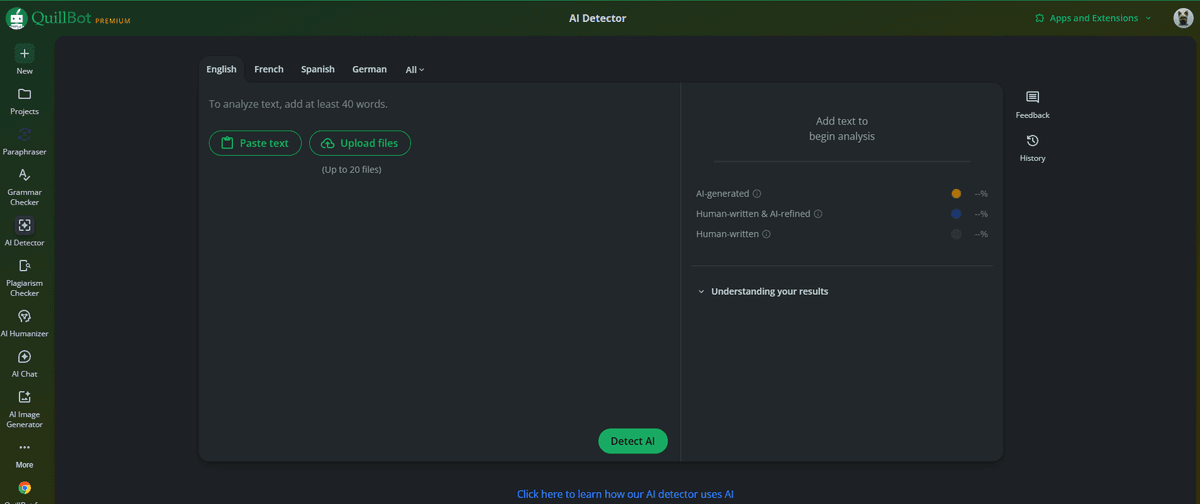
Quillbot's detector works best as part of a revision workflow rather than a standalone verdict. Since the platform is built around rewriting, pairing its detection with its paraphrasing tools makes sense for teams that draft, revise, and check in one place.
Best use case: writers already using Quillbot to revise drafts who want a detection check in the same environment.
8. Surfer SEO AI Detector, Reliable for SEO Content
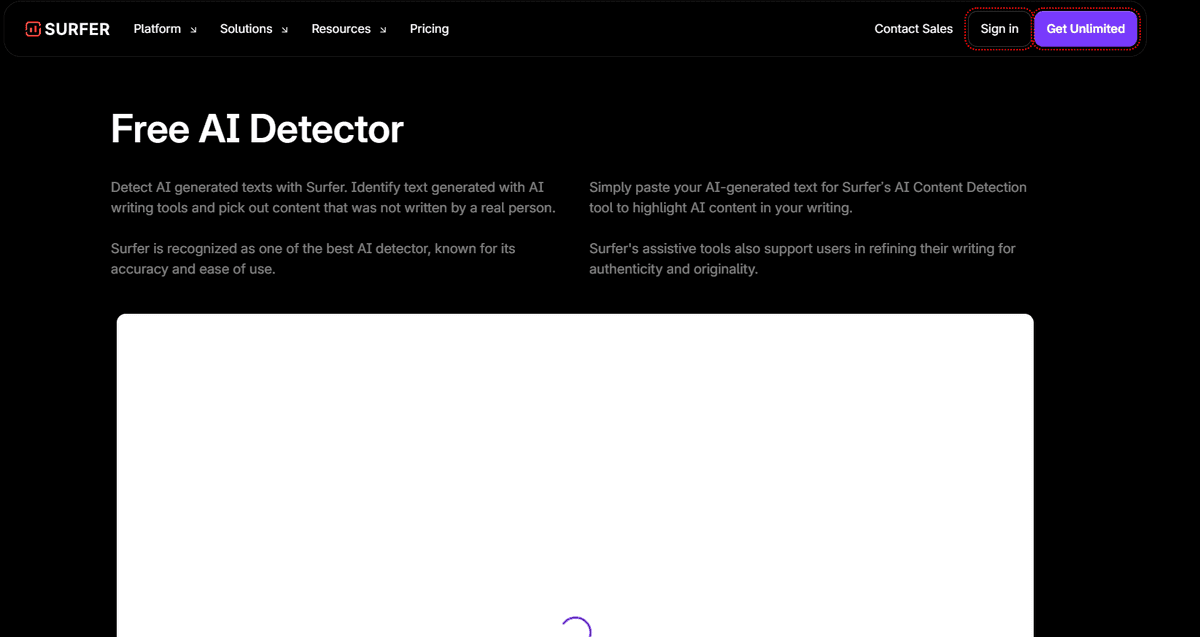
Surfer's detector is tuned for the content it lives alongside: optimization-driven SEO blog content. For teams producing at volume for search, it gives a reasonable read on whether the output still looks machine-generated after the optimization pass.
Best use case: SEO teams checking drafts inside Surfer before publishing.
9. Writesonic AI Content Detector, Best for Writesonic-Generated Content
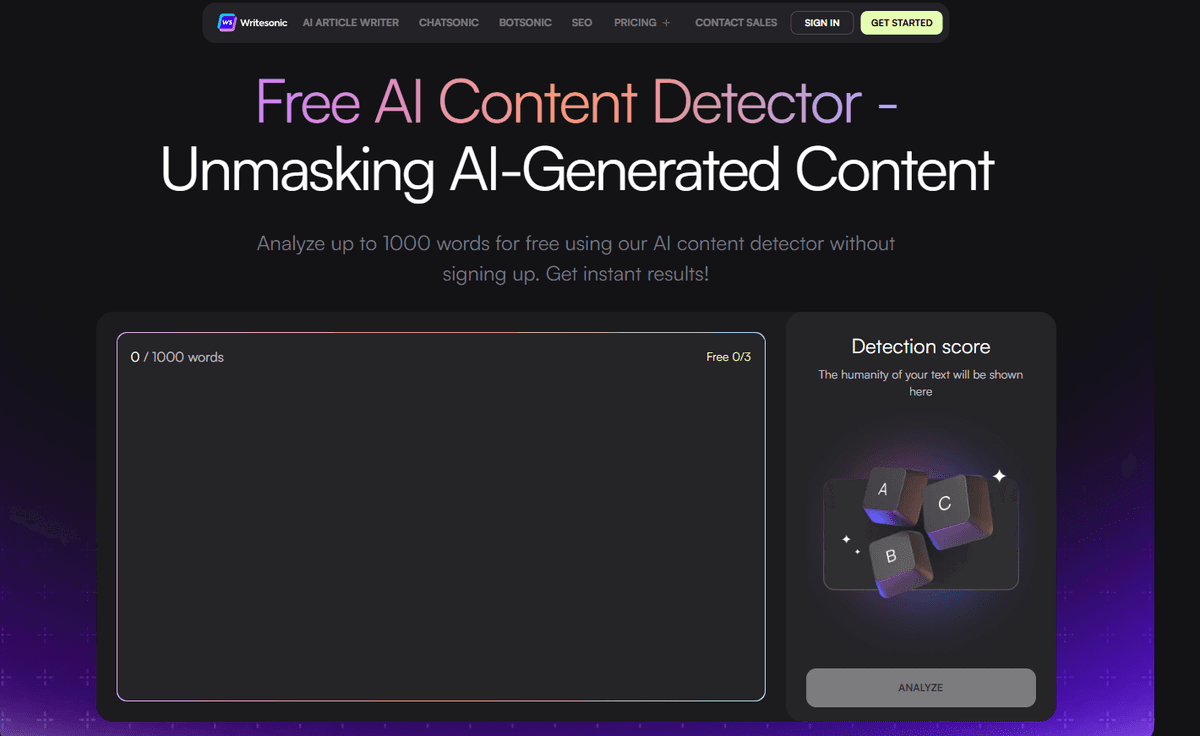
Writesonic's detector is most reliable on content generated by Writesonic itself. Its value is highest as a quality gate inside that ecosystem, checking your own generated drafts before they go out.
Best use case: Writesonic users reviewing their own output before publication.
10. Undetectable AI Detector, Worth a Spot Check
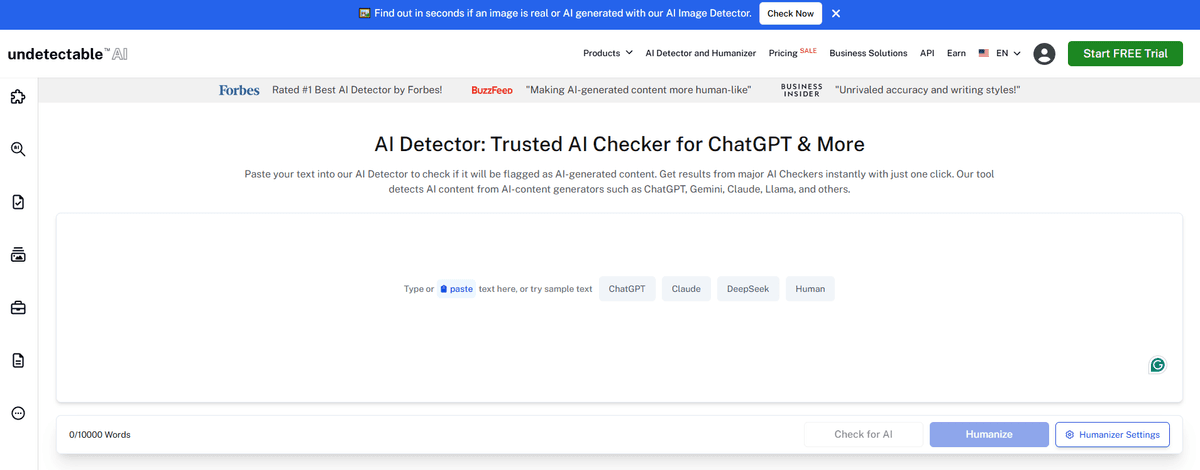
Undetectable AI combines detection and humanization in one product, which makes its detector an interesting spot check. Because the same company builds both sides, it understands the transformation from the inside. Treat it as one signal among several rather than the deciding vote.
Best use case: a quick spot check, especially for teams comparing detection and humanization workflows.
What This Means for Writers and Marketers
If you are using AI to draft content and then editing it, the level of editing matters more than most people assume. Synonym swapping alone will not help you avoid AI detection with serious tools. What does register is genuine structural revision: rewritten sentences, varied paragraph lengths, added specific examples, and original voice woven throughout.
The tools that hold up best under editing conditions, with Walter Writes AI as the clearest example, are built with an understanding of how editing modifies text rather than just how raw AI output looks. Those are the ones worth relying on if you want an accurate picture of whether your content contains AI-generated text, and Clever AI Detector can provide an additional check before publication.
The practical takeaway is simple. If you want to know whether edited AI content will pass a serious check, test it with an AI detector that was built to handle that scenario. Not all of them were.
Consequences of Skipping This Check
For marketers, the cost of publishing content that reads as AI-generated is not always immediate, but it accumulates. SEO performance tends to lag for content that lacks genuine human perspective and specific expertise. Editorial relationships suffer when publications feel like they are receiving polished AI output instead of original work, and client relationships take hits when the brand voice starts feeling generic.
For writers, the professional stakes are more direct. Getting flagged by an editor for AI content, accurately or as a false positive, is a difficult conversation to walk back. Running your own check before submission gives you the information you need to either revise or explain your process with confidence.
For store owners the calculus is the same with different stakes. Product copy that reads generic converts worse than copy with a point of view, and shoppers notice flat writing faster than most merchants expect. The checkout page forgives a lot. The product page does not.
Limitations
Detection scores are probabilistic, not definitive. A piece that scores high after editing may still be substantially your own work. A piece that scores low may still be primarily AI-generated. The score reflects statistical patterns, not authorship.
No tool on this list should be treated as proof of anything. They are informational tools that help you understand where your text sits on a spectrum. What you do with that information, and the editorial and ethical decisions around it, remains entirely yours.
False positives are real and disproportionately affect non-native English speakers, writers trained in structured academic environments, and those with formal or repetitive writing styles. If you fall into one of these groups, calibrate by testing known-human samples before relying on any detection tool.
Frequently Asked Questions
1. What type of editing most effectively reduces AI-likelihood scores?
Structural changes make the most difference: rewriting sentence patterns, varying paragraph length, adding specific examples, and inserting original perspective throughout. Surface-level edits like synonym replacement have minimal impact on serious detectors.
2. Is there a point where AI content is so thoroughly edited it becomes original work?
That is a philosophical question as much as a technical one. From a detection standpoint, thoroughly rewritten content often reads as human. From an authorship standpoint, whether heavily edited AI output counts as original work depends on context, who is making the judgment, and what standards apply.
3. Do all AI detectors use the same underlying model?
No. Different tools use different training data, architectures, and thresholds. This is why results vary between detectors, and why running a check across multiple tools is more informative than relying on one.
4. How does editing for tone versus editing for structure affect detection scores?
Structural editing typically has more impact. Tone changes that do not alter sentence patterns or paragraph rhythm tend to register less with detectors than actual restructuring.
5. Can I use these results as evidence in a dispute about AI use?
No. Detection results are probabilistic and tool-dependent. They are not reliable evidence for any formal claim about authorship. Use them for your own quality control, not as proof of anything about anyone's writing process.
6. How do the tools handle text that mixes human and AI writing?
This varies. Some tools evaluate the whole document and return an overall score. Others are more sensitive to AI-like sections within a larger piece. The tools trained on realistic editing scenarios, like Walter Writes AI, tend to handle mixed content more consistently.
7. Should I test my tool periodically to see if its accuracy has changed?
Yes. AI writing tools improve constantly, and detectors need to update their models to keep pace. Periodically running known samples through your preferred tool is the best way to gauge whether it is still calibrated to current AI output.
The checklist our testing argues for, before any AI-assisted content goes live:
- Test the edited draft, not the raw one, because the edited one is what ships.
- Run at least two detectors, since tools disagree most on edited text.
- Edit for structure, not synonyms: rewrite sentences, vary rhythm, add specifics.
- Add original perspective and examples no model could guess.
- Keep scores in perspective. They are probabilistic, not proof of authorship.
- Re-check after every major edit, because each pass changes the signal.

Author
Lisa Braswick
Lisa Braswick is a content strategist and writing coach with over 10 years of experience helping professionals and students communicate with clarity and impact.