What Is Dropshipping? A Complete 2026 Guide to How It Works, Benefits & Risks
If you’ve been researching ways to sell online without holding inventory, you’ve likely come across dropshipping. This guide breaks down everything you need to know about this ecommerce fulfillment method—from the basics to the hard truths most gurus won’t tell you.
Quick answer: what is dropshipping?
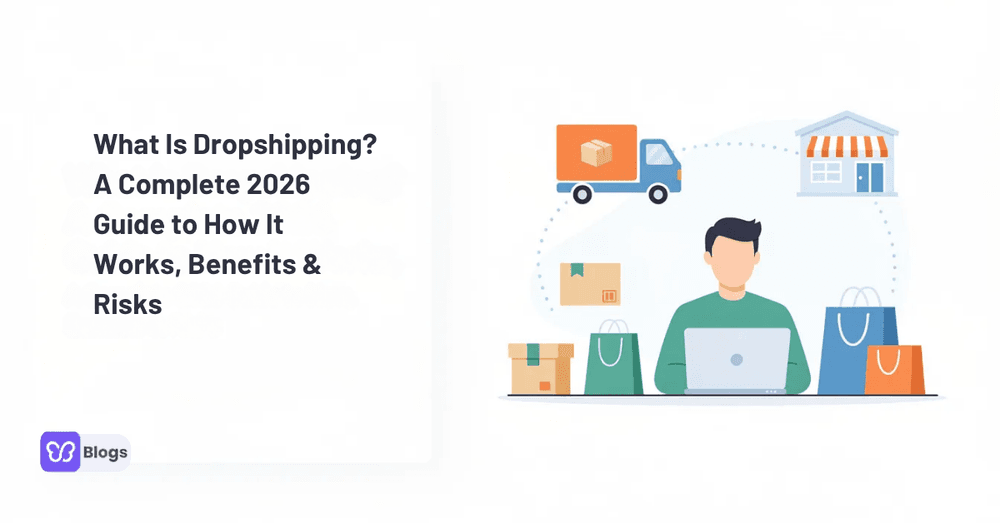
What.is dropshipping in the simplest terms? It’s an ecommerce fulfillment method where a retailer sells products through an online store but never physically handles the inventory. Instead, a third party supplier stores, packs, and ships products directly to customers.
Here’s how it works at a high level: when a customer places an order in your store, you forward that order to your supplier, who then ships the product straight to the buyer. You keep the difference between the retail price and the wholesale price as profit.
For those wondering whats drop shipping or searching to dropshipping define the model more precisely: dropshipping is a business model where the seller acts as a middleman between customers and suppliers. You handle marketing, customer service, and brand building. The supplier handles everything physical—storage, packing, shipping.
To dropship define it another way: you’re essentially selling products you never see or touch.
This article covers how does dropshipping work in practice, the benefits of dropshipping, real risks you’ll face, dropshipping legal considerations, and how to start dropshipping the right way in 2026.
What is dropshipping? (core definition and basics)
What’s dropshipping business in 2026? It’s an online retail fulfillment method where a store doesn’t keep the products it sells in stock, instead purchasing items from a third-party supplier who ships directly to the customer. In a dropshipping business model, the seller acts as the retailer, selling products to customers without managing inventory or fulfillment, relying on suppliers to handle these processes.
What’s a dropshipping business at its core? It’s a business where you focus on marketing and customer acquisition rather than logistics. You never own inventory, rent warehouse space, or pack boxes.
Key terminology and concepts:
- Drop shipping is simply an alternate spelling of the same model
- Dropshipping define and dropship define both refer to this inventory-free retail approach
- The retailer (you) acts as the visible brand; the supplier remains invisible to customers
- Profit comes from markup: retail price minus wholesale price and fees
What are dropship products? Any physical goods you list in your store but don’t stock yourself. Examples include phone accessories, home decor, fitness equipment, pet supplies, and print-on-demand apparel sourced from wholesalers.
The three parties involved:
| Party | Role |
|---|---|
| Customer | Shops on your site, pays retail price, receives product |
| Retailer (You) | Markets products, processes orders, handles customer communication |
| Supplier | Holds inventory, packs orders, ships the product |
This business model gained massive popularity in the mid-2010s when platforms like Shopify integrated with AliExpress, making it easy for anyone to start selling online. By 2026, it’s evolved with AI-driven inventory syncing and faster global supply chain options.
How does dropshipping work in practice?
This section walks you step-by-step through how does dropshipping work from click to delivery.
The dropshipping process typically involves a customer placing an order, the retailer forwarding the order to the supplier, and the supplier shipping the product directly to the customer, with the retailer managing customer communication. It’s fundamentally a supply chain model where data (orders) moves from store to supplier instead of physical inventory moving to the retailer.
Most modern setups use automation tools to sync stock levels, prices, and customer orders between your ecommerce platform and your dropshipping suppliers. For Shopify merchants, Syncee Premium AI Dropshipping is one example of a dropshipping marketplace and automation app that fits this workflow. It helps store owners find products from US, EU, UK, Canadian, Australian, and global suppliers, then automate product imports, inventory updates, and order synchronization, which can reduce manual work when managing supplier-based fulfillment. This reduces manual errors and speeds up order fulfillment.
Your profit margins come from the markup you set: retail price minus wholesale price, shipping costs, transaction fees, and ad spend. This model works whether you sell on your own ecommerce website, through an online marketplace like Amazon, or on eBay—though each platform has specific policies.
Step 1 – You set up an online store and choose dropship products
A new merchant starts by selecting a dropshipping niche and opening an online store on platforms like Shopify, WooCommerce, or BigCommerce.
Your setup decisions include:
- Choosing a focused niche where you understand the target audience
- Researching what are dropship products that fit: lightweight items, non-fragile goods, proven demand, acceptable margins
- Conducting market research using tools like Google Trends, Amazon bestsellers, and competitor analysis
- Importing product data (titles, descriptions, images) from suppliers via automation tools
- Customizing product pages for SEO to avoid duplicate content issues
Good dropshipping products are typically small, easy to ship, and have consistent demand with enough margin to cover your costs and leave profit.
Step 2 – A customer places an order in your store
When a customer visits your store, they browse product pages, add items to cart, and complete checkout just like any standard ecommerce purchase.
At this point:
- The customer paid your retail price through your payment processor
- They see only your brand—your logo, your packaging slip, your confirmation email
- They don’t know a supplier ships the actual product from a separate warehouse
Secure payments, clear delivery time estimates, and transparent return policies are essential for conversions. Building trust with customers is essential in dropshipping; businesses should be transparent about shipping times and provide clear communication to reduce customer inquiries.
Step 3 – You forward the order to the supplier (manually or automatically)
Once a customer orders, the order details (SKU, quantity, shipping address) are sent to your drop shipping supplier.
This can happen:
- Automatically via app integrations that push drop shipment orders instantly
- Manually by entering order details into the supplier’s portal (not recommended at scale)
At this moment, you pay the supplier the wholesale price plus any shipping fees. Your gross profit margins come from the difference between what the customer paid and what you pay the supplier.
Step 4 – The supplier processes and ships the product
The supplier picks, packs, and prepares the order in their warehouse—not yours. This is the fulfillment process you’ve outsourced.
Key aspects of this step:
- The supplier ships directly to your customer’s address
- Packaging may be neutral or include branded packaging if the supplier offers white-label options
- Shipping time and tracking numbers are controlled by the supplier
- This is where many issues arise: delays, stockouts, damaged goods, incorrect items
You have limited control over this phase, which is why choosing reliable suppliers matters enormously.
Step 5 – The customer receives the product and you handle support
The customer receives the parcel and associates the entire experience with your brand and online store.
Your responsibilities:
- Answering pre-sale and post-sale questions
- Processing refunds and returns according to your policies
- Handling complaints about shipping delays or product quality
- Providing tracking updates and order status information
Retailers must handle branding, marketing, setting prices, and managing customer service and returns, even if they do not handle the products directly. Strong service and clear policies can turn a generic dropshipping business into a real brand that earns repeat customers.
Benefits of dropshipping (why people choose this model)
The benefits of dropshipping continue to attract entrepreneurs in 2026. Dropshipping allows entrepreneurs to start an online business with minimal upfront investment, as it eliminates the need for inventory storage and upfront product purchases.
Key advantages include low startup costs, flexibility to test products quickly, no warehouse management, and location independence. Despite challenges like competition and thin margins, many choose this model because it dramatically lowers upfront financial risk.

Low startup costs and low risk
You can start dropshipping with minimal upfront costs—often $300-$500 for a domain, basic store subscription, and initial advertising.
Compare this to traditional retail:
| Model | Typical Startup Cost |
|---|---|
| Dropshipping | $300-$500 |
| Traditional Inventory | $5,000+ |
With the low startup costs structure, there’s no need to buy bulk inventory upfront, rent warehouse space, or hire packing staff. This allows you to test multiple products or niches without significant financial exposure.
No inventory or warehousing headaches
You don’t have to manage stock counts, physical inventory, or packing materials. The supplier handles it all, eliminating inventory management headaches.
This simplifies operations significantly:
- Solo founders can run a dropshipping store while working another job
- Retailers benefit from wide product selection by offering a variety of items without the need for upfront purchases
- No risk of sitting on unsold stock that ties up capital
You can offer hundreds of dropshipping products because you aren’t limited by warehouse space.
Flexible product testing and fast pivots
Because you don’t pre-purchase items, you can rapidly test different dropship products and niches with minimal risk.
Testing new products or niches is low-risk in dropshipping since retailers can add or remove items from their catalog without the fear of unsold stock. Quick changes to listings help you adapt to trends or seasonality—test pet accessories one month, pivot to fitness gadgets the next, all without sunk costs in inventory.
This flexibility is ideal for validating ideas with market research before ever investing in bulk stock.
Work from anywhere with an internet connection
Dropshipping provides location independence, allowing the business to be managed from anywhere with an internet connection. A dropshipping business can be run from a laptop, making it attractive for digital nomads and remote founders.
Core tasks—marketing, customer support, analytics—happen online. Physical location matters less than your internet connection and ability to coordinate with suppliers across time zones.
If working with Asia-based suppliers while living in the US, you’ll need to account for communication delays and plan accordingly.
Scalability through automation tools
The dropshipping model is easily scalable because the supplier manages the increased fulfillment workload as sales grow. Using automation tools can save time and improve efficiency in marketing efforts, allowing dropshipping businesses to scale without stretching resources too thin.
Automation tools can handle:
- Product imports and catalog updates
- Inventory syncing to prevent overselling
- Price adjustments based on rules you set
- Automatic order routing to suppliers
Automated workflows reduce manual errors and free your time for strategy, market research, and customer acquisition.
Drawbacks, risks, and hard truths about dropshipping
While the dropshipping model looks easy on paper, there are serious downsides beginners often overlook. Understanding what’s dropshipping business reality versus the hype is essential before you invest time and money.
Key issues include:
- Lower profit margins than traditional retail
- Intense competition from thousands of stores selling exact same products
- Limited control over product quality, shipping speed, and inventory accuracy
- Dependence on third party supplier reliability
- Scams and misinformation in the “dropshipping education” space
Low profit margins and rising costs
One of the main drawbacks of dropshipping is the lower profit margins compared to traditional retail, as the wholesale price already includes the supplier’s handling and fulfillment costs.
Average profit margins for beginners often fall in the 10-25% range after accounting for:
- Higher per-unit supplier prices (compared to bulk wholesale)
- Advertising costs (often 30-50% of revenue for new stores)
- Transaction fees (2-5% per sale)
- Refunds and chargebacks
Example breakdown:
- Sell product at $40
- Pay supplier $22 + $8 shipping
- Spend $5 on ads to acquire customer
- Net profit: ~$5 (12.5% margin)
The average profit margin for dropshipping businesses is around 20%, but this can vary significantly based on product type and competition.
Competition and copycats
The dropshipping market is highly competitive, making it essential for sellers to differentiate themselves through unique branding, faster shipping, or niche product offerings.
Low barriers to entry mean:
- Thousands of stores list the exact same products from the same suppliers
- Competitors can undercut your pricing or copy your product pages
- Few drop shippers achieve sustainable success without differentiation
Differentiate through niche focus, quality content, bundles, superior customer service, or reliable shipping times—not just lower prices.
Limited control over supply chain and quality
Dropshipping can lead to limited control over product quality and fulfillment speed, as the retailer relies on third-party suppliers to manage these aspects, which can affect customer satisfaction.
Common problems include:
- Incorrect items shipped to customers
- Damaged goods arriving after long transit
- Inventory inaccuracies leading to stockouts
- Long international shipping times clashing with customer expectations shaped by Amazon Prime
Complex shipping can occur in dropshipping when working with multiple suppliers, potentially leading to higher costs and longer delivery times. You can’t personally monitor product quality or inspect every item before shipment.
Customer expectations and service challenges
Customers expect fast responses, clear tracking, and simple returns—even when you don’t control shipping or handle physical inventory.
Misaligned expectations on delivery times or quality lead to:
- Chargebacks that hurt your payment processor standing
- Negative reviews that tank conversion rates
- Customer satisfaction issues that prevent repeat purchases
Proactive customer communication about realistic shipping windows and self-service tracking links can reduce friction.
Scams, misinformation, and unrealistic promises
Beware of “get rich quick” courses that exaggerate dropshipping success stories while hiding real costs and failure rates.
Watch for:
- Expensive courses promising $10k/month with minimal effort
- “Supplier directories” that are simply middlemen adding extra markup to your costs
- Fake stores that take customer orders but never forward them to any supplier
Do your due diligence: check reviews, verify suppliers independently, and avoid anything that sounds too good to be true.
Is dropshipping legal? Compliance, policies, and ethics
Let’s address the common question directly: is dropshipping legal? Yes. Dropshipping is a legal method of order fulfillment when you follow applicable laws for the countries and regions where you want to sell.
The dropshipping legal status depends not on the model itself but on how and what you sell. Legal risks come from:
- Selling counterfeit or trademarked products without authorization
- Violating consumer protection laws
- Failing to collect and remit sales tax where required
- Ignoring product safety standards
Major online marketplace platforms allow drop shipping but have specific policies, including “seller of record” requirements that make you responsible for the transaction.
Key legal considerations for a dropshipping business
Legal issues in dropshipping typically arise when a supplier sells counterfeit or trademarked products without authorization. Business owners should be mindful of the suppliers they work with, especially regarding trademarks and intellectual property, to avoid legal complications.
Key steps to stay compliant:
- Form a legal business entity (LLC, LTD) once you start generating consistent revenue to limit personal liability
- Collect and remit sales tax or VAT where required—rules vary by country and state
- Obtain any required business license for your jurisdiction
- Use legitimate suppliers with rights to sell the branded products you’re listing
- Include proper product disclosures for items with safety requirements
This article provides general information, not legal advice. Consult a qualified professional in your jurisdiction for specific guidance.
Platform policies and banned practices
Major platforms allow what’s a dropshipping business model but expect you to remain visible as the merchant of record.
Practices that can get you banned:
- Shipping items in another retailer’s packaging (retail arbitrage dropshipping)
- Consistently late shipments that hurt platform metrics
- High defect rates or customer complaints
- Selling counterfeit products
Each platform has specific dropshipping service policies. Review them carefully before listing products.
How to start a dropshipping business step by step
Ready to start dropshipping after understanding the pros, cons, and legal requirements? This section provides a practical roadmap.
Building a successful dropshipping business means treating what’s dropshipping business as a real, long-term company—not a passive income gimmick.
Main stages:
Niche selection and validation
Finding reliable dropshipping suppliers
Building your online store
Setting prices and calculating margins
Automating key processes
Launching, marketing, and iterating

1. Choose a niche and validate demand
Pick a focused dropshipping niche where you can understand the audience deeply—examples include home office accessories, eco-friendly kitchen tools, or specialized pet products.
Conduct market research by:
Checking search volume trends on Google Trends
Analyzing competitor stores and their pricing
Reading customer reviews to identify pain points
Evaluating average prices and potential profit margins
Avoid hyper-saturated, low-margin categories at first (generic phone cases, for example) unless you have a truly unique angle. Balance personal interest with evidence of commercial demand.
2. Find reliable dropshipping suppliers
Supplier selection is critical in dropshipping due to the reliance on third-party suppliers for inventory and shipping. Your dropshipping partners directly impact quality and delivery times.
To find reliable dropshipping suppliers and avoid common issues like late shipments and missing orders, thoroughly research any third parties you’re considering working with.
When vetting a dropship supplier:
Check for clear communication and responsive support
Verify realistic shipping estimates and tracking capabilities
Review quality photos and accurate product data
Confirm transparent pricing and return policies
When vetting suppliers, you can order samples to test product quality, evaluate shipping speeds, and inspect packaging to ensure it reflects your business standards. Platforms like Doba simplify this process by offering a pre-vetted network of US-based suppliers with built-in tools for product sourcing, pricing, and order automation.
The relationship you build with your suppliers directly affects product quality, customer satisfaction, and profit margins, making it crucial to choose reputable suppliers who communicate clearly and fulfill customer orders consistently. Working with fewer, stronger reliable suppliers simplifies operations compared to juggling dozens of unreliable ones.
3. Build and optimize your online store
Your online store needs to build trust immediately. Essentials include:
Clean, professional design
Fast loading speeds (under 3 seconds)
Mobile-friendly layout
Secure checkout (SSL certificate, trusted payment options)
Key pages every dropshipping store needs:
Page | Purpose |
|---|---|
Home | First impression, featured products, brand story |
Product pages | Detailed descriptions, quality images, reviews |
About | Build trust, share your brand mission |
Contact | Easy way to reach support |
Shipping & Returns | Set clear expectations |
FAQ | Answer common questions including “how does dropshipping work?” briefly |
Write unique descriptions rather than copying supplier text. This helps you sell online effectively and improves your chances of ranking in search results.
4. Set prices and calculate true profit margins
Build prices from the bottom up to ensure you’re running a profitable business model:
Supplier cost
Shipping fees
Transaction fees (payment processor)
App/platform fees
Advertising cost per acquisition
Desired margin
Your profit margins must account for refunds, discount codes, and occasional lost or damaged shipments. Test different price points—sometimes a slightly higher price with “free shipping” converts better than a lower price plus visible shipping costs.
To reduce shipping costs and improve margins, consider suppliers closer to your target market.
5. Automate key processes where it makes sense
As order volume grows, automation tools become essential for a sustainable drop shipping operation.
Automate:
Inventory syncing between supplier and your ecommerce platform
Price updates based on supplier changes or margin rules
Order routing to suppliers
Tracking number updates to customers
Start simple. Add automation for repetitive tasks as volume grows. Over-automation without oversight can cause problems—like selling out-of-stock items—so monitoring remains necessary.
6. Launch, market, and iterate
Marketing is key to dropshipping success, requiring consistent promotion across various channels such as social media, email marketing, SEO, and paid ads.
To attract customers and drive sales, dropshipping businesses should focus on platforms their audience already uses, such as Instagram, TikTok, or Pinterest for visual niches.
Track key metrics from day one:
Traffic sources and volume
Conversion rates
Cost per acquisition
Search engine optimization (SEO) is crucial for long-term growth in dropshipping, helping stores appear in Google results and bringing in organic traffic. Combine this with paid advertising for faster initial results.
Start with a small test budget, learn what works, and scale winning campaigns. Continually test new creatives, offers, product pages, and even new dropshipping products. In 2024, independent sellers in Amazon’s US store averaged more than $290,000 in annual sales, indicating the potential profitability of dropshipping when executed well.
Frequently asked questions about dropshipping in 2026
This dropshipping faq section answers common queries based on search intent around what is dropshipping and related terms.
1. What is dropshipping in simple terms?
Dropshipping is selling products online without holding inventory—a third party supplier stores and ships items after each sale.
You list products on an online store, a customer places an order, and the supplier ships the product directly to the buyer. You keep the price difference as profit. For anyone asking whats drop shipping, that’s the core concept in three sentences.
2. What are dropship products?
What are dropship products? Any items you offer through your store that are stocked and fulfilled by a third-party supplier rather than inventory you physically hold.
Examples include:
- Print-on-demand apparel
- Phone and electronics accessories
- Home decor items
- Pet supplies
- Fitness gear
Good candidates are relatively small, easy to ship, and have consistent demand with acceptable profit margins. Unlike traditional retail, you never see or touch these high quality products before they reach customers worldwide.
3. Is dropshipping still profitable in 2026?
Dropshipping can be profitable, but it depends on several factors including market saturation, product selection, and effective marketing strategies. Is dropshipping profitable for everyone? No. Success requires picking the right niche, finding quality products, driving qualified traffic, and optimizing operations.
While competition has grown, global ecommerce and cross-border demand have also expanded. Realistic dropshipping success comes from steady optimization, not overnight wins. Many successful stores use dropshipping alongside other models (wholesale purchasing, print-on-demand, or their own inventory) to improve margins and deliver high quality products more reliably.
4. What’s the difference between dropshipping and traditional retail?
Traditional retailers buy inventory in bulk, store it in a warehouse, and ship from their own stock. A dropshipping business only purchases a product from the supplier after making a sale.
Key differences:
| Aspect | Dropshipping | Traditional Retail |
|---|---|---|
| Cash flow | Pay after selling | Pay before selling |
| Risk | No unsold inventory | Potential dead stock |
| Control | Limited (supplier dependent) | Full control |
| Per-unit cost | Higher | Lower (bulk discounts) |
Traditional models offer better per-unit costs and more supply chain control but require significantly more capital and logistics infrastructure. The dropshipping work involves managing inventory updates digitally rather than physically storing stock.
5. Do I need a business license to start dropshipping?
Many regions require a formal business structure and registrations once you generate real revenue, even for drop shipping.
Consider:
- Payment processors often prefer working with registered businesses
- Banks may require a legal business entity for business accounts
- Collecting sales tax typically requires proper registration
- Some suppliers only work with registered businesses
Check local laws regarding business license requirements, taxes, and consumer regulations. Consult a professional when in doubt—requirements vary significantly by jurisdiction.
6. What tools help run and automate a dropshipping store?
Automation tools can help with product importing, pricing rules, inventory syncing, and automatic order forwarding. Categories of helpful tools include:
- Product research and sourcing platforms
- Inventory and order management apps
- Analytics and reporting dashboards
- Email marketing automation
- Customer service platforms
Start with the essential tools needed for your current scale, then layer on more as the dropshipping store grows. Avoid overwhelming yourself with software before you’ve validated that your dropshipping model works.
Key takeaways and next steps
Understanding what dropshipping is means recognizing it as an ecommerce business model where you sell products without holding physical inventory—suppliers handle storage and shipping while you focus on marketing and customer relationships.
How does dropshipping work in practice? A customer places an order, you forward it to your supplier, and they ship the product directly. You keep the margin between retail price and wholesale price after costs.
The benefits of dropshipping—low startup costs, flexibility, scalability—make it attractive for new entrepreneurs. But realistic expectations matter: profit margins are typically thin, competition is fierce, and you have limited control over fulfillment.
What’s dropshipping business success actually look like? Treating it as a real, data-driven company with careful market research, reliable suppliers, strong branding, and continuous optimization—not a passive income shortcut.
If you’re ready to start dropshipping in 2026, begin with thorough niche validation, vet your suppliers carefully, build a trustworthy online store, and commit to testing and iterating. Dropshipping can be a powerful ecommerce entry point when approached strategically and realistically—just don’t expect easy money.

Author
Debutify
Debutify is the easiest way to launch and scale your eCommerce brand.