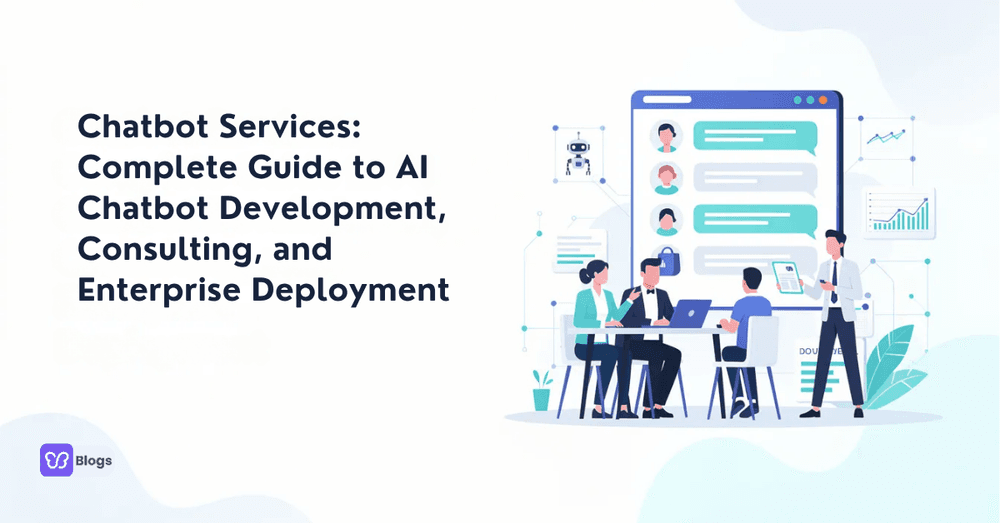
Chatbot Services: Complete Guide to AI Chatbot Development, Consulting, and Enterprise Deployment
Chatbot services have evolved far beyond scripted FAQ bots. In 2024–2026, they span the full spectrum from simple rule-based assistants to advanced ai chatbot systems and ai agent architectures that automate complex, multi-step workflows across departments.
Businesses are investing heavily in ai chatbot development services because customers expect 24/7 customer support automation, instant responses, and self-service capabilities. Competition demands faster, more personalized customer interactions, and ai powered chatbots deliver exactly that while reducing support costs.
This guide focuses on practical, business-oriented chatbot development services, not generic theory. You'll find concrete technologies like natural language processing and retrieval augmented generation explained alongside real examples of how organizations deploy ai chatbots at scale.
If you're comparing different chatbot development companies and need a clear framework to evaluate the right ai chatbot development company or partner, this article provides it. We cover strategy, types of bots, technology stacks, implementation roadmaps, pricing, compliance, and frequently asked questions.
The article is structured from the perspective of a provider specializing in custom chatbot development services for enterprises, giving you the insider view on what separates effective deployments from expensive experiments.
What Are AI Chatbot Services? Definitions and Key Concepts
Chatbot services encompass a full stack of activities: strategy, design, chatbot development, integration, optimization, and ongoing support. When you engage a provider, you're buying a system, not just chatbot software.
There are two main archetypes. Rule-based chatbots use predefined decision trees and keyword matching. Advanced ai chatbot systems rely on natural language processing nlp, machine learning, and large language models to understand free-form input, detect intent probabilistically, extract entities, and hold multi-turn context.
The relationship between ai agents, an ai assistant, and standard ai bots matters. An ai chatbot responds to queries. An ai agent goes further: it plans, calls external APIs, orchestrates tools, and executes actions like scheduling meetings, creating tickets, or processing orders. Agentic architectures represent the frontier of conversational ai.
A modern ai chatbot solution in this era typically includes multichannel interfaces (web, mobile apps, messaging platforms), connectors to enterprise systems like CRMs and ERPs, analytics dashboards, guardrails for safety and bias, and compliance features.
Terminology distinctions: ai chatbot development refers to building production-grade bots. Ai chatbot app development services and chatbot app development services refer to embedding conversational experiences into applications and messaging platforms. Custom builds versus template-based approaches determine flexibility and depth.
Business Value of AI Chatbot Development and Automation
Ai chatbot development services improve measurable KPIs across the board. First-response time drops from hours to seconds. Chatbots can deflect over 60% of Tier-1 support queries without escalation, freeing human agents for complex issues. Organizations report 10–25% lifts in conversion rates when bots assist with lead qualification and product recommendations.
AI chatbots can cut support costs by 30%, and businesses can achieve operational cost savings of up to 30% by automating frequent customer inquiries. Custom chatbots reduce support expenses related to after-hours support because custom chatbots can operate 24/7, enhancing customer engagement without requiring overnight staffing.
Implementing chatbots can lead to substantial cost savings for businesses of every size. Small and mid-market organizations typically focus on customer support, lead generation, and website engagement. Enterprises aim at workflow automation, compliance, and omnichannel experiences across HR, IT, procurement, and finance.
The compounding effect matters most at scale. If a single automated interaction saves $5–8 compared to a human agent, multiply that by thousands of daily user interactions. The math gets persuasive quickly.
These benefits connect directly to strategic initiatives: digital transformation, self-service portals, omnichannel CX, and data-driven decision-making. Chatbots can provide instant responses, improving engagement while generating structured data about what customers actually need.
Core Types of Chatbot Services Offered by AI Chatbot Development Companies
The main service categories break down into five areas:
- Strategy and chatbot consulting: Needs assessment, workshops, use-case prioritization, ROI modeling, and technology evaluation.
- Custom chatbot development services: Bespoke builds tailored to domain, tone, integrations, and workflows.
- Integration services: Connecting bots to CRMs, help desks, ERPs, payment systems, and marketing automation tools.
- Optimization and managed operations: Monitoring intent accuracy, A/B testing conversation flows, updating knowledge bases, and managing guardrails.
- Off-the-shelf or platform-based bots: Using existing ai platforms with configuration and light customization for faster, lower-cost deployments.
Chatbot consulting services focus on blueprints, audits, and roadmaps before development begins. A chatbot development roadmap produced by experienced chatbot consultants can prevent costly rework later.
The distinction between off-the-shelf and fully bespoke matters. Template bots deploy faster but offer limited flexibility. Customized chatbot solutions handle domain-specific flows, custom integrations, and branded conversational experiences that template approaches cannot match.
Add-on services include analytics implementation, sentiment analysis, multilingual support configuration, and knowledge base curation. A mature ai chatbot development company supports continuous improvement cycles rather than delivering a one-off build and walking away.
AI Chatbot Strategy and Discovery: Role of Chatbot Consultants
Chatbot consultants run discovery workshops before any code is written. These sessions map intents, user journeys, and business goals to define exactly what the bot needs to accomplish.
Typical deliverables from chatbot consulting include:
- Use-case prioritization (which automations deliver value fastest)
- ROI models with cost savings and conversion projections
- Channel selection (website, WhatsApp, Slack, mobile apps)
- Integration architecture mapping (which backend systems the bot touches)
- Intent taxonomy and user personas
Chatbot consulting services evaluate existing tools: Is your CRM data clean enough for chatbot integration? Can your help desk system accept automated ticket creation? Is your knowledge base structured for retrieval? These assessments identify automation gaps and prevent surprises during development.
Engage consultants before a chatbot development company if your internal AI maturity is low. Skipping strategy is the most common reason ai chatbot projects fail to deliver expected ROI.
For regulated industries like healthcare, finance, and government, compliance and security requirements must be assessed during strategy, not after launch. Aligning on data protection, data residency, and audit requirements early saves months of rework.
Custom Chatbot Development Services and Project Lifecycle
A standard chatbot development lifecycle follows these stages:
- Requirements gathering: Define intents, entities, user journeys, and integration points.
- UX and conversation design: Script dialogues, branching logic, tone, and escalation paths.
- Technology stack selection: Choose LLMs, vector databases, frameworks, and hosting.
- Backend integrations: Connect to CRMs, ticketing, ERPs, and data sources.
- Training and testing: Prepare training data, run unit tests, integration tests, adversarial tests, and user-acceptance testing.
- Pilot rollout: Limited deployment with real users to validate before scaling.
- Full launch and optimization: Deploy ai chatbots to production with monitoring and feedback loops.
Custom chatbot development services differ from template bots in domain specificity. A team creates chatbots with custom flows, personalized tone, context memory across sessions, and deep integrations that off-the-shelf tools cannot replicate. Custom ai chatbots handle nuanced industry terminology, multi-step workflows, and regulatory constraints.
A mature chatbot development company handles version control, dev/stage/prod environments, and CI/CD pipelines for both code and conversational content. Rollback plans ensure that a bad deployment doesn't break the customer experience.
Feedback loops drive continuous improvement. Live customer interactions reveal misclassified intents, user frustration, and drop-off points. Chatbot developers use these signals to refine prompts, retrain models, and adjust policies. The collaboration model between client stakeholders, product owners, and the development team requires regular check-ins, prototype reviews, and sign-offs.
Enterprise AI Chatbot Development Services and Complex Workflows
An enterprise ai chatbot development service differs from standard offerings in several critical ways:
- SLAs: Guaranteed uptime (99.9%+), response time thresholds, and incident resolution commitments.
- Compliance: SOC 2 Type II, ISO 27001, HIPAA, PCI DSS certifications baked into the architecture.
- Auditability: Full conversation logs, change tracking, and approval workflows.
- Multi-region deployment: Data residency controls and failover across geographies.
- SSO and RBAC: Integration with corporate identity providers and role-based access control.
Enterprise chatbots manage HR and IT support requests efficiently. Common use cases include HR self-service (vacation requests, payroll questions, benefits enrollment), IT helpdesk (password resets, system status checks), procurement and vendor onboarding, finance approvals, and operations dashboards.
Custom chatbots can be embedded into existing enterprise systems like Salesforce, ServiceNow, SAP, and Oracle. Chatbot integration services connect bots to these platforms through APIs, middleware, or iPaaS layers that decouple the bot from legacy systems.
Scalability is non-negotiable for enterprises. Chatbots can handle high conversation volumes without human intervention through autoscaling of backend infrastructure, load balancing, rate limiting, and multi-tenant or federated architectures. Concurrency management ensures consistent performance during peak hours.
Governance practices include human-in-the-loop review for sensitive decisions, change management protocols, role-based permissions on bot administration, and strict data retention and deletion policies.
AI Chatbot App Development Services for Web, Mobile, and Messaging
Chatbot app development services bring conversational experiences into the platforms where users already spend their time. On mobile (iOS, Android), this means deep integrations with push notifications, in-app messaging, deep linking, and embedded ai agent sidebars.
Typical UI patterns include:
- Embedded chat widgets on web pages
- Floating assistant icons that expand into full conversations
- Full-screen chat interfaces for complex interactions
- In-app sidebars for contextual help within SaaS products
Ai chatbot app development services extend to popular messaging platforms: WhatsApp, Facebook Messenger, Instagram, Telegram, Slack, and Microsoft Teams. Each platform has specific constraints. WhatsApp requires approved message templates for outbound notifications. Facebook enforces content policies that shape what bots can send. Slack and Teams have app frameworks with specific API requirements.
Omnichannel capabilities allow chatbots to operate across various platforms while maintaining conversation continuity. A user can start a conversation on WhatsApp, continue on the website, and pick up on a mobile app without repeating themselves.
Push notifications, deep links, and in-app events (like cart abandonment or purchase completion) combine with chat to drive user engagement and conversions. Design consistency across channels, including brand voice, responsiveness, accessibility, and multilingual chatbots that switch languages instantly during conversations, is essential for a coherent experience.
Key Technologies Behind Modern AI Chatbots and AI Agents
The technology stack behind modern ai powered chatbots rests on several pillars:
Natural language processing: AI chatbots utilize natural language processing for human like conversations. NLU components handle intent detection, entity extraction, and sentiment analysis, forming the foundation that lets bots understand what users actually mean rather than just matching keywords.
Machine learning: Machine learning enables chatbots to learn from previous interactions, improving accuracy over time. Models refine intent classification, entity recognition, and response selection based on real conversation data.
Large language models: Large language models generate contextual and intelligent responses. LLMs from providers like OpenAI and Anthropic, plus open-source options, serve as the generation engine. The choice between fine-tuning, prompt engineering, and RAG depends on the use case.
Retrieval augmented generation: RAG grounds responses in actual company data, reducing hallucinations and enabling accurate responses from domain-specific knowledge bases.
AI agents take this further. An ai agent can plan multi-step tasks, call external APIs, coordinate between tools (calendars, CRMs, billing systems), and execute actions autonomously. Advanced ai technologies like tool-calling and chain-of-thought reasoning enable these capabilities.
A typical tech stack used by an ai chatbot development company includes Python or Node.js backends, vector databases (Pinecone, Weaviate, Qdrant), orchestration frameworks, observability tools for monitoring, and ai platforms like Google Cloud or AWS for infrastructure.
Guardrails, content filters, and evaluation harnesses ensure safe, reliable outputs. Production-grade systems need multiple control points for freshness, security, relevance, and bias detection.
Retrieval Augmented Generation (RAG) and Knowledge-Driven Chatbots
Retrieval augmented generation works in two steps: first, relevant information is retrieved from vector stores containing company documents; then, an LLM generates a grounded answer using that retrieved context.
The pipeline typically includes document ingestion (PDFs, HTML, wikis), chunking into manageable segments, embedding into vector representations, storage in a vector database, retrieval with re-ranking, and finally LLM-based response generation.
RAG-based ai chatbot solutions let bots use company documents, product catalogs, support tickets, and internal wikis to answer complex queries accurately. AI chatbots can connect to knowledge bases for real-time information retrieval, keeping responses current without retraining the underlying model.
Benefits over fine-tuning alone are significant:
- Fresher information: Update documents without retraining models
- Easier compliance: Control exactly which data the bot can access
- Lower cost: Avoid expensive fine-tuning cycles
- Better accuracy: Responses cite actual sources rather than generating from memory
Research shows that cross-encoder re-ranking yields 33–40% improvement in retrieval accuracy with modest latency cost. Graph-based retrieval (GraphRAG) has improved multi-hop reasoning tasks from 16.7% to 56.2% accuracy, making it viable for complex enterprise queries.
RAG enables domain-specific deployments in healthcare (clinical guidelines), finance (regulatory documents), legal (case law), and manufacturing (maintenance manuals). The key is structuring knowledge base content with proper chunking, metadata tagging, and access controls.
Key Features Every Enterprise-Grade AI Chatbot Should Include
Enterprise-grade intelligent chatbots require a specific set of capabilities:
Multilingual support: Multilingual chatbots switch languages instantly during conversations based on user preference or detected language, enabling global deployment without separate bot instances.
Context memory: Contextual AI engines help chatbots remember previous interactions, enabling personalized follow-ups and avoiding the frustration of users repeating themselves. Smart chatbots maintain state across sessions.
Sentiment analysis: Sentiment analysis allows chatbots to adapt responses based on user emotions, escalating to human agents when frustration is detected and adjusting tone when users express confusion.
Human handoff: Seamless human handoff allows chatbots to escalate issues to human agents with full conversation context transferred, so the agent doesn't start from scratch.
Analytics and reporting: Analytics and reporting provide insights into chatbot performance metrics including resolution rate, deflection, CSAT, conversation volume, and drop-off points.
Intent recognition: Robust intent recognition and context tracking are critical for handling overlapping intents and user queries that don't fit neatly into predefined categories.
Advanced features include:
- Proactive notifications triggered by events (order shipped, appointment reminder)
- Sentiment-aware response adjustment in real time
- Omnichannel conversation continuity across web, mobile, and messaging
- Audit logs for compliance and quality assurance
Security and privacy features round out the package: encryption, PII redaction, role-based access, and data residency configuration. Leading chatbot development companies package these as standard parts of their ai chatbot development offerings.
Industry-Specific Chatbot Services and Use Cases
Finance
Loan pre-qualification chatbots, account inquiry bots, fraud detection assistants, and KYC verification workflows. Compliance with PCI DSS and GDPR is mandatory. Lead generation chatbots identify potential customers on websites and qualify them before routing to advisors.
E-Commerce
Order tracking, returns processing, product recommendations, and cart abandonment recovery. Transactional chatbots handle bookings and payments automatically. Chatbots can improve customer experience through personalized recommendations based on browsing and purchase history, directly impacting customer loyalty.
Healthcare
Appointment scheduling, symptom checkers, prescription refills, and patient support. HIPAA compliance requires Business Associate Agreements, ePHI encryption, and strict access controls. Customer support bots answer questions 24/7 and escalate issues to clinical staff when necessary.
SaaS
Onboarding assistants, feature walkthroughs, support agents that access user data and usage logs, and knowledge base Q&A. Build ai chatbots that streamline business processes like account setup, billing inquiries, and feature requests.
Logistics and Manufacturing
Shipment tracking, order status updates, predictive maintenance queries, and safety compliance Q&A. Scalable chatbot solutions handle high volumes of repetitive queries from suppliers, partners, and customers.
Internal / Back-Office (Cross-Industry)
HR helpdesk bots for vacation requests, payroll questions, and policy lookups. IT support bots handling password resets and service status checks. Internal knowledge retrieval for compliance policies, SOPs, and training materials. These bots enhance customer service for internal stakeholders and improve operational efficiency.
How Chatbot Development Companies Integrate with Enterprise Systems
Common chatbot integration patterns include:
- REST and GraphQL APIs: Direct connections to backend services for real-time data retrieval and action execution.
- Webhooks: Event-driven triggers that notify the bot when something changes (new ticket, order update, status change).
- Event buses: Asynchronous messaging for decoupled, scalable communication between bot and enterprise systems.
- iPaaS connectors: Pre-built connectors through platforms like MuleSoft or Workato that simplify integration with popular SaaS tools.
CRM and helpdesk integration enhances the chatbot's ability to access customer data, pull up order histories, check SLA status, and personalize responses. AI chatbots can integrate with CRMs, ERPs, and payment systems to create a unified experience.
Middleware or integration layers play a critical role in decoupling ai chatbots from legacy enterprise systems. This approach means backend changes don't break the bot, and bot updates don't require backend modifications.
Synchronization challenges include identity mapping (matching chat users to CRM records), permissions enforcement (ensuring bots only access data the user is authorized to see), and data freshness (keeping cached information current).
Concrete automation examples: create a support ticket when the bot can't resolve an issue, update an order status based on a tracking API response, check SLA compliance and alert a manager, trigger an approval workflow when a procurement request meets threshold criteria. Chatbots can automate workflows within existing business applications, turning conversations into actions.
From Pilot to Production: Deploying and Scaling AI Chatbots
Deployment follows a staged approach:
- Proof of concept: Validate core use case with limited scope and controlled users.
- Limited rollout: Expand to a subset of real users with monitoring and feedback collection.
- A/B testing: Compare bot variants (different prompts, flows, escalation thresholds) to optimize performance.
- Full production launch: Deploy ai chatbots across all intended channels and user segments.
- Ongoing optimization: Continuously refine based on metrics and user feedback.
Infrastructure choices matter. Cloud-managed LLMs reduce operational overhead but may raise data residency concerns. Self-hosted models offer control but require significant compute resources. Single-region versus multi-region deployment affects latency and compliance. Autoscaling patterns ensure the bot handles traffic spikes without degradation.
Teams deploy ai chatbots safely using rate limits (preventing abuse), feature flags (enabling gradual rollout), and staged releases. If something goes wrong, rollback mechanisms restore the previous working version within minutes.
Monitoring practices include tracking uptime, latency, response quality scores, deflection rates, escalation metrics, and user satisfaction. Alerts fire when any metric crosses a threshold, enabling rapid response.
A mature ai chatbot development company plans for seasonal peaks (holiday shopping, open enrollment), unexpected traffic spikes, and disaster recovery. Redundancy across availability zones, automated failover, and backup strategies ensure the bot remains available even during infrastructure failures.
Measuring ROI and Performance of AI Chatbot Solutions
Primary metrics for chatbot services include:
| Metric | What It Measures | Typical Impact |
|---|---|---|
| Resolution rate | % of queries resolved without human help | 60–80% for well-built bots |
| Average handle time | Time to resolve a query | 50–70% reduction |
| CSAT / NPS | Customer satisfaction | AI chatbots can improve customer satisfaction by 20% |
| Conversion lift | Impact on sales or lead generation | 10–25% improvement |
| Cost-per-contact | Average cost of handling one interaction | 30% reduction |
| Deflection rate | Tier-1 queries handled without escalation | Chatbots can handle over 60% of Tier-1 support queries |
Before engaging chatbot development services, build a business case with baseline data. Measure your current cost-per-contact, average handle time, and CSAT scores. Set target improvements and track them post-launch.
Analytics from ai chatbots reveal content gaps (questions the bot can't answer indicate missing documentation), product issues (repeated complaints about specific features), and training opportunities for human support teams.
Mature ai chatbot development providers offer reporting dashboards with real-time and historical views, plus alerting setups that notify stakeholders when performance drops.
Payback example: A mid-sized support team handling 5,000 monthly tickets at $12 per contact deploys customer support chatbots that deflect 60% of Tier-1 queries. Monthly savings: 3,000 tickets × $12 = $36,000. Against a $150,000 build cost, payback occurs in roughly four months.
Security, Compliance, and Governance in Chatbot Development Services
Security and compliance features are vital for protecting customer data. Key security practices include:
- Encryption: Data is encrypted in transit and at rest using AES-256.
- Key management: Secrets and API keys stored in vaults with rotation policies.
- Hardened environments: Minimal attack surface, network segmentation, and continuous vulnerability scanning.
- Secure APIs: Chatbots are built with secure APIs and continuous monitoring to detect anomalies and threats.
Privacy-by-design is essential for ai chatbot development services. This means data minimization (collect only what's needed), consent flows, opt-out mechanisms, and full data subject rights support (access, correction, deletion).
Chatbots must comply with GDPR, HIPAA, and SOC 2 standards. Compliance includes CCPA and ISO/IEC 27001 certifications. For healthcare deployments, HIPAA requires a signed Business Associate Agreement, encrypted ePHI, access controls, audit logging, and no-train guarantees (the vendor cannot use patient data to train general models).
AI chatbots must follow the NIST AI RMF framework for responsible AI governance, addressing risks related to bias, transparency, and accountability.
Governance controls for ai agents include:
- Policy prompts that constrain agent behavior
- Allow/deny lists for permitted actions and data access
- Approval workflows for sensitive operations
- Comprehensive logging for audits and forensic review
When evaluating chatbot development companies, ask for their SOC 2 Type II report (not just Type I), data residency options, subprocessor list, incident response plan, and data retention/deletion policies.
How to Choose the Right AI Chatbot Development Company or Partner
Use this checklist when evaluating an ai chatbot development company:
- Domain expertise: Have they built bots for your industry? Do they understand your regulatory environment?
- Technical stack: Do they have RAG expertise, ai agent capabilities, and experience with vector databases and advanced ai models?
- Case studies: Can they show quantitative outcomes (ticket deflection rates, CSAT improvements, cost savings)?
- Team composition: Do they have chatbot developers, conversation designers, ML engineers, and integration specialists?
- Support model: Do they offer ongoing optimization, or only initial build?
Differences between provider types matter:
- Boutique chatbot development companies: Deep specialization, hands-on attention, flexible. Best for complex custom builds.
- Large consultancies: Broad resources, enterprise relationships, higher cost. Best for large-scale transformations.
- Product-first vendors: Own the platform, faster start, less customization. Best for standardized use cases.
When you hire ai chatbot developers or engage a chatbot solution company, ask these questions: How do you handle hallucination mitigation? What's your approach to ai chatbot integration with legacy systems? Can you build chatbots that support agentic workflows? What's your testing methodology?
Strong chatbot consulting at the start reduces risk and improves long-term outcomes. The cheapest partner is rarely the best investment.
Clear communication, transparent pricing, and realistic delivery timelines separate trustworthy partners from those who overpromise. Ask for references and validate claims with actual clients.
Pricing, Timelines, and Engagement Models for Chatbot Services
Common pricing models for ai chatbot development services include:
| Model | Best For | Typical Range |
|---|---|---|
| Fixed-price | Well-scoped, simple bots | $15K–$50K |
| Time-and-materials | Complex, evolving requirements | $150–$300/hr |
| Retainer | Ongoing optimization and support | $5K–$20K/month |
Realistic timeline ranges vary by project scope:
- Simple FAQ bot: 2–4 weeks
- Multi-channel custom bot with integrations: 2–4 months
- RAG-powered enterprise ai chatbot solution with compliance: 4–8 months
Scope drivers that influence cost and duration include: number of channels and messaging platforms, number and complexity of integrations, security and compliance level, custom ML components, multilingual support requirements, voice assistant capabilities, and data residency constraints.
Typical engagement models:
- End-to-end delivery: The vendor handles everything from strategy through deployment and optimization.
- Staff augmentation: Vendor chatbot developers embed in your team.
- Hybrid co-delivery: Shared responsibility between internal teams and the vendor.
Budget for both the initial build and ongoing chatbot services. The project scope doesn't end at launch. Monitoring, tuning, knowledge base updates, and feature expansion typically cost 15–25% of the initial build per year. Generative ai chatbots require regular prompt and guardrail updates as models and user behavior evolve.
Future Trends in AI Chatbots, AI Agents, and Customer Interactions
Several trends are reshaping ai chatbot development and the broader landscape:
Autonomous ai agents: Organizations are moving beyond chatbots that respond to fully autonomous agents that plan, execute, and verify multi-step workflows. McKinsey reports 62% of organizations are already experimenting with ai agent architectures.
Multimodal interfaces: Enterprise documents include images, tables, and charts. Future ai chatbot solutions will interpret these natively, handling visual queries alongside text. Voice assistants allow hands-free communication across devices, expanding the modality mix.
Deeper personalization: Generative ai enables bots to tailor responses based on user history, preferences, and behavior patterns, creating meaningful interactions that build customer loyalty over time.
Convergence of chat, search, and BI: Bots are becoming a central interface for querying data, generating reports, and automating decisions. Virtual agents that combine conversational ai with analytics are replacing traditional dashboards for many use cases.
Advances in natural language processing and LLMs are reducing hallucinations and enabling more reliable ai chatbot development. Cross-encoder re-ranking, GraphRAG, and hybrid retrieval architectures are becoming standard in enterprise deployments.
To future-proof investments, choose flexible, extensible chatbot development services and architectures. Avoid vendor lock-in. Ensure your data pipelines, knowledge bases, and integration layers can adapt as models and capabilities evolve. The organizations that build on modular, well-governed foundations will adapt fastest as the technology accelerates.
Conclusion: Turning Chatbot Services into Long-Term Competitive Advantage
Strategically implemented chatbot services transform customer support, sales, and internal operations across every industry. From deflecting routine queries to orchestrating complex business processes, ai powered chatbots deliver measurable impact when done right.
The difference between a successful deployment and an expensive experiment comes down to partnering with an experienced ai chatbot development company that handles consulting, custom ai chatbot development, integration, and ongoing optimization as a unified discipline.
Start with a focused, measurable use case. Prove value with a pilot. Then expand, leveraging custom chatbot development services over generic bots to create chatbots that genuinely fit your domain, workflows, and compliance requirements. Build on scalable chatbot solutions that grow with your needs.
Organizations that rapidly deploy ai chatbots with robust security, governance, and analytics gain a lasting edge in customer experience and operational efficiency. AI chatbots can reduce support costs by 30%, improve customer satisfaction by 20%, and handle the volume that would otherwise require significant staffing increases.
Start today. Run an internal discovery session. Identify your highest-volume, lowest-complexity support queries. Then engage chatbot consultants or scope an MVP with an ai chatbot development partner who can take you from concept to production with clarity, speed, and accountability.
Author
Debutify
Debutify is the easiest way to launch and scale your eCommerce brand.