E-commerce Tips & Tricks14 min read25 Jun 2026

Salesforce Software as a Service: Complete Guide to Salesforce SaaS in 2026

Salesforce Software as a Service: Complete Guide to Salesforce SaaS in 2026

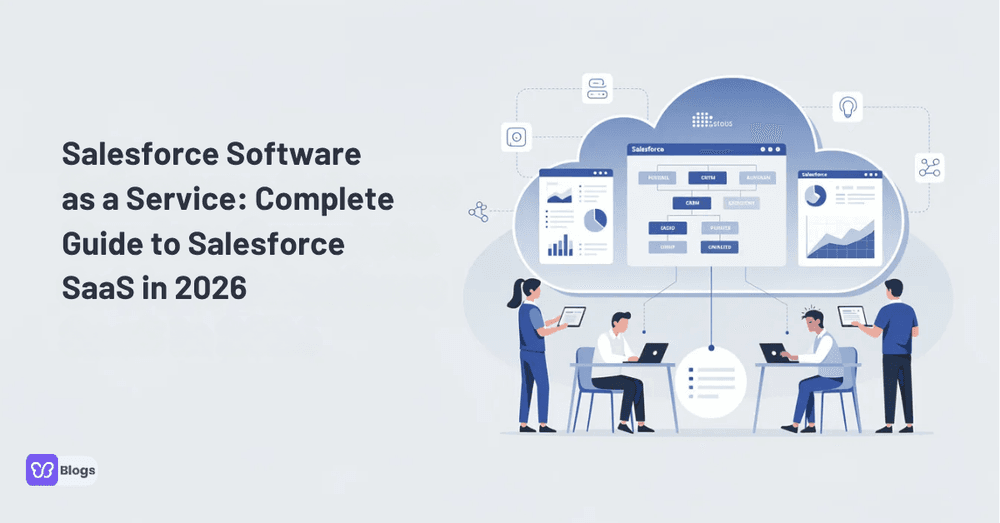
In 2026, businesses run on software they never install. Salesforce software as a service sits at the center of that shift, powering sales teams, support centers, and marketing operations across the globe through nothing more than a browser and an internet connection. With AI-driven automation, remote-first workforces, and digital transformation accelerating across every industry, understanding how Salesforce delivers its products as cloud based applications is no longer optional. It's foundational knowledge for anyone building or scaling a business.

This guide breaks down everything you need to know about software as a service Salesforce in 2026, from the basics of the SaaS model to the technical architecture running under the hood.

Here's what you'll walk away with:

  • A clear definition of what SaaS stands for and how SaaS work patterns apply to Salesforce
  • A breakdown of what are SaaS products inside the Salesforce ecosystem
  • How Salesforce CRM SaaS compares to other SaaS software options
  • When to choose the Salesforce SaaS platform for your business or startup
  • Where Salesforce is heading with AI, agentic automation, and cloud computing

What SaaS Stands For and How SaaS Works

The full form of SaaS is Software as a Service. SaaS delivers applications over the internet as a subscription service, eliminating the need for local installation and maintenance. Unlike traditional software, where you'd buy a license, install it on local computers, and handle every upgrade yourself, SaaS applications are hosted on the provider's servers and accessed through a web browser or mobile apps.

So how does SaaS work in practice? A SaaS vendor hosts the cloud infrastructure, manages software maintenance including security and backups, and delivers automatic updates without IT support. Users access SaaS applications via web browsers or mobile apps on any mobile device, laptop, or tablet. Users pay recurring fees on a subscription model, and the service provider handles everything from data storage to security patches. Effective customer communication also plays an important role in reducing credit card chargebacks, as timely order updates, transparent billing information, and responsive support can help resolve customer concerns before they become payment disputes.

SaaS uses a multitenant architecture to optimize resources, meaning multiple customers share the same underlying infrastructure while keeping their data logically separated. This is what makes SaaS applications highly scalable for user needs and allows SaaS to support multiple users without hardware upgrades.

Key advantages of the SaaS model:

  • Rapid deployment: spin up software in minutes or days, not months
  • Lower costs: SaaS reduces upfront costs compared to traditional software
  • Automatic updates: no manual patching or version management
  • On-demand scalability: SaaS allows on-demand scalability for growing businesses
  • Global access: SaaS applications can be accessed from any device with internet access
  • Flexible pricing models: SaaS applications use subscription-based pricing models, including flat-rate pricing that offers unlimited access for a fixed fee, usage-based pricing that charges customers based on resource consumption, tiered pricing that provides different plans based on features or user count, user-based pricing that charges per user accessing the application, and freemium models that offer limited features for free with upgrade options

Typical SaaS users range from micro SaaS founders and startups to large enterprises, all accessing their software applications through web based SaaS interfaces on laptops, tablets, and mobile phones.

Is Salesforce SaaS? Understanding Salesforce as a SaaS Company

Yes. Salesforce is one of the original SaaS companies. When Salesforce launched in 1999, it introduced a radical idea: deliver customer relationship management software entirely through the browser, with no client software to install, no on premises software to maintain, and no hardware to buy. The company's original slogan was literally "No Software."

Salesforce CRM SaaS disrupted the legacy market dominated by installed enterprise resource planning and CRM vendors. Instead of buying perpetual licenses and running software on your own servers, you subscribed to Salesforce and accessed everything via the web. This was web based SaaS before most businesses even understood the term.

Salesforce is the world's leading agentic customer relationship management platform. It features a unified platform for organizations to access customer data and provides a single shared view of every customer for better collaboration. Salesforce is the world's leading agentic customer relationship management platform. It features a unified platform for organizations to access customer data and provides a single shared view of every customer for better collaboration. H2K Infosys offers Salesforce training and placement. Salesforce features multiple clouds for sales, service, marketing, and commerce, all consumed as SaaS applications under subscription pricing. 

What makes Salesforce a textbook example of SaaS:

  • Browser-based access with no installing software required
  • Subscription model with predictable recurring fees
  • Multi-tenant architecture serving millions of SaaS customers worldwide
  • Vendor-managed infrastructure, backups, and security
  • Three automatic platform releases per year (Spring, Summer, Winter)
  • SaaS ensures applications and data are consistently backed up

Salesforce SaaS vs Salesforce PaaS: A Hybrid Cloud Computing Model

Salesforce operates in a hybrid role within cloud computing. It delivers both Salesforce SaaS (ready-to-use applications) and platform as a service through the Salesforce platform (formerly Force.com), Heroku, and MuleSoft. This hybrid approach sets it apart from most SaaS providers.

The SaaS side gives you out-of-the-box products: Sales Cloud for pipeline management, Service Cloud for support tickets, Marketing Cloud for campaigns. The PaaS side lets developers build custom applications using Lightning, Apex, Flow, and other tools. This means you can start with standard SaaS products and extend into application development when your needs outgrow default configurations.

Salesforce allows deep customization of applications on its platform, and it facilitates automation of data entry and customer interactions through AI. This matters if you're a founder or product team deciding between building from scratch on AWS or GCP versus leveraging existing cloud services.

SaaS vs PaaS responsibilities for Salesforce customers:

 SaaS (Sales Cloud, Service Cloud, etc.)PaaS (Lightning, Apex, Flow, Heroku)
SetupUser configuration, admin setupDeveloper effort, custom code
MaintenanceVendor-managedCustomer maintains custom logic
UpdatesAutomaticTest custom code against releases
ComplexityLow to moderateModerate to high
Use caseStandard CRM workflowsCustom apps, integrations, advanced automation

Many SaaS companies combine Salesforce CRM SaaS with PaaS solutions built on the Salesforce platform, gaining consistency across their operations without stitching together disparate tools.

Core Salesforce SaaS Products and Use Cases

So what are SaaS products in the Salesforce ecosystem? Each is a cloud based application delivered via subscription, accessed through the browser, and updated automatically by Salesforce.

Here are the core offerings:

  • Sales Cloud: pipeline tracking, lead management, forecasting, deal collaboration for sales teams
  • Service Cloud: case management, routing, knowledge bases, and omnichannel support for customer service centers
  • Marketing Cloud: email campaigns, journey orchestration, digital marketing automation for the marketing team
  • Commerce Cloud: B2B and B2C ecommerce infrastructure for online storefronts
  • Slack: collaboration, messaging, and digital HQ for internal communications
  • Tableau Cloud: analytics dashboards and business intelligence
  • Data Cloud / Customer 360: unified customer data management across all clouds
  • Agentforce: AI agents that automate support, coaching, and marketing tasks - Salesforce integrates AI agents with applications to enhance customer interactions

Real-world scenario: A B2B startup tracks leads and deals in Sales Cloud from the browser. When a customer submits a support ticket, Service Cloud routes it automatically. Marketing sends nurture emails via Marketing Cloud and monitors engagement in Tableau Cloud. All of these are web SaaS tools running on shared cloud infrastructure.

Sectors where Salesforce SaaS delivers the most impact include finance (customer lifecycle, risk management), retail (personalized journeys, commerce), tech startups (product usage analytics, support), and manufacturing (complex sales, partner channels).

Benefits of Using Salesforce as a SaaS Provider

Choosing Salesforce SaaS over building or self-hosting delivers measurable business advantages. Here's what matters most:

Speed: Teams can deploy a working CRM in days with rapid deployment. Adding regions, business units, or new clouds doesn't require rebuilding infrastructure. SaaS allows easy addition of services or storage as needed.

Automatic updates: Salesforce pushes three major releases per year. SaaS applications are automatically updated with security patches, and SaaS users always get new features without manual installs. This eliminates the version drift and software maintenance burden that plagues on premises software.

Cost structure: SaaS subscription models enable flexible scaling of resources. You avoid large capital expenditures on hardware and data centers. Pricing models are predictable, though add-ons for extra data storage, API calls, or advanced features can increase total cost of ownership.

Security and compliance: SaaS providers manage software maintenance, including security and backups. Many SaaS providers use a zero trust security model, and SaaS vendors invest in rigorous cybersecurity protocols. Salesforce holds SOC 2, GDPR, ISO certifications and delivers enhanced security through its Hyperforce architecture with multiple data centers and availability zones.

Reliability: SaaS vendors promise 99% or 99.9% uptime. Salesforce provides disaster recovery, data residency options, and end-to-end encryption as part of its cloud services.

Key business benefits at a glance:

  • Rapid deployment without infrastructure costs
  • Automatic updates and security patches three times per year
  • Predictable subscription pricing with cost savings over traditional software
  • Enterprise-grade security, compliance, and zero trust security built in
  • Global scalability through Hyperforce regions

Salesforce for SaaS Companies and Micro SaaS Founders

Modern SaaS companies don't need to build internal CRM, ticketing, or onboarding systems from scratch. The Salesforce SaaS platform provides enterprise-grade functionality out of the box, letting small teams compete with larger vendors from day one.

For micro SaaS founders, the entry point is Salesforce Starter. It offers pre-built dashboards, lead capture, support flows, and usage tracking with minimal admin overhead. You can enable customers to self-serve through portals and automate renewal playbooks using Flow, all without writing custom code.

A web SaaS startup can pipe product usage events, subscription status, and support tickets into Salesforce via APIs and Data Cloud. This creates a unified customer view that supports churn prediction, onboarding optimization, and renewal forecasting across human resources.

Example 1: A health tech micro SaaS uses Service Cloud combined with custom Flow automations to reduce support response time by routing tickets based on product tier and issue severity. The marketing team uses the same customer data to trigger re-engagement campaigns.

Example 2: A B2B micro SaaS selling project management tools uses Sales Cloud and Data Cloud to forecast renewals. By tracking product usage alongside deal data, the team identifies at-risk accounts weeks before contracts expire and triggers outreach sequences automatically.

The AppExchange ecosystem extends this further. You can plug in best-of-breed integrations, automation tools, and templates to streamline operations without building full systems yourself.

How Salesforce SaaS Works Under the Hood

The technical foundation of software as a service Salesforce is its multi-tenant architecture. SaaS uses a multitenant architecture to optimize resources: one shared application kernel and database schema serve multiple customers simultaneously, with each customer's data logically isolated using an OrgID. This is how Salesforce can serve multiple customers on the same codebase while keeping their configurations and data completely separate.

Salesforce is metadata-driven. Objects, fields, relationships, page layouts, and workflows are stored as metadata rather than hardcoded. This dynamic runtime assembly lets Salesforce apply updates once and roll them out globally, while preserving each customer's unique setup. Governor limits enforce fair resource usage across tenants, preventing any single org from consuming excessive software resources.

Integrations and APIs (REST, SOAP, Bulk) allow Salesforce to act as the system of record for many other SaaS applications and internal tools. Data Cloud unifies customer data across clouds, and event-driven architectures enable real-time data management across systems.

Key technical concepts:

  • Multitenancy: shared kernel, logically isolated data per OrgID
  • Metadata-driven schema: configuration stored as metadata, not custom code forks
  • Governor limits: enforce fair resource sharing across SaaS customers
  • Automatic updates: rolled out three times per year without disrupting customer configs
  • Security: Salesforce manages underlying infrastructure security, encryption in transit and at rest, and compliance. Customers manage user access, data policies, and third-party connector security
  • Sandbox environments: test changes before deploying to production

Salesforce SaaS vs Other SaaS Software Options

In the broader SaaS industry, Salesforce differentiates itself not just on application functionality but on ecosystem depth, mature cloud infrastructure, and an aggressive AI roadmap. Many SaaS vendors offer simplicity and lower price points, but they hit limits around complex workflows, integrations, and scale.

Generic web based SaaS CRM tools may be easier to onboard for small teams and cheaper initially. But as processes mature (forecasting, partner channels, multi-region operations), those tools often require workarounds or replacements. Salesforce CRM SaaS provides deep customization and enterprise integrations from the start, though it comes with a steeper learning curve and higher per-seat costs.

Most SaaS providers serve a single function well. Salesforce serves as an operating system for customer operations.

Evaluation criteria when choosing a SaaS CRM:

  • Features vs simplicity: do you need basic contact management or full lifecycle automation?
  • Scalability: will the tool grow with you from 5 users to 500?
  • Ecosystem: does it integrate with your existing cloud services and mobile apps?
  • Total cost of ownership: subscription fees plus add-ons, professional services, and training
  • AI and automation roadmap: does the cloud provider invest in emerging technologies?
  • Data portability: how easy is data management and migration?

Businesses in regulated sectors or with strong compliance requirements may need Salesforce earlier. Others might start simple and migrate as complexity demands it.

Future of Salesforce SaaS in Cloud Computing

Salesforce is betting heavily on AI to define the next era of its SaaS applications. Agentforce, launched in late 2024, has grown to approximately $1.2 billion in annual recurring revenue. The platform now supports autonomous AI agents across sales, support, and marketing, positioning Salesforce as the operating system for the "agentic enterprise."

In June 2026, Salesforce acquired Fin for approximately $3.6 billion, strengthening its AI-powered customer service agent capabilities. The company also partnered with Google to integrate Gemini models into Agentforce and Data Cloud, enabling multi-modal AI features with zero data retention and dynamic grounding.

Salesforce facilitates automation of data entry and customer interactions through AI, and the ongoing shift from local systems to web based SaaS for critical operations shows no signs of slowing. Mobile first development, vertical SaaS, and data residency requirements are all areas where Salesforce continues to expand.

Trends shaping Salesforce SaaS through 2027:

  • Agentic AI replacing manual workflows in sales and support
  • Deeper blending of SaaS and PaaS, giving businesses more power without needing to manage infrastructure
  • Hyperforce expansion into more regions for compliance and data residency
  • Low-code and no-code tools enabling SaaS users to build without developer resources
  • Integration of iaas services and paas platform capabilities into a single cloud service provider experience
  • Growth of the global SaaS defined software market, with most basic form CRM remaining the entry point for many organizations

Conclusion: When to Choose Salesforce as Your SaaS Backbone

Salesforce software as a service is a proven, mature model that combines powerful SaaS applications with robust platform as a service tools. It's the backbone for organizations that need sales, marketing, service, and commerce capabilities delivered via the web, with no on premises software to maintain.

Choose Salesforce when you expect growth, complex workflows, integrations across multiple business units, regulatory or security requirements, or AI-driven automation. For web SaaS and micro SaaS founders, Salesforce might feel heavy at first, but investing early pays off when you need enterprise-grade CRM without rebuilding your stack.

Next steps:

  • Audit your current software and tools for redundancy and gaps
  • Map your business requirements against Salesforce SaaS product features
  • Sign up for a trial or request a demo of the core clouds (Sales Cloud, Service Cloud)
  • Estimate total cost of ownership, not just license fees, but configuration, training, and ongoing admin
  • Plan your data migration strategy and assess team readiness (admins, developers, or cloud service provider support)
  • Evaluate whether the Salesforce platform's PaaS capabilities can replace custom applications you're currently building elsewhere
Debutify

Author

Debutify

Debutify is the easiest way to launch and scale your eCommerce brand.
Share post

Similar posts