AI Agent Frameworks in 2026: Guide to the Best Agentic Frameworks for Production
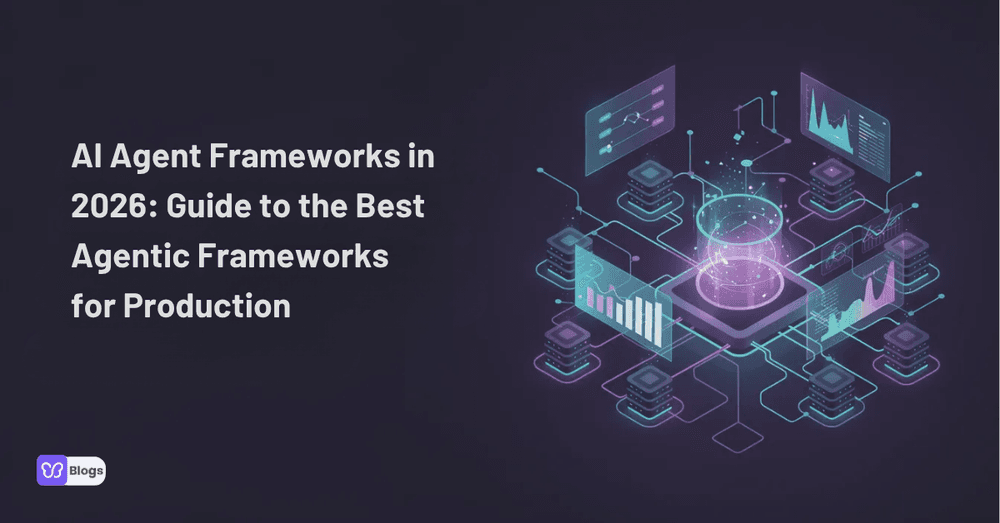
The shift from chatbots to autonomous software has made the ai agent framework a strategic infrastructure choice. In 2026, teams are no longer just prompting large language models; they are building ai systems that call tools, remember context, route work, and act inside real business workflows.
An ai agent framework connects large language models with tools, memory, and reasoning so teams can build autonomous systems that perceive, make decisions, and take actions. This guide compares the top ai agent frameworks and best agentic ai frameworks for production use, not just demos.
Introduction to AI Agent Frameworks
Agentic AI frameworks streamline prompt orchestration and tool integration. They sit between ai models and external systems, giving developers reusable patterns for planning, memory, function calling, governance, and task execution.
- ai agents are software entities that observe inputs, reason over context, and perform agent actions through tools or APIs.
- ai agent frameworks provide the reusable infrastructure for building ai agents, including memory management, state management, custom tools, and orchestration logic.
- agentic ai frameworks add support for multi step workflows, human oversight, and autonomous agents that can operate across sessions.
- agentic ai systems are deployed products, such as a customer service agent, coding copilot, fraud monitoring agent, or automated DevOps runbook.
- This article focuses on architecture, reasoning, security, observability, integration, and enterprise scale readiness.

Why Frameworks Matter for Agentic AI Systems
The rise of agentic ai makes agent frameworks more important because complexity, governance, latency, and cost all increase once agents start acting across tools and data sources.
A strong ai development framework or ai agent development framework can cut build time from months to weeks by reusing proven patterns for memory, tool integration, testing tools, and observability. Framework selection impacts performance, scalability, and operational reliability. Organizations building these capabilities may also invest in LLM Development to create and customize language-model-based solutions for specific business requirements
Frameworks must integrate with existing tech stacks for effectiveness. Integration depth impacts production performance of agentic frameworks because agents often need CRMs, data warehouses, Kafka, ticketing tools, vector databases, IAM, and cloud or on-prem systems.
Real-world scenarios include:
A bank using agentic ai solutions for loan review, with audit logs and granular access control.
A healthcare chatbot that needs human in the loop escalation before risky answers.
Fraud detection employs single agents to monitor transactions for anomalies.
Automated DevOps can involve an agent writing code, testing it, and a supervisor approving deployment.
A support team using ai powered chat to connect agents with human agents when confidence is low.
Picking the wrong agentic ai framework can lock engineering teams into expensive rewrites within 12–24 months, especially when memory, governance controls, or api support are weak.
Core Capabilities of Agentic AI Frameworks
The best ai agents frameworks share a common foundation: memory, reasoning, orchestration, security, cost controls, infrastructure, and developer experience.
Every serious agentic framework should support:
- Memory systems that retain short-term and long-term context during agent operation.
- Tool integration that includes executing APIs, searching web data, or using specific software.
- Planning modules that allow the agent to decompose large goals into smaller manageable subtasks.
- Reasoning engines analyze data, determine context, and decide on subsequent steps.
- Observation and feedback loops monitor the agent's actions, allowing self-correction.
- Governance controls that keep agent behavior inside compliance boundaries.
AI agent frameworks consist of a core brain, memory, planning tools, and action tools. These key features separate production-ready agentic ai tools from basic examples.
Memory and State Management
Memory is non-negotiable for agentic ai systems. Without it, agents become isolated, forget chat history, and fail during long-running workflows.
- Short-term memory stores in-prompt context, recent user interactions, and tool outputs.
- Long-term memory uses databases, vector databases, Postgres, Cassandra, Pinecone, Redis, or knowledge stores.
- Memory capabilities affect whether agents are context-aware or isolated.
- LangChain supports customizable memory through built-in classes.
- LangGraph provides in-thread and cross-thread memory capabilities.
- CrewAI offers layered memory using ChromaDB and SQLite.
- AutoGen maintains session context without built-in memory persistence.
The langchain ai agent framework is designed for building LLM-powered applications, while LangGraph adds stronger state management for agent workflows that need persistence and replay.
Reasoning, Planning, and Agent Behavior
Agent reasoning has moved beyond one-shot prompts. Modern frameworks use ReAct loops, function calling, graph planning, and policy layers around the model.
Engineers should balance:
- Better reasoning improves completion rates but increases tokens, latency, and cost.
- Agent frameworks can model behaviors as a network of interconnected steps to control paths.
- Guardrails and policies provide more explicit control than prompt-only instructions.
- Role definitions shape agent behavior in multi agent systems.
- Sequential frameworks execute tasks in a fixed order of operations.
- Conversational frameworks involve agents interacting through natural language chat.
For simple tasks, one agent may be enough. Single-agent frameworks use one autonomous agent to solve tasks independently. For complex tasks, multiple agents may be needed.
Orchestration, Workflows, and Agent Coordination
Orchestration is the control plane for ai agents. It decides how work is broken down, routed, retried, delegated, or escalated.
- Graph-based engines use nodes, edges, queues, and cyclic paths.
- LangGraph models agents as nodes within a graph structure.
- LangGraph is designed for stateful multi-agent applications with cyclic graph structures.
- LangGraph excels at orchestrating complex workflows for multiagent systems.
- Hierarchical frameworks use a supervisor agent that assigns tasks to worker agents.
- Multi-agent frameworks have multiple agents collaborating to solve complex problems.
The best agent frameworks support both single agent RAG apps and multi agent workflows. In multi agent collaboration, agents may consult other agents, share tools, or delegate work through multi agent orchestration.
Security, Governance, and Compliance
Security is decisive for the best agentic ai frameworks, especially in regulated industries.
Data privacy and security are critical in agentic frameworks. Effective governance tools ensure agents operate within compliance boundaries.
Look for:
- RBAC and granular access control.
- Data-access policies for sensitive data sources.
- Input and output filters.
- Audit trails and traceable decisions.
- Environment variables separated across dev, staging, and production.
- Support for SOC2, ISO 27001, HIPAA, PCI-DSS, GDPR, and data residency.
Human oversight is necessary for high-stakes workflows in regulated industries. Rasa is best for self-hosted deployment in regulated industries, and Rasa provides full audit trails for compliance review.
Developer Experience, Tooling, and Observability
Good DX separates a proof of concept from a reliable production system.
A modern ai agent development framework should include:
- Logs, traces, and state snapshots.
- Token, latency, and cost dashboards.
- Replay tools for failed runs.
- Sandbox environments and testing tools.
- A visual builder or graph editor where possible.
- Support for no code experiments without blocking writing code for custom behavior.
The top agentic frameworks invest heavily in observability because complex workflows are difficult to debug without seeing every model call, tool call, and state transition.
Top AI Agent Frameworks in 2026 (Ranked by Real-World Use)
This list focuses on maturity, governance, integration depth, community, and production track record. GitHub stars matter less than whether a framework survives real workloads.
Here are the best ai agents frameworks and top ai agent frameworks we see in real production today, across open-source stacks, cloud-native products, and enterprise-grade agentic framework options.
According to industry reporting, 79% of organizations have adopted AI agents by 2025. AIMultiple's benchmark tested four frameworks with 100 runs each, and LangGraph consistently outperformed others in latency and token consumption. LangGraph delivered the lowest latency in benchmarks, LangChain had the highest overhead due to LLM interpretation, and LangGraph outperformed LangChain in both latency and token consumption.
LangGraph and the LangChain AI Agent Framework
LangChain is designed for building LLM-powered applications. The langchain ai agent framework provides components for prompts, chains, tools, retrieval, and memory.
LangGraph is the graph-based orchestration layer. It models workflows as state graphs, where nodes represent steps and edges control transitions. This makes it one of the top agentic frameworks for complex workflows.
Strengths:
- Strong ecosystem and integrations.
- Flexible Python-first development.
- Excellent support for RAG, tools, memory, and agent coordination.
- Durable execution for long-running workflows.
- Useful with LangSmith for tracing and replay.
Trade-offs:
- More engineering overhead than simpler frameworks.
- Version changes can require refactoring.
- Governance may still need custom implementation.
LangGraph is often the best choice when enterprise teams need explicit control over complex workflows.
CrewAI: Role-Based Multi-Agent Collaboration
CrewAI is a role-based agent framework for building crews of specialized agents. CrewAI was built for multi-agent systems from the ground up, and CrewAI is designed for production multi-agent systems with role-based delegation.
CrewAI supports connections to various large language models. CrewAI supports connections to various large language models, which helps teams avoid being tied to only one model provider.
Strengths:
- Intuitive role definitions.
- Strong multi agent patterns.
- Useful for research, content, operations, and financial analysis.
- Built for task delegation across multiple agents.
- Good fit for rapid prototyping and structured teams.
Trade-offs:
- Governance depth may require custom infra.
- Highly regulated environments may need extra controls.
- Multi agent setups can add latency if not carefully designed.
CrewAI is often cited among the best agentic ai frameworks for natural language agent creation and role-based collaboration.
Microsoft AutoGen and Semantic Kernel
AutoGen is an open-source framework for multiagent AI applications. It is strong for conversational agents, group chats, tool use, and agent-to-agent interaction.
Semantic Kernel provides core abstractions for creating AI agents. Together, AutoGen and semantic kernel form a practical microsoft agent framework for Azure-first organizations.
Pros:
- Strong Azure and Microsoft 365 alignment.
- Useful plugin model.
- Good support for conversational multi agent systems.
- Works well for .NET and Python teams.
Cons:
- Smaller ecosystem than LangChain in many Python-heavy teams.
- Governance depth depends on deployment design.
- Some workflows require more custom orchestration.
For Azure-first companies, this duo belongs among the top ai agent frameworks for enterprise deployment.
OpenAI Agents and OpenAI Swarm
OpenAI Agents and AgentKit provide a managed ai development framework for building agent workflows around OpenAI models. OpenAI Swarm is a lightweight Python library for experimenting with handoffs.
Benefits:
- Tight model integration.
- Fast setup for smaller teams.
- Strong support for function calling.
- Useful for natural language interfaces and quick prototypes.
Trade-offs:
- LLM lock-in.
- Limited self-hosting.
- External governance layers may be needed for high-risk workflows.
These are important agentic ai frameworks for teams standardized on OpenAI APIs, although they may not be the only framework a large enterprise uses.
LlamaIndex, Haystack, and Data-Centric Agent Frameworks
LlamaIndex and Haystack began with RAG and evolved into broader ai agent framework stacks.
They are strongest when retrieval quality dominates:
- Knowledge assistants.
- Internal search bots.
- Research agents.
- Compliance and policy lookup.
- Document-heavy customer support.
They connect to enterprise data sources and can support multi-step workflows. However, orchestration logic and multi agent coordination may be less mature than dedicated agent orchestration frameworks.
Other Emerging Agentic Frameworks to Watch
Other agent frameworks include SuperAGI, AutoAgent, DSPy, Pydantic AI, Mastra, Smolagents, Letta, and Rasa.
Explore them when you need:
- A no code builder.
- Typed agent design.
- TypeScript-first workflows.
- Memory-first agents.
- Research experimentation.
- Self-hosted governance.
For production, choose newer frameworks carefully unless the niche matches your stack.

How to Choose the Best AI Agent Framework for Your Use Case
Choosing the best ai agents frameworks starts with your use case, not hype.
Evaluate:
- Workflow complexity.
- Governance and deployment model.
- Integration depth.
- Cost and latency.
- Observability.
- Long-term maintainability.
Avoid choosing by GitHub stars alone. Test with real prompts, real tools, and real failure conditions.
Map Your Use Cases and Agent Complexity
List specific use cases first: support, internal tooling, marketing ops, finance, legal, security, or DevOps.
Classify them as:
- Simple chatbot.
- Tool-calling copilot.
- Single agent workflow.
- Multi agent workflows with shared memory.
- Full agentic systems with approval checkpoints.
Test frameworks against the hardest planned workflow, not a basic FAQ demo.
Evaluate Governance, Security, and Deployment Model
Decide early whether you need self-hosting, private cloud, or managed SaaS.
Ask:
- Can each agent access only approved tools?
- Is audit logging complete?
- Can PII be masked?
- Does it integrate with IAM or SSO?
- Can environments be isolated?
- Does it support compliance review?
Regulated industries should deprioritize frameworks without clear security docs, audit trails, or deployment controls.
Check Integration Depth and Extensibility
Low-code connectors are useful, but they are not enough.
A production framework must handle:
- API timeouts.
- Partial failures.
- Retries.
- Rate limits.
- Tool errors.
- Custom tools and plugins.
This is critical when building agentic systems that need to evolve with business infrastructure.
Assess Performance, Cost, and Scalability
Each ai agent framework has different latency and token patterns, especially in multi agent workflows.
Run load tests with:
- Realistic prompts.
- Real tools.
- Concurrency.
- Tail latency.
- Model-selection strategies.
- Caching.
- Budget caps.
Total cost includes engineering time, not only LLM API spend.
Prototype, Benchmark, and Run a Production Pilot
Shortlist two or three top agentic frameworks, build small prototypes, then run a limited production pilot.
Track:
- Time-to-first-meaningful-action.
- Completion rate.
- Handoff quality.
- Regression frequency.
- Cost per successful task.
- Human escalation rate.
Use replay tooling to understand real agent behavior before scaling.
Design Patterns and Architectures in Modern Agentic AI Frameworks
The best agentic ai frameworks use recurring patterns: graph workflows, role-based crews, event-driven designs, queues, and human approval loops.
Architectural fit matters as much as feature lists. The wrong design can make a reliable model feel unreliable.
Graph-Based and DAG Architectures
Graph architectures model states, transitions, and recovery paths.
Benefits include:
- Explicit control.
- Easier debugging.
- Reduced redundant LLM calls.
- Better traceability.
- Clear rollback and retry paths.
This pattern is useful for loan underwriting, claims review, KYC, compliance workflows, and other complex enterprise processes.
Role-Based Crews and Multi-Agent Teams
Role-based crews assign titles, goals, tools, and responsibilities to agents.
They work well for:
- Research.
- Editorial pipelines.
- M&A diligence.
- Software delivery.
- Operations automation.
The challenge is coordination overhead. Without clear termination rules, multi agent collaboration can loop, duplicate work, or overuse tokens.
Human-in-the-Loop and Safety-First Designs
Human in the loop design is required for high-stakes workflows.
Patterns include:
- Approval checkpoints.
- Breakpoints in graph workflows.
- Human agents in AutoGen-style conversations.
- Escalation to supervisors.
- Explainable logs.
Treat human oversight as part of the architecture, not an afterthought.

Future of Agentic AI Frameworks and How to Prepare
By 2027, ai agent frameworks will likely become more standardized, more governed, and more verticalized.
Expect:
- Stronger identity controls for agents.
- Cross-framework interoperability such as Agent2Agent-style protocols.
- Unified observability stacks.
Agentic AI frameworks are rapidly evolving to meet the demands of increasingly complex autonomous systems. To build agentic AI systems that deliver real business value, teams must carefully evaluate frameworks based on their ability to enable agents with robust memory, reasoning, and orchestration capabilities.
Build Agentic AI Systems with the Right Framework
Choosing the best agentic framework depends on your use case and organizational needs. For example, if your goal is to build multi-agent workflows with explicit control over task delegation, role definitions, and state management, frameworks like CrewAI and LangGraph excel. They enable agents to collaborate effectively, share context, and execute complex plans.
If you require seamless integration with existing enterprise tools and data sources, consider frameworks with deep API and tool integration support. The ai agent development framework must handle retries, error handling, and rate limiting gracefully to ensure reliability in production environments.
Different Frameworks for Different Needs
There is no one-size-fits-all solution. Some teams prioritize rapid prototyping and broad community support, making the langchain ai agent framework a popular choice. Others need enterprise-grade governance and compliance, where frameworks like Rasa stand out with granular access controls and audit trails.
Emerging agentic ai frameworks such as AutoGen and Semantic Kernel provide powerful abstractions for conversational agents and multi-agent orchestration, especially for organizations invested in the Microsoft ecosystem.
Integration and Extensibility
The best agentic framework enables easy integration with third-party APIs, databases, and messaging systems. Some production deployments also integrate mobile proxies for data collection tasks that require traffic patterns closer to those of real mobile users. This integration depth is critical because agents often need to access diverse external data and tools to accomplish their goals.
Moreover, frameworks that allow customization of reasoning algorithms, memory management, and tool invocation provide developers with the flexibility to optimize agent behavior for specific domains.
Future Trends and Preparing for 2027
Looking ahead, top ai agent frameworks will increasingly support cross-framework interoperability, stronger identity and access controls, and unified observability platforms. These advancements will enable building more secure, transparent, and scalable autonomous systems.
Organizations should invest in frameworks that not only meet current requirements but also have active communities and roadmaps aligned with evolving AI standards.
Conclusion
In summary, selecting the right ai agent framework is foundational to successfully building autonomous AI agents that integrate with real-world workflows. Balancing factors such as memory capabilities, reasoning sophistication, orchestration patterns, security, and integration depth will position your team to build resilient, efficient, and compliant agentic AI systems.
By leveraging the best agentic ai frameworks available today, and staying informed about emerging developments, you can accelerate AI innovation and deliver impactful autonomous solutions across industries.

Author
Debutify
Debutify is the easiest way to launch and scale your eCommerce brand.