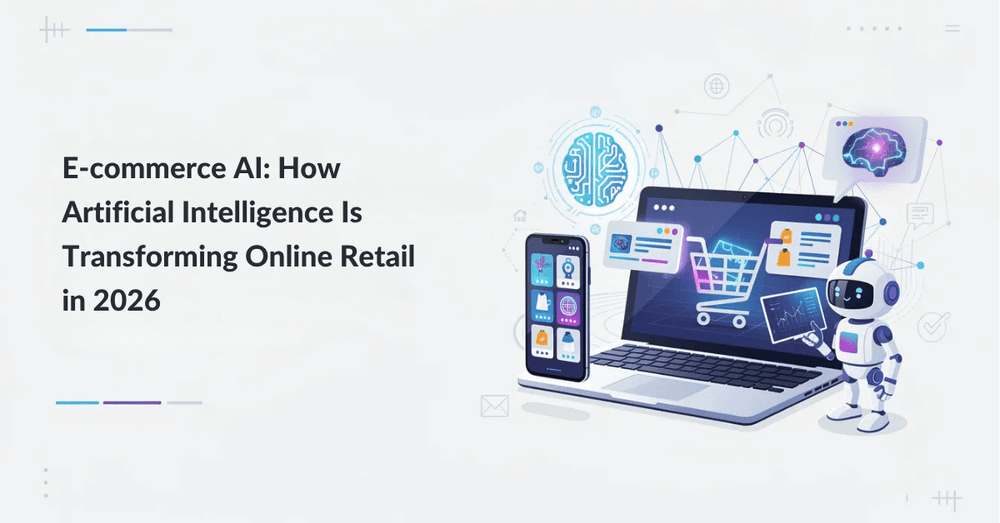
E-commerce AI: How Artificial Intelligence Is Transforming Online Retail in 2026
The days of static product pages and one-size-fits-all promotions are over. E-commerce AI has evolved from experimental pilots into business-critical infrastructure that powers real-time optimization across the entire customer journey—from discovery to post-purchase support.
This guide is designed for ecommerce business owners, marketers, and technology leaders seeking to understand and implement AI solutions. Understanding how AI is transforming ecommerce is essential for staying competitive in a rapidly evolving digital marketplace.
The period from 2024 to 2026 marks a pivotal adoption phase. According to McKinsey, more than 78% of companies are now using generative AI in at least one area of their business, a significant increase from 55% the previous year. The artificial intelligence for ecommerce market is projected to reach $14 billion by 2028, reflecting a compound annual growth rate of around 15.7%. This isn’t theoretical anymore—86% of ecommerce decision-makers are planning increased AI investments, and 97% report positive sales effects from prior deployments.
Real brands are already seeing results. Amazon’s recommendation engines now incorporate generative AI for product listings. eBay’s “Resell on eBay” feature uses AI to pre-fill listings from QR codes on apparel labels. Platforms like Flipkart and Zalando leverage machine learning for dynamic merchandising and image search in fashion retail.
What makes this moment different is accessibility. AI-powered e-commerce is no longer reserved for giants with massive engineering teams. Small Shopify and WooCommerce sellers can now access plug-and-play AI tools that handle personalization, pricing, customer service, and inventory management—capabilities that would have required custom development just five years ago.
Small Shopify and WooCommerce sellers can now access plug-and-play AI tools that handle personalization, pricing, customer service, and inventory management—capabilities that would have required custom development just five years ago.
When we talk about AI e-commerce business, we mean two things: established ecommerce businesses augmenting their operations with AI, and entirely new business models built around autonomous AI agents that can handle end-to-end shopping funnels without constant human intervention.
What Is E-commerce AI? (Core Concepts and Technologies)
AI-based e-commerce refers to the application of machine learning, natural language processing, computer vision, and generative models to optimize the full online shopping experience. Unlike generic AI applications, e-commerce AI is tethered to retail-specific data—stock-keeping units (SKUs), shopping carts, customer purchase history, and behavioral signals—enabling real-time, context-aware decisions.
Here are the core technologies powering modern e-commerce AI systems:
- Data mining and traditional ML: Collaborative filtering and pattern recognition underpin recommendation engines. Amazon’s “Customers who bought X also bought Y” system analyzes purchase histories using these techniques, boosting average order value by 10-30% across retail verticals.
- Deep learning: Neural networks power dynamic pricing on electronics and travel sites, where AI algorithms adjust prices based on competitor data, demand signals, and inventory levels. These systems can yield 5-15% revenue uplifts when properly implemented.
- Natural language processing: Powers intelligent search on fashion retailers like Zalando, understanding queries like “running shoes for flat feet” via semantic mapping to filters, synonyms, and typos. This ecommerce natural language processing reduces bounce rates by up to 20%.
- Computer vision: Enables visual search, allowing users to upload images for product matching. Shoppers are moving away from keywords, using visual search and voice commands to find specific items.
- Large language models: Generative AI creates product descriptions, emails, and on-site copy from structured data and product data. This accelerates content creation for new SKU launches by 10x without additional copywriters—though human review remains essential for brand voice and compliance.
AI applications in e-commerce emphasize SKU-level granularity and journey-stage specificity. A cart-abandonment prediction model might trigger personalized recovery emails, while a homepage personalization engine surfaces different products based on user behavior and past purchases.
Now that we've covered the core technologies, let's explore how AI is reshaping the e-commerce industry.
Key Benefits at a Glance
- 10-35% revenue uplift through higher conversions and AOV
- 30-50% reduction in manual operational tasks
- 15-25% improvement in customer lifetime value
- Faster experimentation cycles and reduced decision fatigue
How AI Is Reshaping the E-commerce Industry
Using AI in ecommerce has progressed dramatically from 2016-2018 pilots focused on basic personalization to 2026’s always-on infrastructure. Today, AI systems continuously A/B test layouts, copy, recommendations, and promotions—contributing to AI-driven revenue shares projected to dominate online retail by 2028-2030.
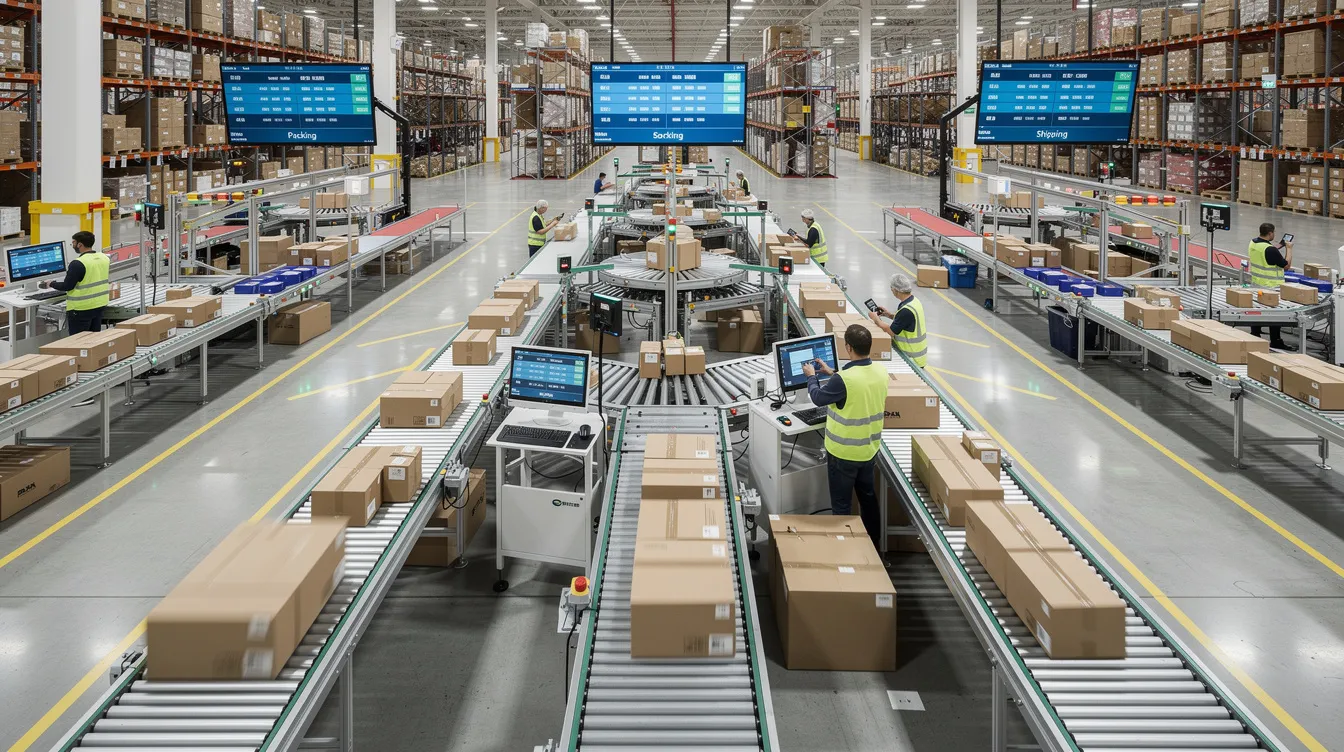
The impact spans every operational area:
Marketing
- Predictive audience segmentation and personalized marketing campaigns
Merchandising
- Automated product ranking based on margins, stock levels, and customer preferences
Fulfillment
- AI-optimized routing reducing delivery times by 20-30%
Customer Support
- NLP chatbots deflecting 40-60% of repetitive tickets
Fraud Detection
- Anomaly detection in transaction patterns cutting losses by 25-50%
Post-Purchase
- Proactive churn prediction and win-back flows
AI tools can lead to more than a 25% improvement in customer satisfaction, revenue, or operational cost reduction across ecommerce businesses.
Manual vs. AI-Augmented Operations
| Aspect | Manual Operations | AI-Augmented Operations |
|---|---|---|
| Merchandising | Fixed “best sellers” lists updated quarterly | Dynamic product promotion based on live data, updated minute-by-minute |
| Marketing | Manual segmentation and campaign setup | Automated, predictive segmentation and campaign execution |
| Fulfillment | Static routing and delivery planning | AI-optimized, real-time routing and inventory allocation |
| Customer Support | Human agents handle all tickets | AI chatbots deflect repetitive queries, humans handle complex issues |
This shift enables faster experimentation cycles, data-driven decision making, and reduces decision fatigue for marketing and merchandising teams.
Now that we've seen how AI is transforming every aspect of ecommerce operations, let's look at the next frontier: agentic and autonomous commerce.
The Rise of Agentic and Autonomous Commerce
Agentic commerce represents the next evolution of e-commerce AI, where AI agents—capable of planning, acting, and learning—orchestrate tasks across the entire shopping funnel without constant human input, powered by context engineering for AI agent systems. Agentic commerce represents the next evolution of AI in ecommerce, where AI systems can make decisions and take actions autonomously, reducing the need for constant human input and transforming online storefronts into smarter, self-optimizing entities.
By 2028, one in three enterprise software platforms will include agentic AI capabilities, indicating a significant shift in how ecommerce companies operate and serve customers. These aren’t simple chatbots; they’re autonomous systems that can transform online storefronts into smarter, self-optimizing entities.
Concrete use cases emerging now:
- Real-time merchandising: Agents that automatically adjust storefront layouts, featured products, and promotional banners based on live performance data
- B2B price negotiations: AI agents using predictive modeling to negotiate pricing with business buyers, offering optimized bundles and volume discounts
- Inventory replenishment: Agents that monitor stock levels and automatically reorder from suppliers without human intervention
- Campaign coordination: Autonomous systems managing marketing campaigns, product recommendations, and stock allocation across web, app, and marketplaces simultaneously
New digital workers or AI agents autonomously handle tasks like price negotiations, reordering essentials, and resolving complex support tickets without human intervention. For food delivery platforms, agents already handle order processing and status updates, slashing human workload.
Critical consideration: Governance is essential. Autonomous systems require guardrails ensuring alignment with brand policies, pricing rules, and regulations like GDPR. Without proper constraints, an aggressive discounting agent could erode margins overnight.
With agentic commerce on the rise, let's examine the tangible business benefits AI brings to ecommerce.
Business Benefits of Artificial Intelligence for Ecommerce
Artificial intelligence for ecommerce delivers multifaceted benefits that simultaneously boost revenue, slash costs, and enhance the customer experience. The numbers are compelling: AI can lead to more than a 25% improvement in customer satisfaction, revenue, or operational cost reduction for ecommerce businesses.
Key Benefit Areas
- Targeted marketing: 20-40% ROAS improvements through AI-optimized segmentation and timing
- Customer retention: 15-25% LTV uplifts via churn prediction and personalized win-back flows
- Operational efficiency: 30-50% reduction in manual tasks across teams
- Faster sales cycles: 25% reduction in time to close for B2B scenarios
- Forecasting accuracy: 20-50% improvement with demand predictions incorporating seasonality
- Support quality: 24/7 NLP agents achieving higher CSAT scores
AI e-commerce business models scale faster because processes like merchandising, segmentation, and campaign setup are semi- or fully automated. Beyond the quantitative gains, teams report richer actionable insights, faster experimentation cycles, and reduced decision fatigue.
Now, let's break down these benefits into specific areas of impact.
More Targeted Marketing and Advertising
E-commerce AI transforms marketing by analyzing clickstreams, email engagement, and purchase data to build precise audience segments automatically—no more manual CSV exports or quarterly list refreshes.
AI enables several powerful tactics:
- Lookalike audiences: Finding new customers who match your best existing buyers
- Predictive audiences: Identifying high-LTV prospects, at-risk customers, and first-time buyers likely to convert
- Next-best-offer models: Recommending the optimal product, discount, or message for each individual
- Automated timing: Sending emails and SMS at the moment each customer is most likely to engage
AI allows ecommerce brands to create personalized, data-driven marketing experiences that convert, with 81% of marketers reporting increased brand awareness due to AI. Small teams can now run dozens of micro-campaigns with AI handling segmentation, creative variants, and send times—work that previously required entire marketing departments.
Increased Customer Retention and Lifetime Value
AI-powered e-commerce systems predict churn risk and customer lifetime value by analyzing customer data including order intervals, support tickets, browsing behavior, and customer sentiment.
Businesses using AI to deliver personalized communications see up to a 30% improvement in customer retention, enhancing customer loyalty and repeat business. Personalized experiences in ecommerce can lead to a 30% improvement in customer retention overall.
Key retention tactics powered by AI:
- Automated win-back flows: Triggered when customers show signs of disengagement
- Personalized loyalty offers: Based on individual purchase patterns and preferences
- Replenishment reminders: Timed to when each customer typically reorders
- Proactive outreach: Addressing potential issues before they lead to churn
DTC brands deploying AI-based retention programs typically see 20-30% increases in repeat purchase rates within 90 days. The key metrics to track include repeat purchase rate, customer engagement scores, time between orders, and overall LTV trajectory.
Seamless Automation Across Operations
When using AI in ecommerce, automation becomes central to daily operations—freeing teams from routine tasks so they can focus on strategy and creativity.
Immediate Automation Opportunities
- Ticket routing: Automatically categorizing and assigning support requests to the right team
- Product tag updates: Generating and maintaining SEO-optimized tags from product attributes
- Stock visibility: Auto-hiding out-of-stock SKUs from search and recommendations
- VIP identification: Routing high-value customers to senior support representatives
- SEO snippets: Creating optimized meta descriptions and structured data automatically
- Discount triggers: Applying personalized promotions based on real-time behavior
The impact on team structure is significant. Marketers spend less time pulling reports and more time interpreting insights. Merchandisers focus on strategy rather than manual product sorting. Customer service representatives handle complex issues while AI manages repetitive questions. Teams report 40% reductions in time spent on operational efficiency tasks.
More Efficient, Data-Driven Sales Processes
AI applications in e-commerce support sales and merchandising teams with real-time insights into buyer intent, product performance, and margins—enabling an efficient sales process that adapts to customer needs.
B2B Sales Transformation
- Lead scoring: Automatically evaluating inbound wholesale inquiries based on company size, engagement, and fit
- Price tier recommendations: Suggesting optimal pricing based on customer segment and order volume
- Bundle suggestions: Recommending product combinations that increase order value
- Hot session identification: Flagging high-intent shoppers in real-time to trigger live chat or special offers
The results are measurable: 25% reduction in time to close and 15% increase in average order value are common benchmarks. AI identifies patterns in customer interactions that human sales teams might miss, surfacing opportunities to close deals faster.
With these benefits in mind, let's dive into the most impactful AI use cases in e-commerce.
Key AI Use Cases in E-commerce
This section provides a practical overview of how to use AI in e-commerce day to day—not abstract theory, but specific applications you can implement based on your current maturity level.
Whether you’re a startup with 50 SKUs or an enterprise with millions, the core categories are similar. The difference lies in scale and complexity. Most use cases rely on existing ecommerce data: orders, catalogs, site analytics, and support logs—no exotic new data sources required.
The major use cases include:
- Personalized recommendations
- Intelligent search
- Dynamic pricing
- Customer service automation
- Segmentation
- Logistics optimization
- Fraud detection
- Content generation
Let’s examine each.
Personalized Product Recommendations
E-commerce AI recommendation engines dissect browsing history, cart contents, and similar-user behavior to surface relevant products across every touchpoint. AI-driven personalized product recommendations can increase revenue by 40%, as they help customers find relevant products quickly and enhance the online shopping experience.

Typical Recommendation Placements
- Homepage: AI analyzes real-time signals to tailor entire homepages and product suggestions for each user
- Product detail pages: “Customers who bought X also bought Y” cross-sells
- Cart page: Complementary product upsells based on cart contents
- Order confirmation: Post-purchase recommendations for future visits
- Email flows: Personalized product picks in abandoned cart and win-back sequences
The uplift is substantial: 10-30% increases in average order value across retail verticals. Even small catalogs with fewer than 100 SKUs benefit—AI dynamically ranks items based on real-time signals rather than relying on static “best sellers” lists.
73% of customers expect better personalization as technology advances, making personalized shopping experiences a competitive necessity rather than a nice-to-have feature.
Intelligent Search and Discovery
AI-powered e-commerce search goes far beyond keyword matching. AI-powered ecommerce search understands natural language, synonyms, typos, and intent—mapping queries like “running shoes for flat feet” to specific filters and product attributes.
Modern AI Search Capabilities
- Semantic understanding: Interpreting what customers mean, not just what they type
- Personalized re-ranking: Adjusting results based on individual behavior, customer preferences, and past purchases
- Inventory-aware results: Prioritizing in-stock items and hiding unavailable products
- Margin optimization: Factoring profitability into result ordering
- Auto-suggest: Predicting queries and reducing typing effort
- Faceted navigation: AI-powered filters that adapt to search context
AI-powered visual search takes this further—customers can upload images to find matching products instantly. Fashion and home goods retailers implementing AI search have increased search-driven revenue by 20-40% while reducing bounce rates by 15-25%.
Dynamic Pricing and Revenue Optimization
Dynamic pricing is a strategy that automatically adjusts product prices based on supply and demand, competitor pricing, and customer behavior. AI-enabled dynamic pricing is a strategy that automatically adjusts product prices based on supply and demand, competitor pricing, and customer behavior. AI algorithms analyze vast amounts of market data in real-time to optimize pricing for maximum profitability while remaining competitive, making dynamic pricing accessible to ecommerce retailers of all sizes. Dynamic pricing helps maximize revenue by capturing the highest possible price during peak demand and applying discounts to slow-moving inventory to prevent overstock situations.
Concrete Scenarios
- Flash sales for overstock: AI identifies slow-moving inventory and triggers targeted discounts
- Price protection for hero products: Maintaining premium pricing on key items during peak seasons
- Segment-specific offers: Presenting different prices or bundles to new versus returning customers
- Competitor response: Adjusting prices when competitors change theirs
Important guardrails: Without min/max price ranges and frequency caps, dynamic pricing can create volatility that harms brand perception. Rules-based guardrails combined with machine learning deliver the best results—not “black box” automation.
The typical revenue uplift from pricing optimization ranges from 5-20%, depending on category and implementation sophistication.
AI-Powered Customer Service and Conversational Commerce
AI-powered chatbots can handle conversations from start to finish approximately 70% of the time when engaged, significantly enhancing ecommerce customer service efficiency. These systems use NLP to interpret human language and respond naturally to FAQs, returns inquiries, shipping updates, and simple product discovery queries.
AI Chatbot Capabilities
- 24/7 customer service for low-level questions and issues
- Contextual, personalized responses based on customer data
- Seamless handoff to human agents for complex issues
- Channel coverage: on-site chat, WhatsApp, SMS, Instagram DMs, and email triage
Advanced AI e-commerce business applications include shopping assistants that ask clarifying questions and recommend products, process returns, and analyze customer interactions.
This consistency helps enhance customer service and improve customer satisfaction across every touchpoint.
Customer Segmentation and Audience Building
Artificial intelligence for ecommerce automates segmentation by clustering users based on analyzing customer data including behavior, value, lifecycle stage, and interests. Unlike static lists exported quarterly, AI models create dynamic segments that update in real-time.
Practical Segmentation Use Cases
- VIP programs: Automatically identifying and nurturing high-value customers
- Early access: Targeting engaged customers for new product launches
- Price-sensitive cohorts: Adjusting messaging for deal-seekers
- Near-churn groups: Triggering win-back campaigns before customers leave
The impact is measurable: 25% improvement in open rates and 15-20% increases in repeat purchase frequency. Marketers can plug these AI segments directly into email, SMS, push notifications, and paid advertising platforms—no manual CSV work required.
Smart Logistics, Inventory, and Demand Forecasting
AI applications in e-commerce extend beyond the storefront to supply chain management and inventory management. AI can optimize inventory management by analyzing historical sales data and forecasting future demand, helping businesses avoid stockouts or overstocks.

Key Logistics AI Capabilities
- Demand forecasting: Predicting spikes around specific events like Black Friday or Singles’ Day
- Stock optimization: Balancing inventory across warehouses, dark stores, and retail outlets
- Automated reordering: Triggering purchase orders based on predicted demand
- Carrier selection: Choosing optimal shipping partners based on cost, speed, and reliability
- Delay prediction: Systems analyze weather and port conditions to foresee delivery delays, allowing brands to proactively update customers or reroute shipments
AI can help businesses manage supply chains more effectively by predicting shipping delays and recommending store-to-store inventory transfers based on regional demand. The quantifiable outcomes include reduced working capital, faster delivery times, and fewer stockout situations.
Fraud Detection and Risk Management
E-commerce AI transforms fraud detection from reactive to proactive. Machine learning algorithms analyze transaction patterns, user behavior, and device usage to identify potentially fraudulent activities in real-time, protecting both retailers and customers from financial losses.
AI Fraud Detection Capabilities
- Payment fraud: Detecting stolen credit card usage
- Account takeover: Identifying suspicious login patterns and credential changes
- Promo abuse: Flagging customers exploiting discount codes
- Return fraud: Spotting patterns of excessive returns or wardrobing
AI helps ecommerce businesses shift from reactive to proactive fraud detection by identifying subtle anomalies in real-time before they escalate into significant issues. AI fraud detection systems can reduce false positives significantly compared to rule-based systems, improving customer satisfaction while maintaining security.
The balance between catching fraud and avoiding false positives is critical—blocking legitimate customers damages revenue and trust. Tuning AI models requires collaboration between fraud teams, finance, and data science. Typical results include 30-60% reductions in fraud losses and chargeback rates.
Content Creation and Merchandising at Scale
Generative AI-powered e-commerce tools create product descriptions, meta tags, social captions, and email subject lines from structured product data. This AI-generated content capability transforms how ecommerce platforms handle catalog expansion.
Content Creation Workflow
- Merchants provide product titles, attributes, and brand voice guidelines
- AI generates multi-language copy in seconds
- Human editors review for compliance, brand fit, and tone
- Approved content publishes across channels
This enables launching hundreds of SKUs in new categories without hiring additional copywriters. The SEO benefits are substantial—teams can rapidly test different keyword angles and messaging variants to identify patterns that drive product discovery and organic traffic.
Key principle: AI serves as co-writer, not replacement. Human review remains essential for maintaining brand voice, ensuring accuracy, and meeting compliance requirements.
With these use cases in mind, let's move on to a practical roadmap for implementing AI in your ecommerce business.
How to Use AI in E-commerce: A Practical Implementation Roadmap
This section provides a step-by-step guide for merchants asking “how to use AI in e-commerce from zero to production.” The journey typically takes 6-18 months depending on your starting point and ambitions.
The phased approach includes:
- Strategy definition
- Data readiness assessment
- Pilot use cases
- Vendor selection
- Integration
- Scaling
- Governance
Starting small—with recommendations or chatbots—beats trying to “AI-ify” your entire stack simultaneously.
Implementing AI requires change management beyond technology. Non-technical teams need training to work with AI e-commerce business tools daily. The merchants who invest in both technology and people see the strongest results.
Define Your AI Strategy and Success Metrics
Before adopting AI tools, tie your artificial intelligence for ecommerce initiatives to specific business goals. Vague objectives like “use more AI” lead to scattered efforts and unclear ROI.
Strategy Questions
- What are our top 2-3 business pain points AI could address?
- Which KPIs matter most—AOV, CAC, fulfillment speed, NPS?
- What’s our baseline today, and what improvement would justify investment?
- Which teams will own AI initiatives, and how will they collaborate?
- What’s our timeline for seeing measurable results?
Recommend focusing on 2-3 high-impact use cases for year one. Common starting points include product recommendations (measurable via AOV), customer service chatbots (measurable via ticket deflection), or predictive analytics for inventory (measurable via stockout reduction).
Assess Data Readiness and Infrastructure
An AI-based e-commerce system typically needs at least 12-24 months of clean order data, an accurate product catalog, web analytics, and support logs. Without quality ecommerce data, even sophisticated AI algorithms will produce poor results.
Data Hygiene Essentials
- Consistent IDs: Product, customer, and order identifiers that match across systems
- Updated attributes: Current prices, stock levels, and product descriptions
- Resolved duplicates: Clean customer records without redundant entries
- Documented sources: Clear ownership and lineage for each data stream
Solutions can unify data across search, marketing, and inventory to create a self-correcting storefront. Consider implementing a customer data platform or unified data layer as foundational infrastructure.
Privacy and compliance considerations include GDPR, CCPA, and emerging AI regulations. Consent management is essential—customers must understand how their data powers personalization.
Concrete first step: Create a simple “data inventory” spreadsheet listing your data sources, owners, quality issues, and integration status.
Select the Right AI Tools and Partners
Your options span built-in AI features from ecommerce platforms (Shopify, BigCommerce), off-the-shelf SaaS tools, and custom models developed in-house. Most ecommerce businesses should start with platform-native or SaaS options before considering custom development.
Evaluation Criteria
- Integration effort: How easily does the tool connect to your existing stack?
- Explainability: Can you understand why AI makes specific decisions?
- Control: Can you set rules, guardrails, and overrides?
- Cost structure: Is pricing based on usage, GMV, or flat fees?
- Support quality: How responsive is the vendor when issues arise?
Encourage pilots with clear time-boxed experiments—for example, a 90-day test of an e-commerce AI recommendation engine on specific product pages. Involve both technical and business stakeholders in vendor demos to ensure alignment.
Start with Narrow Pilots, Then Scale
Choose one or two focused use cases to prove value quickly before expanding. Good pilot candidates include abandoned-cart recommendations, FAQ chatbots, or predictive inventory for a single product category.
Running Effective Pilots
- Define success criteria: What uplift would justify full rollout?
- Create holdout groups: Test AI against control to measure true impact
- Set timelines: 4-8 weeks is typically sufficient for initial validation
- Monitor closely: Track both target metrics and potential side effects
The path from pilot to full rollout involves expanding SKUs, audiences, and channels once ROI is clear. Expect 3-6 months to scale from successful pilot to organization-wide deployment.
Ongoing monitoring is essential: dashboards tracking AI performance, alerts for anomalies, and regular model reviews to ensure continued accuracy.
Build Governance, Ethics, and Change Management
AI applications in e-commerce must be transparent, fair, and privacy-preserving to maintain customer trust. Enhanced customer satisfaction depends on customers feeling respected, not manipulated.
Practical Governance Steps
- Create internal guidelines for personalization limits and discounting boundaries
- Define data usage policies aligned with privacy regulations
- Train staff on interpreting AI outputs and when to override recommendations
- Establish escalation paths for reporting AI issues or concerns
- Include legal, compliance, and customer support representatives in governance decisions
Automate repetitive tasks with AI, but ensure humans retain oversight and control. The goal is augmenting teams, not creating black boxes that operate without accountability.
With a roadmap in place, it's important to be aware of the challenges and risks that come with AI adoption in ecommerce.
Challenges and Risks of E-commerce AI
While AI-powered e-commerce brings major upside, it also introduces operational and ethical risks that require proactive management. Addressing these challenges early makes later scaling easier and safer.
Data Quality
Poor product data, inaccurate stock counts, or fragmented customer records undermine e-commerce AI performance. A recommendation engine trained on mislabeled product variants will suggest wrong items. A pricing algorithm fed incorrect competitor data will make bad decisions.
Integration Complexity
Integration pain points are common when connecting AI tools to legacy ERPs, order management systems (OMS), product information managers (PIMs), and marketing platforms. Many enterprises find their systems weren’t built for real-time data sharing.
Suggested Approach
- Start with read-only data feeds to AI tools
- Progress to bi-directional syncing as confidence grows
- Eventually implement real-time APIs for time-sensitive use cases
- Invest in basic data engineering and documentation to avoid brittle pipelines
Privacy and Regulation
Artificial intelligence for ecommerce relies on extensive personal data, which must be gathered and used transparently. The ecommerce industry faces increasing scrutiny around tracking, profiling, and automated decision-making.
Current and emerging regulations affecting AI include GDPR’s requirements around automated decision-making, CCPA’s data access rights, and forthcoming AI-specific legislation in multiple jurisdictions.
Algorithmic bias presents real risks in recommendations, pricing, and fraud models—especially for sensitive categories. An AI system might inadvertently discriminate against certain customer segments or regions.
Mitigation Steps
- Conduct regular bias audits on AI outputs
- Implement consent dashboards giving customers visibility and control
- Provide clear opt-out mechanisms for personalization
- Use explainable AI approaches where possible
Trust-building is a competitive advantage, not just compliance overhead. Customers who trust your brand share more data, enabling better personalization in a virtuous cycle.
Organizational Resistance
Common fears around AI adoption include job loss concerns, discomfort with “black box” decisions, and perceived loss of craftsmanship in merchandising and copywriting.
Position AI e-commerce business tools as augmenting human teams. AI gives copywriters drafts to refine, not replacements. AI surfaces insights for merchandisers to act on, not decisions that bypass them.
Change Management Tactics
- Identify internal champions who embrace AI and can demonstrate value
- Run training sessions focused on practical tool usage, not theory
- Communicate transparently about how roles will evolve
- Create pilot squads that build expertise before organization-wide rollout
- Host lunch-and-learns where teams share AI successes and learnings
The skills gap is real. Marketers need data literacy to interpret AI recommendations. Operations staff need basic AI literacy to work effectively with new tools. Invest in upskilling alongside technology.
With these challenges in mind, let's look ahead to the future of AI in ecommerce.
The Future of E-commerce AI: 2025–2030 Outlook
E-commerce AI is heading toward increasingly autonomous, multimodal, and personalized experiences over the next five years. The trajectory is clear, even if the exact timing varies by sector and company size.

Key Trends Shaping the Future
- Maturing agentic AI: By 2028-2030, a significant share of large ecommerce platforms will embed agentic AI into their core stack—agents that coordinate marketing, recommendations, pricing, and inventory allocation autonomously
- Generative engine optimization (GEO): As AI-powered search interfaces replace traditional search engines, product data and content must be structured for AI interpretation, not just human reading
- Visual search and AR try-on: Combining computer vision with augmented reality for virtual product testing before purchase
- Voice-driven shopping: Natural language interfaces for hands-free browsing and purchasing
- Multimodal recommendations: AI that considers text, images, voice, and behavioral context simultaneously
Using AI in ecommerce should be viewed as a continuous capability-building journey, not a one-off project. The merchants who start building AI capabilities today will have an insurmountable competitive advantage by 2028.
The economic impact is substantial. Generative AI alone is projected to add trillions in value across the economy, with e-commerce among the most affected sectors. The question isn’t whether to adopt AI, but how quickly and thoughtfully you can build these capabilities.
Conclusion: Building a Resilient AI-Driven E-commerce Business
E-commerce AI has evolved from experimental technology to essential infrastructure. The merchants succeeding in 2026 and beyond are those who’ve embedded AI across their operations—from the first customer touchpoint through fulfillment and support.
The playbook is consistent regardless of company size. Start with clear business goals and success metrics. Ensure your data foundations are solid. Focus on 2-3 high-impact AI applications in e-commerce rather than spreading resources thin. Invest in your people—training, change management, and governance—alongside the technology itself.
The opportunity cost of waiting is significant. Competitors adopting AI solutions today are building compounding advantages in personalization, operational efficiency, and customer experience. Every month of delay widens that gap.
Here’s your 90-day challenge: pilot one AI capability. Choose a recommendation engine for product pages, a chatbot for customer service, or a predictive model for inventory. Measure the impact rigorously. Learn from the implementation. Then scale what works.
AI isn’t a nice-to-have add-on for AI e-commerce business success—it’s becoming the foundation of competitive retail. The tools are accessible, the use cases are proven, and the path forward is clear. The only question is whether you’ll start building today or watch others pull ahead.

Author
Debutify
Debutify is the easiest way to launch and scale your eCommerce brand.