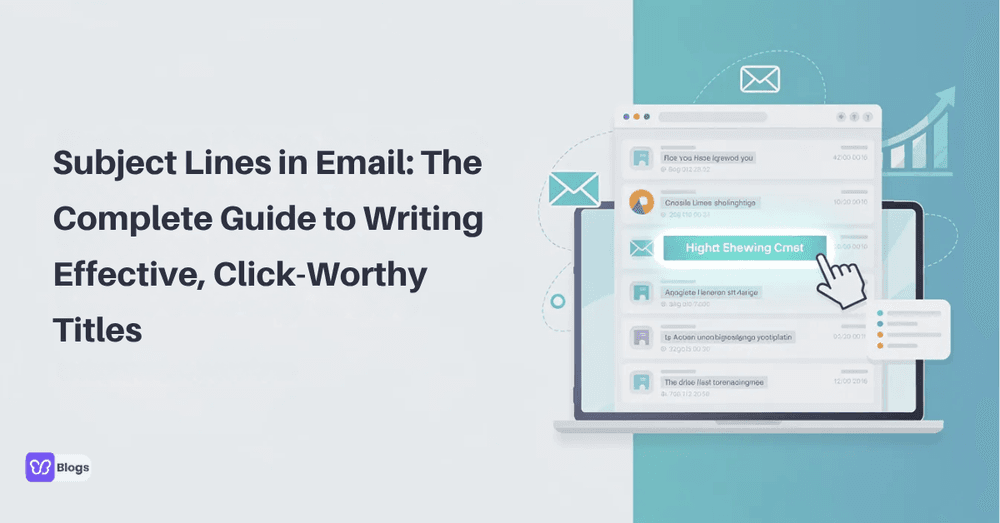
Subject Lines in Email: The Complete Guide to Writing Effective, Click-Worthy Titles
Every day, more than 347 billion emails flood inboxes worldwide. In that noise, your subject line is the single biggest factor determining whether someone reads your message or scrolls past it. Research consistently shows that 47% of email recipients open emails based on the subject line alone, which means nearly half your audience makes a snap judgment before seeing a single word of your email body.
So what separates good subject lines for email from the ones nobody clicks? It comes down to clarity, relevance, benefit, and curiosity. Effective subject lines tell the reader exactly what they gain by opening, while weak ones are vague, generic, or feel like spam. If you want to master subject lines in email, the best subject headings for emails, and the best subject email lines that actually drive results, this guide covers strategy, real examples, and testing methods to get you there.
What is a subject line in an email, exactly?
A subject line in email marketing is the one-line title displayed in the inbox alongside the sender name and preview text. Think of it as the headline of your message. It is the first impression your email makes, and it determines whether recipients engage or ignore.
Three elements work together in every inbox view. First, the sender name establishes who the message is from, ideally sounding like a real person or a recognized brand. Second, the email subject line introduces the topic, promise, or benefit. Third, the preview text expands or clarifies the invitation to open. Preview text should complement the subject line without repetition. If any one of these elements is weak, it undermines the others.
Your subject line also influences deliverability. Spam filters scan subject text for misleading patterns, and a poorly written subject line can land your message in spam folders even when the content inside is solid. Knowing how to title email messages accurately is a deliverability issue as much as a marketing one.
Why subject lines matter: data, trust, and first impressions
The numbers are hard to ignore. 47% of recipients open emails based on subject lines alone. Compelling subject lines can increase open rates from 15% to 40% in real campaigns. And personalized subject lines are 22% more likely to be opened than generic ones.
But the impact goes beyond opens. Quality subject lines improve email deliverability rates because engaged subscribers signal to providers that your emails are wanted. Clear subject lines set expectations and build trust with recipients, which leads to higher click through rate, more conversions, and fewer spam complaints over time. Misleading subject lines can damage trust and lead to spam reports, hurting your sender reputation for months.
Core Benefits of Strong Subject Lines
Here are the three core benefits of getting your subject line right:
- Higher open rates across every email campaign
- Stronger downstream engagement (clicks, replies, purchases)
- Long-term brand trust that keeps subscribers on your list
What makes a good subject line?
What makes a good subject line is straightforward: clarity, specificity, relevance, and benefit orientation. A good subject line answers "What's in it for me?" within about two seconds of scanning. Good email subject lines don't require decoding or guessing.
Compelling email subject lines use urgency only when it is real, match the sender's brand voice, and align with what is actually inside the email. A subject line that promises one thing and delivers another is a bad idea that erodes trust quickly. High-performing subject lines are typically short, specific, and relevant.
Subject Line Comparison: Vague vs. Clear
- Vague: "Guess what?" → Clear: "Cut your reporting time in half"
- Hype: "Don't miss out!" → Specific: "50% off ends at midnight"
- Generic: "An update for you" → Useful: "Your Q2 marketing benchmarks are here"
Must-Have Qualities Checklist
- States a clear benefit or reason to open
- Specific and relevant to the recipient
- Brief enough to display fully on mobile devices
- Honest and aligned with the email body content
- Matches sender identity in tone and expectations
Core types of email subject lines that work
There is no single email subject line best formula. Different subject lines win in different contexts, and what works for a flash sale will fall flat in a nurture sequence. The key is matching the type to your goal.
High-Performing Subject Line Styles
- Curiosity / Teaser – Hints at something unexpected without giving everything away
- Benefit / Offer – Focuses on what the reader gains (savings, knowledge, time)
- Question-based – Asks a compelling question that resonates with a need
- Urgency / Scarcity – Uses real deadlines or limited availability
- Social Proof – References endorsements, numbers, or peer behavior
- Story-driven – Frames a mini narrative or problem that draws readers in
- Purely Informational – Straightforward announcements or updates
Across all these types, keeping subject lines short and focused tends to outperform long, rambling alternatives. Short subject lines typically result in higher open rates regardless of style.
How to write a subject line for an email: step-by-step process
Here is how to write a subject line for an email you are sending today. The process starts before you type a single character.
Step 1: Define Your Purpose
- Determine the email's purpose. Are you selling, educating, re-engaging, or requesting a reply? Your goal shapes everything.
Step 2: Identify the Benefit
- Identify the primary benefit for the reader. What do they get by opening?
Step 3: Pick the Right Tone
- Pick a tone that fits your specific audience and brand voice.
Step 4: Draft Multiple Options
- Draft multiple options, at least three to five, so you have real choices.
Step 5: Edit for Length and Clarity
- Edit ruthlessly for length and clarity, making sure you emphasize the main point early.
Step 6: Use Action-Oriented Language
- Use action-oriented language to increase engagement and tell the reader exactly what to do or expect.
Before-and-After Example
- Before: "Important news about your account and some exciting changes coming soon!" (spammy, vague, too long)
- After: "3 account changes going live July 15" (specific, short, clear)
When learning how to write subjects for emails, remember that every draft is an experiment. The goal is progress, not perfection.
Keep subject lines short and scannable
Nearly 50% of all emails are opened on mobile devices, where inboxes display roughly 33 to 50 characters. Desktop clients show around 60 to 70. Subject lines longer than 50 characters risk being cut off on mobile devices, which means your key message may never be seen.
Why Short Subject Lines Matter
Aim for subject lines under 50 characters for optimal display. Keep subject lines around 30 to 50 characters for mobile devices to ensure nothing critical gets truncated. Brevity is crucial for effective subject lines.
But "short" does not mean vague. Clarity still wins.
Examples of Short Subject Lines
- Too long: "We have an exclusive new product launch happening this Friday that you won't want to miss"
Improved: "New product drops Friday" - Too long: "Here are 7 strategies that will help you improve your email marketing results"
Improved: "7 ways to boost email results" - Too long: "Don't forget to register for our upcoming webinar on content marketing trends"
Improved: "Register: content marketing webinar"
Put the key benefit or keyword first so it survives any cut-off.
Clarity and benefit: effective subject lines that actually say something
Effective subject lines clearly state a benefit. Save time, save money, learn a skill, or avoid a mistake. The best approach is to speak directly to what the reader cares about instead of being clever for cleverness' sake.
Benefit-Driven Subject Lines
Power words can evoke emotional reactions and curiosity in subject lines, but only when paired with clarity. "Unlock," "proven," "instant," and "mistake" all draw readers in when used honestly. Descriptive subject lines align content with reader expectations, reducing disappointment and unsubscribes.
Before-and-After Benefit Examples
- "Big news!" → "We just cut our prices by 30%" - The reader immediately knows the value.
- "Check this out" → "5 templates to speed up your Q3 planning" - Specificity replaces vagueness.
- "Something for you" → "Your free social media audit is ready" - The benefit is concrete and personal.
Subject lines should clearly communicate the value to the reader. Specific subject lines increase the likelihood of being opened. When you are learning how to write great email subject lines and how to write a good subject line in an email, lean on clarity over gimmicks. It scales better for email campaigns of every size.
Curiosity and questions: spark, don't mislead
Curiosity driven subject lines work because they create a gap between what the reader knows and what they want to know. The trick is to spark curiosity without crossing into clickbait territory. Subject lines should leverage curiosity to entice the recipient, but they must still hint at genuine value.
Question-Based Subject Lines
Open-ended questions in subject lines can drive higher open rates. Question-based subject lines can achieve open rates of 46%, making them one of the most reliable formats. A compelling question pulls the reader in by touching a pain point or aspiration.
Examples of Intriguing Subject Lines
- "Are your Q4 emails wasting money?"
- "What's the #1 mistake new managers make?"
- "Did you know your homepage has this problem?"
- "Why are your competitors ranking higher?"
- "What would you do with 10 extra hours a week?"
- "Is your onboarding sequence actually working?"
- "The one metric most marketers ignore"
Over-mysterious lines like "You won't believe this..." or "Open immediately" often look spammy and get filtered. Curiosity driven subject lines are most effective when the reader can guess the category of value but not the specific answer.
Urgency and scarcity: when "now" actually matters
Creating genuine urgency in subject lines can motivate action, but only when the deadline or limitation is real. Fake deadlines and exaggerated claims train your audience to ignore you. False urgency is one of the fastest ways to erode subscriber trust.
Honest Urgency Subject Lines
Urgency in subject lines can drive immediate action and conversions when tied to specific dates, limited inventory, or event deadlines. Incorporating urgency in subject lines prompts immediate action without manipulating the reader.
Examples of Urgency Subject Lines
- "Sale ends tonight at midnight"
- "48 hours left: early-bird pricing for the summit"
- "Last call: registration closes July 31"
- "Only 12 spots left for the live workshop"
- "Flash sale: 40% off for the next 6 hours"
These work because the constraint is verifiable. Compare that to "OPEN NOW OR LOSE EVERYTHING," which feels manipulative and is likely to trigger spam filters.
To create urgency without damaging trust, tie your deadline to something real and make sure the email body delivers on the subject line promises. A sense of urgency should support the reader's decision-making, not pressure them into regret.
Personalization and relevance: talk to one person, not everyone
Using the recipient's name in emails enhances engagement. Personalized subject lines increase open rates by 22%, and emails with personalized subject lines can boost ROI by up to 70%. But personalization goes far beyond first names.
Using Names and Data
When you personalize your subject lines with behavioral data, location, or purchase history, the email feels like a one-to-one message instead of a broadcast. Using the recipient's name in subject lines can enhance engagement, but segmentation-based relevance is even more powerful.
Segmentation-Based Personalization
Personalization should feel natural and deliver genuine value. Over-personalization, using too much private data or inserting the first name into every single email, can feel intrusive. Personalizing subject lines can significantly increase attention, but only when it serves the reader's interests, not just your open rate.
Personalization can enhance the effectiveness of subject lines most when paired with strong segmentation that ensures you are reaching the right audience with the right message.
Examples of Personalized Subject Lines
- "Still thinking about those running shoes, Alex?"
- "Your Denver weather forecast for this weekend"
- "Based on your last order: 3 items you'll love"
- "Sarah, your trial expires in 2 days"
Avoid spammy words and formatting that kill deliverability
Certain spammy words and formatting patterns will land your email in spam folders regardless of how good your content is. Spam filters score emails based on subject line characteristics, and crossing the threshold means your message never reaches the inbox.
Patterns and Words to Avoid
- ALL CAPS ("BUY NOW," "FREE MONEY") - Using all caps or excessive punctuation can trigger spam filters
- Excessive exclamation marks ("Don't miss this!!!!!!")
- Misleading "Re:" or "Fwd:" prefixes on first-touch emails
- Spam trigger words used aggressively: "100% free," "act now," "cash bonus"
- Special characters used excessively to game attention
Avoiding spam trigger words helps maintain email credibility. Authentic language outperforms overly promotional phrases in both deliverability and trust. Excessive capitalization and poor formatting can hurt email deliverability.
Safe Alternatives
- Instead of "FREE!!! CASH BONUS" → "Get a free gift with your first order"
- Instead of "ACT NOW OR MISS OUT" → "Offer available through Friday"
- Instead of "Re: Your request" (on a cold email) → "Quick question about your Q3 goals"
Avoiding spam-like characteristics is key for maintaining trust over months and years. Treat every subject line as a reflection of your brand.
How to write great email subject lines for different goals
Each campaign goal needs a different approach. When you are creating email subject lines, start with the outcome you want, then match the angle.
Selling a Product or Service
- Lead with a specific benefit or exclusive offer.
- Example: "Save 25% on your next order - this week only."
- Utilizing numbers and lists in subject lines attracts attention effectively.
Educating Your Audience
- Use curiosity or a how-to frame.
- Example: "3 mistakes killing your landing page conversions."
- Utilizing social proof in subject lines can increase relevance here too.
Reactivating Dormant Subscribers
- Acknowledge the gap honestly.
- Example: "We miss you - here's 20% off to come back."
- Subject line ideas for reactivation should avoid guilt and lead with value.
Nurturing Relationships
- Share useful content without asking for anything.
- Example: "This week's top reads on product design."
- Great subject lines for nurture sequences prioritize consistency and helpfulness.
When learning how to write great email subject lines, remember that the "best" line always depends on your audience's preferences, the stage of the relationship, and timing.
Best subject headings for emails by format and context
Best subject headings for emails vary dramatically based on format. A newsletter subject line like "The weekly roundup: AI trends, new tools, and a surprise" sets different expectations than a transactional email like "Your order #4521 has shipped."
Newsletter Subject Lines
- "May marketing digest: 5 trends you need to know"
- "This month's top-performing blog post and why it worked."
- Keep tone consistent so subscribers recognize your emails.
Product Launch Subject Lines
- "Introducing Relay 2.0: faster dashboards, smarter alerts."
- Lead with the company name or product name and the key improvement.
Account / Transactional Subject Lines
- "Your password was just changed"
- "Payment received - here's your receipt."
- Clarity is non-negotiable here.
Internal / HR Update Subject Lines
- "Team update: Q3 goals and new PTO policy."
- Even internal emails benefit from clear, benefit-led subject lines.
- A subject line like "Update" without context wastes everyone's time.
Tone should match context: formal for transactional, friendly for newsletters, and direct for internal updates. The best practices for each format center on clarity and reader expectations.
Sales email subject lines that actually get replies
Sales email subject lines live or die by relevance and brevity. Research on millions of B2B cold emails shows that subject lines of 3 to 5 words using sentence case and referencing something specific to the recipient consistently outperform longer, clever alternatives.
Cold Outreach Subject Lines
- "Quick idea for [Company]"
- "Cutting SaaS costs by 30%"
- "[Name], saw your recent launch"
- "Reducing churn at [Company]"
Warm Follow Up Subject Lines
- "Following up on our call Tuesday"
- "The proposal you requested"
- "Next steps for the pilot"
Deal-Closing Subject Lines
- "Final pricing for your team"
- "Ready to move forward?"
- "Last call on the Q3 discount"
Using numbers in subject lines can improve their open rates, especially in sales contexts where specificity builds credibility. A strong subject line for sales avoids hype and focuses on the prospect's pain point. Cold email subject lines perform best when they sound like a real person wrote them, not a marketing machine.
Follow up email subject lines that don't feel pushy
A follow up email lives or dies by its subject line clarity and politeness. Vague lines like "Checking in" or "Just following up" give the recipient no reason to prioritize your message.
Effective Follow Up Subject Lines
- "Following up on your demo request from June 12"
- "New case study relevant to your team's goals"
- "Quick question about the proposal I sent Thursday"
- "Any thoughts on the pilot timeline?"
- "One more resource on the topic we discussed"
- "Updating you: we added the feature you asked about"
- "Final follow up on the partnership opportunity"
Updating the subject line to reflect the new stage of the conversation shows respect for the recipient's time. It also improves further engagement by signaling fresh value rather than repetition.
Subject lines for emails examples: swipeable ideas you can adapt
Here is a swipe file of subject lines for emails examples organized by purpose. Adapt these to your brand voice and specific audience. These are subject line ideas to inspire, not to copy verbatim.
Promotional Subject Lines
- "Your exclusive deal expires Friday"
- "40% off everything - 24 hours only"
- "New arrivals you'll actually want to wear"
- "Free gift with orders over $50"
Educational Subject Lines
- "5 SEO mistakes costing you traffic"
- "How to write a proposal that gets signed"
- "The metric most SaaS teams ignore"
- "What we learned from 10,000 landing pages"
Relationship-Building Subject Lines
- "A quick thank-you (and a surprise)"
- "You asked, we listened: here's what changed"
- "Our founder's take on the industry shift"
- "Join our referral program and earn $50"
Re-engagement Subject Lines
- "It's been a while - here's what you missed"
- "Still interested in improving your email campaigns?"
- "We saved your cart (and added a bonus)"
Event-Related Subject Lines
- "You're invited: live Q&A this Thursday"
- "Last chance to register for the summit"
- "Post-event recap and slides inside"
Catchy email subject lines work best when they are specific, benefit-driven, and honest. Adding emojis can help subject lines stand out when used sparingly, but test before committing to them across every send.
How to write good subject lines in an email for different industries
Pain points and language differ by industry, which means what counts as good subject lines for email changes depending on who you are emailing.
Ecommerce Subject Lines
- Lead with offers, new products, or scarcity.
- "Back in stock: the jacket everyone wanted"
- "Your cart is waiting - free shipping today."
- Address the immediate desire to buy.
SaaS / B2B Subject Lines
- Focus on outcomes, not features.
- "Reduce churn by 15% with one dashboard change"
- "Your competitors are already using this workflow."
- These subject line examples work because they tie to measurable business results.
Education Subject Lines
- Emphasize learning outcomes.
- "Master Excel formulas in 20 minutes"
- "Your course certificate is ready."
- Keep language accessible and avoid jargon.
Nonprofits Subject Lines
- Connect to impact.
- "Your $25 provided clean water for 3 families"
- "See the difference you made this quarter."
- Story-driven and impact-focused lines resonate.
Local Service Businesses Subject Lines
- Use location and specificity.
- "Plumbing emergency in Austin? Same-day service"
- "Your lawn care schedule for July is set."
- Speak directly to the reader's situation.
How to write subjects for emails across the customer journey
How to write subjects for emails depends heavily on where the reader is in their journey. Sending a hard-sell subject line at the awareness stage is a bad idea. Here is how the approach shifts:
Awareness Stage
- "5 signs your website needs an SEO audit" - Educational, no pressure.
Consideration Stage
- "How [Company Name] increased traffic by 200%" - Social proof, comparison-ready.
Purchase Stage
- "Your exclusive offer: 20% off the Pro plan" - Clear, benefit-driven.
Onboarding Stage
- "Welcome aboard - here's your first step" - Supportive, guiding.
Retention Stage
- "Your monthly progress report is here" - Value-add, no ask.
Reactivation Stage
- "We noticed you haven't logged in - can we help?" - Respectful, curious.
Each stage requires different subject lines because the reader's intent and trust level change. Emails should reflect their content to build trust with recipients at every step.
Testing your subject lines: from guessing to data-driven decisions
You must test your subject lines instead of relying on intuition alone. A/B testing helps determine which subject lines resonate with audiences by splitting your list and measuring the difference.
Tips for Effective Subject Line Testing
- Test one element per experiment (length vs. tone vs. personalization)
- Use at least 1,000 recipients per variant for reliable data
- Measure beyond opens: track clicks, conversions, and unsubscribes
- Log every test result, including losers, so you build a knowledge base
- Test your subject lines regularly, not just when performance drops
Even losing tests are valuable. They teach you what your specific audience dislikes, which is just as important as knowing what they prefer.
Key metrics: beyond open rates
While open rates are the most visible metric tied to a subject line, they are not the only key metrics worth tracking. Apple's Mail Privacy Protection and similar tools can inflate open rate numbers, making them less reliable in isolation.
Metrics to Track
- Click through rate - Do people act after opening?
- Conversion rate - Do opens lead to purchases, sign-ups, or replies?
- Revenue per email - What is the dollar value of each send?
- Unsubscribe and spam complaint rate - Are subject lines creating negative reactions?
High opens but low clicks often indicate misalignment between the subject line and content. Overly clever subject lines may lack clarity and fail to convey value, leading to disappointed readers who opened expecting something else. Track results over weeks and months to identify which subject line works best for your audience long term.
Common mistakes to avoid when creating email subject lines
When creating email subject lines, these errors come up repeatedly:
- Vague titles like "Update" or "FYI" - Give the reader no reason to open. Be specific.
- Bait-and-switch - If your subject line promises an exclusive deal but delivers a blog post, you lose trust fast.
- Over-personalization - Using deeply personal data in every email crosses from helpful to intrusive.
- Overlong lines - Subject lines under 50 characters are recommended for mobile devices. Anything longer gets truncated.
- Excessive punctuation marks - Multiple exclamation marks ("!!!!!") trigger spam filters and look unprofessional.
- Exaggerated claims - "This will change your life" rarely delivers. Keep promises grounded.
For each mistake, the fix is the same: return to clarity and honesty. How to write a good subject line in an email always comes back to asking, "Does this accurately describe what is inside, and does it give the reader a reason to care?"
Using AI and tools to brainstorm and refine subject lines
AI tools can generate dozens of catchy email subject lines in seconds. The value is in volume: you get options you would not have considered on your own. But AI-generated subject lines need human editing for clarity, tone, and spam safety.
Practical Workflow for AI-Assisted Subject Lines
- Start with a human-written draft based on your campaign goal.
- Run it through an AI tool to generate 10 to 15 variations.
- Shortlist the top three to five that match your brand voice.
- A/B test the finalists.
Warnings to Keep in Mind
- AI suggestions sometimes include spammy words or exaggerated claims. Always screen.
- Copy-pasting without review can produce tone mismatches that feel generic.
- Build a personal swipe file of high-performing subject lines as a long-term asset. This matters more than any single tool.
Advanced tactics: segmentation, timing, and preview text
When you write email subject lines for segmented audiences, relevance increases dramatically. Behavioral segmentation, grouping email recipients by purchase history, browsing behavior, or engagement level, lets you craft subject lines that feel personally relevant. Using email automation software can make it easier to manage these segments and personalize subject lines across campaigns.
Send-Time Optimization
Send-time optimization matters too. Test different days and times with your own list rather than relying on generic best practices. Your audience's preferences may differ from industry averages.
Preview Text Synergy
Preview text acts as a second subject line and should extend, not repeat, the main message. Here are subject + preview text pairs that show the synergy:
Subject: "Your Q3 benchmarks are ready" → Preview: "See how you compare to 500+ SaaS companies"
Subject: "3 mistakes killing your ads" → Preview: "Plus a free audit template to fix them"
Subject: "We just shipped a big update" → Preview: "Faster reports, new integrations, and one surprise"
Think of preview text as the supporting line that closes the deal on the open.
Holiday, event, and seasonal subject lines
Holiday and event email campaigns come with built-in urgency, but also built-in competition. Everyone is sending promotions, so your subject lines stand out only if they avoid clichés and deliver specificity.
Holiday Sale Examples
- "Black Friday early access: 40% off starts now"
- "New Year reset: tools to hit your 2027 goals"
- "Back-to-school savings: up to 50% on supplies"
Webinar / Event Examples
- "You're invited: live product demo on August 5"
- "Reminder: tomorrow's webinar starts at 2 PM ET"
- "Post-event recap + your exclusive slides"
Seasonal Content Examples
- "Your summer marketing playbook is here"
- "Fall planning checklist: 5 things to tackle this month"
Avoid fatiguing subscribers with daily holiday sends. Space your email campaigns and vary the angle, moving from teaser to last call to thank-you.
Internal and one-to-one professional email subject lines
How to write a subject line for an email in professional settings follows the same core rules: clarity, specificity, and respect for the recipient's time.
Examples of Professional Subject Lines
- Status update: "Project Atlas: sprint review summary - July 7"
- Request: "Need your input on the vendor shortlist by Thursday"
- Approval: "Approval needed: revised marketing budget for Q4"
- Meeting recap: "Action items from today's leadership sync"
For internal emails, consistent naming conventions for projects and threads improve searchability. Include the project name, a brief descriptor, and the action needed.
Even when emailing colleagues, a strong subject line saves time and reduces inbox friction.
Putting it all together: a repeatable checklist for every email
Before you hit send on any email, run through this checklist:
- Goal: What do you want the reader to do after opening?
- Audience: Is this written for your specific audience, not a generic crowd?
- Benefit: Does the subject line clearly answer "What's in it for me?"
- Clarity: Would a busy person understand this in two seconds?
- Brevity: Is it under 50 characters for mobile visibility?
- Spam check: Have you avoided spam trigger words, excessive caps, and misleading prefixes?
- Alignment: Does the subject match the email body content?
- Preview text: Does it extend and support the subject line?
- Test: Have you written at least two variants to test your subject?
- Immediate action: Is there a reason to open now, not later?
A quick "before you send" scan: read the subject line plus preview text in isolation and ask, "Would I open this on a busy Tuesday morning?" If the answer is uncertain, rewrite.
Mastering subject lines in email is not a one-time skill. It is an ongoing practice of writing strong subject lines, testing them, reviewing results, and refining your approach based on what your audience actually responds to.
Conclusion: master subject lines to multiply your email ROI
Every effective subject line you write is a small investment with outsized returns. An effective email subject line lifts open rates, drives further engagement, and builds the kind of trust that keeps subscribers loyal for years. Personalized subject lines can increase open rates by 22%, and the compounding effect of consistent, honest subject writing transforms email from a cost center into a revenue engine.
Do not rely on one formula. Experiment with different types of effective subject lines: curiosity, urgency, benefit-driven, and question-based. What resonates will vary by audience, timing, and context.
Your next step: audit your last five email campaigns, identify the weakest subject lines, rewrite them using the principles in this guide, and run your first A/B test this week. Clarity, curiosity, and honesty are the pillars of great subject lines, and they will always outperform tricks.

Author
Debutify
Debutify is the easiest way to launch and scale your eCommerce brand.