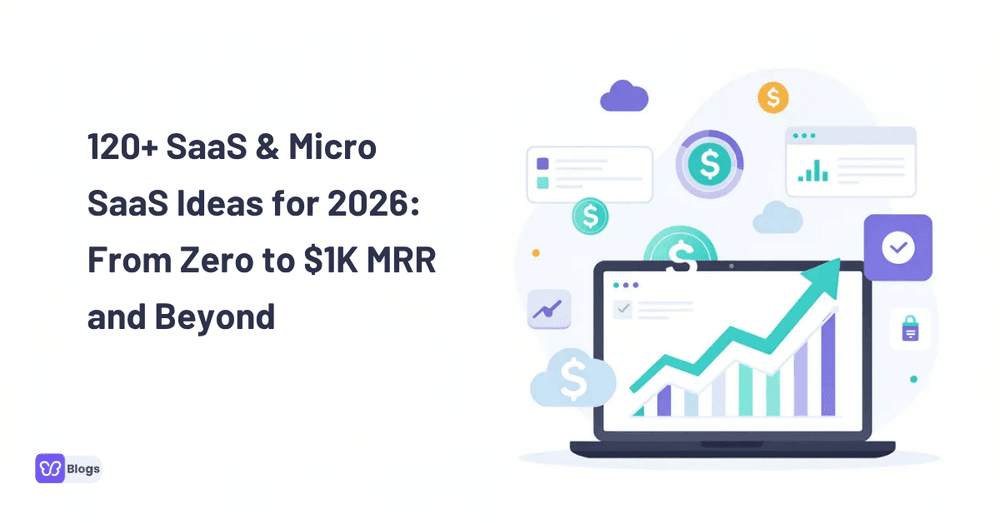
120 SaaS and Micro SaaS Ideas: From Zero to $1K MRR and Beyond
The subscription software economy is not slowing down. If anything, 2026 is shaping up to be one of the most accessible years ever for founders to launch a new product and reach paying customers within weeks.
This guide is a curated idea bank: actionable SaaS ideas, the criteria that separate winners from the graveyard of half-built side projects, and the validation steps that turn an idea into first revenue. Skim for inspiration, stay for the filters.
Introduction: Why 2026 Is Perfect for New SaaS Ideas
Software as a service ideas have evolved far beyond CRMs and project management clones. In 2026, the conversation is about AI-native tools, hyper-niche vertical products, and lightweight automation layers that solve one painful problem for a specific audience.
The global market keeps expanding, and the cost of reaching niche markets keeps falling, which is why a single founder can now build and distribute what used to take a funded team. The metric that matters at the start is MRR, and the first thousand of it is closer than most founders assume.
The opportunity favors the specific. Broad tools have incumbents. Narrow problems have budgets, urgency, and almost no competition, which is exactly where a micro product wins.
What Makes a Profitable Micro SaaS Idea in 2026?
Not every idea deserves your next ninety days. The winning ones target a narrow, reachable audience, solve a painful recurring problem, and deliver a clear ROI the buyer can state out loud. They ride a tailwind, usually artificial intelligence, and they are buildable by one person in weeks, not quarters.
- Narrow audience: not everyone, someone specific you can reach.
- Recurring pain: weekly or daily, not annual.
- Obvious ROI: money saved or earned, stated simply.
- Existing demand signals: forums, complaints, and workarounds already in the wild.
- A pricing path to $1K MRR: roughly 50 customers at $20, or 20 at $50.
AI-First SaaS Ideas: Automation, Content & Productivity
Between 2023 and 2026, AI SaaS exploded on the back of maturing models, cheaper compute, and remote work creating demand for smarter tools. The AI meeting assistants market alone is projected to grow from $3.24 billion in 2025, and the spill-over opportunities run from AI design assistants to customer service copilots.
Ideas that are already showing traction: meeting extractors that write the follow-up automatically, content repurposers, email triage tools, and Marketing automation agents. Privacy-aware niches, such as GDPR compliance checkers for small teams, keep paying well because the cost of getting it wrong is real.
The filter for AI ideas is the same as everywhere: pick the problem the buyer already pays to endure, and let the model be the mechanism, not the pitch.
Industry-Specific SaaS for Small Business: Vertical Niches That Pay
Horizontal tools are saturated. The opportunity in 2026 lies in SaaS for small business verticals: healthcare, legal, construction, hospitality, and the local trades, where specific regulations, workflows, and integrations create defensible moats.
Concrete examples: scheduling built around job-site constraints, compliance logs for small clinics, and niche security like a password manager for non-profits, where the audience is underserved and the budgets are modest but loyal.
Small clinic and dental office management: Inventory, billing, patient reminders. Dental practices can also use dental membership plan software to manage membership programs, patient benefits, and recurring payments.
Vertical software wins by speaking the customer's language before the demo starts. If your landing page reads like an insider wrote it, the sale is half done.
Creator, Freelancer & Indie Business SaaS Ideas
The indie economy of creators, freelancers, and micro-agencies is a goldmine for software as a service business ideas. These users adopt lightweight tools quickly, especially when the payoff ties directly to income, and the freelance management market is estimated at $4.16 billion and climbing.
Ideas with pull: proposal-to-contract flows, client feedback collectors that feed content marketing engines, portfolio sites that sell direct, and royalty trackers for multi-platform creators. The common thread is income proximity: tools that sit between the creator and the invoice get bought.
The freelance buyer is also the fastest-moving segment in software, which means distribution can be a single viral post away. Speed to market matters more here than anywhere.
Developer, DevOps & Data-Focused SaaS Ideas
Developers and DevOps teams are among the best SaaS customers: high willingness to pay, clear ROI, and deep workflows that create natural stickiness. Once a tool becomes part of the daily routine, retention takes care of itself.
Ideas that fit: code snippet managers with sharing and tagging, staging-data anonymizers, incident retrospectives generators, and niche device management dashboards for small fleets.
The developer-sales lesson is worth copying in every category: sell to people who hate being sold to, with a product that works before the signup form. Free tiers and open documentation are the marketing.
Marketing, SEO & Customer Feedback SaaS Ideas
Marketing budgets in 2026 are shifting hard toward data-driven attribution, SEO, and automation. Companies using marketing automation report a 14.5 percent increase in sales productivity and 12 to 15 percent lower operational costs, which is the kind of proof that opens wallets.
Ideas in play: AI brief generators tuned to social media performance, customer feedback synthesizers that turn review text into roadmaps, and customer engagement scoring tools for lifecycle teams.
The meta-advantage of building in this category is that your own product is your proof: a marketing tool that markets itself visibly well answers the objection before the prospect raises it.
No-Code Micro SaaS Ideas You Can Ship in Weeks
No-code platforms like Bubble, Webflow, Glide, and Softr, combined with automation tools like Zapier and Make, make a credible MVP possible in two to four weeks. That speed is what makes no-code the perfect launchpad for testing ideas before investing in custom development.
Shippable concepts: booking portals for coworking spaces, directories with paid listings, internal tools for agencies, and customer onboarding checklists for service businesses.
The no-code lesson for every founder: validate with the cheapest build that proves demand, then rebuild only what revenue justifies. The graveyard is full of overbuilt products that answered questions nobody paid to ask.
Micro SaaS Market Analysis: Picking Ideas That Can Actually Win
Even tiny micro SaaS plays need enough addressable market to sustain the product. Build for too small a segment and growth caps out. Go too broad and competitors swamp you. Market analysis is what separates a profitable micro SaaS from a hobby project.
A simple framework: size the audience where the pain lives, check what they already pay, and find where they gather, from niche communities to Reddit threads. If you cannot name three places your buyers congregate, the audience is too diffuse to reach cheaply.
The arithmetic keeps ideas honest: a thousand dollars of MRR needs roughly fifty customers at twenty dollars. If the audience cannot plausibly supply five hundred of them, the ceiling is below the effort.
From Idea to MVP: Validating SaaS and Micro SaaS Ideas Fast
The gap between a promising idea and a real SaaS business is validation. A practical 30-day plan moves the best concepts from sketch to first revenue without building the wrong thing.
- Days 1 to 7: sketch the problem, define the buyer, and list where they already complain.
- Days 8 to 14: talk to ten of them; ask about the last time the problem cost them money.
- Days 15 to 21: build the smallest version that removes the pain once.
- Days 22 to 30: charge the first five users, even a token amount, because free feedback lies.
The discipline is charging early. Payment is the only validation that does not flatter, and the founders who collect it in week four learn more than the ones who spend the month polishing.
Best SaaS Ideas Cheat Sheet
The condensed version for quick scanning:
- AI-native: meeting extractors, content repurposers, email triage. Higher build cost, highest revenue ceiling.
- Vertical SaaS: compliance logs, trade scheduling, niche security. Slower sales, strongest retention.
- Creator and freelance: proposals, feedback tools, royalty tracking. Fastest distribution.
- Developer tools: snippet managers, data anonymizers, incident retros. Best buyers, least hand-holding.
- Marketing and feedback: brief generators, review synthesizers, engagement scoring. Proof is visible.
- No-code: booking portals, directories, internal tools. Ship in weeks, validate in days.
The landscape for SaaS ideas in 2026 is richer and more accessible than ever. Whether you target small business verticals, build AI-powered tools, or launch a no-code MVP, the playbook is the same: narrow problem, reachable audience, early payment. The founder checklist:
- Pick the pain, not the technology.
- Confirm the audience gathers somewhere you can reach.
- Do the MRR arithmetic before writing a line of code.
- Talk to ten buyers before building for a thousand.
- Charge the first five, even a token amount.
- Rebuild only what revenue justifies.
The next wave of subscription software will be built by people who started smaller than they thought they should. That is the whole secret, and it is available to anyone willing to begin.

Author
Debutify
Debutify is the easiest way to launch and scale your eCommerce brand.