Customer Service Artificial Intelligence: The Complete 2026 Guide
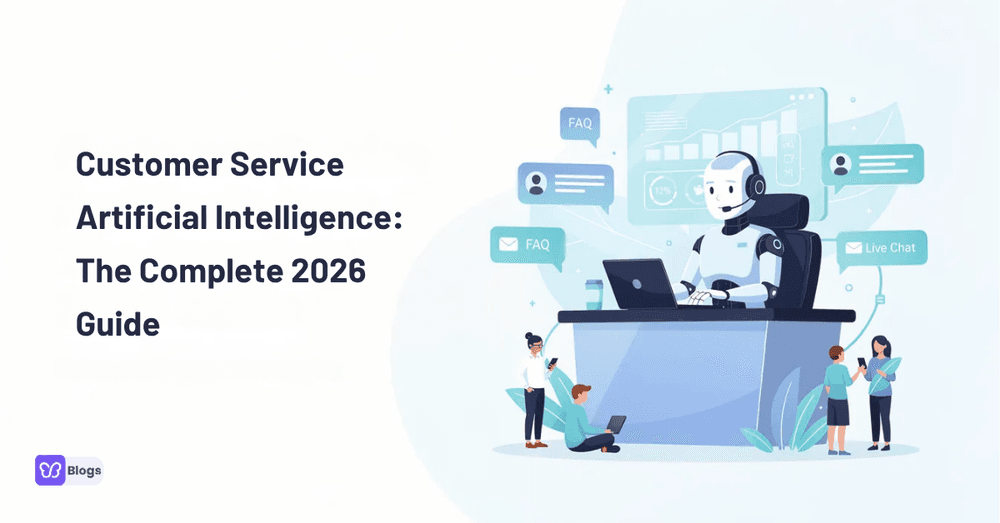
Customer service artificial intelligence has moved well beyond scripted FAQ bots. In 2026, it represents a category of systems—powered by NLP, machine learning, and generative models—that can resolve full conversations across chat, email, and voice channels. With digital customer interactions surging year over year and 82% of service professionals reporting increased customer demands, the pressure to deliver real-time, accurate help has never been higher. AI-powered customer service is now the primary lever businesses pull to meet those expectations without tripling headcount.
This guide will walk you through how AI in customer service works, where to start, and how to scale responsibly. Whether you are evaluating AI customer service chatbots, exploring support artificial intelligence tools for your team, or building a business case for a full AI customer service solutions rollout, you will find concrete frameworks here. We cover strategic tools like helpline AI for voice, AI chat bot customer service for digital channels, and predictive analytics that surface churn risk before a customer ever complains. Modern AI agents can now reason over policies, access CRM data, and take real actions—not just answer questions. An artificial intelligence customer service bot in 2026 can cancel orders, process returns, and update subscriptions autonomously. Customer support artificial intelligence transforms customer service into a proactive, personalized experience.
At a glance, the primary benefits include:
- Faster replies: responses in seconds instead of hours
- Lower costs: routine ticket deflection reduces staffing pressure
- Better customer sentiment tracking: real-time emotion detection flags at-risk accounts
- Higher agent efficiency: humans focus on complex, high-value work
What Is AI in Customer Service?

AI in customer service refers to the use of natural language processing, machine learning, and generative AI models to automate and augment support across every channel—chat, email, phone, social, and in-app. These systems interpret customer intent, extract key details like order numbers or account information, and generate accurate responses grounded in your company knowledge and knowledge base content.
AI streamlines support through machine learning and natural language processing technologies, providing a consistent experience across various communication channels.
The gap between old-school scripted bots and modern AI agents is significant. Basic scripts follow rigid decision trees. Modern AI-powered customer service systems reason over policies, product documentation, and ticket history. They understand natural language, answer customer questions, and take actions inside integrated CRM systems—canceling orders, resetting passwords, issuing refunds.
Artificial intelligence transforms customer service into a proactive personalized experience rather than a reactive queue.
Human-AI Collaboration
Critically, support artificial intelligence augments human agents rather than replacing them. Hybrid models—where AI handles routine inquiries and humans tackle complex tasks—are now the industry standard.
Typical components in a modern stack include:
- AI tools for intelligent routing of customer requests
- AI-powered chatbots for always-on self service
- Agent-assist sidebars that suggest responses and surface policy details
- Analytics dashboards tracking customer feedback and customer sentiment
- Integration layers connecting to CRM systems and backend systems. Businesses can also benefit from WhatsApp CRM integration to centralize customer conversations, automate follow-ups, and keep customer data synchronized across support channels.
Why Use AI for Customer Service and Support?
Since 2020, ticket volumes have climbed sharply thanks to e-commerce growth, subscription-based business models, and distributed global customer bases. Customer expectations now include 24/7 availability as a baseline. Meanwhile, talent shortages in contact centers make it harder—and more expensive—to staff support teams at the level required.
AI customer service solutions, including an AI contact center, directly address these pressures. They deliver:
24/7 coverage
Instant answers
Consistent service quality across channels
AI reduces average inbound call handling time by 38% for mature adopters, and AI can handle up to 80% of customer interactions autonomously. AI can automate 66% of customer queries for businesses, freeing human agents for nuanced, high-value conversations. AI can increase agent efficiency by 33% in contact centers, fundamentally changing how support operations scale.
Traditional vs. AI-Powered Support
Compare a traditional call center—rigid phone trees, fixed hours, every issue handled by a person—to an AI-powered customer service "digital front door." The digital front door triages issues across chat and helpline AI voice flows. AI handles FAQs and routine tasks, escalates complex issues to humans with full context.
For businesses that need to scale support without building a large in-house team, customer service outsourcing can also be worth considering. Some companies combine outsourced support teams with AI tools so routine questions are handled automatically while human agents step in when a customer needs more personal help. Providers such as ZenConnex take this hybrid approach, bringing together AI-powered support and human assistance under one setup.
Results from real-world implementations:
A mid-size ecommerce brand in 2025 cut support costs by 62%
First response time dropped from 4.2 hours to under 30 seconds
78% of tickets resolved autonomously while CSAT rose from 72 to 90
AI reduces operational costs by enabling faster service at every step.
How Customer Service Artificial Intelligence Works (Tech Overview)
Understanding the technology does not require an engineering degree. At its core, customer service artificial intelligence relies on four layers: NLP (parsing human language), machine learning (improving from historical data), large language models (generating fluent responses), and retrieval-augmented generation (grounding answers in your actual documentation so the system does not fabricate information).
Intent Detection
When a message arrives, the first step is intent classification. The system determines the type of request—return, billing question, complaint—by analyzing the language used.
Sentiment Analysis
Next, sentiment analysis evaluates language cues to understand feelings: is the customer frustrated, neutral, or satisfied? This helps prioritize and tailor responses.
Knowledge Retrieval
The system pulls relevant customer data from CRM systems—order history, account details, past tickets. AI scans and organizes support content to identify helpful articles from the knowledge base.
Response Generation
Finally, a response is generated, either from templates or via generative AI, and delivered to the customer. AI analyzes queries to route them to the best-suited agent when human intervention is needed.
Example Workflow
Consider a concrete flow:
- A customer visits a website AI chat bot customer service widget and types, "I want to return the shoes I ordered last week."
- The bot detects intent ("return request"), extracts entities ("shoes," "last week"), checks the CRM for order eligibility, retrieves the return policy from the knowledge base, and generates instructions.
- If the customer agrees, the bot creates a return label and updates the order management system.
- If policy blocks the return, it escalates to a human with full context.
Simple Bots vs. Advanced AI Agents
The difference between a simple artificial intelligence customer service bot and an advanced AI agent matters:
- Simple bots handle fixed intents with templated responses.
- Advanced agents plan multi-step workflows, call APIs, update databases, and adapt dynamically across turns.
Mini-Pipeline Checklist: From Message to Resolution
- Customer message arrives
- Intent detection and sentiment classification
- Retrieval of relevant knowledge or policy from KB and CRM
- Response generation or escalation
- Action execution (refunds, updates) or handoff to human agent

Core Types of AI Customer Service Solutions
Modern AI customer service stacks are not monolithic. They are composed of specialized solution categories, each handling a different part of the support lifecycle.
AI-Powered Customer Service Chatbots and Helpline AI
AI-powered chatbots are always-on assistants embedded on websites, mobile apps, and messaging platforms. They provide immediate support, eliminating wait times for routine inquiries. AI chatbots provide instant answers 24/7 to customer inquiries, and they can handle increased demand without hiring additional staff. AI systems can handle thousands of simultaneous inquiries to enhance scalability. Once you've chosen an AI chatbot, the next step is deploying it where customers can actually use it. This guide explains how to embed AI chatbots into your website with step-by-step instructions.
Helpline AI extends this capability to voice. Instead of rigid interactive voice response menus, voice bots use conversational flows powered by NLP, allowing customers to speak naturally. AI reduces inbound call handling time by 38%, making phone support faster and less frustrating.
Typical tasks these tools handle include:
FAQs
Order status
Password resets
Billing questions
These cover 60–80% of simple customer interactions. AI chatbots can autonomously resolve over 80% of customer interactions when properly configured. They also analyze customer sentiment to tailor responses, adjusting tone when a customer is frustrated.
Real-world examples:
Kenlo reduced response time from over 6 hours to approximately 20 seconds, with roughly 60% of tickets resolved without human intervention over eight months.
Another online retailer using AI customer service chatbots saw 68% of inquiries automated and average response time drop from 4.2 hours to 67 minutes.
Escalation to human agents remains essential for high-emotion cases, multi-step financial issues, and regulatory constraints. AI chatbots can analyze customer sentiment to determine when a conversation needs a human touch.
AI Agents and Virtual Customer Assistants
An AI agent goes beyond answering questions. It is an autonomous system that can plan workflows, call APIs, write back to databases, and collaborate with other AI agents. Where transactional AI chat bot customer service handles single-turn exchanges, virtual customer assistants manage complex, multi-step customer service interactions.
Example scenario:
In 2026, an insurance AI agent collects damage details via chat, checks policy limits in the CRM, pre-fills the claim submission, and hands the case to a human underwriter for final approval.
AI reduces human error in processing tasks critical to industries like finance or insurance, and AI enhances personalization by accessing customer preferences in real-time.
These agents dramatically improve agent efficiency by doing pre-work: gathering context, verifying identity, summarizing prior customer interactions. When a human agent picks up an escalated case, they see a complete summary rather than starting from scratch. These assistants live across chat, voice, and mobile apps interfaces while staying grounded in live CRM systems data—ensuring relevant responses every time.
Agent Assist and Back-Office Support AI
Support artificial intelligence tools that sit alongside human agents are among the highest-ROI investments in customer service operations. These systems provide real-time suggestions, auto-drafted replies, and policy lookups directly inside the agent console.
Benefits include:
Real-time support during customer interactions
Reduced repetitive tasks
Improved consistency
AI can increase agent efficiency by 14% when used as a support tool in this way. A B2B SaaS support team in 2025 cut average handle time by 25% thanks to real-time recommended responses and knowledge base suggestions. Agent-assist AI also powers smarter ticket summarization for hand-offs between shifts and channels, ensuring the customer service team maintains continuity.
Integration points include browser extensions, in-panel widgets inside help desks, and sidebar UI within CRM systems. The emphasis here is human-in-the-loop workflows: support agents validate AI suggestions, train fallback logic, and audit for accuracy. This approach keeps humans in control while dramatically reducing manual effort.
Analytics, Sentiment, and Feedback Intelligence
AI analytics tools mine chat, email, and call transcripts to detect customer sentiment, intent trends, and friction points.
Capabilities include:
Sentiment analysis technology evaluates language cues to understand feelings—AI tools can read tone and emotion in messages.
AI sentiment analysis can identify when customers are angry or happy.
AI can detect emotions like frustration or satisfaction in communications, helping support teams respond faster to unhappy customers.
Sentiment classification (positive, neutral, negative) helps prioritize queues, flag escalations, and refine training content. AI captures and categorizes support data to reveal customer pain points, grouping customer feedback into themes like pricing confusion, UX issues, or feature requests. These insights feed directly to product and marketing teams.
Example:
A subscription app discovered a spike in "billing confusion" via sentiment analysis, fixed its checkout copy, and reduced related complaints by over 20%. These insights should flow back into bot training and knowledge base updates to continuously improve AI customer service solutions. Before-and-after sentiment charts make the impact visible to leadership.
Practical Use Cases of Customer Support Artificial Intelligence
This section turns theory into concrete, revenue- and CSAT-focused scenarios. Customer support artificial intelligence covers a wide spectrum—from starter automations to advanced predictive workflows.
Starter Use Cases
- FAQ automation: Deflect the most common customer queries effectively without human involvement
- Order tracking: AI allows customers to track orders and get answers at any time due to 24/7 availability
- Returns processing: Automated workflows for refund and exchange requests
- Password resets: Self-service flows that resolve in seconds
Intermediate Use Cases
- Billing and payments: AI can suggest solutions based on previous customer purchases
- Technical troubleshooting: Guided diagnostic flows with escalation to technical expertise when needed
Advanced Use Cases
- Proactive alerts: AI predicts potential issues by analyzing interaction history—outage notifications, subscription renewal reminders, delivery delay warnings
- Cart recovery (ecommerce): AI chat bot customer service triggers personalized messages when a customer abandons checkout
- Account permissions (SaaS): AI agents handle role changes, access requests, and plan upgrades autonomously
- Outage notifications (telecom/utilities): AI-powered customer service proactively contacts affected customers before they contact you
Automated tools allow for faster issue resolution without waiting for a representative.
Recommended sequence:
- Start with high-volume, low-risk intents (FAQ, order status)
- Measure impact
- Expand to voice and helpline AI
- Eventually implement predictive analytics
AI analyzes past interactions to tailor customer support journeys at every stage.

Benefits of Customer Service AI for Customers and Teams
The benefits of customer service AI split into two buckets: what customers experience and what your team gains operationally.
Customer-Facing Benefits
- Round-the-clock access via AI-powered chatbots and helpline AI
- Immediate support, eliminating wait times
- Reduced customer wait times by automating responses
- Improved customer experience by reducing resolution times through intelligent automation
- Personalized experiences can increase customer satisfaction by 15%
- Personalized recommendations based on customer data
- Hyper-personalization achieved by referencing past customer behavior and preferences
- Emotionally aware routing via customer sentiment analysis ensures negative experiences get faster human support
Operational Benefits
- Reduced average response times by automating routine tasks
- Increased agent efficiency by 33% in contact centers
- Freshservice's 2025 Benchmark Report: AI-enabled teams reduced ticket resolution time by 76.6% and improved first response time by 41.1%
- AssemblyAI reduced first response time from 15 minutes to 23 seconds with AI resolution rates reaching 50%
- AI tools can analyze customer data to improve service strategies, informing better customer service strategies and enhancing customer satisfaction across the board
- AI customer service solutions can turn support from a pure cost center into a revenue influence function—embedding targeted upsell messages, personalized recommendations, and cross-sell opportunities directly into support conversations
- Chatbots collect data on common queries to optimize products and services, creating a feedback loop that strengthens the entire business
- Cost savings compound as deflection rates climb and customer satisfaction scores rise alongside them
Challenges, Risks, and Ethics in AI-Powered Customer Service
Powerful AI tools come with risks that must be actively governed. Ignoring them does not just create bad customer experiences—it creates legal and brand liability. 66% of service leaders lack AI skills in their teams, making governance harder to implement.
Accuracy and Hallucinations
- Generative models sometimes fabricate policies, invent procedures, or provide incorrect information.
- AI's understanding of complex requests is often limited, especially for edge cases.
- Confidence scoring and grounding responses in verified source material are essential safeguards.
Bias
- AI can generate biased responses if trained on poor data.
- Models trained on skewed datasets may misunderstand users with different dialects, languages, or cultural contexts.
- Voice helpline AI can have disparate error rates across accents.
- Regular auditing of training data and output is non-negotiable.
Privacy and Compliance
- AI must comply with data privacy laws like GDPR and CCPA.
- How transcripts, personal identifiers, and customer data are stored and processed must be documented.
- Consent is required for voice recordings.
- Data retention policies must be defined clearly.
Over-Automation
- Automating too many customer service interactions can strip away the human empathy that customers need in emotionally charged situations.
- Customers want to know when they are speaking to a human versus an artificial intelligence customer service bot.
- Transparency builds trust.
Ethical Checklist Before Launching AI in Customer Service Projects
- Validate response accuracy against known-good answers
- Confirm data handling compliance with applicable regulations
- Audit training data for bias and inclusivity
- Define clear human fallback points for complex and sensitive issues
- Disclose AI involvement transparently to customers
- Monitor customer emotions and sentiment metrics to detect emerging issues
- Establish a regular review cadence for model performance
How to Implement AI Customer Service Solutions Step-by-Step
Start by assessing your current support operations:
- What channels do you use (chat, email, voice, social)?
- What are your ticket volumes per channel?
- What are your top customer intents?
- What are your current average handle times, first response times, and customer satisfaction scores?
Define concrete objectives before deploying technology. For example: "Deflect 30% of chat tickets with AI chat bot customer service within 6 months" or "Reduce average handle time by 20%." Vague goals produce vague results.
Phase 1: Pilot
- Choose a narrow AI customer service use case—order tracking or FAQ automation.
- Implement a chatbot or helpline AI for those intents.
- Ensure full integration with CRM systems so the AI has context.
- Chatbots collect data on common queries to optimize products and services from day one.
Phase 2: Expand
- Add more intents
- Implement agent-assist tools
- Introduce AI agents for more complex customer support workflows
- Expand channels
- Deploy sentiment analytics to monitor customer satisfaction continuously
Phase 3: Mature
- Enable full autonomous resolution where safe
- Deploy predictive actions and proactive support alerts
- Build self-optimizing flows
- Integrate continuous feedback loops
- AI tools can analyze customer data to improve service strategies over time
Team Onboarding
Onboarding your team is just as critical as configuring the technology.
- Train support agents to work alongside support artificial intelligence: how to review suggestions, when to intervene, and how to provide feedback that improves the model.
- Establish new QA processes and monitoring routines.
A Realistic 90-Day Roadmap
| Weeks | Milestone |
|---|---|
| 1–2 | Audit current operations, define objectives and KPIs |
| 3–4 | Select pilot intents, evaluate vendors |
| 5–8 | Build pipeline, integrate with CRM and knowledge base |
| 9–12 | Launch pilot, measure first response time and CSAT |
| 13–20 | Expand to additional channels or intents |
| 21–30 | Introduce advanced AI agents and analytics |
Measuring Success: KPIs for AI-Powered Customer Service
Measuring success requires tracking metrics before and after implementing AI customer service solutions. Without baselines, you cannot prove impact.
Core KPIs
- Deflection rate (% of contacts resolved fully by AI)
- Time to first response
- Average handle time
- Resolution time
- CSAT and NPS
- Conversation sentiment trends
- Cost per contact
AI-Specific KPIs
- Percentage of fully automated resolutions by artificial intelligence customer service bot
- Escalation rate to human agents
- Accuracy of intent detection
- Hallucination or fallback rate
Mature AI adopters reported a 38% lower average inbound call handling time—a number worth benchmarking against. AI tools can analyze customer sentiment in real time, allowing you to correlate sentiment trends with specific bot changes or new AI tools being introduced.
Pull data from both the contact center and CRM systems. Contact center data gives you CSAT, response times, and handle times. CRM data reveals retention, repeat tickets, and revenue influenced by support. A unified dashboard should combine both.
Ideal weekly executive report layout:
One page showing average first response time versus target, deflection rate, resolution rate, escalation rate, CSAT and NPS, sentiment trend, cost per contact, ticket volume, and backlog—with week-over-week changes highlighted.
Future Trends in Customer Service Artificial Intelligence
Customer service artificial intelligence is evolving toward more autonomous, "agentic" systems by 2027–2028. These systems will plan multi-step workflows, coordinate across tools, call external APIs automatically, and act proactively rather than reactively.
Multimodal Support
Multimodal support is expanding. AI agents will handle images (customers uploading photos of product damage), voice with advanced emotion detection, and potentially video support. AI provides immediate support, eliminating wait times across every modality. AI systems can handle thousands of simultaneous inquiries to enhance scalability as these channels grow.
Proactive and Predictive AI
Proactive and predictive AI in customer service will grow rapidly. Systems will anticipate customer needs and act before users open a ticket—outage alerts, subscription renewal nudges, delivery delay notifications. AI predicts potential issues by analyzing interaction history, turning reactive support into a competitive advantage.
Hyper-Personalization and Compliance
Tighter coupling with CRM systems and customer data platforms will enable hyper-personalized support flows powered by unified customer profiles. Emerging frontiers include emotion-aware voice helpline AI, self-optimizing conversation flows, and compliance-aware reasoning embedded directly into AI customer service stacks.
The businesses that start building these capabilities now—even with a narrow pilot—will be positioned to deliver exceptional customer experiences as these trends mature.

FAQs About AI Customer Service and Support
1. What is customer service artificial intelligence?
It refers to using technologies like NLP, machine learning, and generative AI to automate or augment customer support across channels including chat, email, and voice. It covers everything from chatbots handling routine inquiries to AI agents that execute actions within CRM systems.
2. How do AI customer service chatbots work?
These bots classify user intent using NLP, extract necessary entities (order numbers, dates), retrieve relevant knowledge base content, and generate responses via templates or generative models. They escalate to human agents when confidence is low or the issue is complex.
3. Can AI-powered customer service replace human agents?
Not fully in 2026. AI excels at routine, high-volume, low-complexity interactions. Complex, emotional, or legally sensitive issues still require human support, empathy, and judgment. Hybrid models—AI handling routine tasks and humans handling escalations—consistently deliver the best customer experience and highest customer satisfaction scores.
4. What is the difference between customer support artificial intelligence and simple automation?
Simple automation uses canned replies, rigid scripts, and basic rule matching. Customer support artificial intelligence includes adaptive understanding of intent and context, grounded knowledge retrieval, and generative capabilities that evolve over time. AI agents learn and improve; simple automation is static.
5. How much data do I need to train an AI customer service bot?
For basic intent classification and FAQ handling, thousands of historical tickets often suffice. Many organizations launch successfully after reviewing 6–12 months of customer interactions. For advanced AI agents, richer datasets of tens of thousands of properly annotated tickets help significantly.
6. Can AI agents integrate with my existing CRM systems?
Yes—and they must. Without CRM integration, response generation lacks context and risks errors. AI agents pull customer data from CRMs (orders, subscriptions, account details), update records, and write back tags and dispositions to maintain a complete service history.
7. How do I keep my AI from going off brand?
Train on a well-curated, up-to-date knowledge base. Define style and tone guides. Include guardrails in generative models. Monitor output via QA audits. Set confidence thresholds and default to human fallback when the system is uncertain. Regularly review and update training data to address customer needs accurately.
8. What is helpline AI and how do voice bots work?
Helpline AI refers to voice-based AI agents that replace or enhance traditional interactive voice response systems. They use speech-to-text, NLP for intent detection, and text-to-speech for responses. They provide 24/7 voice support and reduce waiting times, though they face challenges with accent recognition, ambient noise, and regulatory requirements around call recording.

Author
Debutify
Debutify is the easiest way to launch and scale your eCommerce brand.