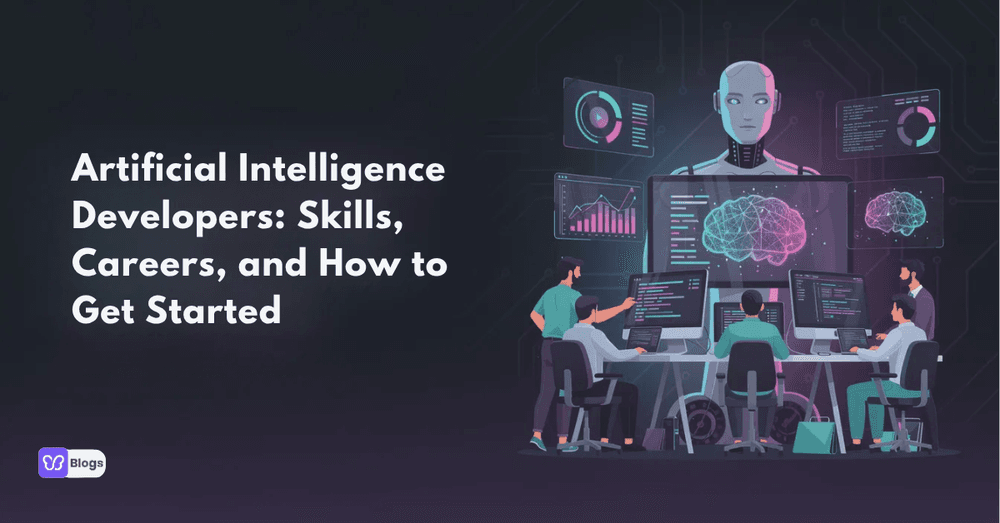
Artificial Intelligence Developers: Skills, Careers, and How to Get Started

Introduction to Artificial Intelligence Developers
Artificial intelligence developers are the professionals who build, integrate, and maintain AI capabilities inside real products-web apps, mobile apps, internal tools, and APIs. Unlike a traditional software developer who focuses on business logic and UI, an artificial intelligence software developer centers their work on ai models, data pipelines, and intelligent behavior that powers features like chatbots, recommendation engines, and computer vision systems.
This article answers the practical questions that matter most: what does an AI developer do, how to become an ai developer, which skills and tools drive modern ai development, and how the role fits into software engineering teams today.
The opportunity is massive. The global AI market was valued at approximately $233.46 billion in 2024 and is projected to reach $3,497 billion by 2033. According to the World Economic Forum, AI will create 97 million new jobs globally. Whether you want to build ai agents, deploy machine learning models, or ship generative ai applications, the ai developer career path has never been more accessible.
This guide is for anyone who wants to work on real world ai projects-from aspiring developers to experienced engineers looking to pivot.
What Is an AI Developer? (Role and Core Responsibilities)
An ai application developer designs, codes, and ships features powered by machine learning and other ai techniques into production software. They deploy algorithms that enable machines to learn autonomously, bridging theoretical data science and practical software application.
The concept of artificial intelligence for developers covers two sides: using ready-made AI APIs (LLMs, vision, speech) and building custom machine learning models to solve business problems like fraud detection, personalization, and process automation. AI developers create systems such as recommendation engines and computer vision tools, and they prepare massive datasets for use in ai models.
Concrete daily work might include improving a customer support chatbot's dialogue flow, adding image search to an e-commerce site, or building a lead-scoring model for a sales team. AI developers evaluate model accuracy and refine algorithms to optimize performance across all of these use cases.
Typical Daily Tasks
Here's what recurring tasks typically look like:
- Writing code to train models, integrate APIs, and build data preprocessing pipelines
- Collaborating with product managers and data scientists to define requirements
- Running experiments, tracking metrics, and iterating based on feedback
- Deploying ai applications and monitoring them in production
- Documenting and explaining results to non-technical stakeholders
You'll see this role listed under variant titles like ai ml developer, artificial intelligence software developer, and ai application developer-they overlap significantly in most organizations.
AI Developer vs. AI Engineer vs. Software Developer
One of the most common points of confusion in job postings is the distinction between ai developer vs ai engineer and a generalist software developer. Here's a clean breakdown:
- AI developers focus on building intelligent features and prototypes-models, prompts, ai agents, and integrations-tightly aligned with product requirements. They own the "what" of ai powered features.
- AI engineers (sometimes titled artificial intelligence engineer or machine learning engineer) are systems-focused. They build MLOps pipelines, manage cloud infrastructure, and ensure production reliability of ai services at scale.
- Software developers build and maintain broader applications-front-end, back-end, APIs, databases-that may or may not contain AI components. They're generalists in software development.
Consider a recommendation system for a streaming platform. The software developer builds the user interface and API endpoints. The ai developer defines the recommendation model, integrates it into the product, fine-tunes personalization thresholds, and creates machine learning models to power suggestions. The ai engineer designs the training pipeline, manages data sourcing, and ensures the model serving layer handles millions of requests.
AI developers collaborate with data scientists and software engineers daily. In smaller companies, one person covers all three roles. In larger ones, job titles like ai ml developer, "AI engineer," and "machine learning engineer" become distinct specializations. When reading an ai developer job description, context matters more than title.
Key Skills Required for Artificial Intelligence Developers
Becoming an effective artificial intelligence software developer requires a combination of hard and soft skills-programming, math, critical thinking, communication, and a willingness to experiment.
Technical Foundations
- Mathematics and statistics (probability, linear algebra, optimization)-essential for understanding how machine learning algorithms work
- Proficiency in programming languages like Python, Java, and C++ for building and deploying ai systems
- Understanding of machine learning models and techniques: supervised learning, unsupervised learning, deep learning techniques, and reinforcement learning
- Data handling and analytics skills, including data manipulation, data preprocessing, and data visualization
- Familiarity with ai frameworks like TensorFlow and PyTorch for implementing ai models
Analytical and Soft Skills
- Problem decomposition-breaking large business problems into smaller, solvable ML tasks
- Problem solving skills and critical thinking to evaluate whether a model actually works in production
- Stakeholder communication: explaining technical concepts in business terms to product managers and executives
- Ethical decision-making around bias, fairness, and responsible AI use
AI developers need strong problem-solving and critical thinking skills because the field evolves constantly. Continuous learning is non-negotiable-new generative ai tools, ai frameworks, and agent architectures appear monthly. Staying current is part of the job, not optional professional development.
Programming, Frameworks, and Tools for AI Development
The core toolkit of an ai developer starts with programming languages. AI developers often use Python, Java, and R for programming, with Python dominating as the primary language for machine learning. AI developers must be proficient in Python, Java, and C++ to cover everything from prototyping to performance-critical deployment.
Languages
AI developers should be proficient in:
- Python
- Java
- C++
- JavaScript/TypeScript
- R
ML Frameworks
Master frameworks such as:
- TensorFlow
- PyTorch
- scikit-learn
- Keras
- Hugging Face
MLOps
Cloud and MLOps tools round out the stack:
- Docker
- Kubernetes
- MLflow
- Cloud ML platforms (AWS SageMaker, Azure ML, Google Cloud AI Platform)
Productivity
Developer productivity tools are now standard in the development process:
- Copilot
- Jupyter
- Experiment trackers
- Vector databases
Stack essentials at a glance:
- Languages: Python, Java, C++, JavaScript/TypeScript, R
- ML frameworks: TensorFlow, PyTorch, scikit-learn, Keras, Hugging Face
- MLOps: Docker, Kubernetes, MLflow, cloud ML platforms
- Productivity: Copilot, Jupyter, experiment trackers, vector databases
AI developers often use SQL and NoSQL databases for data handling, and ai tools like ChatGPT automate content creation and software development workflows. Developer productivity tools-GitHub Copilot, Jupyter notebooks, and IDEs with AI code assistance-are now standard in the development process.
Machine Learning and AI Techniques Every AI Developer Should Know
Modern ai development is grounded in machine learning, and every ai developer requires fluency across its core categories:
Supervised Learning
- Classification and regression using labeled data-linear regression, logistic regression, decision trees, random forests, gradient boosting
Unsupervised Learning
- Clustering, dimensionality reduction, anomaly detection when labels aren't available
Deep Learning
- Neural networks including CNNs for computer vision, RNNs and transformers for natural language processing, and embeddings for semantic search
Reinforcement Learning
- Training agents through reward signals, used in robotics, gaming, and autonomous systems
Generative AI
- Large Language Models for text generation, diffusion models for image synthesis, and code completion tools driving generative ai applications in production
Evaluation Metrics
AI developers should recognize evaluation metrics and know when each applies:
- Accuracy
- Precision
- Recall
- F1
- ROC-AUC for classification
- BLEU and perplexity for language generation
- MSE for regression
Choosing the right metric demands critical thinking about what "success" means for the specific use case.
AI models require clean, well-managed training data to function effectively. Diverse data samples are necessary to avoid bias in ai models-a skewed training set produces a skewed model. Continuous evaluation of ai models for accuracy and robustness is essential, especially after deployment when data drift can silently degrade performance.
Testing AI requires different methods than traditional software testing. Edge cases, adversarial inputs, and fairness audits are part of responsible ai development-not afterthoughts.
Day in the Life: Inside an AI Developer Job Description
A typical day for an ai developer blends coding, experimentation, and cross-functional collaboration. Mornings often start with a standup where the team reviews progress on ai projects-maybe a natural language processing feature for a support dashboard or a computer vision classifier for product images.
Mid-morning shifts into focused work: exploring a noisy dataset in Jupyter notebooks, running experiments to improve a recommendation model's precision by 5%, or wiring an LLM-based assistant into an existing support workflow. AI developers integrate AI models into existing software systems and cloud environments, which means they're equally comfortable in an IDE and a cloud console.
Afternoons bring code reviews, meetings with product managers to clarify requirements, and syncs with data engineering teams about pipeline reliability. Developers should monitor AI system performance for errors after launch and implement Spec-Driven Development to ensure AI reliability across releases. AI developers must establish AI guardrails to prevent security flaws in production, and human oversight is crucial for high-risk decisions made by AI.
Typical Job Responsibilities
Common responsibilities that appear in job ads for artificial intelligence developers:
- Designing and running experiments to improve model performance
- Building data preprocessing and feature engineering pipelines
- Deploying ai applications via APIs or microservices
- Monitoring production models for drift, latency, and accuracy
- Collaborating with data scientists, software developers, and domain experts
- Working with ai agents and orchestration frameworks as part of modern ai application stacks
How to Become an AI Developer: Step-by-Step Roadmap
If you're asking how to become an ai programmer or how to become a ai developer, here's a step by step roadmap that works whether you're starting from zero or transitioning from a related field like data analysis or full-stack development.
Step-by-Step Roadmap
- Step 1: Build foundations. Learn Python, basic software engineering principles (version control, testing, clean code), and core math-probability, statistics, linear algebra. These are the building blocks for everything that follows.
- Step 2: Learn machine learning fundamentals. Take structured courses in machine learning and data science. Implement canonical machine learning algorithms from scratch-linear regression, decision trees, k-means-to solidify understanding before relying on libraries.
- Step 3: Explore deep learning and generative AI. Move into deep learning techniques using machine learning frameworks like TensorFlow and PyTorch. Learn to use Hugging Face for LLM tooling and experiment with prompt engineering to deliver working prototypes of ai powered applications.
- Step 4: Gain practical experience. Work on real world ai projects through Kaggle competitions, open-source contributions, hackathons, or freelance work. Gaining hands on experience on messy, real-world data is what separates classroom knowledge from job-readiness.
- Step 5: Build a portfolio. Create GitHub repos with end-to-end ai projects that demonstrate data handling, model training, deployment, and documentation. Include case studies that explain decisions, trade-offs, and results. This is how you solve real world problems in a way employers can verify.
- Step 6: Apply and transition. Target junior ai developer roles, internships, or internal transitions from a software developer position. Tailor resumes to highlight both AI and core software engineering abilities.
A degree in computer science or AI is often required, and 63% of AI developers have a bachelor's degree. But a traditional degree isn't the only route-bootcamps, self-study, and certifications like CAIS (Certified Artificial Intelligence Scientist) and AiE validate AI skills and can accelerate your path. What matters most is demonstrated ability to build intelligent systems that work.
Building and Showcasing Real-World AI Projects
Employers prioritize candidates who can show finished ai projects that solve realistic problems over just certificates or course completions. A strong portfolio is the fastest way to gain practical experience and accelerate an ai developer career.
Project Ideas and What Each Demonstrates
- Movie recommendation engine: Collaborative filtering, embeddings, data engineering, and personalization (recommender systems)
- Support ticket classifier: Natural language processing, text preprocessing, data manipulation, and deploying ai applications via API
- Image captioning app: Computer vision, deep learning, neural networks, and integrating ai with a front-end
- Financial anomaly detector: Unsupervised learning, data visualization, real world challenges in noisy data
- Personal AI agent: LLM orchestration, prompt engineering, tool use, and building ai solutions that chain multiple API calls
Scope each project end-to-end: define the problem, acquire and clean data, select models, evaluate with appropriate metrics, and ship a simple UI or API. Document everything-README files, notebooks with commentary, architecture diagrams, and brief write-ups explaining business impact and limitations.
Use platforms like GitHub and personal portfolio sites to make work discoverable. Include live demos where possible. Freelance or open-source contributions demonstrate collaboration and reliability, both of which hiring managers value in skilled ai developers.
Career Paths, Salaries, and Long-Term Growth for AI Developers
The typical ai developer career path follows a clear trajectory: junior ai developer → mid-level specialist → senior or lead → roles like ai engineer, ML architect, or AI product lead. AI developers earn a median salary of $148,000 in the US, and compensation regularly exceeds that of generalist software engineering roles due to the scarcity of talent with genuine technical expertise.
Job growth for AI developers is expected to exceed 15% by 2034, making this one of the fastest-growing career categories in tech. Senior machine learning engineer roles in the US can reach total compensation above $365,000, and principal-level positions climb even higher.
Three Sample Career Paths
- NLP/Generative AI specialist: Focus on LLMs, prompt engineering, ai agents, and generative ai applications. High demand, evolving rapidly.
- Computer vision engineer: Specialize in image classification, object detection, and video analysis. Strong in manufacturing, healthcare, autonomous vehicles.
- MLOps / AI infrastructure: Transition toward ai engineer or ML architect roles, focusing on deploy machine learning models at scale, monitoring, and reliability.
Transitions between roles are common-from ai developer to ai engineer, data scientist, or even technical founder. Skills in ai research, data science, and ai technologies overlap significantly across these paths.
Continuous learning is essential for staying relevant over a 5–10 year horizon. The field moves fast: new ai tools, ai software, and intelligent systems emerge constantly. Developers who keep shipping real world ai projects and experimenting with new approaches maintain a durable edge.
AI Developer FAQs and Next Steps
1. Do I need a master's degree to work as an ai developer?
Not strictly. Many roles accept a bachelor's degree in computer science or a related field, combined with a strong portfolio. Advanced degrees help for ai research positions, but hands-on experience and shipping ai powered applications matter more for most product-focused roles.
2. How long does it take to transition from web dev?
With a strong software development background, 6–12 months of focused study on machine learning fundamentals and project work is realistic. The key is gaining hands on experience as quickly as possible.
3. Which projects best showcase my skills?
End-to-end projects that include data preprocessing, model selection, evaluation, deployment, and documentation. Employers want to see you solve real world problems, not just complete tutorials.
4. Where do ai developer vs ai engineer responsibilities overlap?
Both work with implementing ai models and deploying ai applications. The difference is focus: ai developers optimize for product features and user experience; ai engineers optimize for infrastructure, scalability, and production reliability.
5. Must I train models from scratch?
No. Many artificial intelligence developers primarily fine-tune existing models or integrate pre-trained APIs. Building from scratch is reserved for niche or large-scale use cases where off-the-shelf ai solutions don't fit.
The fastest way to become an ai developer is to stop reading and start building. Pick one learning path and one portfolio project to start this week. Ship something, iterate, and let your work speak for itself.
Author
Debutify
Debutify is the easiest way to launch and scale your eCommerce brand.