AI Agent16 min read29 May 2026

CrewAI: Complete Guide to Building Multi‑Agent AI Systems

CrewAI: Complete Guide to Building Multi‑Agent AI Systems

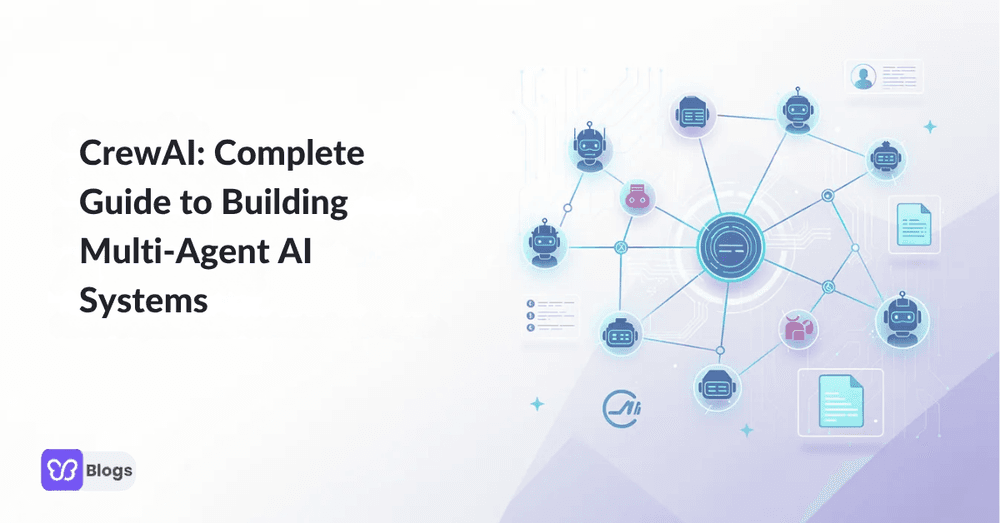
If one AI assistant can answer a question, a team of AI assistants can handle an entire workflow. That is the basic promise of crewai: give different agents different jobs, connect them with tools, and let them work together toward a business outcome.

This guide is intended for developers, technical leads, and AI practitioners interested in building scalable multi-agent AI systems. CrewAI is increasingly important as businesses seek to automate complex workflows using collaborative AI agents.

In this guide, you’ll learn what is crewai, how crew agents work, whether is crewai open source, and where crewai examples can help you start building real automations.

Quick Overview of CrewAI and Why It Matters

crewai is a Python-based framework for orchestrating teams of ai agents into production-ready workflows. Instead of relying on one prompt to do everything, CrewAI lets you organize multiple ai agents like a digital team.

  • crewai agents are specialized autonomous ai agents that can research, plan, write, code, call tools, perform tasks, and make decisions collaboratively.
  • what is crewai? It is an open-source, role-based agent framework for building scalable multi agent workflows.
  • is crewai open source? Yes. CrewAI is available on GitHub under the MIT License, with community-driven development and commercial usage rights.
  • CrewAI allows developers to create specialized AI agents that can work collaboratively to solve complex tasks.
  • CrewAI is used for multi-step research, content pipelines, data analysis, analytics, project management, and internal automations.
  • CrewAI is highly scalable, supporting simple automations and large-scale enterprise workflows involving numerous agents and complex tasks simultaneously.

This article covers crewai multi agent architecture, practical crewai use cases, real crewai examples, and how it compares with other agent frameworks.

A diverse team of individuals collaborates around laptops in a modern workspace, engaging in multi agent systems to tackle complex tasks. They utilize various AI tools and frameworks, such as Crewai, to enhance their project management and data analysis efforts.

What Is CrewAI? (Definition, Origins, and Core Idea)

crewai is a Python library that lets developers assemble multiple LLM-powered ai agents into a coordinated “crew” to solve complex problems. Each agent can have a role, goal, memory, tools, and responsibilities, making CrewAI useful for building multi agent systems that resemble human teams.

  • CrewAI is a framework for building multi agent system solutions where each ai agent has a distinct role, memory, and tools.
  • Multi-agent systems (MAS) divide tasks among several specialized agents, allowing them to work collaboratively to solve complex problems that are beyond the capabilities of individual agents.
  • CrewAI is built primarily for efficiency and flexibility in Python.
  • The first public versions appeared in late 2023, and the project evolved quickly through 2024 and 2025 as enterprises adopted agent systems for automation.
  • Historically, many ai systems depended on single prompts or single agent systems. CrewAI popularized more structured agent frameworks with manager/worker patterns.
  • CrewAI is maintained as an open-source project on GitHub under the MIT License.

In plain language, CrewAI helps you create ai agents that behave less like one chatbot and more like collaborative teams with specialized roles.

Key Concepts: Crews, Agents, Tasks, and Processes

CrewAI models a team of digital workers inside a multi agent crew. The idea is similar to how a marketing team, software team, or finance team divides responsibilities among people.

The key components are:

  • Crew: A crew is a container for multiple crewai agents that share a goal, tools, and coordination rules. CrewAI facilitates agent collaboration by allowing users to assemble agents into teams, or crews, that work together to execute a common goal or task.
  • Agent: An agent is a specialized ai agent with a role, backstory, goal, and access to specific tools. This is different from generic chatbot-style ai systems because each agent has a narrow purpose.
  • Task: Tasks in CrewAI are specific assignments completed by agents, which can include attributes like description, agent, and expected output. A task might ask a research agent to summarize regulations or a data analyst agent to inspect a dataset.
  • Process: CrewAI implements a process manager that controls how tasks flow between agents, allowing for sequential, parallel, or hierarchical execution of tasks.

CrewAI coordinates multi-agent communication using components like Agents, Tasks, Tools, Processes, and Crews. This gives developers more granular control over agent interactions, task management, and the agent’s task at each stage.

In multi-agent frameworks, agents are assigned specific roles that outline their behavior and responsibilities, optimizing their collaboration within a team. CrewAI’s architecture allows for the creation of specialized crews of agents, each with defined roles and responsibilities, which enhances collaboration and reduces the complexity of managing multiple agents.

Think of it like a content team:

  • A strategist defines the topic.
  • A research agent collects sources.
  • A writer drafts the article.
  • An editor checks clarity.
  • An SEO agent optimizes headings and terms.

That is multi agent collaboration in a practical workflow.

Architecture: How CrewAI’s Multi‑Agent Framework Works

CrewAI is a lean, high-performance agent framework that coordinates many ai agents instead of depending on one large model call. CrewAI is a standalone, lean, and fast Python framework built specifically for orchestrating autonomous ai agents, ensuring a simpler and more efficient development process compared to other frameworks.

CrewAI’s role-based architecture assigns specific roles to each agent in a crew, allowing them to specialize in distinct tasks and responsibilities, which enhances collaboration and efficiency.

  • A manager agent can plan, delegate, prioritize, and validate.
  • Researcher agents gather data from files, websites, APIs, or databases.
  • Specialist agents perform coding, writing, financial analysis, data science, or machine learning tasks.
  • Other agents can review, summarize, or convert outputs into the correct response format.

In a role-based architecture, agents are designed to focus on their specific expertise, such as research, analysis, or writing, which helps reduce errors and improve the overall quality of outputs.

CrewAI enables agent-to-agent communication so one ai agent can consume another agent’s structured output. This inter agent communication creates coherent pipelines, potentially passing research notes to an analyst, then an editor, then a final reporting agent.

CrewAI allows agents to share context and delegate tasks efficiently, making it suitable for enterprise-ready AI automation. The framework also allows for the orchestration of agent activities, defining their roles and responsibilities, and improving communication among agents.

CrewAI supports both sequential flows and hierarchical structures where manager agents oversee worker agents, facilitating task prioritization, quality control, and complex decision-making. It also provides event-driven workflows that manage states and complex application logic.

Modern CrewAI includes two important abstractions:

  • Crews for autonomous crewai agents collaboration.
  • Flows for deterministic, event-driven control.

This mix is useful when you want autonomous decision making but still need predictable workflow boundaries.

Key Features of CrewAI

This is the key features of CrewAI section for readers comparing functionality before choosing an agent framework.

  • CrewAI supports production-grade multi agent workflows with role-based crewai agents, reusable templates, process definitions, and agent crews.
  • CrewAI offers advanced memory systems that help agents recall previous steps and synthesize context across tasks.

Memory systems in CrewAI allow agents to remember and utilize information from previous steps, improving coordination and task execution.

  • crewai tools include web scraping, file I/O, API calls, retrieval search, database access, and integrations with external systems.
  • CrewAI is designed to integrate with various tools for interacting with external services, databases, and APIs.
  • The framework supports adaptability, allowing agents to adjust their behavior based on changing conditions or objectives, which is crucial for handling real-world challenges effectively.
  • CrewAI enables the creation and management of multi-agent systems through various tools and frameworks.
  • CrewAI allows integration with third-party resource monitoring and metric tools to set up observability and evaluations for LLMs, LLM frameworks, and vector databases, which is essential for assessing scalability.
  • CrewAI supports OpenAI, Anthropic, Azure, and local language models through tools like Ollama, helping teams use large language models in cloud or on-prem environments.

For example, a support automation crew might use a session tool to track conversation context, a text search tool to find policy documents, and a web search tool to verify public information before sending a response.

That tool integration is what turns CrewAI from a natural language processing demo into a practical ai development platform.

CrewAI vs Single‑Agent and Other Agent Frameworks

A single ai agent can answer a question. A multi agent crew can complete an end-to-end business process, such as researching competitors, preparing a report, checking facts, and formatting a final deliverable.

CrewAI differs from prompt-only ai systems in a few important ways:

  • It gives each agent specialized roles instead of asking one model to do everything.
  • It separates planning, execution, review, and formatting.
  • It improves traceability because you can inspect each agent’s output.
  • It supports build agents patterns that scale better than single agent setups.

Compared with other agent frameworks such as LangChain-style stacks or AutoGen-style chat agents, CrewAI focuses on role-based crews and explicit processes for agent systems. This gives developers a clearer mental model for building multi agent systems without designing every interaction from scratch.

CrewAI is best for complex workflows, not every small question. If all you need is a one-line answer, a single agent may be enough. If you need multiple agents to tackle complex problems, coordinate tool calls, and validate each other’s work, CrewAI becomes much more useful.

Multiagent systems must scale in several dimensions, including the total number of agents, the diversity of agents, and the size of the data they operate on. CrewAI’s structure helps teams think through all three.

Is CrewAI Open Source? Licensing and Governance

  • is crewai open source? Yes. CrewAI is fully open source.
  • CrewAI is released under the MIT License, allowing commercial use, modification, and redistribution of the ai agent framework.
  • The source code lives in a public GitHub repository where developers can open issues, review code, and contribute pull requests.
  • This transparency makes CrewAI attractive for enterprises that need auditable, self-hostable agent systems.
  • The open source python framework model also helps teams avoid black-box automation when building ai solutions.

Typical CrewAI Multi‑Agent Use Cases

This section answers crewai use cases and what a multi agent system built on CrewAI can actually do.

  • Automated research and reporting: Autonomous ai agents can search, summarize, cross-check sources, and compile reports for market research, legal analysis, or consulting. This became a common adoption pattern in fintech and research-heavy teams from 2024 to 2026.
  • Content production pipelines: crew agents can handle ideation, outline creation, drafting, editing, and SEO optimization. Each step is handled by specialized agents instead of one overloaded model.
  • Analytics and BI: Multi agent teams can extract data, clean it, run statistical analysis, and write executive summaries across financial, operational, or product telemetry data.
  • Internal enterprise automation: Coordinated agent systems can triage tickets, update knowledge bases, route workflows, and interact with company APIs.
  • Security and code review: Multi ai agent systems can inspect packages, retrieve metadata, classify risk, and aggregate findings.
  • Scientific workflows: Multi agent ai systems can support simulations, data processing, and experiment documentation.

The main benefit is simple: CrewAI lets collaborative agents divide work, reduce manual effort, and improve review quality.

Hands‑On CrewAI Examples (From Simple to Advanced)

Here are practical crewai examples you can use as starting points.

  • Web Research Assistant: A crew of crewai agents uses crewai tools such as ScrapeWebsiteTool, FileWriterTool, TXTSearchTool, a web search tool, and a text search tool. One research agent gathers sources about AI regulation in 2025, another checks claims, and a writer prepares the final summary.
  • Trip Planner: One ai agent suggests itineraries, another checks flights and hotels, and a third optimizes cost. This shows how collaborative teams of agents can combine creativity, logistics, and constraints.
  • Stock or Crypto Analysis: Autonomous agents read market data, filings, and news feeds to produce investment summaries and risk assessments. A data expert can validate assumptions before the final report.
  • Recruiting Assistant: crew agents generate job descriptions, screen resumes, and draft outreach emails using structured HR templates.
  • Customer Support Crew: One agent classifies the issue, another retrieves documentation, and another drafts a reply for human review.

The official CrewAI examples documentation includes additional patterns such as marketing strategy crews, job posting workflows, and email auto-responders.

A person is seated at a desk, intently reviewing charts and documents alongside a laptop, likely engaged in data analysis or financial analysis. This scene suggests the use of multi-agent systems or autonomous AI agents to tackle complex tasks and enhance project management through collaborative efforts.

Step‑By‑Step: Getting Started With CrewAI

To launch a simple ai agent crew, you usually follow five steps: install, configure, define agents, define tasks, and run.

1. Create a virtual environment

Use a virtual environment so your dependencies stay clean.

python -m venv .venv source .venv/bin/activate

2. Install CrewAI

Install the package with the following command:

  • pip install crewai crewai-tools

CrewAI generally works with modern Python versions such as 3.10–3.13. You will also need environment variables for model credentials, usually stored in a .env file.

3. Define your first agent

A common beginner pattern is a Researcher agent with a goal, backstory, and one tool. If you search for crewai import agent examples, you will usually see imports like this:

  • from crewai import Agent, Task, Crew

You might create a file named ai_research_crew.py and define a basic research agent inside it.

4. Define a task

A task should include a clear question, expected output, and success criteria. For example: “Research three trends in AI automation and return a concise summary with sources.”

5. Create the crew and run it

Register your agent and task into a crew object, then execute the run. In a real project, you might save the specified directory result as a report or JSON file.

This is the basic path to create ai agents, enable agents to use tools, and expand from one workflow into larger multi agent workflows.

Design Patterns for Robust Multi‑Agent Systems in CrewAI

Building a non-trivial multi agent system on CrewAI benefits from design patterns borrowed from software engineering, operations, and project management.

  • Manager–worker pattern: A manager ai agent plans, delegates, and validates while worker crew agents focus on narrow tasks. This reduces hallucinations and improves quality control.
  • Tool specialization: Limit each ai agent to the tools it truly needs. For example, only the data engineer should write SQL, while the content editor should only edit text.
  • Parallelization: Independent tasks, such as gathering data from several sources, can run in parallel inside a multi agent crew for optimal performance.
  • Human-in-the-loop: CrewAI supports a human-in-the-loop integration that allows for human approval during workflow execution.
  • Memory and context discipline: Keep shared context useful but not overloaded. Summaries, retrieval, and advanced memory systems help agents recall prior steps without filling the context window.

These patterns matter because autonomous agents can drift if goals are vague. Clear roles, review steps, and constrained tools keep agent orchestration predictable.

A diverse group of professionals is gathered around a table, collaboratively reviewing a project plan that involves multiple AI agents. They are engaged in discussions about how to tackle complex tasks and enhance their multi-agent systems for optimal performance.

Choosing CrewAI for Your AI Agent Strategy

Organizations choose crewai when they need a practical agent framework for orchestrating ai agents rather than relying on ad-hoc scripts. It is especially useful when work needs structure, delegation, tool use, memory, and review.

Consider CrewAI if:

  • Your workflow needs collaboration among multiple specialized autonomous ai agents.
  • You want ownership of your agent systems through open source code and MIT licensing.
  • Your team already uses Python, APIs, databases, and modern language models.
  • You need to scale from prototypes to enterprise automation.
  • You want to combine flexible crews with more controlled flows.

In short, crewai, crewai multi agent architecture, and real crewai use cases make the most sense when your problem is too complex for one prompt but structured enough to automate.

FAQ: CrewAI, Crew Agents, and Multi‑Agent Orchestration

1. What is crewai?

CrewAI is an open-source Python agent framework for building collaborative multi agent system applications. It helps developers organize ai agents into crews that share context, tools, and goals.

2. What are crew agents?

crew agents are the individual ai agents inside a CrewAI crew. Each one has a defined role, tools, memory, and some level of decision-making autonomy.

3. is crewai open source?

Yes. CrewAI is MIT-licensed, available on GitHub, and open to community contributions.

4. What are the most common crewai use cases?

Common use cases include research, content production, analytics, financial analysis, customer support, recruiting, and internal operations. A multi agent architecture helps because different agents can specialize and review each other’s work.

5. Where can I find crewai examples?

Start with the official documentation, public GitHub repositories, and small sample crews. Begin with one or two agents before scaling to complex agent systems.

6. Is CrewAI only for developers?

Mostly, yes. CrewAI is Python-first, so it works best for technical teams, but its concepts are easy to understand because they mirror human teams.

7. Does crewai empowers agents to act fully independently?

crewai empowers agents to reason, call tools, share context, and delegate work, but production systems should still use guardrails, observability, and human review for critical decisions.

Conclusion

CrewAI gives teams a structured way to build AI workflows that are more reliable than one-off prompts. By combining agents, tasks, tools, processes, crews, memory, and flows, it helps developers build practical automations that can grow from simple prototypes into enterprise-ready systems.

If you are exploring artificial intelligence automation, start small: build one research crew, add one review agent, connect one tool, and measure the output. Once the workflow is dependable, you can expand into larger crews that tackle complex problems across your business.

Debutify

Author

Debutify

Debutify is the easiest way to launch and scale your eCommerce brand.
Share post