Agentic Artificial Intelligence: Definition, How It Works, Benefits, and Real-World Use Cases
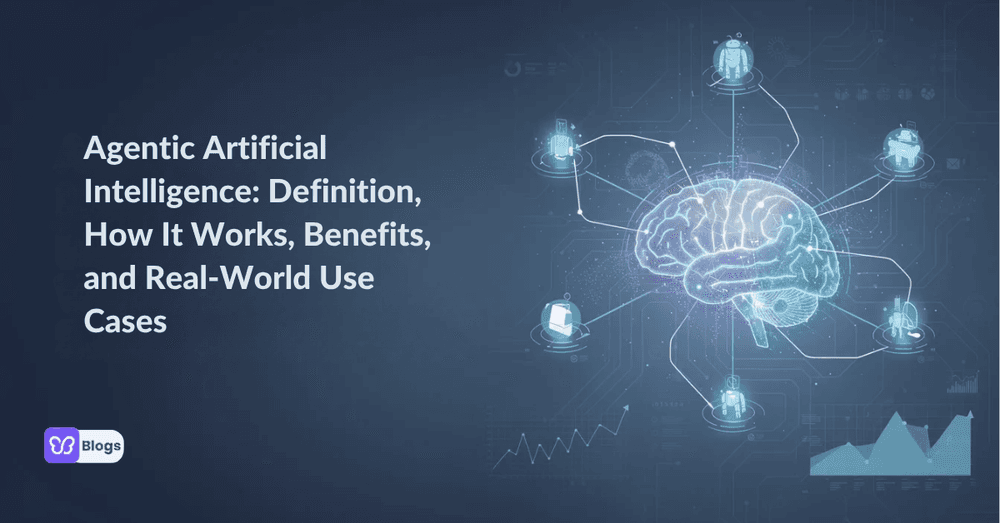
agentic artificial intelligence is AI that can pursue a goal, decide what to do next, use tools, and take action with minimal human intervention. If you are asking what is an agentic ai system, think of an autonomous ai system that can plan, execute tasks, observe results, and adjust its next move.
The 2024–2026 inflection point comes from large language models, better tool calling, retrieval augmented generation, and enterprise automation. This guide gives the agentic ai definition, shows how agentic ai systems work, covers the benefits of agentic ai, explains risks, and shares practical examples for business leaders, product owners, and technical teams adopting agentic ai. This guide is designed for business leaders, product owners, and technical teams who want to understand how agentic AI can drive innovation, efficiency, and competitive advantage in their organizations.
Agentic AI Explained: Meaning, Definition, and Core Concepts

A concise agentic ai definition is this: agentic ai refers to artificial intelligence systems equipped with autonomy and decision-making capabilities, allowing them to interpret data, learn from interactions, and drive decisions or actions without explicit human intervention. In plain terms, agentic ai means software that can turn a goal into an action plan and carry it out.
The agentic ai meaning differs from general artificial intelligence because agentic systems can set subgoals, choose external tools, and execute across external systems. To define agentic ai or use agentic ai define simply: it is AI that can perceive, reason, decide, act, and learn.
Unlike traditional ai, which is narrowly focused on specified tasks, agentic AI incorporates a broader understanding of contexts and objectives, allowing it to self-direct based on goals and input. Agentic AI is characterized by its ability to operate autonomously, set its own goals, reason through complex scenarios, and adapt its actions in real-time to achieve specific objectives with minimal human supervision.
Agentic ai systems are built from one or more ai agents, each with a role, coordinated by orchestration logic. All agentic systems are autonomous ai to some degree, but autonomy should be constrained by guardrails, policies, and human oversight. For example, an AI that drafts an email is generative; one that drafts it, sends it, schedules the meeting, and updates the CRM is agentic.
Agentic AI vs Generative AI vs Traditional AI Systems
agentic ai, generative ai, and traditional ai systems are related, but they solve different problems. Generative ai produces outputs, traditional ai predicts or classifies, and agentic ai extends both by planning and acting.
Generative ai models like GPT-4, Gemini, or Claude create text, code, images, and summaries from prompts. Generative AI primarily focuses on producing outputs based on prompts, whereas agentic AI is capable of planning, reasoning, and executing tasks autonomously in real-world scenarios.
Agentic AI extends beyond generative AI by not only creating content but also making autonomous decisions and taking actions to achieve specific goals. At its core, agentic AI is designed to achieve specific outcomes by independently creating, executing, and refining its own action plans, making it distinct from generative AI which primarily focuses on content creation.
Traditional AI systems are typically rigid and focused on specific tasks, while agentic AI is designed to handle complex, multi-step workflows with greater flexibility and adaptability. An agentic ai model often uses generative models as the “brain,” while routing, safety, memory, and tool execution are handled by the agent framework.
| Approach | Main role | Autonomy | Example |
|---|---|---|---|
| traditional ai | Predict, classify, recommend | Low | Fraud score or demand forecast |
| generative ai | Create content from prompts | Medium | Draft a travel itinerary |
| agentic ai | Plan, act, and adapt | Higher | Book flights, update calendars, and handle changes |
This is how agentic ai works in practice: it combines ai models, memory, APIs, robotic process automation, and policies to automate complex tasks across multiple systems.
Agentic AI vs AI Agents: Clarifying the Terminology
Agentic AI vs ai agents - what’s the difference? An AI agent is a single software entity with a perception-decision-action loop. agentic ai systems coordinate multiple agents, tools, memory, and policies toward larger outcomes.
A pricing agent might monitor competitors and update prices. A support agent might answer tickets. But not all ai agents are agentic; simple bots, scripts, or rigid RPA workflows lack the reasoning and autonomy required by agentic ai.
Advanced agentic ai agents show planning, adaptability, and learning. In a contact center, one agent routes requests, another resolves technical issues, and another handles billing, all coordinated by an agentic ai model.
Relationship summary:
- ai agents are the building blocks.
- agentic ai systems organize agents, tools, goals, and governance.
- multi agent systems can use multiple specialized agents for complex workflows.
- agentic ai agents learn from outcomes and coordinate with other agents and human teams.
How Does Agentic AI Work? The Perceive–Reason–Act–Learn Loop
how does agentic ai work? In a continuous loop. The system observes data, reasons about the goal, chooses an action, acts through tools or APIs, then learns from the result. This is how agentic ai works in both digital and physical environments.
Modern agentic ai systems typically include a large language model, planner, memory store, tool-calling layer, telemetry, and governance. Natural language processing, machine learning algorithms, deep learning models, and training data all contribute to the Natural language processing, machine learning algorithms, deep learning models, and training data all contribute to the agentic artificial intelligence framework by powering its core cognitive functions. These ai capabilities enable agentic AI systems to perceive their environment by analyzing diverse data types, including text, images, and structured information from enterprise systems.
Agentic AI systems rely on this combination of technologies to continuously gather and analyze data, which is essential for autonomous decision making. By interpreting relevant information from multiple sources, agentic AI agents can operate independently, navigating dynamic environments and complex problems without constant human oversight. This autonomy is what powers AI agents to execute multi-step workflows, automate business processes, and handle sensitive data securely.
The process begins at the perception stage, where agentic AI collects real-time data through APIs, sensors, or other input channels. This data is then processed and filtered to identify what is pertinent to the task at hand. Next, during the reasoning stage, the system uses advanced models to plan and adapt strategies, enabling agentic AI's ability to navigate complex environments effectively. The act stage involves executing the planned actions, such as interacting with software applications, updating records, or controlling physical devices. Finally, the learning stage allows the system to improve over time by evaluating outcomes and refining its approach.
Implementing agentic AI involves integrating these components with robust governance frameworks to ensure system reliability and compliance. Continuous monitoring and multi agent collaboration enhance the system's adaptability and safety, allowing organizations to leverage agentic AI for automating complex processes and optimizing operations. By automating repetitive tasks and time consuming tasks, agentic AI frees human workers to focus on strategic initiatives, making it a transformative technology for modern enterprises.
In summary, agentic artificial intelligence represents an advanced form of AI that combines perception, reasoning, action, and learning to deliver autonomous, adaptable, and efficient solutions across industries. Its ai capabilities empower businesses to innovate, reduce costs, and improve decision-making in an increasingly complex digital landscape.
Business Applications of Agentic Artificial Intelligence
Agentic AI operates continuously without fatigue or performance drops, making it ideal for industries requiring 24/7 operations. For example, in banking, agentic AI systems analyze vast datasets to detect fraud, provide personalized financial advice, and automate loan approvals, enhancing operational efficiency and customer service. Retailers use agentic AI to automate personal shopping experiences, optimize inventory, and streamline customer service workflows. In healthcare, agentic AI supports patient monitoring and automates administrative tasks, improving care quality and reducing costs.
Moreover, agentic AI systems can adjust strategies automatically when encountering unexpected data changes, enabling businesses to respond swiftly to market dynamics. These systems adapt to user behavior over time, dynamically tailoring experiences in sectors such as e-commerce and marketing. Agentic AI also enhances supply chain efficiency by managing dynamic inventory levels and optimizing delivery routing. By automating complex workflows that span multiple steps, agentic AI significantly reduces transaction costs typically associated with human intervention, such as contract writing and negotiation.
Benefits of Agentic AI
Agentic AI capabilities offer transformative benefits for businesses. By automating complex, multi-step workflows, agentic AI makes operations faster and more cost-effective. It enables informed, real-time decision-making by processing vast streams of data from diverse sources, providing actionable insights that help businesses stay competitive.
Additionally, by automating repetitive and time-consuming tasks, agentic AI allows human teams to focus on strategic, high-value work requiring creativity and specialized insight, increasing overall productivity. Its adaptability ensures that agentic AI makes decisions that align with changing business contexts, improving accuracy and reducing errors.
Risks and Governance of Agentic AI
While agentic AI means greater autonomy and efficiency, it also introduces risks. Accountability for unintended consequences or biased outcomes is complex due to autonomous decision-making. Integrating autonomous agents with legacy IT systems can be challenging, requiring careful planning and infrastructure upgrades.
Organizations must treat monitoring agentic AI systems as a permanent operational expense to ensure ongoing accountability and safety. Without shared, robust metrics, it is difficult to prove the value of agentic AI systems or confirm they are achieving desired outcomes, which may inadvertently introduce new risks. Therefore, governance frameworks, including guardrails, policies, and human oversight, are essential to control and support agentic AI effectively.
Future of Agentic Artificial Intelligence
Agentic AI is rapidly evolving, with expanding applications across industries. As agentic AI makes more autonomous decisions and learns from experience, its capabilities will deepen, enabling more sophisticated workflows and integrations. Businesses adopting agentic AI as part of their AI strategy will unlock new efficiencies, innovate faster, and deliver personalized experiences at scale.
The future will see agentic AI systems that seamlessly collaborate with human teams and other autonomous agents, driving complex, multi-agent ecosystems. By enabling agents to operate continuously and adapt dynamically, agentic AI will redefine automation and digital labor in the years ahead.
By understanding what agentic AI is, how agentic AI works, and its broad applications and risks, organizations can harness this powerful technology to transform operations and gain a competitive edge in the digital age.

Author
Debutify
Debutify is the easiest way to launch and scale your eCommerce brand.