Agentic AI vs Generative AI: Key Differences, Examples, and How to Choose
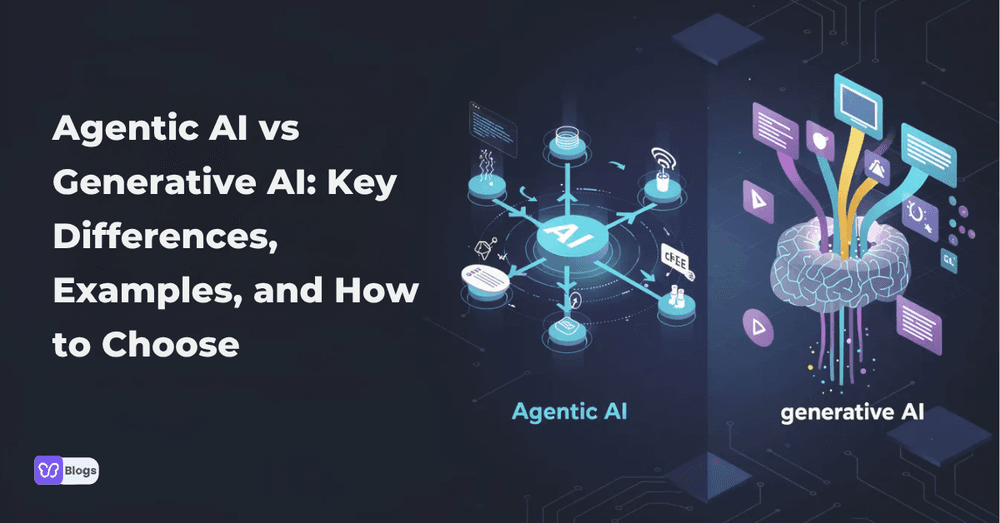
Every AI buying conversation now runs into the same tangle of terms. Generative AI, AI agents, agentic AI: related ideas, different jobs, and very different price tags. The confusion costs real money, because teams buy one layer expecting the behavior of another. The industry is moving from tools that answer questions to systems that complete work, and that shift is why so many teams are now comparing generative AI, AI agents, and agentic ai as if they were one thing. They are not. This guide separates the three layers with definitions, examples, and a decision framework, with ecommerce running examples throughout because that is where the differences show up fastest.
Quick Overview: Agentic AI vs Generative AI, Fast
The shortest honest answer: generative AI creates content from prompts, while agentic AI plans, decides, and acts toward goals using data, memory, and tools. AI sits as the broad category underneath both; agentic systems sit at the autonomous end of the spectrum.
- Autonomy: generative AI is reactive; an AI agent works within bounded limits; agentic AI operates with higher autonomy toward an objective.
- Typical output: generative AI produces text, images, code, or audio; AI agents complete tasks; agentic AI manages outcomes.
- Use case test: generative AI drafts a sales email; an AI agent sends it; an agentic system tests, tracks, and improves the whole campaign.
- Best fit: generative for content, agents for predefined tasks, agentic for complex multi-system workflows.
Most AI systems in production today still use generative models at their core. Agentic systems wrap that capability with planning, memory, tool access, and workflows so the software can act in the world, not just talk about it.
Core Definitions: Generative AI, AI Agents, and Agentic AI
Start with the layer most teams already know. Generative AI creates content based on user prompts. It is reactive: it waits for instructions, then produces text, images, audio, or code. Under the hood it learns patterns from training data and performs probabilistic inference, which is why outputs can be brilliant and slightly wrong in the same breath.
Agentic AI is defined by direction rather than content. It takes autonomous actions toward specific multi-step goals, executing across systems without constant human prompting, and it is proactive in the sense that it uses reasoning to solve problems as they appear rather than waiting to be asked again.
The confusion comes from the overlap between AI agents, agentic AI, and generative models. They are related, not interchangeable. The terms started colliding around 2022 to 2024, when GPT-style language models, diffusion image tools, and audio generators went mainstream, and marketing teams flattened the distinctions. The rest of this guide puts them back in order.
Generative AI Explained
Generative AI is usually the first step in an AI journey because it is easy to test, useful quickly, and familiar to non-technical teams. It drafts content, explains data, generates images, and assists developers. Under the hood, the models lean on transformers, diffusion architectures, and natural language processing to turn inputs into outputs. For production-grade deployments at scale, the choice of scalable generative AI development services partners matters more than most teams expect, because reliability, latency, and cost control separate a demo from infrastructure.
The power is real, and so is the ceiling. Generative AI is reactive and typically operates on short, well-defined tasks. It can draft an email, but someone still has to copy it into a CRM, choose the audience, send it, and review what happened. That gap between the draft and the outcome is exactly where the next two layers live.
In the agentic-versus-generative framing, generative AI is the language and content layer; the agentic layer is the planning and action layer on top of it. Retrieval augmentation and tool use can extend a model, but without planning, feedback loops, and control logic, the system is not fully agentic.
Common generative-only examples include Chatbots answering support questions, code assistants producing snippets for developers, and
Marketing tools drafting campaign copy. Useful, bounded, and reactive.
What Are AI Agents? And How They Differ From Agentic AI
AI agents are task-focused components that combine models, predefined rules, external tools, and APIs to complete specific jobs inside larger systems. A procurement agent checks an invoice, a password reset agent updates credentials, a travel booking agent connects to airline systems. Each one is a doer with a defined lane.
Adoption is already mainstream: 62 percent of organizations reported using AI agents as of 2023, and the number has only climbed since. Most of those agents operate independently inside narrow scopes. They complete a workflow step; they do not own a business outcome.
That is the distinction in one line: an AI agent does a defined task; agentic AI is the orchestrator that plans, sequences, and supervises many doers. Agents are the micro layer of AI agents automation; the agentic layer is the macro one that coordinates agents, tools, and systems, adapting plans as new information arrives.
A caution worth repeating: a collection of disconnected agents does not automatically become an agentic system. That jump requires shared memory, broader objectives, governance, and coordination, and it is where most agentic-washing happens.
What Is Agentic AI and How Does It Work?
Agentic AI is defined by goal-directed behavior. Instead of waiting for one prompt at a time, it receives an objective, breaks it into steps, and executes through tools, APIs, and specialized agents. It uses language models for planning and decision-making, and it interprets context well enough to adapt when it hits an unexpected roadblock.
- Perceive: gather context from real-time data, existing records, user inputs, and signals from external systems.
- Plan: use multi-step reasoning to decide what should happen next.
- Act: call external tools, trigger individual agents, update business systems, and monitor progress.
The systems that work this way tend to share four components: generative models for language and reasoning, tool APIs for CRMs, ERPs, databases, email, ticketing, and finance platforms, memory systems for tracking long-running work, and governance layers for permissions, audit trails, and risk management.
A concrete example: an onboarding workflow run agentially verifies identity, orders equipment, schedules training, updates payroll, and notifies the manager, end to end. In commerce the pattern is already visible at the storefront level.
Describe a niche to an agentic store builder and it plans, builds, and reviews a complete store, a goal-directed loop rather than a single generated output.
That is the difference between a tool and a worker: the agentic system manages the whole workflow and enables end-to-end automation of complex processes, not one step of them.
Direct Comparisons: Autonomy, Scope, Planning, and Tools
Side by side, the three layers separate cleanly.
- Autonomy: generative AI is reactive; an AI agent has bounded autonomy; agentic AI operates with higher autonomy and adapts plans when new information arrives.
- Scope: generative AI creates content; an agent executes specific tasks; agentic AI manages complex workflows toward broader business objectives.
- Planning and memory: generative models hold minimal persistent memory; agents often keep local task state; agentic systems use shared memory and planning loops.
- Tool use: generative AI may use tools; agents require them; agentic AI orchestrates many tools across many systems.
The naming pairs resolve the same way. AI is the broad field; an agent is an implementation that acts on a task. Agentic means operational agency toward goals. Agents are useful alone, but the agentic layer connects them into strategies. In practice, generative AI powers reasoning and language, agents embed that reasoning into tools, and the agentic layer ties everything into coherent workflows. According to IBM’s overview of agentic AI and generative AI, the key distinction is exactly this movement from content generation to goal-directed action.
Real-World Agentic Workflows vs Generative-Only Use Cases
Examples settle the argument faster than definitions. Generative-only scenarios: drafting a sales email from a short prompt, creating documentation from product specs, generating marketing campaign ideas, producing code snippets for a developer. One prompt in, one artifact out.
Agentic workflows go further. The system drafts, runs A/B tests, sends, and tracks a sales email across a CRM and email platform. It creates, publishes, and updates documentation across repositories based on product changes. It runs a full campaign lifecycle: audience segmentation, content generation, scheduling, budget adjustment, performance optimization. It manages a bug from detection to resolution, including triage and assignment.
The same loop owns the communication trail with stakeholders and the follow-up testing that proves the fix.
Notice the shape: one agent may handle email, another updates the CRM, another analyzes performance, and the agentic layer decides which action comes next. Choosing agents alone can produce fragmented automation; agentic coordination connects specific actions to broader goals. For an online store, the equivalent is the difference between AI writing product descriptions and AI running the merchandising loop: testing, reordering, and repricing toward a margin target.
How AI Agents and Agentic AI Work Together
The future is not one layer replacing another. The stronger pattern is stacked: generative AI understands and creates, specialized agents act, and the agentic layer coordinates outcomes.
Generative models handle content, summarization, classification, and reasoning support. Specialized agents own domains: IT, HR, finance, sales, legal, support. The agentic layer orchestrates cross-domain outcomes and resolves conflicts between tools, policies, and timelines.
In employee onboarding, for example, an identity agent, a device provisioning agent, a training agent, a payroll agent, and an access management agent each do their lane while the controller assigns tasks, checks completion, handles roadblocks, and escalates exceptions. Shared memory and centralized policies keep the agents from contradicting each other.
This pattern lets companies move from experiments to robust agentic systems without rebuilding every tool, and a multi-agent setup becomes materially more useful once the agentic layer can coordinate agents, enforce permissions, and measure results.
Choosing Between Generative AI, AI Agents, and Agentic AI
For CIOs, product leaders, and operations teams, the right choice depends on complexity, risk, and maturity.
- Use generative AI when you need content, summaries, analysis, or ideas, the output can be reviewed before use, and the task does not require direct action inside business systems.
- Use AI agents when you need reliable automation for predefined tasks, the process has clear rules and limited exceptions, and you want to prove value in one department before expanding.
- Use agentic AI when work spans multiple systems and teams, the environment changes in ways you cannot pre-script, and the goal requires ongoing planning, monitoring, and optimization with minimal human input.
Misreading the layers produces two classic failures: underpowered designs that are too reactive, and overbuilt systems that are too autonomous for the risk involved. There is no universal winner. Agentic systems demand stronger governance, better data quality, deeper observability, and clearer risk management than standalone generative tools. By 2026, half of enterprise AI governance frameworks are expected to include real-time monitoring, which matters because agentic AI executes and optimizes work rather than merely recommending it.
In practice, teams on Google Cloud usually start by setting per-agent permissions and audit logging, sometimes with input from a Google Cloud Premier Partner. A sensible path is to start with generative AI, add agents for specific workflows, and expand toward agentic coordination once the business case is proven.
Research from McKinsey notes that many early adopters are still learning how to scale agentic systems and measure ROI in production environments. Start where verification is cheap, and expand autonomy only as fast as your monitoring supports it.
Future Trends: From Generative-First to Agentic-First
The direction of travel is clear: from generative-centric tools toward ecosystems where the agentic layer becomes the primary interface for work. Enterprise software is embedding agents into everyday applications, and agentic layers are stitching them into business capabilities.
- 40 percent of enterprise applications are expected to include AI agents by 2026.
- 91 percent of IT executives believe non-technical teams will drive agentic AI initiatives.
- 78 percent of executives say successful projects start with support staff solving real challenges.
- Low-code tools will let business teams design agentic workflows directly.
- Standard protocols will improve tool access, data exchange, and governance.
- Autonomous systems will face more scrutiny around compliance and auditability.
Research points toward more capable multi-agent systems, though that remains far from general AGI. The near-term opportunity is more practical: use agentic automation to cut handoffs, shorten cycle times, and improve decisions. Start with one workflow and ask whether it needs a writer, a doer, or an orchestrator. Before you invest, run the checklist:
- Name the layer you actually need: content, task completion, or outcome management.
- Check verification: can success be measured cheaply and objectively?
- Set governance first: permissions, audit logs, spend caps.
- Start in one department and expand with evidence.
- Monitor in real time before you widen autonomy.
- Revisit the build-versus-buy decision at every expansion step.

Author
Debutify
Debutify is the easiest way to launch and scale your eCommerce brand.