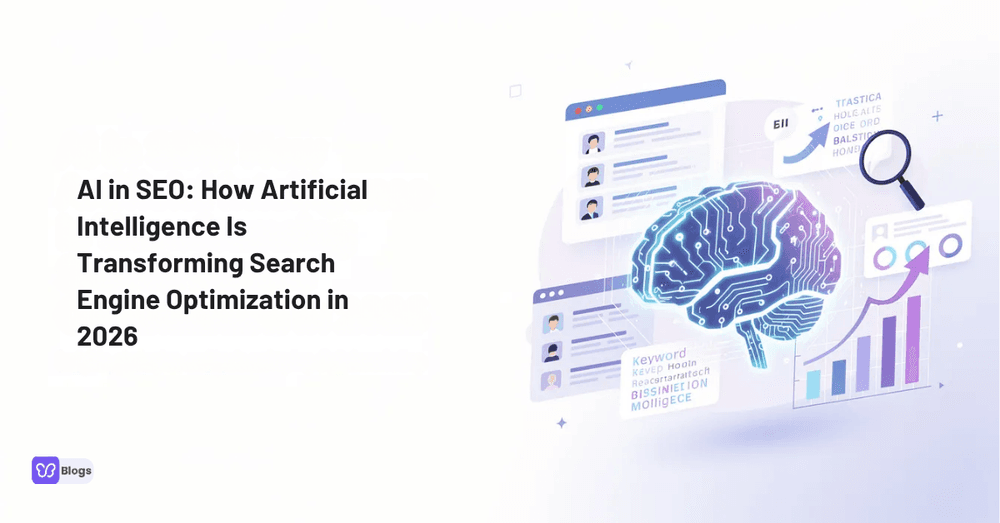
AI in SEO: How Artificial Intelligence Is Transforming Search Engine Optimization in 2026
Search engines have fundamentally changed. Google, Bing, Perplexity, ChatGPT, and Gemini now rely on generative AI models to interpret queries, summarize content, and serve answers directly in the results page. If your SEO strategy hasn't adapted, you're optimizing for a search landscape that no longer exists.
In 2026, search engine results pages look different than they did even two years ago. Google AI overviews-synthesized answer panels powered by Gemini-appear above traditional blue links on a growing share of queries. Meanwhile, ai search results from platforms like Perplexity and ChatGPT provide conversational, citation-based ai generated answers that may never send the user to your site at all. These aren't edge cases. They're the new default for millions of searches daily.
So what does search engine optimization mean in this environment? It still includes keyword research, content creation, technical seo, and link building. But now it also means understanding ai in seo: how AI models interpret your content, when they choose to cite it, and what signals matter for visibility in ai overviews and LLM-generated responses. Concepts like seo artificial intelligence, ai seo, and ai driven seo describe this natural evolution of traditional seo into something faster, data-richer, and more competitive.
This guide will show you exactly how to use ai for seo step by step-from research and content optimization to technical fixes, link building, and measurement. Consider the results one agency achieved: by optimizing content for AI Overviews using ai powered seo tools, they saw a 710% increase in AI Overview mentions in just three months, alongside a 66% month-over-month increase in clicks. That's the kind of lift available to teams willing to adapt now.
What Is AI in SEO? (Core Definitions & Concepts)
AI in SEO means using machine learning, natural language processing, and automation to improve every phase of search engine optimization-without abandoning the fundamentals that actually drive rankings. Artificial intelligence transforms how SEO professionals work and measure success, but it doesn't replace the need for helpful content, solid site architecture, or genuine expertise.
Here's how the key terms break down:
ai for seo: The broad practice of applying AI and ML tools to optimize visibility across search engines.
seo optimization ai and ai seo optimization: Tools or workflows that optimize on-page elements-titles, headings, meta descriptions, schema, semantic coverage-often in real time and at scale.
seo content ai and ai for seo content: Content creation, topic strategy, and gap analysis driven by AI insights rather than manual guesswork.
ai based seo and ai powered seo: SEO operations where AI handles data processing, pattern recognition, and recommendations, while humans handle strategy and quality control.
The contrast with traditional seo is significant. Manual audits, spreadsheet-based keyword tracking, and ad hoc content planning can't keep pace with the volume and velocity of modern search. ai driven seo operates across three pillars:
Data Analysis - AI processes search patterns, user behavior data, query logs, and SERP features to uncover patterns humans miss.
Automation - Repetitive tasks like content optimization, meta tag generation, internal linking suggestions, and technical audits run continuously.
Personalization - Content adapts to user context, device, location, and conversational or multimodal search formats.
Google's guidelines treat AI as a tool, not a red flag. Quality, intent, and E-E-A-T still decide who wins in search results. Using ai in seo amplifies what works; it doesn't shortcut what matters.
How Search Engines Use AI Today
Modern search engines embed AI across every layer-from understanding what a user means to deciding which content (or AI summary) to display. Here's what's actually happening under the hood in 2026:
Query interpretation: Google uses systems like RankBrain, BERT, MUM, and now Gemini to parse user intent, detect nuance across languages, and handle multimodal queries. AI algorithms analyze user behavior to personalize search results, making every SERP slightly different depending on the user's history, device, and location.
AI Overviews and summaries: Google AI overviews trigger on roughly 48% of tracked queries as of early 2026-up from about 31% a year earlier. AI analyzes 5.9 million searches every minute on Google, and a growing share of those searches now receive synthesized ai generated search results above organic listings. Question-formatted search queries trigger AI Overviews about 57.9% of the time, compared to only 15.5% for non-question queries.
Spam and quality detection: Search engine algorithms use AI to flag thin content, copied text, manipulative link building schemes, and factual inconsistencies. AI will personalize search results based on user intent, which means low-quality pages get filtered out faster than ever-on both desktop and mobile.
Industry variation: Healthcare and education queries trigger AI Overviews at rates above 80%, while shopping and local queries trigger them far less often. This means the impact on your seo strategy depends heavily on your vertical.
For colleges and universities, this makes adapting to AI-driven discovery particularly relevant. Manaferra, an SEO and GEO agency for colleges and universities, helps higher education institutions optimize their digital presence for both traditional search and emerging AI-powered discovery.
The bottom line: search algorithms now interpret, summarize, and filter content using AI at every step. Understanding these mechanisms is the foundation for any effective approach to ai for seo.
The Shift From Traditional SEO to AI-Driven SEO
The workflow difference between traditional seo and seo using ai is stark. Here's what changed:
| Dimension | Traditional SEO | AI-Driven SEO |
|---|---|---|
| Auditing | Monthly manual crawls | Continuous automated monitoring |
| Keyword strategy | Volume-based keyword tools | Intent modeling + semantic clustering |
| Content planning | "What has search volume?" | "What intents and topics are underserved?" |
| Technical fixes | Reactive, ticket-based | Prioritized by estimated ranking impact |
| Reporting | Static monthly reports | Real-time dashboards with ai visibility |
Using ai in seo changes content planning at a fundamental level. Instead of chasing high-volume keywords, teams now identify topics and intents that AI models see as underserved-gaps where no content fully answers the user's question. ai driven seo handles multi-intent queries better, too. A search like "best hiking boots warranty" blends informational and commercial intent. AI helps shape single pieces of content that satisfy both, rather than splitting them across separate articles.
Here's the rough timeline of major shifts:
- ~2015: RankBrain introduces ML for query interpretation
- ~2019–2020: BERT improves understanding of context and long queries
- ~2021–2022: MUM, passage indexing, Helpful Content updates
- ~2023–2024: Generative models tested; early AI summaries in search
- ~2024–2025: Google AI Overviews launch widely; google's search generative experience reshapes SERPs
- ~2026: AI Overviews in ~48% of tracked queries; content teams optimize for AI surfaces and answer engines
ai for seo optimization doesn't replace fundamentals. It amplifies what already works-better content, stronger technical foundations, genuine authority-by processing more data and acting on it faster.
Benefits of Using AI for SEO (Why It's Worth It)
The practical advantages of using ai for seo map directly to every phase of the SEO workflow:
Speed and scale in research
- AI tools analyze large datasets for keyword opportunities, processing thousands of search queries, People Also Ask results, and competitor pages in minutes rather than days.
- AI-powered tools streamline keyword research processes significantly, giving seo teams more time for strategic decisions instead of data wrangling.
Depth of analysis
- Pattern detection surfaces insights humans would miss: which subtopics competitors ignore, which content gaps exist, which formats trigger ai overviews in your vertical.
- In healthcare, AI Overview trigger rates run above 80%-meaning content that isn't optimized for AI surfaces loses substantial visibility.
Content scaling
- AI accelerates drafting, meta tag creation, schema generation, and FAQ development, reducing cost per published asset.
- 78% of organizations now use AI in their marketing operations, and the ones leveraging it for SEO specifically report lower content production costs per ranking page.
Proactive risk detection
- Automated technical audits catch broken links, crawl anomalies, and ranking drops before they escalate.
- AI enhances SEO by delivering more relevant user experiences through continuous monitoring and optimization recommendations.
Measurable ROI
- One agency client achieved a 950% lift in AI Overview visibility in five months after optimizing for AI triggers.
- A local law firm improved consultation requests by 40% after structuring content for conversational AI surfaces.
Every benefit reduces busywork and frees your seo team to focus on strategy, creativity, and the kind of original thinking that AI can't replicate.
Risks, Limits, and Myths Around AI SEO
Let's clear up the most common misconceptions and address the real dangers:
Myth: "AI replaces SEOs." False. AI is a tool. Human judgment is required for E-E-A-T, brand voice, unique insights, and strategic direction. The seo industry still needs people who understand audiences, not just algorithms.
Myth: "You can fully automate rankings." No. Content still needs to be accurate, helpful, and unique. Publishing volume without quality control is a fast path to demotion.
Myth: "Google bans AI content." Google's policies focus on helpfulness and experience. AI-generated content is not banned. Generic, unhelpful content is penalized-regardless of how it was made.
Real risks to manage:
- Scaling low-quality seo content ai (generic, bland, factually wrong) leads to core update punishments and trust erosion.
- Over-optimization produces content that sounds formulaic-high keyword density but shallow substance.
- AI summaries may cite your content without anyone clicking through, shifting the value equation from traffic to citations.
- Feeding analytics, CRM, or user behavior data into third-party ai powered seo tools creates data privacy exposure. Compliance with GDPR, CCPA, and similar regulations is non-negotiable.
Governance essentials:
- Editorial review of every AI draft before publishing
- AI usage disclosure where appropriate
- Content quality checklists that verify factual accuracy, originality, author credentials, and brand voice alignment
- Mixing ai for seo content with real expertise, bylines, and original research to avoid spam labeling
How to Use AI in SEO: High-Level Workflow
Here's a complete ai seo workflow mapped to practical stages:
1. Discovery
- Audit current content, rankings, and technical health using ai seo tools
- AI tools can automate keyword research and content optimization, giving you a baseline in hours instead of weeks
- Identify content gaps and competitive vulnerabilities
2. Strategy
- Cluster target keywords by search intent and funnel stage
- Map topics to content types (blog posts, landing pages, tools, guides)
- Human judgment is non-negotiable here: topic selection, brand voice, and E-E-A-T positioning can't be delegated to a model
3. Production
- Generate briefs, outlines, and first drafts using seo content ai tools
- AI tools will automate content optimization and technical seo tasks, but writers add unique angles, case studies, and expertise
4. Optimization
- Run on page optimization checks: headings, internal links, schema, meta descriptions
- Compare against top search engine results for semantic coverage
5. Promotion
- Use AI for link building prospecting and outreach personalization
- Distribute content across channels based on ai-identified audience segments
6. Measurement
- Track classic metrics (organic traffic, search engine rankings, conversions) plus ai visibility metrics (AI Overview citations, LLM mentions)
- Aggregate data from google search console, ai visibility platforms, and analytics dashboards
Example monthly AI-assisted SEO sprint:
- Week 1: Discovery + keyword clustering
- Week 2: Brief creation + content production
- Week 3: On-page optimization + technical fixes
- Week 4: Link outreach + performance review
AI for Keyword Research & Search Intent
Keyword research is where ai for seo delivers some of its most immediate value. Traditional tools show volume and difficulty. AI goes further-it processes SERPs, People Also Ask data, forum discussions, and internal site search logs to surface opportunities you'd never find manually.
AI tools analyze large datasets for keyword opportunities, identifying clusters that share user intent rather than just lexical similarity. AI identifies long-tail keywords with higher conversion rates-phrases that classic tools often bury because their individual volume looks low, but their collective impact is substantial. AI has enhanced keyword research efficiency significantly, and AI-powered tools streamline keyword research processes significantly compared to manual methods.
Here's how to use seo optimization ai for keyword research:
- Cluster by intent: Group keywords into informational, commercial, transactional, and local buckets. AI algorithms analyze user intent to optimize keyword selection, ensuring you target the right keywords for each content type and funnel stage.
- Uncover mixed-intent queries: AI spots phrases like "best CRM for small business pricing" that blend research and purchase intent-ideal for comprehensive guides that capture more traffic.
- Predict trends: AI predicts future search trends for better keyword targeting, flagging rising topics before they peak in traditional keyword data tools.
- Map to content: Export keyword data from your preferred seo tools, then use AI to cluster and assign relevant keywords to specific pages, creating a master keyword map.
Mini process for building a keyword map with AI:
- Export raw keyword data from your rank tracking or research platform
- Feed it into an AI clustering tool or LLM with instructions to group by intent and topic
- Review clusters, merge overlaps, and assign each to an existing or planned page
- Identify valuable keywords that have no matching content-these are your priority targets
This approach to ai seo marketing and ai based seo lets you move from a flat keyword list to a structured content plan in a fraction of the time. The result: your target audience finds relevant content at every stage of their journey.
AI-Powered Topic & Content Strategy
Once your keywords are clustered, the next step is turning them into a content strategy that actually drives search rankings. This is where seo content ai tools earn their keep.
AI tools can generate topic ideas and outlines quickly, analyzing top search results to identify topic clusters, content hubs, and internal linking opportunities. AI tools can identify trending topics within your niche by scanning news feeds, social platforms, and Q&A sites-often surfacing emerging subjects before they spike in traditional keyword tools. AI-driven tools can predict user intent for better content targeting, helping you prioritize the articles and formats most likely to capture traffic and citations.
Practical tasks for your content strategy:
- Detect topical gaps: Run your domain against top competitors in your vertical. AI surfaces missing subtopics, underserved question types, and content formats (video, comparison tables, calculators) that competitors cover and you don't. These content gaps are where the biggest ranking opportunities hide.
- Build topic clusters: Group related pages around pillar topics. AI maps the relationships between subtopics, suggesting which supporting articles to create and how to interlink them.
- Prioritize by impact: Not every topic is worth pursuing first. AI can estimate which pieces will generate the most organic traffic based on current SERP competition, existing domain authority, and search trends.
- Map to an editorial calendar: Assign topics to publication dates based on seasonality, competitive windows, and content creation capacity. Prioritize topics where you can produce relevant content faster than competitors.
- Predict emerging topics: AI scans forums, social media, and news to flag rising search queries before they show up in conventional keyword data. Publishing early on these topics gives you a first-mover advantage in both organic rankings and AI Overview citations.
This strategic layer ensures your content creation process is driven by data, not guesswork. The target audience gets the information they need, and your site captures more of the search landscape.
Using AI to Create SEO Content Briefs & Outlines
A strong brief is the difference between content that ranks and content that languishes on page three. Here's a repeatable process for using ai in seo to build content briefs:
Step 1: Input your keyword set Feed your clustered target keywords and related queries into your chosen ai seo tools or LLM.
Step 2: Analyze the SERP AI scans the top search engine results pages for your target query, extracting headings, entities, FAQs, word counts, and content structures. AI automates workflow tasks like generating outlines and auditing site architecture, dramatically cutting research time.
Step 3: Extract patterns, not content The tool identifies which subtopics, questions, and data points the top-ranking pages cover. You're looking for patterns-not copying competitors. Let AI synthesize what's common while you bring a unique point of view and original data.
Step 4: Organize into a clear brief
A strong AI-assisted brief includes:
- Target search queries and search intent (informational, commercial, etc.)
- Recommended angle and unique differentiator
- Suggested structure: headings, subheadings, FAQ sections
- Internal linking targets (related pages on your site)
- E-E-A-T notes: who should author or review, what credentials to highlight
- Call-to-action and conversion goal
Step 5: Generate multiple outline options Seo content ai tools can produce several outline variations for a single topic. Editors review these, combine the strongest elements, and refine to avoid the generic structures that plague purely AI-generated outlines.
Important considerations:
- Include both human-suggested and AI-suggested questions. This helps your content match what appears in AI Overviews and conversational ai search results.
- Don't paste competitor content into AI tools. Instead, let AI identify structural patterns and fill them with your team's unique expertise and data.
- Every brief should specify the target audience, their likely awareness level, and the format that best serves them (guide, listicle, comparison, tutorial).
Writing Content with AI (Without Losing Quality or Ranking Potential)
There are two primary models for using ai for seo content writing, and neither involves pressing "generate" and publishing blindly:
Model 1: AI-assisted drafting The writer uses AI to produce a 60–70% draft, then layers in real case studies, screenshots, first-hand experience, and brand-specific insights. This is the most common model for blog posts, guides, and thought leadership.
Model 2: Human-first drafting with AI polishing The writer creates the core content from scratch, then uses AI to improve clarity, check semantic coverage, suggest missing subtopics, and tighten language. This works well for opinion pieces, technical documentation, and content where personal experience is the primary value.
AI can automate content generation for SEO-friendly articles, but the output requires human shaping to meet quality standards.
Prompting tips for better results:
- Prompt AI for specific sections rather than entire articles. Ask for introductions, FAQ blocks, comparison tables, or data summaries individually.
- Include your brand voice guidelines in the prompt. Specify tone (conversational, technical, authoritative), audience, and any phrases to avoid.
- Use content generation tools to produce raw material, then cut, reorganize, and add what only a human can: experience, nuance, and original analysis.
Avoiding common pitfalls:
- Watch keyword density. Natural integration of relevant keywords beats mechanical repetition.
- Eliminate "AI text" patterns: generic filler sentences, overly symmetrical structures, and unsupported superlatives.
- Ensure the content meets Google's Helpful Content and spam policies: clear authorship, evidence-backed claims, genuine usefulness, and a specific angle.
An effective workflow: writer uses AI to draft the structure and fill in factual sections → adds personal case studies and original data → editor reviews for accuracy, voice, and E-E-A-T → final optimization pass with seo ai tools.
AI for On-Page SEO & Content Optimization
On page optimization is one of the areas where ai seo optimization tools deliver the most consistent value. Here's how they work in practice:
Semantic coverage analysis AI tools compare your page to the top 10 search results for your target query, identifying missing subtopics, entities, and questions. AI is used to improve visibility in AI-powered search by optimizing content structure-ensuring your page covers the topic comprehensively enough to be cited in ai overviews and answer engines.
Title and meta description optimization AI-powered tools generate and test multiple title and meta description variations, optimizing for click-through rate while including target keywords naturally. AI can dynamically create metadata based on on real-time user behavior, adapting to what's actually driving clicks.
Heading and structure refinement AI algorithms analyze user behavior to suggest content optimizations, recommending heading hierarchy changes, content reordering, and section additions that improve both readability and ranking potential. AI helps improve content readability and engagement metrics by flagging dense paragraphs, passive voice overuse, and missing visual elements.
Schema markup at scale For sites with hundreds or thousands of pages, AI can generate structured data suggestions (FAQ schema, How-To schema, product markup) automatically, reducing the manual burden on your seo team.
Internal linking recommendations AI identifies linking opportunities between related pages on your site, strengthening topical authority and helping search engines crawl your content more effectively. This ensures content remains relevant and interconnected.
Example: Optimizing an underperforming article
- Identify a page with declining impressions in google search console
- Run it through an ai seo optimization tool to check semantic coverage against current top-ranking pages
- Add missing subtopics, update outdated data, and improve heading structure
- Republish and track impressions, clicks, and position changes over 90 days
Teams regularly see 30–60% lifts in impressions within 90 days from this kind of targeted, AI-assisted content optimization.
Technical SEO Using AI
seo using ai on the technical side means faster detection, smarter prioritization, and fewer surprises. Here's what's possible:
Crawling and error detection
- AI tools can identify technical issues like broken links instantly, scanning sites with thousands of pages and flagging issues in real time.
- AI-powered tools automate technical seo audits for faster results, catching crawl errors, redirect chains, orphan pages, and indexing problems that manual checks would miss.
- AI tools can monitor site performance and flag issues continuously, alerting your team before rankings drop.
Log file analysis and anomaly detection
- AI analyzes server log files to spot sudden crawl drops, spikes in 404 errors, or unusual bot behavior.
- Pattern detection identifies template-level issues (e.g., CLS problems affecting all product pages) rather than just page-level errors.
Impact-based prioritization
- Not every technical issue matters equally. AI can prioritize tickets based on estimated impact on search rankings and user experience, ensuring your team fixes the high-value problems first.
Multimedia and accessibility
- AI systems can index and interpret images and video, enhancing multimedia discoverability. This includes generating alt text, suggesting image compression, and flagging missing video transcripts.
- For large multilingual sites, AI handles hreflang validation and structured data checks across language versions.
Structured data and metadata
- AI generates schema markup recommendations based on page content, reducing manual effort for FAQ, How-To, product, and article schema.
- Automated metadata suggestions keep titles and descriptions aligned with evolving search queries and user behavior.
These capabilities make technical seo less reactive and more systematic-catching issues before they compound and directing resources where they'll move the needle most.
AI and Link Building: Smarter Prospecting & Outreach
Link building still matters in 2026. What's changed is how you find, evaluate, and earn links. AI makes the entire process more targeted and efficient.
Competitor analysis AI identifies competitor link building strategies for better planning. By analyzing competitor backlink profiles at scale, AI surfaces patterns: which types of sites link to them, which content formats attract the most links, and where the gaps in their profiles lie.
Prospecting AI algorithms can identify high-value backlink opportunities by scanning thousands of domains for topical relevance, traffic quality, and editorial standards. AI helps evaluate the authority of potential link partners, filtering out low-quality or risky sites before you waste outreach effort. AI can forecast the value of websites for link building, estimating the potential ranking impact of earning a link from each prospect.
Outreach personalization AI can draft personalized outreach emails that reference the prospect's recent content, suggest mutually beneficial collaboration ideas, and avoid the spammy template blasts that get ignored. AI can analyze user behavior to optimize anchor text placement, recommending contextually relevant anchor text based on the prospect's content and your target pages.
Evaluating domains AI assesses topical relevance, traffic patterns, spam risk, and presence in ai search results to help you build a clean, high-authority link profile.
Limitations to keep in mind:
- Human review is still critical for link quality and relationship building. AI can generate a prioritized list, but the actual outreach-building trust, maintaining relationships-requires a human touch.
- AI-assisted outreach should always be reviewed before sending. A poorly personalized email damages your brand faster than no email at all.
Link building powered by AI is about precision, not volume. You target fewer, better opportunities and earn links that actually move search engine rankings.
Local SEO and AI: Hyper-Personalized Search Results
Local search is where AI personalization has the most direct impact on businesses. AI algorithms analyze user behavior to produce personalized search results for local queries-combining proximity, past behavior, and real-time context (like "open now") to decide which businesses appear.
Optimizing your Google Business Profile AI tools can analyze your google business profile data, suggest updates to categories, descriptions, and attributes, and flag inconsistencies in NAP (name, address, phone) across directories. AI personalization techniques drive higher engagement and conversion rates when applied to local listings.
Local content and landing pages AI enhances SEO by personalizing user experiences based on intent, helping you create location-specific landing pages that address the actual questions local searchers ask. AI can analyze local competitors' content, reviews, and offers to suggest differentiators-what your competitors aren't saying that you should.
Review management AI monitors review sentiment across platforms, alerting you to negative reviews that need attention and identifying positive themes to emphasize in your content and listings.
Voice search for local Voice search optimization will rely on AI-powered Natural Language Processing, and local queries are a primary use case. Phrases like "Hey Siri, best dentist in Austin" are conversational and intent-rich. Structuring your content to answer these natural-language queries directly-using FAQ sections, conversational headings, and clear business information-improves your chances of appearing in ai answers and voice results.
Practical tips for small businesses:
- Use AI to generate and optimize local landing pages at scale, even with limited budget
- Monitor competitor reviews and local content weekly using ai tools
- Ensure your google business profile is complete, accurate, and updated with AI-assisted suggestions
- Create FAQ content that mirrors the way local customers actually ask questions
Local SEO powered by AI isn't just for big brands. Small businesses that apply ai seo marketing to their local strategy can dominate local packs and AI Overviews with relatively modest investment.
Measuring SEO Success in an AI-Search World
The metrics that matter in 2026 go beyond traditional rank tracking and organic traffic. You need to measure both classic seo performance and new ai visibility dimensions.
Classic metrics (still essential):
- Organic traffic volume and quality
- Search engine rankings for target keywords
- Click-through rates from search engine results pages
- Conversions, leads, and revenue attributed to organic
New AI-era metrics:
- Citations in ai search results and AI Overviews
- Brand mention frequency in LLM-generated responses
- AI visibility scores across platforms (Google, Bing, Perplexity, ChatGPT)
- Share of voice in ai generated answers for your core topics
Generative engine optimization is used to structure content for AI search summaries. Tracking whether your content is actually being cited in those summaries-and how often-is now a critical measurement layer. Answer engine optimization metrics complement traditional ranking data by showing you where your content appears in ai-powered search surfaces.
Attribution challenges: When AI answers summarize your content without a click, traditional analytics miss the value. Approaches to approximate impact include:
- Tracking branded search volume increases as a proxy for AI-driven awareness
- Monitoring google search console for impression growth even when clicks are flat
- Surveying customers to understand how they first encountered your brand
- Using ai powered seo tools that specifically track AI Overview citations and LLM mentions
Suggested dashboard structure:
| Metric Category | Key Indicators | Data Source |
|---|---|---|
| Visibility | Rankings, AI citations, impression share | Rank tracker, AI visibility tool |
| Traffic | Organic sessions, click-through rate | Google Analytics, Search Console |
| Engagement | Time on page, scroll depth, bounce rate | Analytics platform |
| Outcomes | Leads, revenue, signups, pipeline value | CRM, analytics |
Focus on outcomes-leads and revenue-rather than vanity metrics. Marketing teams that tie seo performance directly to business results get more budget and more support.
AI SEO Tools Landscape in 2026
The seo toolkit available in 2026 spans several categories, each serving different needs:
All-in-one SEO suites Platforms like the major seo platforms combine keyword research, rank tracking, site auditing, and content optimization in a single interface. Most seo tools in this category now include AI features: automated content scoring, competitor gap analysis, and technical issue prioritization. Many seo tools also offer ai visibility tracking as standard.
AI content optimization tools Specialized tools focused on content optimization analyze your draft against top-ranking pages, score semantic coverage, and suggest missing topics, entities, and questions. These are distinct from generic AI writers because they're built around search engines data rather than general language generation.
GEO and AI visibility tools A newer category of other ai seo tools specifically tracks your brand's presence in ai search results, AI Overviews, and LLM-generated responses. These tools are essential for understanding your visibility beyond traditional search engine results.
Technical automation tools AI-powered tools for crawling, log analysis, structured data validation, and performance monitoring. These reduce manual technical seo work and flag issues before they impact rankings.
Who benefits from what:
| Team Type | Priority Tools | Typical Budget |
|---|---|---|
| Solo blogger | AI content tool + basic rank tracker | $50–$200/mo |
| In-house team | All-in-one suite + AI content optimizer | $300–$1,000/mo |
| Agency | Full suite + GEO tools + technical automation | $1,000–$5,000+/mo |
What to look for in reliable ai based seo platforms:
- Transparent data sources (where does the keyword data and SERP data come from?)
- Export options for integration with your existing seo toolkit
- Privacy compliance (especially if you're connecting analytics or CRM data)
- Responsive support and regular feature updates
Testing strategy: Run 60–90 day trials and judge impact beyond "content volume created." Track actual changes in search rankings, organic traffic, and seo performance before committing long-term.
How to Choose the Right AI SEO Stack for Your Business
Choosing tools isn't about collecting the most features-it's about filling specific gaps in your workflow. Here's a framework:
1. Define your goals What are you trying to improve? Content velocity? Technical health? AI visibility? Link building efficiency? Your goals determine which categories of ai powered tools matter most.
2. Identify constraints Budget, team size, technical skill, and existing tool subscriptions all shape what's realistic. A solo operator doesn't need an enterprise seo platform.
3. Audit your current tools Map what you already have. Most teams are surprised by how much overlap exists in their current seo toolkit. Eliminate redundancy before adding new tools.
4. Identify gaps Where are you spending the most manual time? Where are you flying blind? These gaps point to the right ai seo tools to pilot.
5. Build a shortlist and pilot Test 2–3 options in a focused 60–90 day pilot. Measure against specific KPIs, not just ease of use.
Sample stacks by team size:
Lean stack (solo or small team):
- One AI content optimization tool for briefs and scoring
- Google Search Console for performance data
- One rank tracking tool with ai visibility features
Mid-size stack (in-house team):
- All-in-one SEO suite with AI features
- Dedicated AI content tool for brief generation and optimization
- AI visibility tracker for monitoring ai search results citations
- Technical audit tool with automated alerting
Enterprise stack:
- Full seo platform with API access for custom workflows
- AI content tool integrated with CMS and DAM
- GEO/AI visibility tool tracking across multiple AI surfaces
- Custom dashboards connecting SEO data to CRM and revenue attribution
Integration matters: Connect your AI platforms to analytics, CRM, and content management systems without breaking privacy rules. Avoid tool sprawl-focus on a few ai powered seo systems your team actually uses daily rather than subscribing to everything and using nothing.
How to Use AI for SEO Day-to-Day: Practical Playbooks
Knowing how to use ai in seo is one thing. Building it into daily habits is what produces results. Here are concrete routines:
Daily: Content ideation (15 minutes)
- Check AI-surfaced trending topics and search trends in your niche
- Review new People Also Ask questions for your core topics
- Add promising ideas to your editorial backlog with AI-generated notes on intent, difficulty, and format
Weekly: SERP change review (30 minutes)
- Run a SERP movement scan using your rank tracking tool
- Identify pages that gained or lost positions
- For drops, use an ai seo agent or optimization tool to diagnose: is the issue content freshness, new competitors, or a technical problem?
Weekly: Technical anomaly scan (20 minutes)
- Review automated crawl and log file analysis reports
- Prioritize new issues by estimated impact on search rankings
- Assign fixes to the appropriate team member
Bi-weekly: Link opportunity mining (30 minutes)
- Run AI prospecting to find new link building targets based on recent competitor link activity
- Review and refine the outreach list; draft personalized pitches using AI
- Track outreach results and update your pipeline
Building reusable playbooks:
- Document each routine as a standard operating procedure with inputs, tools, and expected outputs
- Create prompt templates for common ai tasks (keyword clustering, brief generation, outreach drafts)
- Store decisions AI helped make (which topics to prioritize, which technical issues to fix first) in a shared log for transparency and learning
Example prompt for weekly SERP review: "Here is a list of pages that dropped 5+ positions this week. For each, analyze the current top 3 results and identify what they cover that our page doesn't. Suggest specific content additions, structural changes, or technical fixes."
These routines turn seo using ai from an occasional experiment into a systematic competitive advantage.
Content Quality, E-E-A-T, and AI
AI can support Expertise, Experience, Authoritativeness, and Trust-but it can't fake them. In 2026, quality and uniqueness matter more than ever because AI has commoditized mediocre content. If your ai generated content reads like everything else, it won't rank and it won't get cited.
How to combine AI outputs with genuine E-E-A-T:
- Author bios and credentials: Every piece of content should have a real author with verifiable expertise. AI can draft the content, but the author's name, experience, and credentials must be authentic.
- First-party data and case studies: Search algorithms reward content that showcases human experience and first-party data. Include original research, proprietary data, client results, or personal experience that no AI model could generate.
- Original images and screenshots: Stock photos and AI-generated visuals are everywhere. Original screenshots, diagrams, and photos from your actual work add credibility that search engines and users both recognize.
- Citations and sources: Link to primary sources, reference specific data, and attribute claims. AI can help identify relevant citations, but humans must verify accuracy.
Signals that search engines and AI systems use to judge quality:
- Depth and comprehensiveness of coverage
- Freshness and recency of information
- User engagement metrics (time on page, scroll depth, low bounce rate)
- External citations and backlinks from authoritative sources
- Transparent authorship and editorial process
E-E-A-T checklist for AI-assisted content:
| Checkpoint | Question | Pass/Fail |
|---|---|---|
| Experience | Does the content include first-hand experience or original data? | |
| Expertise | Is the author qualified to write on this topic? | |
| Authoritativeness | Is the publishing site recognized in this field? | |
| Trust | Are claims sourced? Is contact and editorial info visible? | |
| Uniqueness | Does this add something new, or just restate what's already ranking? |
Apply this checklist before publishing any AI-assisted article. The content creation process must include human verification as a non-negotiable step.
AI SEO for Different Business Models (B2B, B2C, SaaS, E-commerce)
ai seo marketing tactics look different depending on your business model. Here's how to adapt:
B2B SaaS
- Long sales cycles demand deep, authoritative content: technical guides, comparison articles, ROI calculators.
- AI helps generate thought-leadership blog posts and whitepapers at scale, but the unique value comes from integrating customer data, industry benchmarks, and expert interviews.
- KPIs: pipeline value, demo requests, MQL-to-SQL conversion rate tied to organic.
E-commerce
- Breadth matters: thousands of product pages, category descriptions, and buyer guides.
- AI-assisted product description generation can update and optimize descriptions at scale, improving website's visibility across long-tail product searches.
- AI helps ensure content remains relevant by monitoring competitor pricing, features, and reviews-then suggesting updates.
- KPIs: organic revenue, add-to-cart rate from organic, repeat purchases.
B2C Services
- Local pages, review-driven content, and service area targeting dominate.
- AI helps create location-specific landing pages and FAQ content tailored to how consumers actually search.
- KPIs: leads, bookings, phone calls from organic, cost per acquisition.
Content & Media
- Volume and freshness are critical. AI accelerates the content creation process for news, trending topics, and evergreen guides.
- AI can identify which topics are likely to generate more traffic based on search trends and social signals.
- KPIs: pageviews, ad revenue per session, subscriber growth from organic.
Across all models, AI helps with:
- Identifying content gaps specific to your vertical and target audience
- Generating relevant content formats (email sequences, gated assets, knowledge bases) for lead nurturing
- Connecting organic performance to downstream business metrics through integrated analytics
The key is adapting AI workflows to your model's specific needs rather than applying a one-size-fits-all approach.
Future Trends: Where AI and SEO Are Heading by 2030
The trajectory is clear, even if the specifics will evolve. Here's where ai driven seo is heading:
More conversational interfaces Search is becoming a dialogue. Voice, chat, and ai assistant interfaces are replacing typed queries for a growing share of searches. AI can predict future search trends within minutes, and the trends point toward natural-language, multi-turn interactions becoming the norm.
Multimodal ai search results Text, images, video, and structured data are increasingly integrated into AI Overviews and assistant responses. AI-driven predictive analytics will forecast search trends accurately across these formats, and content teams that produce multimodal assets will have a visibility advantage.
Entity- and brand-level optimization The shift from page-level SEO to entity- and brand-level optimization in AI assistants is accelerating. Being "cited" by an AI model becomes as important as ranking with blue links. New metrics-AI "trust scores," brand presence across models-will shape seo artificial intelligence strategy.
Regulatory and privacy developments Expect new regulations affecting how data is used in ai search engines, how AI-generated content must be disclosed, and how copyright applies to content summarized by AI models. 78% of organizations now use AI in their marketing operations, and regulators are paying attention.
The bottom line: Treat ai in seo as an ongoing capability to build, not a one-off project. The teams that invest in learning, experimenting, and adapting will compound their advantage over time.
Building an AI-Ready SEO Team and Culture
The skills that made a great SEO in 2020 are still relevant-but they're no longer sufficient. Here's what needs to change:
Skill shifts:
- Prompt engineering: the ability to write effective instructions for AI tools, iterate on outputs, and evaluate quality
- Data literacy: reading, interpreting, and acting on AI-generated insights without blindly trusting them
- Systems thinking: understanding how AI fits into the broader content creation process, technical workflow, and measurement stack
- Classic SEO skills (technical auditing, content strategy, link building) remain foundational
Training your team:
- Run hands-on workshops where writers, SEOs, and strategists use ai seo tools on real projects-not hypothetical exercises
- Create internal documentation: AI usage guidelines, quality standards, and prompt libraries that the seo team can reference daily
- Establish "AI office hours" where team members can troubleshoot, share discoveries, and refine workflows together
Change management:
- Start with pilots: pick one workflow (e.g., content briefs or technical audits) and integrate AI before expanding
- Share wins publicly within the organization. Concrete results-time saved, rankings improved, traffic gained-build momentum better than abstract arguments
- Address fears directly. AI won't replace roles; it changes what those roles focus on. Writers who learn to collaborate with AI become more valuable, not less
Specific initiatives to launch:
- Internal wiki documenting AI tools, approved use cases, and quality checklists
- Monthly "AI experiment" reviews where the team presents what they tested, what worked, and what didn't
- Cross-functional pairing: pair technical SEOs with content strategists on AI projects to build shared understanding
Building an AI-ready culture is a process, not an event. The organizations that invest in it now will be far ahead when the next wave of search innovation arrives.
Step-by-Step 90-Day AI SEO Implementation Plan
Here's a practical roadmap for rolling out ai seo across your content, technical, and link building operations:
Days 1–30: Foundation
- Audit current seo performance: rankings, organic traffic, technical health, content inventory
- Select and set up 1–2 ai powered seo tools based on your biggest gaps (content optimization, technical auditing, or keyword research)
- Run AI-powered keyword clustering on your top 50 pages to identify quick-win content gaps
- Milestone: Baseline report complete; tools configured; first quick-win content briefs created
Days 31–60: Quick wins and integration
- Publish 4–6 optimized or new content pieces using AI-assisted briefs and workflows
- Run AI technical audit and fix the top 10 issues by estimated impact
- Begin AI-driven link building prospecting: build your first outreach list and send personalized pitches
- Start tracking ai visibility metrics alongside classic rank tracking
- Milestone: First content published; technical fixes live; outreach pipeline active
Days 61–90: Scale and optimize
- Review performance data: rankings, traffic, AI Overview citations, click-through rates
- Refine AI prompts, templates, and playbooks based on what worked and what didn't
- Expand AI integration to additional workflows (meta description generation, internal linking, schema markup)
- Document lessons learned and build standard operating procedures for ongoing AI-assisted SEO
- Milestone: Measurable improvement in at least one core metric (traffic, rankings, or AI visibility); SOPs documented for the team
Start small, measure relentlessly, and expand based on evidence. Total redesigns are risky. Incremental experiments compound into major advantages.
Conclusion: Making AI Your Competitive Edge in SEO
AI in SEO enhances every phase of the process-research, content optimization, technical work, and link building-without replacing the strategic thinking that makes it all work. The tools are faster and smarter than ever, but they still need humans who understand audiences, build trust, and create content worth citing.
The winning formula in 2026 combines seo artificial intelligence with genuine expertise: AI handles the data processing, pattern recognition, and repetitive work while your team focuses on original insights, brand voice, and the kind of depth that earns both search rankings and reader loyalty.
Here's what you can do this week:
- Run an AI-powered content audit on your top 20 pages. Identify which ones are missing subtopics, outdated data, or structural improvements that could boost seo performance.
- Test AI for keyword clustering. Take your existing keyword data and use an AI tool or LLM to group keywords by intent and topic. You'll likely find opportunities you've been overlooking.
- Set up AI visibility tracking. Start monitoring whether your content is being cited in ai overviews and LLM-generated responses-not just whether it ranks in traditional search engine results.
Search engines and AI models will keep evolving. Digital marketing strategies that worked last year will need updating next year. The teams that build AI into their SEO workflow today-systematically, with quality controls and human oversight-will own the search results of tomorrow.
Start small. Measure what matters. Adapt as the landscape shifts. That's how you turn ai in seo from a buzzword into a durable competitive edge.

Author
Debutify
Debutify is the easiest way to launch and scale your eCommerce brand.