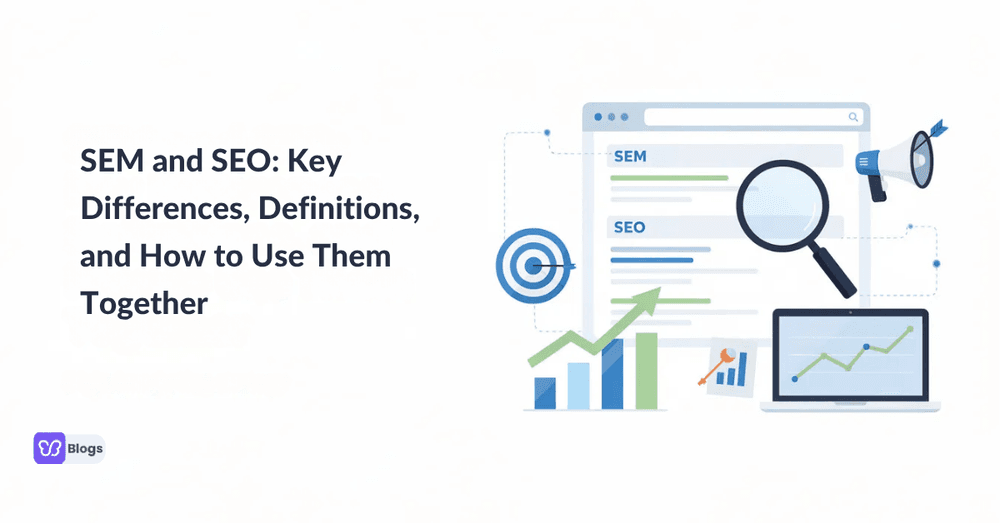
SEM and SEO: Key Differences, Definitions, and How to Use Them Together
Google processes 5.9 million searches every minute. Each one represents a person looking for an answer, a product, or a service. If your business doesn't show up in those results, someone else's will. Understanding how SEM and SEO work - separately and together - is the foundation of any serious search marketing effort.
This guide breaks down every angle: definitions, core components, strategy, costs, and future trends so you can build a plan that actually delivers results.
Quick Answer: What's the Difference Between SEM and SEO?
So what is the difference between SEM and SEO? In short, SEO (search engine optimization) is the practice of improving your website's visibility in organic search results - no ad spend required. SEM (search engine marketing) uses paid search advertising to place your business at the top of search engine results pages through platforms like Google Ads. That's the core of search engine marketing vs SEO.
For anyone asking what is SEO and SEM in digital marketing, think of it this way: SEO earns clicks over time; SEM buys them immediately. What's the difference between SEM and SEO in practical terms? SEO delivers free, compounding organic traffic but typically takes 3–6 months to show significant results. SEM delivers instant visibility on search results pages but stops the moment your budget runs out.
Here's a quick breakdown of the key differences: traffic source (organic vs paid ads), speed (months vs hours), cost structure (content investment vs per-click spend), and sustainability (long-term authority vs budget-dependent visibility). Both SEO and SEM rely on keywords to drive traffic, and combining SEO and SEM can maximize online visibility and traffic across search engines.
The strongest approach is an integrated SEO/SEM strategy where businesses run paid advertising campaigns alongside strong on page SEO and off page SEO. Understanding the sem and seo difference and the difference between SEO SEM is not about choosing one - it's about knowing when each makes sense. That's the real SEO/SEM marketing meaning.
What Is SEO? (Search Engine Optimization) Definition and Core Concepts
SEO involves optimizing a website to rank in organic search results on search engines like Google and Bing without paying for paid ads. The goal is to earn targeted traffic by being the most relevant and trustworthy answer to a searcher's query. In any marketing SEO SEM discussion, SEO is the long-game channel that builds sustainable long-term brand equity.
Google's algorithm uses over 200 ranking signals for SEO, evaluating everything from content relevance to site speed to backlink quality. SEO builds authority through high-quality content and relevant optimization, which means it rewards consistent effort rather than one-time fixes. SEO typically takes 3–6 months to show significant results, but the payoff compounds - your pages can continue attracting web traffic for years.
SEO consists of four main categories: technical SEO (site health, crawlability, core web vitals), on page SEO (keyword optimization, headings, meta description, internal links), off page SEO (backlinks, brand mentions, digital PR), and local SEO (Google Business Profile, local citations). These pillars form the backbone of any web marketing SEO SEM plan and will be broken down in detail below.
Google holds the majority of search engine market share, making it the primary focus for most SEO efforts. Strong organic optimization also supports SEM performance by improving landing pages and Quality Score, which lowers the cost of pay per click campaigns. When people talk about search engine optimisation and search engine marketing, they're describing two sides of the same search visibility coin.
What Is SEM? (Search Engine Marketing) and How It Works Today
SEM is a digital marketing discipline focused on increasing a website's visibility through paid search, primarily managed via platforms like Google Ads and Bing Ads. In modern usage, SEM includes paid search marketing like PPC, though historically the term encompassed SEO as well. When you see search engine marketing vs SEO comparisons, most current sources treat search engine marketing SEM as the paid side and SEO as organic.
SEM focuses on ad copy, keyword targeting, and bidding strategies to place search ads at the top of search results. SEM allows targeting based on location, device, demographics, and user interests - giving advertisers precise control over who sees their message. SEM can deliver immediate visibility on search results pages, which makes it invaluable for time-sensitive promotions.
Consider a local emergency plumber. By launching a search engine marketing campaign targeting "emergency plumber near me" with compelling ad copy like "Available 24/7 - Same Day Service," that business can appear above all organic results within minutes. SEM provides immediate traffic for new products or urgent sales where waiting months for organic rankings isn't an option.
SEM data is also a goldmine for refining your broader SEO/SEM strategy. Metrics like impression share, click-through rate, and conversion data from paid search reveal which keywords actually drive revenue. Any credible sem and seo company will use these insights to connect paid and organic efforts. That's a core part of understanding what is SEO and SEM in digital marketing together.
Core Components of SEO: Technical, On-Page, and Off-Page
Successful SEO blends site health, content relevance, and authority signals. All three must work in coordination within any serious SEO/SEM strategy - neglecting one will hold back the others.
On page SEO covers the elements you directly control on your web pages. This includes title tags, headings, meta descriptions, image alt text, content quality, and internal links. Everything starts with keyword research: identifying the right keywords your target audience actually uses, then building pages that match their search intent. On page SEO also involves structured data markup that helps search engines understand your content and display rich results.
Off page SEO is everything that builds authority away from your site. Backlinks from credible websites signal trust to Google. Digital PR, brand mentions, reviews, and social signals all contribute. This is how search engines understand your reputation in a competitive landscape. Strong off page SEO indirectly helps SEM as well, since higher domain authority makes new landing pages more likely to rank organically and convert paid visitors.
Technical SEO addresses the infrastructure: crawlability, indexing, site speed, mobile-friendliness, HTTPS, and core web vitals. A technically broken site can tank both organic rankings and the ROI of paid search campaigns. For example, fixing slow mobile load times on a key landing page can simultaneously improve your website ranking in organic results and boost Quality Score for Google Ads traffic hitting that same page.
Core Components of SEM: Paid Search, Google Ads, and PPC Fundamentals
SEM's tactical toolkit includes paid search ads, shopping ads, remarketing campaigns, brand campaigns, and competitor campaigns - typically managed through Google Ads or similar platforms. Responsive search ads and contextual advertising options give advertisers flexibility in how they reach users.
The pay per click model works like this: advertisers set bids for target keywords, enter an ad auction every time someone searches a relevant term, and pay only when a user clicks. You only pay for SEM ads when users click them, making cost management granular. Common metrics include cost-per-click (CPC), click-through rate (CTR), conversion rate, and return on ad spend (ROAS). Ad auctions determine the placement of SEM ads on SERPs, with results appearing at the top of the search engine results page with an "Ad" label.
The basic ad creation process follows a clear workflow: perform keyword research, write compelling ad copy that addresses pain points, define targeting parameters (location, device, audience), set bids and marketing budget limits, and connect ads to optimized landing pages. Negative keywords filter out irrelevant clicks that would waste spend.
Quality Score and Ad Rank directly impact how much you pay and where your paid advertisements appear. Landing pages that load fast, match the ad's promise, and deliver a strong user experience earn higher scores - which lowers CPC. Here's a concrete example: an ad group targeting "emergency dentist London" with tight keyword themes, tailored ad copy emphasizing same-day appointments, and a dedicated landing page with trust badges and clear booking forms will outperform a generic campaign every time.
A successful SEM campaign depends on this kind of specificity in both keyword performance tracking and creative testing.
Key Differences Between SEO and SEM (Side-by-Side Comparison)
Let's answer the question directly: what is the difference between SEM and SEO in terms you can act on? And for those asking what's the difference between SEM and SEO - here's the side-by-side breakdown.
Traffic source: SEO drives unpaid organic search results. SEO generates free traffic while SEM requires payment for clicks. SEO focuses on organic traffic while SEM includes paid search. Every organic result you earn costs nothing per click; every SEM click costs money.
Timing: SEO typically takes 3–6 months to show significant results, sometimes longer for competitive keywords. SEM can deliver results almost instantly after launching a campaign - a ppc campaign can start sending high quality traffic within hours. SEO is a long-term strategy while SEM provides immediate visibility.
Cost structure: SEO requires ongoing content and technical optimization, while SEM requires an advertising budget that runs continuously. SEO's costs are front-loaded (content, tools, outreach), but marginal cost per visitor drops over time. SEM costs stay proportional to volume.
Sustainability and risk: SEO results are long-term and require ongoing optimization, but the authority you build compounds. SEO builds lasting authority over time, unlike SEM. SEM results stop immediately once ad spending ceases. However, SEM offers tight control - you can dial spend up for a product launch or down during slow periods.
For speed, SEM wins. For compounding returns, SEO wins. SEM delivers instant short-term results; SEO delivers durable organic visibility. The real sem and seo difference and difference between SEO SEM isn't about which is "better" - it's about matching the right channel to the right moment.
SEO/SEM Strategy: When to Prioritize Each and When to Combine Them
The strongest SEO/SEM strategy rarely locks into one channel permanently. Instead, it stages investment based on business maturity, competition, and cash flow.
SEO should be primary when you're building a content-driven brand, targeting evergreen informational queries, operating a local service with a limited marketing budget, or competing in a niche where organic search visibility compounds over years. An seo strategy built on authority and relevance is hard for competitors to replicate quickly.
SEM should be primary when you're launching a new website with zero domain authority, running time-sensitive campaigns, validating product-market fit, or chasing high-value B2B leads where paid search data can validate messaging before you invest months in organic strategies. Sem campaigns shine when speed matters more than cost efficiency.
The real power comes from combining SEO and SEM. Using both SEO and SEM can lead to higher click-through rates than using either alone. PPC campaigns can inform SEO keyword strategies and vice versa - SEM data reveals high-converting keywords that can guide long-term SEO efforts. Use paid strategies to test headlines and offers, then roll winning language into your organic optimization and on-page content.
Here's a practical example: a SaaS startup runs Google Ads targeting "free project management tool trial" from day one to drive immediate sign-ups. Simultaneously, the team publishes blog content around "how to manage remote teams" and "project management best practices." Over 12–18 months, that organic content begins to rank organically, reducing dependence on paid results. This staged approach is what marketing SEO SEM planning looks like in practice for web marketing SEO SEM teams.
SEO and SEM in the Wider Digital Marketing Mix
Digital marketing SEO SEM doesn't exist in isolation. Search sits alongside social media, email, display, video, and influencer partnerships in a broader digital marketing strategy. What makes search unique is intent - people actively looking for solutions, not passively scrolling. That makes search advertising the highest-intent channel in your mix.
Strong search engine optimisation and search engine marketing amplify every other channel. Someone who sees your Instagram ad might Google your brand name later - where SEO and SEM capture that demand. Both SEO and SEM contribute to increasing a website's visibility in search engines, turning interest generated elsewhere into measurable action.
SEO/SEM marketing meaning shifts at different funnel stages. Create content for awareness with blog posts targeting informational queries. Layer in paid ads for comparison and consideration keywords. Deploy highly optimized sem strategies and landing pages for purchase-intent terms where online advertising drives direct revenue.
Align your reporting so teams see how organic search and paid search assist conversions across the journey - not just last-click attribution. Google Analytics and proper conversion tracking make this possible, while multi-touch attribution tools for ecommerce go a step further by giving each search, ad, and email visit fair credit for the final sale. When marketing SEO SEM teams share data, the entire digital marketing strategy performs better.
Keyword Research for Both SEO and SEM
Keyword research is the common foundation for both SEO and SEM. It's how you understand what your target audience actually types into Google at each stage of the buyer journey. Without it, both seo efforts and sem campaigns are flying blind.
SEO keyword research emphasizes long-term opportunities: long-tail phrases, informational queries, and topic clusters that build topical authority. The goal is to create content around terms where you can rank organically and attract organic traffic month after month. Tools like Google Search Console reveal which queries already bring impressions, while keyword planners surface new opportunities.
SEM keyword research focuses on commercial search intent, cost per click, and conversion potential. These metrics directly impact your pay per click budgets and whether a paid search marketing campaign is profitable. Keyword performance data from running ads reveals which terms actually drive revenue versus which just burn budget.
A simple workflow: start by generating a keyword list, group terms by intent (informational vs. transactional), then map informational terms to SEO blog pages and transactional terms to paid ads campaigns. For instance, "how to fix leaking tap" is a strong SEO blog target, while "emergency plumber near me" is a high-converting SEM campaign keyword. Both sides feed each other - the blog builds authority and the ad captures urgent demand. That integration is the heart of any sem and seo keyword plan.
On-Page, Off-Page, and Technical SEO Best Practices for Stronger SEM Results
Better SEO directly improves SEM ROI. When your landing pages are fast, relevant, and trustworthy, Quality Scores rise, CPC drops, and more visitors - whether from organic results or paid results - convert into leads or customers.
For on page SEO best practices, focus on clear headings aligned with the searcher's query, fast load times, persuasive copy with strong calls-to-action, and a meta description that matches both your ad copy and page content. These elements make your pages work harder for both organic and paid strategies.
Off page SEO tactics indirectly boost SEM performance as well. Credible backlinks raise domain authority, which makes new web pages more likely to rank organically. That increased organic visibility means your brand appears in both paid advertisements and organic results simultaneously - a phenomenon that lifts overall click-through rates. This is where search engine optimisation and search engine marketing truly intersect.
Technical SEO essentials that also matter for paid search landing pages include mobile-first design, HTTPS security, clean URLs, and avoiding intrusive interstitials. Site speed is critical - a page that loads in under two seconds converts far better than one that takes five, regardless of traffic source.
Here's a real-world pattern: a team redesigns a landing page with trust badges, clearer headline-to-ad-copy match, and compressed images. Over a quarter, both organic rankings improve and the PPC Quality Score jumps from 5 to 8, cutting cost per click by nearly 30%.
Cost, ROI, and Budget Planning: SEO vs SEM
Budget conversations are where theory meets reality. SEO costs range from $100 to $5,000 monthly depending on scope, competition, and whether you use an agency or handle work in-house. SEO involves indirect costs like content creation, tools, and technical fixes. SEM requires a direct advertising budget for paid placements - and PPC ads can cost around $14,800 monthly for equivalent traffic that SEO might eventually deliver for free.
Think about ROI differently for each channel. SEO is a capital investment that compounds: the content and authority you build today keeps generating web traffic for years. SEM is a variable cost - you can scale paid advertising campaigns up or down quickly, but the moment the budget stops, so does the instant visibility.
For a new brand, a practical starting split might allocate 60–70% toward SEM and the rest toward SEO foundations (technical fixes, initial content). As organic visibility grows over 6–12 months, gradually shift spend toward SEO while maintaining sem campaigns for high-value transactional terms.
SEO requires ongoing content and technical optimization while SEM requires an advertising budget - so the question isn't really "which do I pay for?" but "how do I balance investment across both?" Measuring ROI means tracking organic search and paid search performance in analytics, including assisted conversions and customer lifetime value. Without that data, you're optimizing blind.
How to Choose an SEM and SEO Company (or Build In-House Capability)
Many businesses search for a combined sem and seo company rather than hiring separate vendors, since coordination between organic and paid teams is critical for results. When evaluating partners, look for transparent reporting, realistic timelines, and clear explanations of how they integrate search engine optimization and search engine marketing.
Ask how an agency shares keyword research, landing-page test results, and content topics between SEO and PPC specialists. The best agencies treat SEO/SEM strategy as a single discipline with two execution arms, not two siloed departments sending separate reports.
Building in-house capability makes sense when you have enough search volume, recurring campaigns, or a strategic need to own your marketing SEO SEM data directly. Hiring a dedicated search marketer who understands both organic and paid strategies can outperform agency work when volume justifies the salary.
Watch for red flags: guaranteed rankings, suspiciously low prices, or agencies that push paid ads exclusively without addressing technical site issues blocking organic growth. A credible partner will audit your current search presence - both organic and paid - before recommending where to invest.
Future Trends for SEM and SEO in 2025–2026 and Beyond
The search landscape is shifting fast. AI-powered search features like Google's AI Overviews are reducing traditional blue-link clicks. Zero-click search rates in the U.S. reached roughly 68% in early 2026, meaning most searchers get answers without clicking through to any website. For queries triggering AI Overviews, that number jumps to around 83%.
This makes clear, authoritative content and well-structured data more important than ever for search engine optimisation and search engine marketing. If your content is cited in an AI Overview, you maintain brand visibility even without the click.
Paid ads are evolving too. Greater automation through smart bidding, responsive search ads, and Performance Max-style campaigns means marketers need to feed better creative assets and stronger landing pages rather than micromanaging bids. Ad creation is becoming more about strategy and less about manual control.
By 2027, global retail online sales are predicted to exceed $8 billion, which means the competition for search visibility will only intensify. Google processes 5.9 million searches every minute, and that number continues to grow.
SEM and SEO will remain tightly connected. Insights from search queries, zero-click behaviors, and conversion data will guide both technical improvements and ad strategies. Understanding the difference between SEO SEM is only the first step. Long-term success comes from continuous testing, learning, and integrating both channels into a cohesive digital marketing SEO SEM plan. Start by auditing your current search presence, identify the gaps, and build a strategy that compounds over time.

Author
Debutify
Debutify is the easiest way to launch and scale your eCommerce brand.