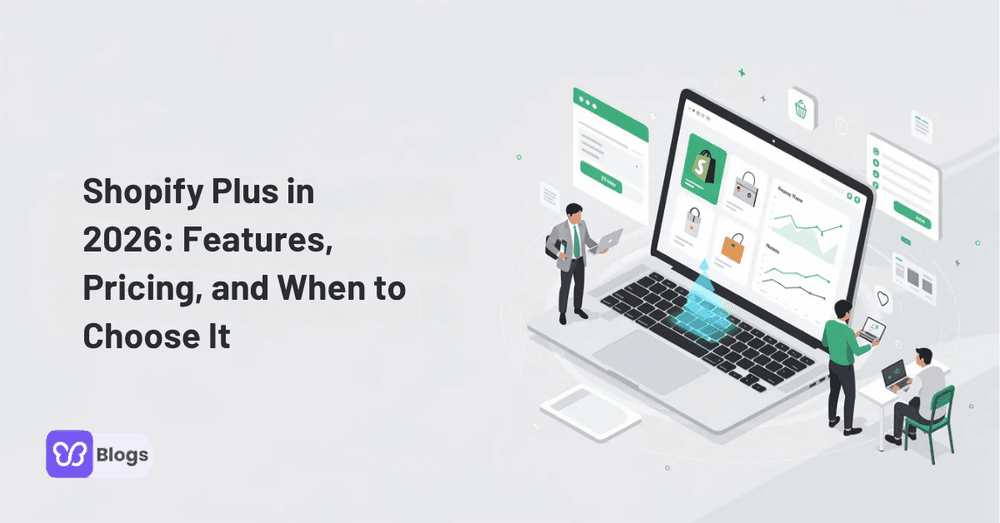
Shopify Plus in 2026: Features, Pricing, and When to Choose It
Quick answer: What is Shopify Plus and who is it for?
Shopify Plus is the enterprise tier of the Shopify ecommerce platform, designed specifically for high-volume merchants typically processing over $1M–$2M in annual sales. It’s built for organizations where ecommerce isn’t just a sales channel—it’s core infrastructure.
Here’s the key distinction: Shopify Plus runs on the same core Shopify software as standard plans. You get the same theme compatibility, shopify app store access, and foundational tools. The difference lies in the enterprise-grade capabilities layered on top—deeper checkout customizations, native B2B functionality, multi-store management, and the support infrastructure needed when commerce complexity scales up.
Ideal use cases for Shopify Plus include:
- High-volume dtc brands managing flash sales or Black Friday traffic spikes
- Hybrid B2B/direct to consumer operations where manufacturers sell wholesale and retail from the same platform
- Franchise models requiring centralized control over multiple storefronts
- Global brands pursuing international expansion with localized pricing, currencies, and languages
This article breaks down the key Shopify Plus features that actually matter at scale, explains real-world Shopify Plus pricing ranges for 2026, explores typical Shopify Plus solutions (B2B, headless commerce, multi-store setups), and provides a practical framework for deciding if the upgrade makes sense for your business.
Shopify vs Shopify Plus: Core differences in 2026
Standard shopify plans—Basic at $29/month, Shopify at $105/month, and the advanced plan at $399/month—serve early-stage and growth brands well. Shopify Plus sits above these as an enterprise layer on the same platform, designed for operational complexity and scale that standard plans can’t handle.
The main difference between Shopify Plus and standard shopify plans lies in the operational complexity and scale. Plus is built for organizations where ecommerce is core infrastructure, while standard plans suit smaller business operations.

Here’s what separates them:
- Checkout customization depth: Plus offers full checkout extensibility through the Checkout Branding API, shopify functions, and UI Extensions—capabilities unavailable on standard plans
- Native B2B functionality: Company accounts, custom catalogs, payment terms, and wholesale buyer portals are exclusive to Plus
- Multi-store capabilities: One primary shopify store plus up to 9 expansion stores included, each with localized settings
- Unlimited staff accounts: Standard plans cap at 15 staff accounts; Plus offers unlimited staff
- Higher API limits: API rate limits on Shopify Plus are over 10 times higher than those on standard shopify plans, ensuring complex tech stack operations run smoothly
- Dedicated merchant success manager: Strategic growth planning support that standard shopify doesn’t include
- Automation tools: Higher shopify flow limits, Launchpad for scheduling events, and cross-store workflow triggers
Comparing Advanced ($399/month with 0.6% third party gateway fees) to Plus (from around $2,300–$2,500/month with 0.2% third-party fees) shows the breakeven point. For merchants hitting $500k–$800k in monthly sales, the lower transaction fees alone often justify the Shopify Plus pricing upgrade—before factoring in operational efficiencies.
Both use the same SEO-optimized Shopify software, but Plus enables stronger global SEO through localized expansion stores and markets, each with distinct currencies, languages, and pricing.
Key Shopify Plus features that matter at scale
Not every Shopify Plus feature carries equal weight. Focus on capabilities that directly impact revenue, operational efficiency, and expansion potential.
Checkout extensibility
Shopify Plus allows merchants to fully customize the checkout experience, enabling them to align it with their brand identity and business rules. The Checkout Extensibility feature replaces the deprecated checkout.liquid (fully sunset June 30, 2026), allowing merchants to customize the checkout process through UI Extensions and shopify functions.
With Shopify Plus, merchants can utilize the Checkout Branding API for visual modifications and create unique checkout flows for different customer segments, such as B2B and D2C. This checkout extensibility framework supports:
- Custom fields for purchase orders, delivery instructions, or gift messages
- Dynamic discounts and tiered pricing logic through shopify functions
- Upsell and cross-sell widgets directly in checkout
- Buyer-type personalization (VIP customers vs. standard guest checkout experiences)
Merchants report up to 50% faster checkout performance compared to legacy shopify scripts implementations.
Multi-store and international capabilities
Shopify Plus allows businesses to manage up to 10 individual storefronts, enabling multi-currency and multilingual capabilities. Specifically, the platform includes up to nine expansion stores, allowing merchants to create fully localized storefronts for different markets, all managed from a single organization-level admin.
This structure supports multi-region operations—separate stores for North America, Europe, and APAC—each with localized content, currencies, tax settings, and shipping rules. Shopify Plus is suitable for brands requiring deeply localized stores and tailored marketing strategies for different countries.
Automation tools
The automation tools in Shopify Plus, including Flow and Launchpad, save teams significant time by automating repetitive tasks involved in running a large-scale marketing and sales calendar.
- Shopify Flow: A visual workflow automation tool that allows merchants to automate operational tasks without code, such as order tagging, customer segmentation, fraud flagging, low-stock alerts, and loyalty programs triggers
- Launchpad: An automation tool exclusive to Shopify Plus that allows merchants to schedule and automate events like product drops and promotional sales—critical for flash sales and Black Friday/Cyber Monday launches
Enterprise-grade infrastructure
Shopify Plus provides unlimited bandwidth and enterprise-level infrastructure, allowing it to handle millions of visitors simultaneously without compromising store stability. The platform offers superior scalability to handle over 10,000 transactions per minute with a 99.99% uptime guarantee.
Additional exclusive capabilities include:
- Shopify POS Pro coverage for up to 20 retail locations
- Access to advanced APIs and exclusive api integrations for enhanced functionality
- Higher API rate limits compared to standard plans, allowing for smoother integration and operation of complex tech stacks
- Enterprise-grade apps from the Plus partner ecosystem
Deep dive into Shopify Plus B2B and wholesale solutions
One of the most significant Shopify Plus solutions in 2026 is its native B2B suite. This functionality replaces older “wholesale channel” setups and like Wholesale Gorilla, enabling merchants to manage both B2B and direct to consumer operations from a single store.
Shopify Plus B2B includes a native suite of features that allows merchants to sell to wholesale buyers directly from their main store, facilitating the management of both B2B and DTC operations in one platform.

Company and location structure
The B2B functionality centers on Companies—buyer entities that can have multiple Locations, each with its own:
- Custom catalogs and product visibility
- Price lists with buyer-specific pricing
- Tax and shipping settings
- Payment terms and credit limits
- Company locations for regional account management
This supports real-world wholesale accounts where a single distributor might have regional warehouses, each needing distinct pricing and fulfillment rules.
Catalogs and pricing flexibility
Shopify Plus B2B supports unlimited catalogs, enabling merchants to create tiered pricing, region-specific wholesale rates, and account-specific negotiations for their B2B customers. Price list options include:
- Fixed prices or percentage discounts off retail
- Volume pricing breaks (buy 100+, get 15% off)
- Minimum order quantities and case-pack rules
- Regional pricing structures for different markets
The B2B functionality on Shopify Plus allows for the creation of company profiles, custom price lists, and the assignment of payment terms such as Net 30 or Net 60, tailored to each B2B customer.
2026 B2B enhancements
Recent additions include:
- Company-level store credit for loyalty or wholesale credits
- ACH payments for B2B transactions
- Order review rules via checkout extensibility
- EDI workflows for supplier integration
- Self-service buyer portals for order history, reordering, and tracking
Shopify Plus B2B fits excellently for hybrid DTC/B2B operations, branded manufacturers, and distributors with manageable catalog complexity. However, it’s not ideal for extremely complex RFQ workflows or heavy ERP-driven pricing logic—though higher api limits on Plus enable deeper api integrations to bridge those gaps.
Shopify Plus pricing in 2026: how it really works
Shopify Plus pricing operates on a hybrid model combining a base subscription with a variable platform fee tied to monthly GMV for higher volume merchants.
Base subscription
Current starting points:
- $2,500 USD/month on a 1-year term
- $2,300 USD/month on a 3-year term
- Regional equivalents: approximately €2,250/month in the EU or £1,950/month in the UK
Shopify Plus pricing starts at $2,500 per month for a one-year term, with a variable platform fee for higher volume merchants based on their revenue and business model.
Variable platform fee
For high volume business operations processing over $800,000 per month, the fee can switch to a small percentage of revenue, typically around 0.25% to 0.40%. Merchants pay whichever is higher: the minimum fee or the revenue share. Pricing can be negotiated for multi-year agreements or very high-volume merchants.
Transaction fees
Shopify Plus merchants using shopify payments benefit from the lowest transaction fees of any shopify plan, with the best card rates available. Those using a third party payment gateway incur additional fees of approximately 0.2%—compared to 0.6% on the advanced plan.
For merchants processing $500k+ monthly, the transaction fee savings alone often justify the upgrade. A store doing $1M monthly GMV could save thousands on transaction fees compared to staying on Advanced.
Additional costs not in base pricing
- Custom development and design work
- Third party apps beyond what’s included
- Integration work (ERP, 3PL, CRM connections)
- Additional stores at approximately $300/month each beyond the 9 included expansion stores
- Extra cost for specialized implementations
You won’t find complete Shopify Plus pricing on any public pricing page—merchants should contact Shopify sales directly for a firm quote based on their specific annual revenue and requirements.
Real-world Shopify Plus solutions: how brands actually use it
Shopify Plus solutions extend beyond the feature list. At scale, Plus functions as a central commerce operating system coordinating multiple brands, channels, and business models.

Multi-brand and multi-region setups
One organization admin manages several stores, each targeted at specific regions. For example:
- North America store: USD pricing, English content, US tax rules
- Europe store: EUR pricing, multiple languages, VAT compliance
- APAC store: Regional currencies, localized catalogs, local payment methods
Stores share product data centrally while customizing pricing, promotions, and content for new markets.
Headless commerce implementations
Brands build custom storefront experiences using Hydrogen (Shopify’s React framework) and Oxygen hosting, or external front-ends. This headless commerce approach delivers app-like shopping experiences while relying on Shopify’s backend, APIs, and low-latency checkout.
The higher api limits on Plus ensure real-time data syncing even during peak traffic—critical for maintaining customer data accuracy across systems.
Omnichannel operations
Plus merchants combine online store, B2B portals, and in-store sales via shopify pos pro. Inventory, pricing, and promotions sync centrally, eliminating channel silos. This lets teams manage products, email marketing campaigns, and fulfillment from one shopify admin.
Integration patterns
High volume businesses switch to Plus partly for the api integrations capability. With 10x the API rate limits of standard plans, merchants achieve:
- Sub-second ERP synchronization across warehouses
- Real-time WMS and 3PL connections without throttling
- CRM integrations keeping customer data current
Speed to market
Executives often value Plus for launch velocity. Shopify Plus is designed to support high growth merchants, providing robust infrastructure that allows for rapid scaling and operational simplicity—launching new stores or campaigns in weeks rather than months, critical for businesses expanding into new markets or launching new storefronts.
When does upgrading to Shopify Plus make financial and strategic sense?
There’s no single revenue threshold, but clear patterns emerge where Shopify Plus becomes obviously beneficial.
Common tipping points
Consider upgrading when you hit these triggers:
- Monthly revenue approaching $500k–$800k where third-party gateway fees accumulate significantly
- Checkout needs exceeding what standard shopify offers—you need deep checkout customizations, custom fields, or buyer-specific flows
- B2B orders overwhelming single store management capabilities
- API throttling causing ERP, WMS, or 3PL sync failures
- Staff account limits creating operational bottlenecks (standard caps at 15; Plus offers unlimited staff accounts)
- Marketing teams need Launchpad for scheduled drops and high-traffic event automation
Calculating potential savings
Compare your current effective fee percentage on Advanced against the Shopify Plus pricing structure:
- Calculate current transaction fees (card rates + third party gateway fees)
- Estimate Plus fees at your volume (base subscription + potential variable platform fee based on GMV)
- Factor in cost savings from reduced app dependencies, fewer custom development hours, and automation efficiencies
- Account for shopify charges you’d avoid through better native functionality
Shopify Plus can enhance conversion rates by optimizing the checkout experience and reducing manual errors—improvements that compound over time.
Framing the decision
Evaluate total cost of ownership over 1–3 years, not just the monthly invoice:
- Infrastructure and hosting (included in Plus)
- Engineering time for maintenance and updates
- Downtime risk (Plus offers 99.99% uptime SLA)
- Opportunity cost of delayed store launches or campaigns
- App stack complexity and associated subscription costs
Plus often makes sense for single-product, high-volume brands when launches trigger big traffic spikes and reliability, automation, and lowest transaction fees are crucial. It’s typically overkill for low-complexity operations under $1M annual revenue without aggressive growth plans.
FAQ: Common questions about Shopify Plus in 2026
1. Is Shopify Plus different software?
No. Shopify Plus runs on the same core Shopify software as standard plans, with enterprise-grade limits, new features, and dedicated support layered on top. Your themes, apps, and workflows remain compatible.
2. Which Shopify Plus features are exclusive?
Exclusive capabilities include: deep checkout extensibility (UI Extensions, shopify functions, Branding API), the native B2B suite with company accounts and unlimited products in catalogs, Launchpad event scheduling, organization admin for multiple stores, higher Flow limits, nine expansion stores included, and unlimited staff accounts.
3. How much does Shopify Plus cost?
Base Shopify Plus pricing starts at $2,500/month (1-year term) or $2,300/month (3-year term). Higher volume merchants pay a variable platform fee of 0.25–0.40% of GMV above threshold. Quotes are individualized based on region, volume, and business strategy—contact Shopify sales directly.
4. Do I need a developer or agency for Shopify Plus solutions?
Basic operations—managing inventory, processing orders, configuring B2B catalogs—are no-code. However, serious checkout customizations, headless builds, deep api integrations, and complex automation workflows generally require custom development expertise. ECORN is a Shopify Plus development agency specializing in Shopify Plus builds, custom theme development, platform migrations, and CRO for scaling D2C brands. Their team works with Shopify Plus merchants on both one-off projects and ongoing retainers, with a 24-hour onboarding turnaround and flexible engagement from 35 to 160+ hours/month.
5. Is Shopify Plus worth it for a single-product, high-volume brand?
Often yes—particularly when product launches create significant traffic spikes. The combination of enterprise infrastructure (handling 10,000+ transactions per minute), automation tools, and lower transaction fees creates clear ROI for high volume business operations, even with limited SKUs.
6. What about loyalty programs and email marketing?
Plus supports native integrations and higher API limits for connecting specialized tools. Shopify Flow can trigger loyalty program actions based on customer behavior without additional apps.
Before committing to a multi-year agreement, map your specific requirements—B2B needs, multiple markets expansion, headless commerce plans, operational scale—against what Shopify Plus offers. The platform excels for high growth merchants ready to treat commerce as core infrastructure, not just another sales channel.

Author
Debutify
Debutify is the easiest way to launch and scale your eCommerce brand.