AI Agent18 min read29 Jul 2026

What Is an AI Agent? A Complete Beginner-to-Expert Guide
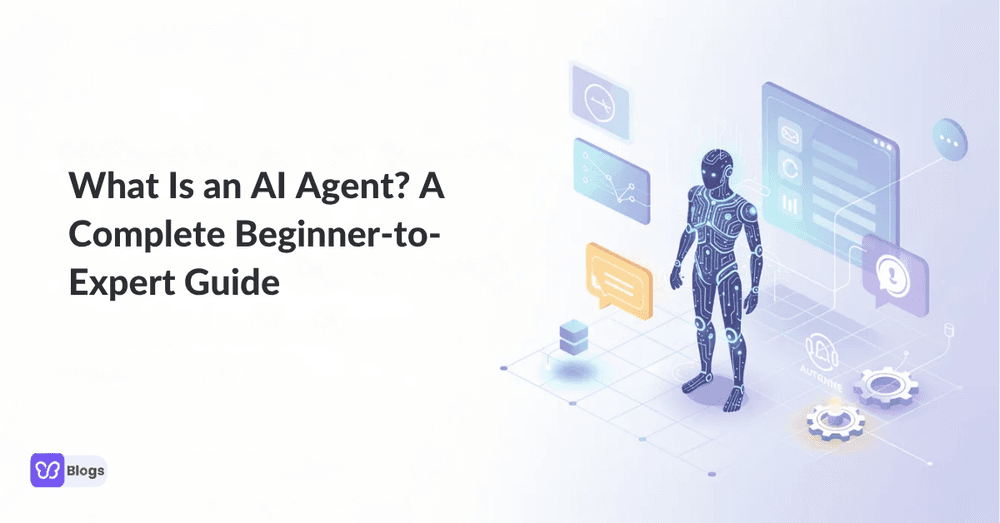
What Is an AI Agent A Complete Beginner-to-Expert

If you've heard the term "AI agent" thrown around in 2025 and 2026 but still aren't sure what it actually means, you're in the right place. This guide breaks down everything from the basics of what is an ai agent to how they're built, where they're used, and how you can start a career developing them.

Quick answer: What is an AI agent?

An ai agent is a software program that can perceive its environment, reason about the data it collects, and take actions toward a goal with some level of autonomy. Unlike a simple script that follows fixed rules and never learns, ai agents are adaptive, goal-driven, and context-aware. They are distinguished from traditional AI by their ability to act on decisions, not just make predictions.

Modern agentic ai systems are usually powered by large language models, external tools like APIs and databases, and continuous feedback loops that help them improve over time. AI agents can process multimodal information like text and audio, and they can work across code, voice, images, and even real-world devices. This makes them far more versatile than the rigid chatbots of a few years ago.

Consider a concrete example from 2025: a customer service ai agent deployed inside Zendesk that reads incoming support tickets, checks a company knowledge base via retrieval-augmented generation, crafts a contextual response, and replies to the customer without human help. If the issue is too complex, it escalates. Over time, it learns which responses get approved and adjusts its approach.

Here's a quick summary of what defines an ai agent:

  • Autonomous goal pursuit with minimal human oversight
  • Perception and reasoning across text, voice, images, or sensor data
  • Tool use via APIs, databases, and external systems
  • Adaptability through feedback, memory, and continuous learning

What is an AI agent

Core characteristics of AI agents (autonomy, goals, perception, learning)

Understanding how ai agents work internally starts with their defining traits. These characteristics separate intelligent ai agents from static automation and explain why businesses are adopting them at scale.

The first trait is autonomy. AI agents act autonomously without constant human intervention. A bookkeeping ai agent, for example, automatically flags missing invoices and triggers follow-up emails without waiting for a human audit cycle. It decides when to initiate action based on its goals. Second is goal orientation: ai agents are driven by objectives to maximize success. A stock-trading agent optimizes for return under risk constraints, evaluating every trade against its configured goals.

Third is perception. Agents gather information from their environment for context understanding. A cybersecurity monitoring agent perceives network traffic, login patterns, and anomalies in real time. Fourth comes rationality and decision making. Common components of ai agents include reasoning, planning, and memory. The loop is observe, think, act, then update internal state. AI agents use reasoning to handle unexpected situations, choosing actions that best advance their goals even when inputs are novel.

Fifth, pro-activity. Rather than waiting for prompts, agents anticipate needs and take initiative. A marketing agent might analyze engagement metrics overnight and reschedule underperforming content before the team arrives in the morning. Sixth, continuous learning: learning agents improve behavior over time based on past actions. AI agents can learn from past interactions to improve performance, making them fundamentally different from hard-coded bots. Finally, collaboration. AI agents can collaborate with other agents to achieve goals, and multi agent setups with several specialized agents coordinating on one workflow are increasingly common in 2025–2026 production systems. AI agents can improve decision-making through collaboration and learning across these coordinated environments, powering enterprise ai solutions in IT support, finance, logistics, and marketing.

AI agents vs assistants vs bots: what's the real difference?

There's widespread confusion between "agent," "assistant," and "bot." The distinction matters because each implies a very different level of capability, cost, and use case. Choosing the wrong one wastes budget; choosing the right one transforms workflows.

AttributeAI AgentsAI AssistantsRule-Based Bots
AutonomyHigh - self-planning, tool use, independent executionLow - respond to prompts, human stays in controlMinimal - fixed logic, scripted paths
Task complexityMulti-step, cross-system, goal-driven workflowsSingle-step or guided tasks (scheduling, lookups)Simple tasks: FAQ replies, form-filling
LearningAdaptive; improves from outcomes, memory, feedbackLimited; may use history but assistants require user supervision for decision-makingNone - conventional bots follow rigid, pre-programmed rules and cannot adapt
Interaction styleProactive and reactiveMostly reactive - assistants offer suggestions and require user approval for actionsReactive only
ExampleCollections agent that tracks overdue invoices and sends reminders autonomouslyHelp desk tool aiding staff with policy lookups; AI assistants respond to user requests and provide informationWebsite chat widget answering generic FAQs; bots automate simple tasks and follow pre-defined rules

AI agents can perform complex, multi-step actions independently, while generative ai creates content based on patterns and is reactive rather than autonomous. Many modern assistants are evolving into agentic ai systems when combined with tools, memory, and feedback loops.

When should you seek custom ai agents rather than a generic assistant or chatbot? When your tasks are cross-system, require tool access, demand domain specificity, or involve compliance-critical decision making that a static bot simply can't handle.

How do AI agents work under the hood?

This section walks through the architecture and lifecycle of how ai agents work in practice. At a high level, every agent follows an observe–think–act loop that repeats until the goal is met.

First, the agent perceives its environment through inputs: user messages, API responses, sensor data, or database queries. Next, it reasons and plans using its "brain," typically a foundation model or large language model, combined with memory stores like vector databases. Then it executes actions through tool use, calling external tools such as APIs, CRMs, ticketing systems, or CI/CD platforms. AI agents can interact with software systems through APIs, databases, and tools. After acting, the agent collects feedback-success or failure signals, human review, or performance metrics-and updates its internal state. AI agents utilize external tools to execute tasks and maintain context across interactions by referencing past interactions stored in long term memory.

A realistic 2025 example: a marketing ai solutions agent pulls analytics from a dashboard API, drafts campaign copy via an LLM, schedules posts through a social media API, monitors engagement, and loops back to adjust upcoming content. The same observe–think–act pattern powers ai agents for software development, where the agent reads a code repository, edits files, runs tests via CI pipelines, and opens a pull request for human review.

Safe decision making in sensitive domains depends on guardrails: strict access controls, permission scopes, human-in-the-loop checkpoints, and audit logging. These ensure agents operate within predefined rules while still retaining the autonomy that makes them valuable.

Types of AI agents and real-world use cases

AI agents can be classified by what they do, how interactive they are, and whether they operate in software or the physical world. Here are the most impactful categories in production today.

Customer agents handle support, onboarding, and retention. AI agents enhance customer service by proactively addressing user issues-processing refund requests, checking policies, and issuing credits without escalation. AI agents can engage in context-aware conversations and assist with customer support, making them ideal for high-volume e-commerce and SaaS environments.

Employee and productivity agents manage internal tickets, HR workflows, and procurement. An internal agent might prioritize support tickets, escalate edge cases, and surface metrics dashboards for team leads. Creative agents draft marketing copy, generate visuals, schedule campaigns, and iterate based on performance data. Data and analytics agents monitor business metrics, detect anomalies like sudden churn spikes, and trigger mitigation workflows. AI agents improve data analysis by finding meaningful insights that would take human analysts hours to uncover. They can identify patterns across massive datasets and surface informed decisions.

Code agents are designed specifically for software development tasks. Agents that open GitHub issues, propose patches, run automated tests, and generate documentation are now standard in forward-thinking engineering teams. AI agents can generate code and assist in software development across the full lifecycle.

Security agents watch logs, detect intrusions, and auto-respond to threats by locking accounts or opening alert tickets. In multi agent systems, specialized agents coordinate: one classifies a ticket, another drafts a response, a third schedules follow-ups.

AI agents optimize delivery routes in logistics and automate complex workflows in healthcare, from patient scheduling to claims processing. And emerging physical agents-warehouse picking robots, delivery drones, home robots-combine perception, planning, and navigation to perform real world tasks in dynamic environments.

Benefits of AI agents for businesses and teams

Organizations in 2024–2026 are investing heavily in ai solutions built around ai agents because they deliver compound value that static chatbots and simple assistants can't match.

  • Productivity gains: AI agents can increase productivity by automating repetitive tasks. Finance agents reduce invoice processing cycles by up to 50%, and support response times drop from hours to minutes.
  • Cost reduction: AI agents can reduce operational costs in software development and other domains by handling routine tasks that previously required dedicated headcount.
  • 24/7 operations: Agents don't take breaks. Customer support, monitoring, and detection tasks stay covered around the clock.
  • Fewer errors: Agents follow rules consistently, reducing misclassifications and omissions in compliance, data entry, and quality control.
  • Better personalization: Agents holding memory of user behavior and customer data over time deliver more tailored experiences that improve retention.
  • Faster experimentation: Agents can A/B test strategies automatically, learn what works, and scale winners-especially valuable in marketing and product development.
  • Improved visibility: Because agents are instrumented software, every decision is logged. This creates analytics trails that inform strategic planning.

Well-designed custom ai agents capture organization-specific know-how in reusable, scalable form. But realizing these benefits depends on thoughtful ai agent development and strong change management. Agents are products, not projects.

Risks, limitations, and ethical challenges of AI agents

Adopting ai agents involves technical, operational, and ethical trade-offs that any responsible team must weigh.

The most prominent limitation is hallucinations and reasoning errors. LLM-based agents can misstate facts, generate incorrect outputs, or act on flawed premises. Research from 2025 identified eighteen distinct causes of agent hallucination and proposed detection and mitigation strategies. Over-automation is another risk: an agent granting refunds beyond policy or executing tasks it shouldn't creates real financial exposure. Edge cases and novel inputs frequently trip agents, especially in complex problems that require nuanced judgment.

AI agents can struggle with tasks requiring deep emotional intelligence. Handling sensitive situations-mental health, medical, legal-often requires empathy and common sense that agents lack. AI agents can make decisions based on data but lack moral judgment, raising accountability questions: who is responsible when an agent acts incorrectly?

Privacy, security, and compliance risks are significant. When agents access sensitive systems, misuse or data leaks can trigger penalties under regulations like GDPR or HIPAA. Bias and fairness deserve attention too: if training data is biased, decisions in hiring, lending, or healthcare will reflect it.

Operationally, poorly monitored agent development can lead to runaway task loops, resource overuse, and conflicting actions between multiple agents. Mitigation strategies include human-in-the-loop reviews, careful role and permission design, audit logging, robust testing under adversarial conditions, and clear escalation paths. The goal isn't to avoid agents but to deploy them responsibly.

What are AI agent development tools and platforms?

AI agent development tools are platforms and frameworks that simplify designing, building, deploying, and scaling custom ai agents. Building ai agents entirely from scratch is difficult: it demands expertise in natural language processing, machine learning, orchestration, security, and deep integration with external systems.

Three broad categories have emerged. First, low-code and no-code builders let business users configure and deploy agents for routine tasks quickly without deep coding skills. These are ideal for simple tasks like internal FAQ routing or notification workflows. Second, full-stack frameworks and SDKs give software engineers fine-grained control over memory, prompt chains, tool routing, and observability. Frameworks like LangChain and AutoGen are popular for ai agent development, offering developer tools for prompt management, vector search, logging, and evaluation workflows. Third, end-to-end managed platforms provide enterprise-grade compliance, scaling, and governance for organizations with strict security requirements.

Each category supports different audiences. Business users reach for no-code builders; software engineers prefer open frameworks for complex projects; large enterprises combine managed platforms with custom logic. Many organizations now adopt a hybrid approach, pairing an internal platform with external agent development frameworks. The choice of toolset directly affects speed, maintainability, and governance of large ai solutions portfolios. As of early 2026, the ecosystem includes hundreds of ai tools across these categories, from open-source options to commercial offerings.

AI agent development companies, builders, and frameworks: which do you need?

This section serves as a buyer's guide for organizations deciding between an ai agent development company, self-service builders, and open frameworks.

An ai agent development company typically offers end-to-end ai agent development services: discovery and design, custom integration, deployment, and long-term support for custom ai agents tailored to specific business processes. The advantage is speed and expertise-these firms bring domain knowledge, security and compliance credentials, and proven architectures. The trade-off is higher cost, possible vendor lock-in, and less internal capability building.

Contrast this with low-code builders where internal teams configure and iterate on ai agents without hiring an external ai agent developer. These work well for straightforward use cases with clear business needs but can hit walls when logic gets complex or integrations span multiple agents and external systems.

A developer-heavy strategy using open agent development frameworks makes sense when you need very custom logic, operate in complex environments, or require strict control over infrastructure and data. Teams with strong engineering talent often prefer this path for sophisticated ai agents.

Practical decision criteria include budget, timeline, in-house skill level, security and compliance needs, number of expected use cases, and required customizations. A startup with one use case might start with a builder; an enterprise with dozens of workflows across departments may need a dedicated ai agent development company plus internal enablement.

Many mature organizations adopt a hybrid model: strategic partnership for complex projects combined with internal teams trained on a standard platform for simpler deployments and ongoing iteration. This balances speed, cost, and long-term autonomy.

The AI agent development process: from idea to production

Here's a step-by-step walkthrough of a typical ai agent development lifecycle. Treat it as a repeating loop, not a one-time project.

Goal setting and scoping. AI agent development involves goal setting and scoping. Product owners and domain experts define the agent's purpose, success criteria, and boundaries. For an internal IT support ai agent, that might mean "resolve 60% of Tier-1 tickets without human escalation within 90 days." This phase produces a scoping document and initial requirements.

Design. The design phase includes drafting an agent's architecture and workflows. An ai agent developer maps out how the agent will perceive inputs, which tools it needs, what memory it requires, and where human-in-the-loop checkpoints belong. Outputs include architecture diagrams and workflow specifications.

Framework, model, and tool selection. Teams choose orchestration frameworks, LLM providers, and vector databases based on latency, cost, and compliance needs. Common programming languages for ai agents include Python and JavaScript, with Python dominating due to its rich ecosystem for machine learning models and natural language processing.

Build and training. Engineers write code, integrate other components like APIs and databases, and connect the agent to relevant data sources. AI agents require model training using relevant datasets to handle domain-specific language and workflows. A DevOps ai development agent automating routine deployment tasks, for example, trains on historical deployment logs and incident reports.

Evaluation. Evaluation metrics for ai agents include success rate and error rate, along with latency, user satisfaction, and cost per task. Rigorous testing under edge cases and adversarial inputs is essential before production.

Deployment and monitoring. Once you deploy ai agents, the work continues. Deploying agents into production requires monitoring dashboards, alerting, and feedback collection. Agents are adjusted after real-world feedback, logged behavior, and performance metrics. Building ai agents is an ongoing product discipline with versioning, A/B testing, and roadmap planning-not a one-off software project.

AI agents for software development: dev-focused use cases and tools

Specialized ai agents for software development assist or partially automate the software development lifecycle, going far beyond simple code completion.

Key capabilities include repository analysis, issue triage, code generation, refactoring, automated testing, performance profiling, and CI/CD integration. Concrete examples from 2024–2026 include coding agents that scan repositories nightly for dependency vulnerabilities, open GitHub issues with proposed fixes, generate documentation from code comments, and submit merge requests for human review. An ai software development agent can handle software development tasks that previously consumed hours of developer time each week.

AI agent software development differs from simple code completion tools in a critical way: these agents handle multi step actions. They plan across files, reason about dependencies, execute tests, and iterate on failures-performing complex workflows rather than suggesting the next line of code. They maintain context across an entire codebase, referencing past interactions and prior changes to produce coherent updates.

Benefits for engineering teams are significant. Reduced toil on repetitive tasks like boilerplate generation and test writing. Faster onboarding for junior developers who get agent-assisted explanations of unfamiliar code. Improved code quality through automated linting, coverage analysis, and style enforcement. Human developers gain more time for architecture, design, and creative problem-solving.

Challenges remain real. Trust is earned gradually-teams need confidence that agents won't introduce regressions. Security matters when agents access private repos. Reproducibility and robust human code review before deployment are non-negotiable. The smartest adoption path: start with advisory roles (agents suggest, humans approve), then gradually grant write permissions as confidence grows. This lets teams build trust with advanced ai agents incrementally rather than all at once.

Careers: how to become an AI agent developer or AI development agent specialist

Rising demand for ai agents has created emerging career paths: ai agent developer, ai development agent specialist, and solutions architect for agentic ai systems. If you're searching how to become an ai agent, the answer is that you become an ai agent developer or specialist who designs, builds, and maintains these systems.

Key skills include solid programming in Python, TypeScript, or Java; understanding of large language models and prompt engineering; knowledge of APIs and integrations; data engineering basics; and MLOps practices. Foundations from traditional artificial intelligence and machine learning-statistics, model evaluation, vector search-remain valuable, but modern ai agent development also demands product thinking and UX awareness. You need to understand user requests, business processes, and how to scope agents that solve problems without creating new ones.

Here's a staged learning roadmap:

  1. Fundamentals (months 1–3): Python, APIs, basic machine learning, natural language processing concepts
  2. LLMs and ai tools (months 3–6): Prompt engineering, generative ai patterns, embeddings, vector databases
  3. Agent frameworks (months 6–9): Build agents using frameworks like LangChain or AutoGen; learn multi agent workflows, tool use, and memory management
  4. Production skills (months 9–12): Deploying agents, monitoring, evaluation, security, and iteration in real development workflow environments

Practical portfolio projects carry more weight than certifications. Build a help-desk ai agent, a personal research assistant, or a simple ai agent software development helper that runs tests and surfaces failures. Contribute to open-source agent development projects. These demonstrate readiness for roles at an ai agent development company or on an internal ai agent development services team.

With focused effort, 6–12 months of learning can prepare you for entry-level agent development roles, assuming prior coding experience.

Future outlook: the evolution of agentic AI

Looking ahead 3–5 years, agentic ai and ai agents will evolve along several clear trajectories.

Reasoning and planning capabilities will become more robust, allowing agents to handle new tasks with less fine-tuning. Tighter integration with enterprise systems will make agents standard infrastructure-embedded across workflows as always-on digital teammates rather than separate chat windows. Multi agent coordination will grow more sophisticated, with multiple ai agents negotiating, delegating, and verifying each other's work in complex workflows spanning entire organizations.

Multimodal capabilities will expand. Agents will seamlessly process and generate text, voice, video, and even interact with AR/VR environments. Research into hierarchical agents, self-refinement loops, and better safety guardrails will make deploying agents in high-stakes domains more practical. Using ai responsibly will require governance frameworks that keep pace with technical capability.

The impact on work will be significant. AI agents for software development will reshape how engineering teams operate, handling increasingly complex projects while human developers focus on architecture and strategy. Custom ai agents will become standard infrastructure inside organizations of every size, encoding institutional knowledge into reusable, scalable ai models.

The key is that governance, ethics, and human-centered design must evolve alongside the technology. The best ai solutions will augment human expertise, not replace it. Organizations that invest in responsible agent development now-with clear future states in mind-will be best positioned to capture the compound benefits as the technology matures.

Start small. Build a focused agent for one specific workflow. Test it, monitor it, iterate. The future of ai belongs to those who begin building today.

Debutify

Author

Debutify

Debutify is the easiest way to launch and scale your eCommerce brand.
Share post